


 By St John Bosco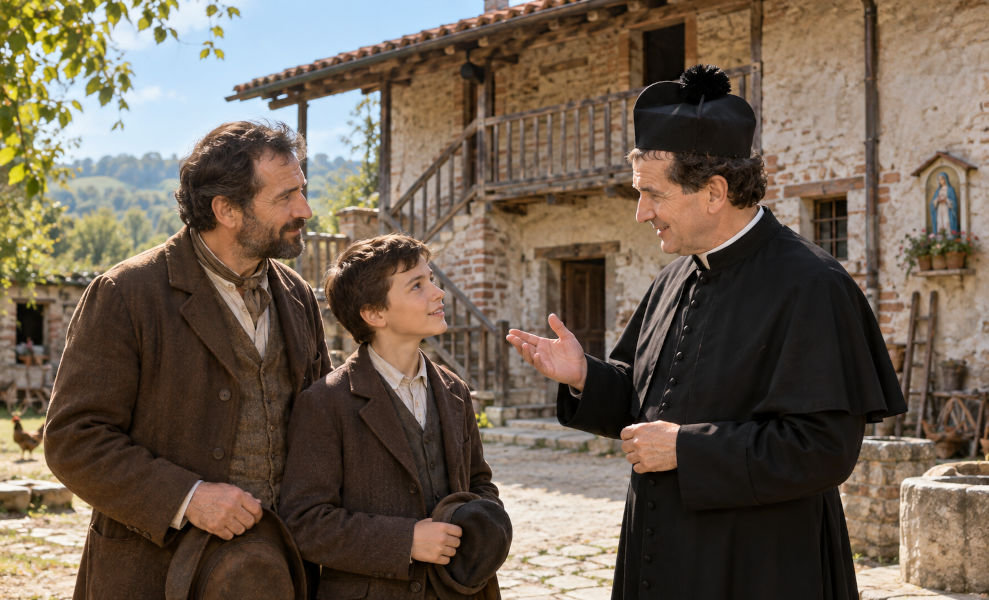
Reading time: 105 min.
‘So I am the cloth; let her be the tailor.’ With these words, on 2 October 1854, at Becchi, a twelve-year-old boy entrusted himself to Don Bosco. Dominic Savio entered Valdocco on 29 October and remained there for less than three years: he died on 9 March 1857. A short time, yet enough for the grain to ripen and be gathered into the Lord’s granary. In Don Bosco’s writings, he appears not as a young man removed from everyday life, but as a companion who could make study, prayer, friendship and recreation a path to holiness. His ‘I want to become a saint’ still speaks to every boy: ‘If he managed it, why can’t I?’ We present the complete text of the fourth edition (1878), the last prepared by the author himself.
Life of the Young Dominic Savio, Pupil of the Oratory of St Francis de Sales
CHAPTER I. His native place – His character – His first acts of virtue
CHAPTER II. His conduct at Murialdo – Fine examples of virtue – His attendance at the village school
CHAPTER IV. School at Castelnuovo d’Asti – An edifying episode – A wise reply to bad advice
CHAPTER V. His conduct at the school of Castelnuovo d’Asti – His teacher’s account
CHAPTER VI. School at Mondonio – He endures a serious false accusation
CHAPTER VII. My first acquaintance with him – Curious incidents on that occasion
CHAPTER VIII. He comes to the Oratory of St Francis de Sales – His first way of life there
CHAPTER X. His resolution to become a saint
CHAPTER XI. His zeal for the salvation of souls
CHAPTER XII. Episodes and his pleasant way of conversing with his companions
CHAPTER XIII. His spirit of prayer – Devotion to the Mother of God – The month of Mary
CHAPTER XIV. His frequent reception of the holy Sacraments of Confession and Communion
CHAPTER XVI. Mortification of all the external senses
CHAPTER XVII. The Sodality of the Immaculate Conception
CHAPTER XVIII. His particular friendships – His relations with the young Camillo Gavio
CHAPTER XIX. His relations with the young Giovanni Massaglia
CHAPTER XX. Special graces and particular events
CHAPTER XXI. His thoughts about death and his preparation for a holy death
CHAPTER XXII. His care for the sick – He leaves the Oratory – His words on that occasion
CHAPTER XXIII. He says farewell to his companions
CHAPTER XXV. His last moments and his precious death
CHAPTER XXVI. News of his death – Words of Professor Fr Picco to his pupils
My dear boys,
You have often asked me, my dear boys, to write something about your companion DOMINIC SAVIO; and I have done what I could to satisfy this pious desire of yours. Here, then, is his life, written with that brevity and simplicity which I know will please you.
Two difficulties stood in the way of publishing this work. The first was the criticism to which a writer is usually exposed when he writes about matters witnessed by many people still living. I believe I have overcome this difficulty by taking care to relate only things that were seen either by you or by me, and nearly all of which I still preserve in writing, signed by your own hands.
Another obstacle was the need to speak of myself on many occasions. Since this young man lived for about three years in this house, I must often relate events in which I myself took part. I believe I have overcome this obstacle too by keeping to the duty of the historian, which is to write the truth about facts without regard to persons. Nevertheless, if you should find some incident in which I speak of myself with a certain satisfaction, attribute it to the great affection I bore our departed friend and still bear towards you all; an affection which makes me open the depths of my heart to you, as a father would when speaking to his beloved children.
Some of you may ask why I have written the life of DOMINIC SAVIO rather than that of other boys who lived among us with a reputation for outstanding virtue. It is true, my dear friends, that Divine Providence was pleased to send us several models of virtue, such as Gabriele Fascio, Luigi Rua, Camillo Gavio, Giovanni Massaglia and others; but their deeds were not so widely known or so remarkable as those of SAVIO, whose manner of life was manifestly extraordinary. However, if God grants me health and grace, I intend to collect the deeds of these virtuous companions of yours, so that I may satisfy both your wishes and mine by giving them to you to read and imitate in whatever is suited to your state of life.
In this new edition I have also added various items of information which, I hope, will make it interesting even to those who have already read what was printed in the earlier editions.
Meanwhile, begin to profit from what I am going to describe to you, and say in your hearts what St Augustine used to say: ‘Si ille, cur non ego?’ If a companion of mine, of the same age, in the same place, exposed to the same and perhaps even greater dangers, nevertheless found the time and the means to remain a faithful follower of Jesus Christ, why cannot I do the same? Remember well that true religion does not consist in words alone; it must be put into practice. Therefore, when you find something worthy of admiration, do not content yourselves with saying: This is beautiful; I like this. Rather say: I will strive to do those things which, when I read of them in others, fill me with admiration.
May God grant you and all the readers of this little book health and grace to profit from what they read in it; and may the Blessed Virgin, of whom young SAVIO was a fervent devotee, obtain for us the grace to be of one heart and one soul in loving our Creator, who alone deserves to be loved above all things and faithfully served on every day of our lives.
DECLARATION
In obedience to the decree of the Supreme Pontiff Urban VIII, of holy memory, I declare that I intend to attribute to all the supernatural events related here no value other than that of human authority, until the Holy See has approved them by its infallible authority.
CHAPTER I. His native place – His character – His first acts of virtue
The parents of the boy whose life we are undertaking to write were Carlo Savio and his wife Brigida, poor but honest inhabitants[1] of Castelnuovo d’Asti[2], a town ten miles from Turin. In 1841, finding themselves in great hardship and without work, the good couple went to live at Riva[3], a village two miles from Chieri, where the husband took up work as a blacksmith, a trade he had practised in his youth. While they were living there, God blessed their marriage with a son who was to be their consolation. He was born on 2 April 1842. When they took him to be reborn in the waters of baptism, they gave him the name Dominic, a circumstance which, though in itself unimportant, later became a subject of serious reflection for our boy, as we shall see.
Dominic was completing his second year when, for reasons of family convenience, his parents decided to return to their native district and settled at Murialdo, a hamlet of Castelnuovo d’Asti.
The chief concern of his good parents was to give their child a Christian education, and from that early time he was already the object of their delight. Nature had endowed him with a good disposition and a heart truly born for piety. He learnt the morning and evening prayers with astonishing ease, and at only four years of age he was already saying them by himself. Even at that age, when children are naturally inclined to distraction, he obeyed his mother in everything; and if he sometimes went away from her, it was only to find some little corner of the house where he could pray more freely during the day.
‘From his tenderest years,’ his parents affirm, ‘when, for want of reflection, children are a continual disturbance and trial to their mothers, and at an age when they want to see and touch everything and usually spoil it, our Dominic never caused us the slightest displeasure. Not only was he obedient and ready to do whatever we asked, but he tried to anticipate the things which he saw would please us.’
The welcome he gave his father when he saw him returning home after his ordinary work was both curious and delightful. He would run to meet him, take him by the hand and sometimes throw his arms around his neck. ‘Dear Papa,’ he would say, ‘how tired you are! Is it not true? You work so hard for me, and I am good for nothing but causing you trouble. I shall pray to the good God to give you health and to make me good.’ As he said this he would accompany him into the house, bring him a chair or stool to sit on, keep him company and shower him with affection. ‘This,’ says his father, ‘was a sweet comfort to me in my labours, and I could hardly wait to reach home and give a tender kiss to my Dominic, who possessed all the affections of my heart.’
His devotion increased faster than his years, and when he was only four he no longer needed to be reminded to say his morning and evening prayers, the prayers before and after meals, or the Angelus; indeed, he himself would invite the others in the household to pray if they had forgotten.
It happened one day that his family, distracted by some commotion, sat down to dinner without more ado. ‘Oh Papa,’ said the attentive Dominic, ‘we have not yet asked the blessing.’ On another occasion a stranger who had been welcomed into their home likewise began to eat without making any act of religion. Dominic, not daring to correct him, withdrew sadly into a corner of the house. Afterwards, when his family asked him the reason for this unusual behaviour, he replied: ‘I did not dare sit at table with someone who begins to eat like the beasts of the Lord, without thanking Him for our food.’ Having said this, he himself made the sign of the holy cross and recited the usual prayer.
CHAPTER II. His conduct at Murialdo – Fine examples of virtue – His attendance at the village school
Here are matters which would scarcely be believed if the one who asserts them did not remove every ground for doubt. I shall follow the account which the chaplain of that hamlet[4] kindly gave me concerning his dear pupil.
‘In the first days after I came to the hamlet of Murialdo,’ he says, ‘I often saw a boy of perhaps five years of age coming to church with his mother. The serenity of his face, the composure of his person and his devout bearing drew both my eyes and those of others towards him. If, on reaching the church, he found it closed, a charming sight would then take place. Far from running about or making a noise, either alone or with others, as boys of that age are wont to do, he would go to the threshold of the door, kneel down, bow his little head and, with his innocent hands joined before his breast, pray fervently until the church was opened. It should be noted that sometimes the ground was covered with mud, or snow or rain was falling; but he paid no attention to any of this and knelt there just the same to pray. Astonished and moved by pious curiosity, I wanted to know who that boy was who had become the object of my admiration, and I learnt that he was the son of the blacksmith Carlo Savio.
‘When he met me in the street, even from a distance he would begin to show his pleasure and, with a truly angelic air, respectfully greet me before I could greet him. He also began to attend school; and because he was intelligent and very diligent in carrying out his duties, he made notable progress in his studies in a short time. He was obliged to mix with unruly and thoughtless boys, but I never saw him quarrel. If some dispute arose, he would patiently endure the insults of his companions and immediately move away from them. Nor do I remember ever seeing him take part in dangerous amusements or cause the slightest disturbance in school. Many companions would invite him to go with them to play tricks on elderly people, throw stones, steal other people’s fruit, or cause damage in the countryside; but he knew how tactfully to disapprove of their conduct and refused to take part.
‘The piety he had already shown by praying on the threshold of the church did not diminish as he grew older. By the age of five he had already learnt to serve Holy Mass, and he served it with the greatest devotion. He went every day; if someone else wished to serve, he heard Mass, otherwise he served it himself with the most edifying bearing. Since he was young and small, he could not carry the missal, and it was amusing to see him approach the altar eagerly, rise on tiptoe, stretch out his arms as far as he could and make every effort to reach the missal stand. If the priest or someone else wished to do him the greatest favour in the world, he must not carry the missal for him, but bring the stand close enough for him to reach it; then Dominic would joyfully carry it to the other side of the altar.
‘He went to confession frequently, and as soon as he was able to distinguish the heavenly bread from ordinary bread, he was admitted to Holy Communion, which he received with truly admirable devotion. At the sight of those beautiful works which divine grace was accomplishing in that innocent soul, I often said to myself: Here is a boy of the highest promise. May God grant that a path be opened for him so that such precious fruit may come to maturity.’ Thus far the chaplain of Murialdo.
CHAPTER III. He is admitted to First Communion – His preparation – Recollection and resolutions of that day
Nothing was lacking in Dominic for admission to First Communion. He knew the whole little catechism by heart; he had a clear understanding of this august sacrament and burned with desire to receive it. His age alone stood in the way, for in the villages children were ordinarily not admitted to First Communion until they were eleven or twelve years old. Savio was only in his seventh year. Besides his childish appearance, his small body made him look even younger, so the chaplain hesitated to put him forward. He also sought the advice of other priests, who, after carefully considering Dominic’s precocious understanding, instruction and ardent desires, set aside every difficulty and admitted him for the first time to the food of angels.
It is very difficult to express the holy joy with which this announcement filled his heart. He ran home and told his mother with delight; now he prayed, now he read; he spent a great deal of time in church before and after Mass, and it seemed that his soul already dwelt with the angels of heaven. On the eve of the day appointed for Communion he called his mother. ‘Mamma,’ he said, ‘tomorrow I am going to make my Communion. Forgive me for all the displeasure I have caused you in the past. In future I promise to be much better; I shall be attentive at school, obedient, docile, and respectful in whatever you command me.’ Having said this he became deeply moved and began to weep. His mother, who had received nothing but consolation from him, was moved as well and, scarcely able to hold back her tears, comforted him, saying: ‘Go in peace, dear Dominic; everything is forgiven. Pray to God that He may always keep you good; pray to Him also for me and for your father.’
On the morning of that memorable day he rose early and, dressed in his best clothes, went to the church, which he found still closed. As he had done on other occasions, he knelt on the threshold and prayed until other children arrived and the door was opened. Between confessions, preparation and thanksgiving after Communion, the service lasted five hours. Dominic was the first to enter the church and the last to leave it. Throughout that time he no longer knew whether he was in heaven or on earth.
That day remained ever memorable to him and may be called the true beginning, or rather the continuation, of a life which can serve as a model for every Christian. Several years later, when he was made to speak about his First Communion, the liveliest joy could still be seen shining in his face. ‘Oh!’ he used to say, ‘that was the most beautiful day and a great day for me.’ He wrote down several resolutions which he carefully kept in a prayer book and often read. I was able to have them in my hands and reproduce them here in their original simplicity. They ran as follows: ‘Resolutions made by me, Dominic Savio, in the year 1849, when I made my First Communion at the age of seven.
- I shall go to confession very often and receive Communion whenever my confessor gives me permission.
- I wish to sanctify Sundays and holy days.
- My friends shall be Jesus and Mary.
- Death, but not sin.’
These resolutions, which he often repeated, were like the guide of his actions until the end of his life.
If among those who read this little book there should be anyone who has yet to make his First Communion, I would earnestly recommend that he take young Savio as his model. But I also recommend, as strongly as I know how, to fathers and mothers and to all who exercise any authority over the young, that they attach the greatest importance to this religious act. Be convinced that a First Communion well made lays a firm moral foundation for the whole of life; and it would be strange to find anyone who has fulfilled that solemn duty well without a good and virtuous life following from it. On the other hand, there are thousands of unruly young people who are the sorrow of their parents and of those responsible for them; but if one goes to the root of the evil, one finds that their conduct began to go astray through little or no preparation for First Communion. It is better to postpone it, indeed better not to make it at all, than to make it badly.
CHAPTER IV. School at Castelnuovo d’Asti – An edifying episode – A wise reply to bad advice
After completing his first schooling, Dominic ought long before to have been sent elsewhere to continue his studies, which he could not do at a country chaplaincy. Dominic desired this, and his parents also had it very much at heart. But how could it be done when they had no money at all? God, the supreme Master of all things, would provide the necessary means for this child to follow the path to which He was calling him.
‘If I were a bird,’ Dominic would sometimes say, ‘I should like to fly to Castelnuovo morning and evening and so continue my schooling.’
His keen desire to study enabled him to overcome every difficulty, and he resolved to attend the municipal school in the town, although it was nearly two miles away. Thus a boy not yet ten years old undertook a journey of six miles a day in going to and returning from school. Sometimes there was a troublesome wind, a scorching sun, mud or oppressive rain. No matter: every hardship was endured and every difficulty overcome. He saw in it obedience to his parents and a means of learning the knowledge that leads to salvation, and that was enough to make him bear every inconvenience gladly. One day an elderly man saw Dominic walking alone to school at two o’clock in the afternoon beneath a blazing sun. Wishing, as it were, to encourage him, he approached and spoke to him as follows:
‘My dear boy, are you not afraid to walk all alone along these roads?’
‘I am not alone. I have my guardian angel, who accompanies me at every step.’
‘At least the road must be hard for you in this heat, since you have to make it four times a day!’
‘Nothing is hard, nothing is tiring, when one works for a master who pays very well.’
‘Who is this master?’
‘God the Creator, who rewards even a cup of water given for love of Him.’
That same man told this episode to some of his friends, and always ended his account by saying: ‘A boy so young who already nourishes such thoughts will certainly make people speak of him in whatever path he undertakes.’
On his way to and from school he once ran a grave danger to his soul because of some companions.
In the heat of summer many boys are accustomed to go bathing in ditches, streams, ponds and similar places. When several boys are together, undressed and sometimes bathing in public places, there is danger to the body, so much so that unfortunately we often have to lament drownings of boys and others who lose their lives in the water; but the danger to the soul is much greater. How many young people lament the loss of their innocence and trace its cause to having gone bathing with those companions in those unfortunate places!
Several of Savio’s schoolfellows were in the habit of going there. Not content with going themselves, they wanted to take him with them and had succeeded in enticing him there once. But when he was warned that such a thing was wrong, he was deeply grieved; it was never possible to persuade him to go again, and more than once he lamented and wept over the danger in which he had placed both his soul and his body. Nevertheless, two of the boldest and most talkative companions made a fresh attempt, speaking to him like this:
‘Dominic, will you come with us for a bit of fun?’
‘What sort of fun?’
‘A swim.’
‘Oh no, I am not going. I cannot swim; I am afraid of dying in the water.’
‘Come on, it is great fun. Those who go swimming no longer feel the heat, they get a very good appetite and become much healthier.’
‘But I am afraid of dying in the water.’
‘Nonsense, do not be afraid. We shall teach you everything you need. First you will watch how we do it, and then you will do the same. You will see us moving through the water like fish, and we shall make giant leaps.’
‘But is it not a sin to go to places where there are so many dangers?’
‘Not at all; everyone goes there.’
‘The fact that everyone goes does not prove that it is not a sin.’
‘If you do not want to go into the water, you can begin by watching the others.’
‘Enough; you have confused me, and I do not know what to say.’
‘Come, come; take our word for it. There is nothing wrong, and we shall keep you out of every danger.’
‘Before I do what you say, I want to ask my mother’s permission. If she says yes, I shall go; otherwise I shall not.’
‘Keep quiet, you fool, and mind you do not tell your mother. She certainly will not let you come; indeed, she will tell our parents, and they will cool us down with a good caning.’
‘Oh! If my mother will not let me go, that is a sign that it is wrong; so I shall not go. And if you want me to speak frankly, I shall tell you that I was deceived and went there once, but I shall never go again, because in such places there is always the danger either of drowning or of offending the Lord in some other way. And do not speak to me any more about swimming. If your parents are displeased by it, you should not do it either, because the Lord punishes children who act against the wishes of their father and mother.’
Thus our Dominic, by giving a wise reply to those bad advisers, avoided a grave danger into which, had he plunged, he might perhaps have lost the priceless treasure of innocence, followed by a thousand sad consequences.
CHAPTER V. His conduct at the school of Castelnuovo d’Asti – His teacher’s account
While attending this school, he began to learn how to conduct himself with his companions. If he saw a schoolmate who was attentive in class, docile and respectful, who knew his lessons well, did his work and was praised by the teacher, that boy immediately became Dominic’s friend. Was there an unruly or insolent boy who neglected his duties, used bad language or blasphemed? Dominic avoided him like the plague. As for those who were somewhat idle, he greeted them and rendered them some service when the occasion arose, but he did not become familiar with them.
The conduct he maintained at the school of Castelnuovo d’Asti can serve as a model for any young student who wishes to advance in learning and piety. On this point I reproduce the judicious account written by his teacher, Fr Alessandro Allora, who is still the municipal schoolmaster of this district centre. It reads as follows:
‘I am very pleased to give my judgement concerning the young Dominic Savio, who in a short time succeeded in winning all my goodwill, so that I loved him with the tenderness of a father. I gladly accept this invitation, because I still preserve a vivid, clear and complete memory of his studies, his conduct and his virtues.’
‘I cannot say very much about his religious conduct because, living at a considerable distance from the town, he was excused from the religious association; had he attended, he would certainly have made his piety and devotion shine forth.’
‘After completing the first elementary class at Murialdo, this good boy asked for and readily obtained admission to my second elementary class, precisely on 21 June 1852, a day which the pupils dedicated to St Aloysius, protector of youth. He was of a somewhat weak and delicate constitution, with an expression both serious and gentle, and with something about him at once grave and pleasing. He had the mildest and sweetest disposition and an even temper at all times. His bearing in school and outside it, in church and everywhere, was such that whenever the teacher’s eye, thought or words turned towards him, he left the happiest and most pleasant impression. For a teacher this may be called one of the dear rewards for the hard labour which he so often expends in vain in cultivating the dry and ill-disposed minds of certain pupils. I may therefore say that he was Savio in name and wise in fact as well. He showed it by his deeds: in study, in piety, in his dealings with his companions and in every action. From the first day he entered my school until the end of that school year, and during the four months of the following year, he advanced in his studies in an extraordinary manner. He constantly deserved first place in his class, together with the other honours of the school, and almost always the highest marks in every subject as it was taught. Such a happy result in learning is not to be attributed only to the uncommon intelligence with which he was gifted, but also to his very great love of study and to his virtue.’
‘Worthy of special admiration, moreover, was the diligence with which he sought to fulfil even the smallest duties of a Christian schoolboy, and particularly his remarkable regularity and constancy in attending school. Thus, although always weak in health, he walked more than four kilometres of road each day, making the journey four times in going and returning. He did this with wonderful calmness of spirit and serenity of countenance even amid the bad weather of winter, in bitter cold, rain or snow: conduct which his teacher could not fail to recognise as a proof and example of rare merit. Meanwhile this worthy pupil fell ill during the same school year, 1852–1853, and his family afterwards changed residence. As a result, to my genuine regret, I was no longer able to continue teaching so dear a pupil. The great and beautiful hopes I had placed in him were overshadowed by my growing fear that, for want of health or financial means, he might be unable to continue his studies.’
‘It was then a great consolation to me when I learnt that he had been received among the boys of the Oratory of St Francis de Sales, for in this way the path was opened for the cultivation of his rare intelligence and luminous piety.’ (Thus far his schoolmaster.)
CHAPTER VI. School at Mondonio[5] – He endures a serious false accusation
It seems that Divine Providence wished to show this young boy that this world is an exile in which we go as pilgrims from place to place; or rather, perhaps, wished him to become known in different places and thus to show himself in many places as an outstanding mirror of virtue.
Towards the end of 1852 Dominic’s parents left Murialdo and settled at Mondonio, a small village bordering Castelnuovo. There he continued the manner of life he had followed at Murialdo and Castelnuovo; I should therefore have to repeat what his former teachers wrote about him, for Fr Cugliero[6], who had him as a pupil, gives an almost identical account. I shall select from it only a few particular facts, omitting the rest so as not to repeat myself.
‘I can say,’ he writes, ‘that in the twenty years during which I have devoted myself to teaching boys, I never had one who equalled Savio in piety. He was young in years but as sensible as a mature man. His diligence, constancy in study and affability won the affection of his teacher and made him the delight of his companions. When I looked at him in church, I was filled with profound wonder at seeing such recollection in a boy so young. More than once I said to myself: Here is an innocent soul to whom the delights of paradise are opening, and whose affections already go to dwell with the angels of heaven.’
Among the particular incidents the teacher records the following:
‘One day an offence was committed among my pupils, and it was of such a kind that the culprit deserved expulsion from school. The offenders anticipated the consequences and, going to the teacher, agreed to lay all the blame on good Dominic. I could not believe him capable of such misconduct; but his accusers gave their slander such an appearance of truth that I was forced to believe it. I therefore entered the classroom, justly indignant at what had happened; I spoke generally about the culprit, then turned to Savio and said: Was it really you who had to commit such an offence? Would you not deserve to be expelled from school at once? Fortunately for you, this is the first fault of this kind you have committed; otherwise… see that it is also the last. Dominic could have said a single word in his defence and his innocence would have been known. But he remained silent, bowed his head and, like one who had been rightly rebuked, did not raise his eyes again.’
‘But God protects the innocent, and the next day the real culprits were discovered and Dominic’s innocence was made clear. Full of regret for the rebukes I had given the supposed offender, I took him aside and said: Dominic, why did you not tell me at once that you were innocent? Dominic replied: Because that boy, already guilty of other faults, might perhaps have been expelled from school; for my part, I hoped to be forgiven, since this was the first offence of which I had been accused at school; besides, I was also thinking of our Divine Saviour, who was unjustly slandered.’
‘I said no more then, but everyone admired Savio’s patience: he had known how to return good for evil and was ready to endure even a severe punishment for the sake of the very person who had falsely accused him.’ (Thus Fr Cugliero.)
CHAPTER VII. My first acquaintance with him – Curious incidents on that occasion
The things I am about to relate I can describe with fuller details, because almost all of them happened before my own eyes and, for the most part, in the presence of a great many boys who all agree in affirming them. It was the year 1854 when the above-mentioned Fr Cugliero came to speak to me about one of his pupils who, for his piety, deserved particular attention. ‘Here in your house,’ he said, ‘you may have boys who equal him, but you will scarcely have one who surpasses him in talent and virtue. Put him to the test and you will find a St Aloysius.’ We agreed that he would send him to me at Murialdo on the occasion when I was accustomed to go there with the boys of this house, so that they might enjoy a little country air while at the same time making the novena and celebrating the solemnity of the Rosary of the Blessed Virgin Mary.
It was early in the morning of the first Monday in October when I saw a boy, accompanied by his father, approaching to speak with me. His cheerful face and smiling yet respectful manner immediately attracted my attention.
‘Who are you?’ I asked him. ‘Where do you come from?’
‘I am Dominic Savio,’ he replied, ‘the boy Fr Cugliero, my teacher, has spoken to you about, and we have come from Mondonio.’
I then called him aside, and as we began to speak about the studies he had done and the manner of life he had followed until then, we quickly came to complete confidence with one another.
I recognised in that boy a soul entirely in accordance with the spirit of the Lord, and I was greatly astonished when I considered the work that divine grace had already accomplished at so tender an age.
After a rather long conversation, before I called his father, he said these very words to me: ‘Well then, what do you think of me? Will you take me to Turin to study?’
‘Well! It seems to me there is good material here.’
‘What can this material be used for?’
‘To make a fine garment to offer to the Lord.’
‘Then I am the material; you be the tailor. Take me with you, and you will make a fine garment for the Lord.’
‘I am afraid that your frail health may not stand up to study.’
‘Do not be afraid of that. The Lord who has given me health and grace until now will help me in the future as well.’
‘But when you have finished your study of Latin, what will you want to do?’
‘If the Lord grants me so great a grace, I ardently desire to embrace the ecclesiastical state.’
‘Good. Now I want to see whether you have sufficient ability for study. Take this little booklet’ — it was an issue of the Catholic Readings — ‘study this page today, and tomorrow come back and recite it to me.’
Having said this, I left him free to go and amuse himself with the other boys, while I began speaking with his father. No more than eight minutes had passed when Dominic came towards me smiling and said: ‘If you like, I can recite my page now.’ I took the book and, to my surprise, found that not only had he learnt the assigned page word for word, but that he also understood perfectly the meaning of what it contained.
‘Well done,’ I said to him. ‘You have anticipated the study of your lesson, and I shall anticipate my answer. Yes, I shall take you to Turin, and from this moment you are numbered among my dear sons. From now on you too must begin to pray to God that He may help you and me to do His holy will.’
Not knowing how better to express his joy and gratitude, he took my hand, pressed it, kissed it several times, and finally said: ‘I hope to behave in such a way that you will never have reason to complain of my conduct.’
CHAPTER VIII. He comes to the Oratory of St Francis de Sales – His first way of life there
It is characteristic of the changeable age of youth frequently to alter one’s purpose about what one wants. Thus it often happens that one thing is decided today and another tomorrow; today a virtue is practised to an eminent degree and tomorrow the opposite; and unless there is someone keeping careful watch, an education which might have had the happiest outcome often ends badly. This was not so with our Dominic. All the virtues which we have seen being born and growing through the various stages of his life continued to grow wonderfully and grew together, without one being to the detriment of another.
When he came to the Oratory he went to my room to place himself, as he used to say, entirely in the hands of his superiors. His eyes immediately fell upon a notice on which, in large letters, were written the words St Francis de Sales often repeated: Da mihi animas, coetera tolle. He began to read them attentively, and I wanted him to understand their meaning. So I invited him — indeed I helped him — to translate them and draw out this sense: ‘O Lord, give me souls, and take away all the rest.’ He thought for a moment and then added: ‘I understand. Here there is no business of money, but a business of souls. I understand; I hope that my soul too will have a part in this business.’
For some time his way of life was altogether ordinary; there was nothing else to admire in it except an exact observance of the rules of the house. He applied himself diligently to study. He attended eagerly to all his duties. He listened to sermons with delight. It was deeply rooted in his heart that the word of God is man’s guide on the road to heaven; consequently every maxim he heard in a sermon became for him a fixed reminder which he never forgot.
Every moral instruction, every catechism lesson, every sermon, however long, was always a delight to him. If he heard something he had not properly understood, he immediately asked for an explanation. From this began that exemplary manner of life, that exactness in the fulfilment of his duties, beyond which it would be difficult to go.
In order to be instructed about the rules and discipline of the house, he would gracefully seek to approach one of his superiors, question him, ask for guidance and advice, and beg him kindly to warn him whenever he saw him failing in his duties. His behaviour towards his companions was no less praiseworthy. Did he see someone dissipated, negligent in his duties or careless in piety? Dominic avoided him. Was there an exemplary companion, studious, diligent and praised by the teacher? He immediately became Dominic’s friend and intimate companion.
As the feast of the Immaculate Conception of Mary drew near, every evening the Director gave a few words of encouragement to the boys of the house, so that each might make an effort to celebrate it in a manner worthy of the great Mother of God. He insisted especially that they should ask this heavenly protectress for those graces of which each recognised himself to be most in need.
It was the year 1854, when Christians throughout the world were in a kind of spiritual excitement because in Rome the dogmatic definition of the Immaculate Conception of Mary was under consideration. Among us too everything our circumstances allowed was done to celebrate that solemnity with dignity and for the spiritual benefit of our boys.
Savio was one of those who felt himself burning with the desire to celebrate it in a holy manner. He wrote out nine little practices, that is, nine acts of virtue to be carried out, drawing one by lot each day. He prepared himself and, with great joy of soul, made a general confession, and approached the holy Sacraments with the greatest recollection.
On the evening of that day, 8 December, after the sacred functions in church had been completed, Dominic, on the advice of his confessor, went before the altar of Mary and renewed the promises he had made at his First Communion. Then he repeated several times these very words: ‘Mary, I give you my heart; make it always yours. Jesus and Mary, always be my friends! But, I beg you, let me die rather than have the misfortune to commit a single sin.’
Having thus taken Mary as the support of his devotion, his moral conduct appeared so edifying and was joined to such acts of virtue that from that time I began to write them down so that I would not forget them.
Having reached this point in describing the actions of young Savio, I find before me a whole collection of facts and virtues which deserve special attention both from the writer and from the reader. For greater clarity, therefore, I judge it better to set things out not in chronological order, but according to the similarity of facts which have a special relation to one another or concern the same subject. I shall therefore divide them into a corresponding number of chapters, beginning with the study of Latin, which was the principal reason why he came to and was received into this house at Valdocco.
CHAPTER IX. Study of Latin – Curious incidents – Conduct at school – He prevents a fight – He avoids a danger
He had studied the rudiments of Latin at Mondonio; and so, through his great diligence in study and his uncommon ability, he soon succeeded in being placed in the fourth class, or what we would now call the second year of Latin grammar. He took this course under the pious and charitable Professor Giuseppe Bonzanino, because at that time the secondary classes had not yet been established in the house of the Oratory as they are today. Here too I ought to describe his behaviour, progress and exemplary conduct in the same words used by his former teachers. I shall therefore mention only some things which, during this year of Latin and the two following years, were observed with particular admiration by those who knew him. Professor Bonzanino said more than once that he could not remember ever having had a pupil more attentive, more docile or more respectful than young Savio. He appeared a model in everything. He was not at all particular about his clothes or hair; yet with his modest dress and humble condition he appeared clean, well-mannered and courteous, so that his companions of respectable and even noble family — many of whom attended that school — greatly enjoyed being with Dominic, not only for his learning and piety but also for his civil and pleasant manners. If the professor happened to notice a rather talkative pupil, he would seat Dominic beside him, and Dominic tactfully tried to bring him to silence, study and the fulfilment of his duties.
It was during this year that Dominic’s life provides us with an incident of almost heroic character, scarcely credible at his young age. It concerned two of his school companions who came to a dangerous quarrel. The dispute began with some words each had spoken in contempt of the other’s family. After several insults they exchanged abuse and challenged one another to settle their claims with stones. Dominic discovered the quarrel; but how could he stop it, since the two rivals were both older and stronger than he? He tried to persuade them to abandon their plan, pointing out to both of them that revenge is contrary to reason and to the holy law of God. He wrote letters to one and the other; he threatened to report the matter to the professor and even to their parents; but all in vain. Their minds were so embittered that every word was useless. Besides the danger of seriously injuring one another, they would be committing a grave offence against God. Dominic was extremely distressed; he wanted to prevent it but did not know how. God inspired him to act in this way. He waited for them after school and, when he was able to speak to both of them apart, said: ‘Since you persist in this brutal plan of yours, I beg you at least to accept one condition.’ ‘We accept it,’ they replied, ‘provided it does not prevent our challenge.’ ‘He is a scoundrel,’ one of them immediately exclaimed; ‘and I shall not be at peace with him,’ added the other, ‘until either he or I has a broken head.’ Savio trembled at this brutal exchange; nevertheless, in his desire to prevent a greater evil, he stood firm and said: ‘The condition I am going to make will not prevent the challenge.’
Companions. What is this condition?
Savio. I only want to tell it to you at the place where you intend to fight with stones.
Companions. You are making fools of us, or you will try to put some obstacle in our way.
Savio. I shall be with you, and I shall not deceive you; be at ease.
Companions. Perhaps you mean to go and call someone.
Savio. I ought to do so, but I shall not. Come, I shall be with you. Only keep your word to me. They promised him, and they went to the so-called Cittadella meadows outside Porta Susa[7].
So great was the hatred between the two opponents that Savio could scarcely prevent them from coming to blows during the short walk they had to make.
When they reached the appointed place, Savio did something which certainly no one would have imagined. He allowed them to take up positions some distance apart. Each already had five stones in his hand when Dominic spoke: ‘Before you carry out your challenge, I want you to fulfil the condition you accepted.’ Saying this, he drew out the small Crucifix he wore around his neck and, holding it in one hand, said: ‘I want each of you to fix your eyes on this Crucifix and then, as you throw a stone at me, pronounce aloud these words: Jesus Christ, though innocent, died forgiving those who crucified Him; I, a sinner, wish to offend Him and take solemn revenge.’
Having said this, he went and knelt before the one who appeared the more furious, saying: ‘Make the first throw at me. Hurl a heavy stone at my head.’ The boy, who had not expected such a proposal, began to tremble. ‘No,’ he said, ‘never. I have nothing against you; indeed I should defend you if anyone tried to insult you.’
On hearing this, Dominic ran to the other and said the same words. He too was disconcerted and, trembling, said that since Dominic was his friend, he would never harm him.
Dominic then stood up and, taking on a serious and deeply moved expression, said to them: ‘What! Both of you are ready to face even a serious danger to defend me, a miserable creature, and yet you are unable to forgive an insult and a mockery suffered at school in order to save your own souls, which cost the Saviour His blood and which you are about to lose through this sin?’ Having said this, he fell silent, still holding the Crucifix high in his hand.
At this spectacle of charity and courage the companions were overcome. ‘At that moment,’ one of them affirms, ‘I was deeply moved; a chill ran through my limbs, and I was filled with shame at having forced so good a friend as Savio to use extreme measures to prevent our wicked plan. Wishing at least to give him some sign of goodwill, I forgave from my heart the one who had offended me and asked Dominic to recommend to me some patient and charitable priest to whom I could go to confession. In this way, after once more becoming his friend, I was reconciled with the Lord, whom I had certainly gravely offended by hatred and the desire for revenge.’
This is an example well worthy of imitation by every young Christian whenever he happens to see another about to take revenge, or when he himself is in some way offended or insulted by others.
What particularly honours Savio’s conduct and charity in this incident is the silence with which he knew how to keep what had happened. Everything would have remained completely unknown had not those who took part in it repeatedly told the story themselves.
Going to and returning from school, which is so dangerous for young people who come from villages into large cities, became for our Dominic a true exercise of virtue. Constant in carrying out the orders of his superiors, he went to school and returned home without even glancing at, or listening to, anything unsuitable for a Christian boy. If he saw someone stopping, running about, jumping, throwing stones or going through forbidden places, he immediately moved away from him. One day he was invited to go for a walk without permission; on another occasion he was advised to miss school in order to amuse himself, but he always knew how to answer with a refusal. ‘My finest amusement,’ he would reply, ‘is to fulfil my duties; and if you are true friends, you ought to advise me to fulfil them exactly, never to neglect them.’ Nevertheless, he had the misfortune to have some companions who pressed him so much that Savio found himself on the point of falling into their snares. He had already decided to go with them and so miss school that day. But after walking a short distance he realised that he was following bad advice; he felt great remorse, called the bad advisers back and said to them: ‘My dear friends, duty requires me to go to school, and I intend to go. We are doing something displeasing to God and to our superiors. I am sorry for what I have done; if you give me such advice again, you will cease to be my friends.’
Those boys accepted their friend’s warning; they went with him to school, and in future no longer tried to draw him away from his duties. At the end of the year, through his good conduct and constant diligence in study, he deserved to be promoted among the best pupils to the next class. But at the beginning of the third year of grammar Dominic’s health appeared somewhat worse, so it was thought best to let him follow the course privately here in the house of the Oratory, so that due care could be taken of him in rest, study and recreation.
In the year of humanities, or first rhetoric, when he seemed to be in better health, he was sent to the worthy professor Fr Matteo Picco. He had already heard several times of the fine qualities which adorned Savio, and so gladly received him free of charge into his school, which ranked among the best approved schools in our city.
Many were the edifying things said or done by Savio during the year of third grammar and first rhetoric; we shall set them out little by little as we relate the events with which they are connected.
CHAPTER X. His resolution to become a saint
Having thus briefly mentioned the studies he pursued in the Latin classes, we shall now speak of his great resolution to become a saint.
Savio had been living at the Oratory for six months when a sermon was preached there on the easy way to become a saint. The preacher dwelt especially on three thoughts which made a deep impression on Dominic’s mind, namely: it is God’s will that we should all become saints; it is very easy to succeed; and a great reward is prepared in heaven for those who become saints. For Dominic that sermon was like a spark which set his heart aflame with the love of God. For several days he said nothing, but he was less cheerful than usual, so that his companions noticed it and I noticed it too. Thinking that this came from some new trouble with his health, I asked whether he was suffering from anything. ‘On the contrary,’ he replied, ‘I am suffering from something good.’ ‘What do you mean?’ ‘I mean that I feel a desire and a need to become a saint. I did not think I could become a saint so easily; but now that I have understood that this can be done even while remaining cheerful, I absolutely want to become a saint, and I absolutely need to become one. So tell me how I must set about beginning this undertaking.’
I praised his resolution, but urged him not to become anxious, because amid emotional agitation it is difficult to recognise the voice of the Lord. The first thing I wanted from him was a constant and moderate cheerfulness; and while advising him to persevere in fulfilling his duties of piety and study, I recommended that he should never fail to take part in recreation with his companions.
One day I told him that I wanted to give him a present of his own choosing. ‘The present I ask for,’ he immediately replied, ‘is that you make me a saint. I want to give myself wholly to the Lord, for ever to the Lord, and I feel a need to become a saint; if I do not become a saint, I shall have done nothing. God wants me to be a saint, and I must become one.’
On one occasion the Director wished to give a special sign of affection to the boys of the house and allowed them to ask him by means of a written note for anything within his power, promising that he would grant it. Anyone can easily imagine the amusing and extravagant requests made by one and another. Savio took a scrap of paper and wrote only these words: ‘I ask you to save my soul and make me a saint.’
One day some words were being explained according to their etymology. ‘And Dominic,’ he was asked, ‘what does it mean?’ The answer was given: ‘Dominic means “of the Lord”.’ ‘You see,’ he immediately added, ‘whether I am not right to ask you to make me a saint: even my name says that I belong to the Lord. Therefore I must and will belong wholly to the Lord; I want to become a saint, and I shall be unhappy until I am one.’
The eagerness he showed to become a saint did not arise from his not already leading a truly saintly life. He spoke in this way because he wished to practise severe penances and spend long hours in prayer; these things were forbidden him by the Director because they were not compatible with his age, health and occupations.
CHAPTER XI. His zeal for the salvation of souls
The first thing recommended to him in order to become a saint was to work to gain souls for God, since there is nothing holier in the world than to co-operate in the good of souls, for whose salvation Jesus Christ shed even the last drop of His precious blood. Dominic understood the importance of this practice and was often heard to say: ‘If only I could gain all my companions for God, how happy I should be!’ Meanwhile he let no opportunity pass to give good advice or to warn anyone who had said or done something contrary to the holy law of God.
What caused him great horror, and did no little harm to his health, was blasphemy, or hearing the holy name of God taken in vain. If in the streets of the city or elsewhere he happened to hear any such words, he would immediately lower his head in sorrow and say with a devout heart: ‘Praised be Jesus Christ.’
One day while he was crossing a square in the city, a companion saw him remove his cap and utter a few words under his breath. ‘What are you doing?’ he asked. ‘What are you saying?’ ‘Did you not hear?’ Dominic replied. ‘That carter took the holy name of God in vain. If I had thought it useful, I would have run to warn him never to do it again; but fearing that I might make him say even worse things, I limit myself to taking off my cap and saying: Praised be Jesus Christ. I do this with the intention of making some reparation for the insult offered to the holy name of the Lord.’
His companion admired Dominic’s conduct and courage, and still takes pleasure in recounting the incident in honour of his friend and for the edification of others.
Once, returning from school, he heard a man of rather advanced age utter a dreadful blasphemy. Our Dominic trembled on hearing it; he praised God in his heart and then did something truly admirable. With the most respectful manner he ran towards the thoughtless blasphemer and asked whether he could tell him where the Oratory of St Francis de Sales was. Faced with that heavenly expression, the man laid aside his roughness and said: ‘I do not know, dear boy; I am sorry.’
‘Oh! If you do not know that, perhaps you could do me another favour.’
‘Tell me; I shall gladly do it.’
Dominic went as close to his ear as he could and, speaking softly so that no one else might understand, added: ‘You would do me a great favour if, when you are angry, you would use other words and not blaspheme the holy name of God.’
‘Well done,’ said the other, full of astonishment and admiration. ‘Yes, you are right. It is a cursed habit, and I mean to overcome it at any cost.’
One day a boy of perhaps nine years began quarrelling with a companion near the door of the house and, during the dispute, uttered the adorable name of Jesus Christ in vain. At those words Dominic, although he felt just indignation in his heart, nevertheless calmly stepped between the two disputants and quietened them. Then he said to the boy who had taken God’s name in vain: ‘Come with me and you will be glad you did.’ His gracious manner induced the boy to agree. Dominic took him by the hand, led him into the church before the altar, then made him kneel beside him and said: ‘Ask the Lord to forgive the offence you have committed by taking His name in vain.’ Since the boy did not know the act of contrition, Dominic recited it with him. Then he added:
‘Say these words with me to make reparation for the insult offered to Jesus Christ: Praised be Jesus Christ, and may His holy and adorable name be praised for ever.’
He preferred to read the lives of those saints who had worked in a special way for the salvation of souls. He gladly spoke of missionaries who labour so much in distant countries for the good of souls; and since he could not send them material help, every day he offered some prayer to the Lord for them and at least once a week received Holy Communion for their intentions.
I heard him exclaim several times: ‘How many souls in England are waiting for our help! Oh, if I had strength and virtue, I would go there at once and, by preaching and good example, I would try to gain them all for the Lord.’ He often complained to himself, and often spoke to his companions, about the little zeal many people have for instructing children in the truths of the faith. ‘As soon as I become a cleric,’ he would say, ‘I want to go to Mondonio and gather all the children beneath a shelter. I want to teach them catechism, tell them many examples, and make them all saints. How many poor children perhaps go to perdition for want of someone to instruct them in the faith!’ What he said in words he confirmed by deeds, for as far as his age and education allowed he gladly taught catechism in the church of the Oratory; and if anyone needed it, he would give lessons and instruct him in the catechism at any hour of the day and on any day of the week, with the sole aim of being able to speak about spiritual matters and make them understand the importance of saving their souls.
One day an indiscreet companion wanted to interrupt him while he was telling an edifying story during recreation. ‘What does all this matter to you?’ he asked. ‘What does it matter to me?’ Dominic replied. ‘It matters because the souls of my companions were redeemed by the blood of Jesus Christ; it matters because we are all brothers and, as such, must love one another’s souls; it matters because God commands us to help one another to be saved; it matters because if I succeed in saving one soul, I shall also make my own salvation secure.’
Nor did Dominic’s concern for the good of souls lessen during the short holidays he spent in his father’s house. Every picture, medal, crucifix, little book or other object that he had won at school or in catechism he put aside to use during the holidays. Indeed, before leaving the Oratory he was accustomed to make a special request to his superiors that they give him such objects in order, as he used to say, to keep his playmates cheerful.
As soon as he reached home, he was immediately seen surrounded by boys of his own age, younger ones and even older ones, who took real pleasure in being with him. By distributing his gifts at the right moment, he encouraged them to pay attention to the questions he asked them, now about the catechism and now about their duties.
By these pleasant means he succeeded in taking several of them with him to catechism, prayer, Mass and other practices of piety.
I am assured that he spent a considerable amount of time instructing one companion. ‘If you learn to make the sign of the holy cross properly,’ he told him, ‘I shall give you a medal, and then I shall ask a priest to give you a nice book. But I want it to be done properly: while you say the words with your mouth, your right hand must begin at the forehead, go down to the breast, then touch the left shoulder properly, then the right, and finish by truly joining your hands as you say: Amen.’ He ardently desired that this sign of our redemption should be made well, and he himself made it several times in their presence, inviting the others to do likewise.
Besides being exact in fulfilling every smallest duty of his own, he also took care of two younger brothers, teaching them to read and write and to recite the catechism, and assisting them at morning and evening prayers. He took them to church, gave them holy water and showed them the proper way to make the sign of the holy cross. The time he might have spent wandering about in amusement he used instead in telling edifying stories to his family or to other companions willing to listen. Even at home he was accustomed to make a daily visit to the Blessed Sacrament; and he considered it a real gain whenever he could persuade some companion to go and keep him company. It may therefore be said that whenever an opportunity presented itself to perform a good work or give good advice tending to the good of a soul, he never allowed it to pass.
CHAPTER XII. Episodes and his pleasant way of conversing with his companions
The thought of gaining souls for God accompanied him everywhere. During free time he was the life of recreation; but everything he said or did always tended to the moral good either of himself or of others. He always kept in mind that fine principle of education, never to interrupt others when they are speaking. If, however, his companions fell silent, he would immediately raise questions about school, history or arithmetic; and he always had a thousand little stories ready at hand which made his company delightful. If anyone happened to turn the conversation towards gossip or similar matters, he would interrupt it and bring out some joke, fable or other amusing story; thus, while making them laugh, he diverted the conversation from gossip and prevented an offence against God among his companions.
His cheerful manner and lively disposition made him dear even to companions who were less inclined to piety, so that everyone enjoyed spending time with him and readily accepted the advice he occasionally offered.
One day a companion wanted to dress up in disguise, but Dominic did not approve. ‘Would you be pleased,’ he asked him, ‘to become in reality what you want to dress up as, with two horns on your forehead, a nose a foot long and the clothes of a mountebank?’ ‘Certainly not,’ the other replied. ‘Then,’ added Dominic, ‘if you do not wish to have such an appearance, why do you want to look like that and disfigure the fine features God has given you?’
Once during recreation a man came among the boys who were playing and, turning to one of them, began to talk in such a loud voice that everyone nearby could hear. The cunning fellow, wishing to draw them around him, began by telling strange stories to make them laugh. The boys, attracted by curiosity, soon crowded round him and listened intently to his odd tales. As soon as he saw himself surrounded, he turned the conversation to religion and, as people of that sort are accustomed to do, uttered outrageous statements that made one shudder, mocking the holiest things and discrediting all ecclesiastical persons. Some of those present, unable to endure such impiety and not daring to oppose him, merely withdrew. A considerable number imprudently continued to listen. Just then Savio happened to arrive. As soon as he understood the nature of the conversation, casting aside all human respect, he immediately turned to his companions: ‘Let us go away,’ he said. ‘Leave this unhappy man alone; he wants to steal our souls.’ The boys, obedient to the voice of so lovable and virtuous a companion, all promptly withdrew from that emissary of the devil. Finding himself abandoned by everyone, the man went away and was seen no more.
On another occasion some boys wanted to go bathing, an activity which, if dangerous elsewhere, is much more so around Turin, where, quite apart from dangers to morality, the waters are so deep and swift that young people often become unhappy victims of swimming. Dominic became aware of their plan and tried to keep them with him, telling them one piece of news after another. But when he saw that they were determined to go, he spoke resolutely: ‘No,’ he said, ‘I do not want you to go.’
‘We are not doing anything wrong.’
‘You are disobeying your superiors; you are exposing yourselves to the danger of giving or receiving scandal, and of being drowned. Is that not wrong?’
‘But we are so hot that we cannot bear it any longer.’
‘If you cannot bear the heat of this world any longer, how will you bear the terrible heat of hell which you are going to deserve?’
Moved by these words, they changed their minds and remained with him at recreation; at the proper time they went to church to attend the sacred functions.
Some other boys of the Oratory who were concerned for the good of their companions formed a kind of society devoted to bringing unruly boys back to a better life. Savio belonged to it and was one of its most zealous members. If he had a sweet, a piece of fruit, a cross, a picture or something similar, he saved it for this purpose. ‘Who wants it? Who wants it?’ he would say. ‘Me! Me!’ everyone cried, running towards him. ‘Slowly,’ he would say, ‘I shall give it to whoever answers a catechism question best.’ He would then question only the most unruly boys, and as soon as they gave a reasonably satisfactory answer he gave them the little present.
Others were won over in other ways. He would take them aside, invite them to walk with him, draw them into conversation and, if necessary, play with them. He was sometimes seen with a large stick across his shoulders, looking like Hercules with his club, playing the game known popularly as cirimella and appearing utterly devoted to it. But suddenly he would stop the game and say to his companion: ‘Would you like us to go to confession on Saturday?’ The other, because Saturday seemed far away, because he wanted to resume the game, and also to please Dominic, would answer yes. That was enough for Dominic, and he continued the game. But he never lost sight of the promise: every day, for one reason or another, he reminded him of that yes and gradually suggested how to make a good confession. When Saturday came, like a hunter who has secured good prey, he accompanied him to church, went to confession before him, usually informed the confessor beforehand, and afterwards remained with him to make the thanksgiving. Such incidents were frequent and gave Dominic the greatest consolation while bringing great benefit to his companions; for it often happened that someone derived no fruit from a sermon heard in church, yet yielded to Dominic’s pious suggestions.
Sometimes someone would humour him all week and then on Saturday would disappear when the hour for confession came. When Dominic next saw him, he would say almost jokingly: ‘Ah, you rogue! You got the better of me.’ ‘But look,’ the other would answer, ‘I was not ready; I did not feel able…’ ‘Poor fellow,’ Dominic would add, ‘you gave way to the devil, who was very ready to receive you; and now you are even less prepared — in fact, I can see you are in a thoroughly bad mood. Come, try going to confession; make an effort and do your best to confess well, and you will see how much joy will fill your heart.’ Usually, after the boy had gone to confession, he would immediately return to Dominic with a heart full of happiness: ‘It is true,’ he would say, ‘I am really happy. In future I want to go to confession more often.’
In communities of young people there are usually some who, because they are rather rough, ignorant, less well brought up, or troubled by some sorrow, are generally left aside by their companions. These suffer the burden of being neglected precisely when they have greater need of the comfort of a friend.
These were Dominic’s friends. He approached them, cheered them with some good conversation and gave them sound advice. It often happened, therefore, that boys who had decided to abandon themselves to disorder, encouraged by Savio’s charitable words, returned to better dispositions.
For this reason everyone who had some trouble with his health asked for Dominic as a nurse, and those who had sorrows found comfort in confiding them to him. In this way he had an open path continually to practise charity towards his neighbour and increase his merit before God.
CHAPTER XIII. His spirit of prayer – Devotion to the Mother of God – The month of Mary
Among the gifts with which God enriched him, one of the most outstanding was fervour in prayer. His spirit was so accustomed to converse with God that in any place, even amid the noisiest confusion, he could recollect his thoughts and with pious affections raise his heart to God.
When he prayed in common he truly seemed like a little angel: motionless, composed and devout in his whole person, leaning on nothing except his knees, with a smiling face, his head slightly bowed and his eyes lowered; one would have said he was another St Aloysius.
It was enough merely to see him in order to be edified. In 1854 Count Cays was elected prior of the Sodality of St Aloysius established in this Oratory. The first time he took part in our functions he saw a boy praying with such a devout attitude that he was filled with astonishment. When the sacred functions were over, he wished to enquire who that boy was who had been the object of his admiration: the boy was Dominic Savio.
Even his recreation was almost always divided in two: a good part of it was usually spent in pious reading or in some prayer which he went to make in church with a few companions, for the souls in purgatory or in honour of the Blessed Virgin Mary.
Dominic’s devotion to the Mother of God was very great. In her honour he made some mortification every day. He never looked directly at persons of the opposite sex; on the way to school he never raised his eyes. At times he passed public entertainments which his companions watched with such eagerness that they became unaware of where they were. Asked whether he had enjoyed those spectacles, Savio replied that he had seen nothing. One companion, almost annoyed, reproached him: ‘What do you want your eyes for, then, if you do not use them to look at such things?’ ‘I want to use them,’ he replied, ‘to look upon the face of our heavenly Mother Mary when, if with God’s help I am worthy, I go to meet her in paradise.’
He had a special devotion to the Immaculate Heart of Mary. Whenever he went to church he went before her altar to pray that she would obtain for him the grace of keeping his heart always far from every impure affection. ‘Mary,’ he would say, ‘I want always to be your son: obtain for me that I may die rather than commit a sin against the virtue of purity.’
Every Friday he also chose part of the recreation time to go to church with other companions to recite the chaplet of the seven sorrows of Mary, or at least the Litany of Our Lady of Sorrows.
Not only was he devoted to the Blessed Virgin, but he was very happy whenever he could lead someone else to practise devotion towards her. One Saturday he had invited a companion to go with him to church to recite Vespers of the Blessed Virgin. The other agreed reluctantly, saying that his hands were cold. Dominic took off his gloves and gave them to him, and so they both went to church. On another occasion he took his little cloak from his own shoulders to lend it to another boy so that he would willingly go with him to church to pray. Who would not be filled with admiration at such acts of generous piety?
At no time did Dominic appear more fervently devoted to our heavenly protectress Mary than during the month of May. He agreed with others to perform each day of that month some special practice in addition to what took place publicly in church. He prepared a collection of edifying stories which he told with great pleasure in order to encourage others to be devoted to Mary. He often spoke of her during recreation; he encouraged everyone to go to confession and receive Holy Communion frequently, especially during that month. He himself set the example by approaching the Eucharistic table every day with a recollection beyond which nothing more could be desired.
A curious incident shows the tenderness of his heart in his devotion to Mary. The boys in the dormitory where he slept decided, at their own expense, to make an elegant little altar for the solemn closing of the month of Mary. Dominic was very busy with the undertaking; but when the amount each one would have to contribute was mentioned, he exclaimed: ‘Alas! This is awkward! Such things need money, and I have not a penny in my pocket. Yet I want to do something at any cost.’ He went, took a book which had been given him as a prize and, after asking permission from his superior, returned full of joy, saying: ‘Companions, now I too am able to contribute to honour Mary. Take this book and get whatever benefit you can from it; this is my offering.’
At the sight of that spontaneous and generous act his companions were moved, and they too wished to offer books and other objects. With these a small lottery was organised, and the proceeds were more than enough to meet the expenses.
When the altar was finished, the boys wished to celebrate their feast with the greatest splendour. Everyone was very busy with it, but since the decorations could not be completely finished, it was necessary to work during the night before the feast. ‘I,’ said Savio, ‘will gladly spend the night working.’ But his companions, because he had recently been ill, obliged him to go to bed. He did not want to yield and went to bed only out of obedience. ‘At least,’ he said to one of his companions, ‘as soon as everything is finished, come at once and wake me so that I may be among the first to look at the altar decorated in honour of our dear Mother.’
CHAPTER XIV. His frequent reception of the holy Sacraments of Confession and Communion
Experience proves that the strongest supports of youth are the Sacraments of Confession and Communion. Give me a boy who frequents these Sacraments and you will see him grow through youth, reach manhood and, if it so pleases God, arrive at extreme old age with a manner of life that is an example to all who know him. Let young people understand this maxim in order to practise it; let all those concerned with their education understand it in order to instil it.
Before Savio came to live at the Oratory he received these two Sacraments once a month, according to the custom of the schools. Afterwards he frequented them much more assiduously. One day he heard from the pulpit this maxim: ‘Young people, if you wish to persevere on the road to heaven, three things are recommended to you: approach the Sacrament of Confession often, receive Holy Communion frequently, and choose a confessor to whom you dare open your heart; but do not change him without necessity.’ Dominic understood the importance of this advice.
He began by choosing a confessor, whom he kept regularly throughout the time he lived among us. So that the confessor might form a correct judgement of his conscience, he wished, as has been said, to make a general confession. He began by going to confession every fortnight, then every eight days, receiving Communion with the same frequency. Seeing the great progress he was making in spiritual matters, his confessor advised him to receive Communion three times a week, and within a year permitted him even daily Communion.
For some time he was troubled by scruples; for this reason he wished to go to confession every four days and even more often. His spiritual director did not allow this and kept him obedient to weekly confession.
He had unlimited confidence in him. Indeed, with complete simplicity he spoke to him about matters of conscience even outside confession. Someone had advised him sometimes to change confessor, but he never wished to do so. ‘The confessor,’ he used to say, ‘is the doctor of the soul, and one does not usually change doctors unless one has lost confidence in him or the illness is almost desperate. I am not in either of these cases. I have complete confidence in my confessor, who with fatherly goodness and care works for the good of my soul; nor do I see in myself any illness which he cannot cure.’ Nevertheless, his regular director advised him sometimes to change confessor, especially on the occasion of spiritual retreats, and Dominic promptly obeyed without raising any difficulty.
Savio was content with himself. ‘If I have some sorrow in my heart,’ he would say, ‘I go to my confessor, who advises me according to the will of God, because Jesus Christ has said that for us the voice of the confessor is like the voice of God. If I then want something great, I go to receive the sacred Host, in which is found corpus quod pro nobis traditum est, that is, the same body, blood, soul and divinity which Jesus Christ offered to His Eternal Father for us upon the cross. What do I lack in order to be happy? Nothing in this world. I lack only the joy of seeing unveiled in heaven Him whom now, with the eye of faith, I behold and adore upon the altar.’
With these thoughts Dominic passed truly happy days. From them sprang that cheerfulness and heavenly joy which shone through all his actions. Nor should we imagine that he failed to understand the importance of what he was doing, or that he did not lead the Christian life befitting one who desires frequent Communion. His conduct was irreproachable in every respect. I invited his companions to tell me whether, during the three years he lived among us, they had noticed in Savio any fault to correct or any virtue to recommend to him; but they all agreed in saying that they had never found in him anything that deserved correction, nor could they have named any virtue to add to those he already possessed.
His preparation for receiving the Holy Eucharist was devout and edifying. On the evening before Communion, before going to bed, he offered a prayer for this purpose and always ended it in these words: ‘May the most holy and divine Sacrament be praised and thanked every moment.’ In the morning he made a sufficient preparation beforehand, but his thanksgiving knew no limit. Usually, unless he was called, he forgot breakfast, recreation and sometimes even school, remaining in prayer — or rather in contemplation of the divine goodness which in an ineffable manner communicates to men the treasures of His infinite mercy.
It was a true delight for him to spend some time before Jesus in the Blessed Sacrament. At least once a day he invariably went to visit Him, inviting others to go with him. His favourite prayer was a little chaplet[8] to the Sacred Heart of Jesus, in reparation for the insults He receives from heretics, unbelievers and bad Christians.
In order that his Communions might be more fruitful, and at the same time that each day might give him fresh encouragement to make them fervently, he assigned a special intention to each day.
This is how he distributed his Communions through the week.
Sunday. In honour of the Most Holy Trinity.
Monday. For my spiritual and temporal benefactors.
Tuesday. In honour of St Dominic and my guardian angel.
Wednesday. To Our Lady of Sorrows for the conversion of sinners.
Thursday. For the relief of the souls in purgatory.
Friday. In honour of the Passion of Jesus Christ.
Saturday. In honour of the Blessed Virgin Mary, to obtain her protection in life and at death.
He took part with transports of joy in every practice concerning the Blessed Sacrament. If he happened to meet the Viaticum being carried to a sick person, he immediately knelt wherever he was and, if time permitted, accompanied it until the function was completed.
One day the Viaticum passed near him while it was raining and the streets were muddy. Having no better place, he knelt down in the middle of the mud. A companion afterwards reproved him, pointing out that it was not necessary to soil his clothes in that way and that the Lord did not command such a thing. He answered simply: ‘My knees and my trousers all belong to the Lord; therefore everything must serve to render Him honour and glory. When He passes near me, I would not only throw myself into the mud to honour Him; I would cast myself into a furnace, because in that way I should share in that fire of infinite charity which moved Him to institute this great Sacrament.’
On a similar occasion he once saw a soldier remaining standing at the very moment when the Blessed Sacrament was passing close by. Not daring to invite him to kneel, Dominic took his small handkerchief from his pocket, spread it on the dirty ground and then motioned to the soldier to use it. The soldier at first appeared confused; then, setting the handkerchief aside, he knelt down in the middle of the same street.
On the feast of Corpus Christi he was dressed as a cleric with several companions and sent to take part in the parish procession. He went with the greatest pleasure and regarded this as a precious gift, greater than any other that could have been given him.
CHAPTER XV. His penances
His age, delicate health and innocent life would certainly have excused him from every kind of penance; but he knew that a young person can scarcely preserve innocence without penance, and this thought made a life of suffering seem to him covered with roses. By penance I do not mean patiently enduring insults and annoyances, nor the continual mortification and composure of all his senses in prayer, at school, during study and recreation. Such penances were continuous in him.
I refer only to penances which afflicted the body. In his fervour he had resolved to fast every Saturday on bread and water in honour of the Blessed Virgin, but his confessor forbade it. He wanted to fast throughout Lent, but after a week this came to the attention of the Director of the house and was immediately forbidden. He wished at least to give up breakfast, and that too was prohibited. The reason these penances were not allowed was to prevent his already delicate health from being completely ruined. What, then, was he to do? Forbidden to practise abstinence in food, he began to afflict his body in other ways. He started putting splinters of wood and pieces of brick in his bed to make his very rest uncomfortable; he wished to wear a kind of hair-shirt; all these things were likewise forbidden. He resorted to a new means. During autumn and winter he let the season advance without adding blankets to his bed, so that January arrived and he was still covered as in summer. One morning, when he remained in bed because of some indisposition, the Director went to visit him. Seeing him all curled up, he approached and discovered that he had nothing over him except a thin covering. ‘Why have you done this?’ he asked. ‘Do you want to die of cold?’ ‘No,’ he replied, ‘I shall not die of cold. Jesus in the stable at Bethlehem, and when He hung upon the cross, had less covering than I have.’
He was then absolutely forbidden to undertake any penance of any kind without first asking express permission; and to this command, though with difficulty, he submitted. Once I met him looking very troubled and exclaiming: ‘Poor me! I am really in a difficulty. The Saviour says that if I do not do penance I shall not go to heaven; yet I am forbidden to do any. What, then, will become of my heaven?’
‘The penance the Lord wants from you,’ I told him, ‘is obedience. Obey, and that is enough for you.’
‘Could you not allow me some other penance?’
‘Yes. You may practise the penance of patiently enduring insults whenever they are offered to you; of bearing with resignation heat, cold, wind, rain, weariness and every discomfort of health which God may be pleased to send you.’
‘But those things have to be borne out of necessity.’
‘Whatever you must bear of necessity, offer it to God, and it becomes virtue and merit for your soul.’
Content and resigned with this advice, he went away in peace.
CHAPTER XVI. Mortification of all the external senses
Anyone who observed Savio’s outward composure found it so natural that he might easily have thought the Lord had created him that way. But those who knew him closely or had charge of his education can affirm that there was great human effort, assisted by the grace of God.
His eyes were very lively, and he had to do himself no little violence to keep them recollected. ‘At first,’ he repeated several times to a friend, ‘when I made it a rule absolutely to control my eyes, I found it very difficult; and sometimes I even suffered severe headaches.’ The reserve of his gaze was such that, among all who knew him, no one remembers ever having seen him cast a single glance beyond the limits of the strictest modesty. ‘The eyes,’ he used to say, ‘are two windows. Through windows there passes whatever we allow to pass. Through these windows we can admit an angel, or the devil with his horns, and allow either one to become master of our heart.’
One day an outside boy thoughtlessly brought with him a newspaper containing indecent and irreligious pictures. A crowd of boys gathered around to see the wonders of those images, which would have disgusted Turks and pagans themselves. Savio also ran over, thinking from a distance that some devotional picture was being shown.
But when he came near, he showed surprise; then, almost laughing, he took the paper and tore it into tiny pieces. His companions were filled with astonishment, looking at one another without speaking.
He then spoke as follows: ‘Poor us! The Lord has given us eyes to contemplate the beauty of the things He created, and you use them to look at such obscenities invented by human malice to harm our souls? Have you perhaps forgotten what has so often been preached? The Saviour tells us that by a single bad look we stain our souls with guilt; and you feast your eyes on things of this kind?’
‘We,’ one replied, ‘were looking at those pictures to laugh.’ ‘Yes, yes, to laugh; and meanwhile you are preparing yourselves to go to hell laughing… but would you still laugh if you had the misfortune to fall into it?’
‘But we,’ another replied, ‘do not see so much wrong in those pictures.’
‘Worse still. Not seeing much wrong in looking at such obscenities is a sign that your eyes are already accustomed to looking at them; and such habits do not excuse the evil, but make you more guilty.’
‘O Job, O Job! You were old, you were a saint, you were oppressed by an illness that left you lying on a dunghill; nevertheless you made a covenant with your eyes not to allow them the slightest liberty in regard to immodest things!’
At these words everyone fell silent, and no one dared to reproach him any further or even make another observation.
To modesty of the eyes he joined great reserve in speaking.
Whether rightly or wrongly, whenever someone else was speaking he remained silent, and more than once broke off his own words to give another the opportunity to speak. His teachers and other superiors all agree in affirming that they never had even a reason to warn him for having uttered a single inappropriate word during study, in school, in church, or while any duty of study or piety was being carried out. Indeed, on the very occasions when he received some insult, he knew how to control both his tongue and his anger.
One day he had warned a companion about a bad habit. Instead of receiving the admonition with gratitude, the boy allowed himself to be carried away into brutal excess. He covered Dominic with insults and then struck him with fists and kicks. Savio could have asserted his rights by force, since he was older and stronger. Instead, he took no revenge except that of Christians. His face did indeed become completely red, but, restraining the impulse of anger, he limited himself to these words: ‘I forgive you. You have done wrong; do not treat others in this way.’
What shall we say, then, of the mortification of the other bodily senses? I shall confine myself to mentioning only a few incidents.
During winter he suffered from chilblains on his hands. However painful they were, he was never heard to speak of them or give any sign of complaint. Rather, he seemed almost pleased by them. ‘The larger the chilblains,’ he used to say, ‘the better they will be for health,’ meaning the health of the soul. Many of his companions affirm that in the bitter winter cold he was accustomed to walk slowly to school, out of a desire to suffer and do penance whenever an opportunity offered itself. ‘More than once,’ one of his companions testifies, ‘I saw him in the severest winter scratch his skin and even his flesh with needles and pen-points, so that the wounds thus produced might make him more like his Divine Master.’
In communities of young people one meets some who are never satisfied with anything. Now they complain about religious functions, now about discipline, now about rest or the arrangements at table; in everything they find something to criticise.
Such people are a real cross for superiors, because the discontent of one person is communicated to the others, sometimes with no small harm to the community. Savio’s conduct was entirely the opposite of theirs.
Never did his lips utter a complaint, either about the heat of summer or the cold of winter. Whether the weather was fine or bad, he was always equally cheerful. Whatever was served at table, he showed himself entirely satisfied. Indeed, with admirable ingenuity he found there a means of mortifying himself. When something was criticised by others as too well cooked or too raw, too little or too much salted, he on the contrary showed himself pleased, saying that it was exactly to his taste.
It was his ordinary practice to remain in the refectory after his companions, gathering the crumbs of bread left on the table or scattered on the floor, and eating them as though they were something delicious. To those who expressed surprise, he concealed his spirit of penance by saying: ‘Loaves are not eaten whole, and if they have already been reduced to crumbs, that is work already done for the teeth.’
Every remnant of soup, main dish or any other kind of food was picked up and eaten by him. Nor did he do this from greediness, for he often gave his own portion to other companions.
Asked why he took such care to collect those leftovers which would have disgusted some people, he replied:
‘Everything we have in the world is a precious gift made to us by God; but of all His gifts, after His holy grace, the greatest is the food by which He preserves our life. Therefore the smallest part of this gift deserves our gratitude and is truly worthy of being guarded with the most scrupulous care.’
Cleaning shoes, brushing his companions’ clothes, performing the humblest services for the sick, sweeping and doing similar tasks were for him pleasant recreation. ‘Let everyone do what he can,’ he used to say. ‘I am not capable of doing great things, but what I can do I want to do for the greater glory of God; and I hope that God in His infinite goodness will be pleased to accept these poor offerings of mine.’
Eating things contrary to his taste, avoiding those he would have liked, controlling his eyes even in indifferent matters, remaining where he noticed an unpleasant smell, renouncing his own will, and enduring with perfect resignation anything that caused suffering to his body or spirit — these were acts of virtue which Dominic practised every day, indeed we may say at every moment of his life.
I therefore pass over very many other incidents of this kind, all of which help to show how great in Dominic was the spirit of penance, charity and mortification of all the senses, and at the same time how resourceful his virtue was in knowing how to make use of great and small occasions, indeed of indifferent things themselves, in order to sanctify himself and increase his merit before the Lord.
CHAPTER XVII. The Sodality of the Immaculate Conception
The whole of Dominic’s life may be said to have been an exercise of devotion to the Blessed Virgin Mary. Nor did he let any opportunity pass without paying her some homage. In 1854 the supreme Head of the Church defined as a dogma of faith the Immaculate Conception of Mary. Savio ardently desired to make the thought of this august title given by the Church to the Queen of Heaven alive and lasting among us. ‘I should like,’ he used to say, ‘to do something in honour of Mary, but to do it quickly, because I fear that I may not have much time.’
Guided, therefore, by his usual resourceful charity, he chose several of his trusted companions and invited them to unite with him in forming a sodality called the Sodality of the Immaculate Conception.
Its aim was to obtain the protection of the great Mother of God during life and especially at the hour of death. Savio proposed two means for this purpose: to practise and promote acts of piety in honour of Mary Immaculate, and frequent Communion. In agreement with his friends he drew up a rule, and after much preparation, on 8 June 1856, nine months before his death, he read it with them before the altar of the Blessed Virgin. I gladly reproduce it here in the thought that it may serve others as a guide for doing the same. It reads as follows.
‘We, Dominic Savio, etc. (here follow the names of the other companions), in order to secure for ourselves in life and death the patronage of the Most Blessed Immaculate Virgin and to dedicate ourselves entirely to her holy service, on the eighth day of June, all strengthened by the holy Sacraments of Confession and Communion, and resolved to profess towards our Mother a filial and constant devotion, declare before her altar, and with the consent of our spiritual Director, that we wish to imitate, as far as our strength permits, LUIGI COMOLLO[9].
Therefore we bind ourselves:
- To observe rigorously the rules of the house.
- To edify our companions by admonishing them charitably and encouraging them to do good by our words, but much more by our good example.
- To use our time exactly. In order to assure ourselves of perseverance in the manner of life to which we intend to bind ourselves, we submit the following rule to our Director.
No. 1. As our primary rule we shall adopt strict obedience to our superiors, to whom we submit ourselves with unlimited confidence.
No. 2. The fulfilment of our own duties shall be our first and special occupation.
No. 3. Mutual charity shall unite our hearts and make us love all our brothers without distinction, whom we shall gently admonish when correction appears useful.
No. 4. Half an hour each week shall be chosen for us to meet together; after invoking the Holy Spirit and making a short spiritual reading, we shall discuss the progress of the Sodality in devotion and virtue.
No. 5. Privately, however, we shall warn one another of those faults of which we need to correct ourselves.
No. 6. We shall endeavour to avoid causing one another even the slightest displeasure, patiently bearing with companions and other troublesome persons.
No. 7. No particular prayer is prescribed, since the time remaining after the fulfilment of our duty shall be devoted to whatever purpose appears most useful to our souls.
No. 8. We nevertheless adopt these few practices:
- 1. Frequent reception of the holy Sacraments, as often as we are permitted.
- 2. We shall approach the Eucharistic Table every Sunday, on holy days of obligation, throughout all novenas and on the solemnities of the Blessed Virgin Mary and the patron saints of the Oratory.
- 3. During the week we shall endeavour to approach it on Thursday, unless some serious occupation prevents us.
No. 9. Every day, especially during the recitation of the Rosary, we shall commend our society to Mary, asking her to obtain for us the grace of perseverance.
No. 10. We shall endeavour to consecrate every Saturday in honour of Mary some special practice or act of Christian piety in honour of her Immaculate Conception.
No. 11. We shall therefore maintain an especially edifying bearing in prayer, in devout reading, during divine services, in study and in school.
No. 12. We shall guard the holy word of God with the greatest care and recall the truths we have heard.
No. 13. We shall avoid every waste of time in order to safeguard our souls from the temptations which usually assail us strongly in idleness; therefore:
No. 14. After fulfilling the obligations belonging to each of us, we shall devote the remaining free hours to useful occupations, such as devout and instructive reading or prayer.
No. 15. Recreation is desired, or at least permitted, after meals, after school and after study.
No. 16. We shall endeavour to make known to our superiors anything that may be helpful to our moral conduct.
No. 17. We shall also endeavour to make sparing use of the permissions granted to us by the goodness of our superiors, since one of our special aims is certainly the exact observance of the rules of the house, which are too often offended against by abuse of such permissions.
No. 18. We shall accept from our superiors whatever is assigned for our food without ever complaining about the arrangements at table, and we shall discourage others from doing so.
No. 19. Whoever wishes to become a member of this society must first purify his conscience through the Sacrament of Confession and nourish himself at the Eucharistic Table; he must then give proof of his conduct during a week of trial, read these rules attentively, and promise their exact observance to God and to Mary Most Holy Immaculate.
No. 20. On the day of his admission the brothers shall approach Holy Communion, praying His Divine Majesty to grant the new companion the virtues of perseverance and obedience and true love of God.
No. 21. The society is placed under the patronage of the Immaculate Conception, whose title we shall bear and whose devotional medal we shall wear. A sincere, filial and unlimited confidence in Mary, a singular tenderness towards her, and constant devotion will make us superior to every obstacle, firm in our resolutions, strict with ourselves, loving towards our neighbour and exact in everything.
We further recommend that the brothers write the holy names of Jesus and Mary first in their hearts and minds, and then on their books and on objects which may come before their eyes.
Our Director is requested to examine these rules and give us his judgement concerning them; we assure him that we all depend entirely upon his will. He may make whatever changes to this rule he considers appropriate.
And Mary? May she bless our efforts, for the inspiration to give life to this pious society came entirely from her. May she smile upon our hopes and hear our prayers; and we, sheltered beneath her mantle and strengthened by her patronage, shall brave the storms of this treacherous sea and overcome the assaults of the infernal enemy. Thus comforted by her, we hope to be an edification to our companions, a consolation to our superiors, and her beloved sons; and if God grants us grace and life to serve Him in the priestly ministry, we shall strive with all our strength to do so with the greatest zeal. Distrusting our own strength but trusting without limit in divine help, we may hope that after this valley of tears, consoled by the presence of Mary, we shall safely attain in that final hour the eternal reward which God keeps for those who serve Him in spirit and in truth.
The Director of the Oratory did in fact read the rule of life set out above and, after examining it attentively, approved it under the following conditions:
- The promises mentioned above do not have the force of vows.
- Nor do they bind under pain of any sin.
- At the meetings some external work of charity should be established, such as cleaning the church, assisting or teaching catechism to some more ignorant child.
- The days of the week should be divided in such a way that on each day there are some Communions.
- No religious practice is to be added without the special permission of the superiors.
- The fundamental aim should be to promote devotion to Mary Most Holy Immaculate and to the Blessed Sacrament.
- Before accepting anyone, he is to be made to read the life of Luigi Comollo[10].
CHAPTER XVIII. His particular friendships – His relations with the young Camillo Gavio
Everyone was Dominic’s friend; anyone who did not love him respected him for his virtues. He knew how to get on well with everyone. He was so firmly established in virtue that he was advised to spend time with some rather unruly boys in order to try to win them for the Lord. He made use of recreation, games and even indifferent conversations to draw spiritual advantage from them. Nevertheless, those enrolled in the Sodality of the Immaculate Conception were his particular friends. With them, as has been said, he met sometimes for spiritual conferences and sometimes to perform exercises of Christian piety. These meetings were held with the permission of the superiors, but were conducted and regulated by the boys themselves. They discussed how to celebrate the novenas of the principal solemnities, divided among themselves the Communions each would take care to make on the appointed days of the week, and assigned to one another those boys who needed moral assistance; each took such a boy as his client and protégé and used every means suggested by Christian charity to guide him towards virtue.
Savio was among the most active, and one may say that in these meetings he played the part of the learned adviser.
Several of Savio’s companions who took part in these meetings and had much to do with him could be mentioned; but since they are still living, prudence suggests that nothing be said of them. I shall mention only two who have already been called to their heavenly homeland: Camillo Gavio of Tortona and Giovanni Massaglia of Marmorito.
Gavio lived among us for only two months, and that time was enough for him to leave a holy memory of himself among his companions.
His shining piety and his great talent for painting and sculpture had induced the municipality of his city to help him come to Turin to continue his artistic studies. He had suffered a serious illness at home; and when he came to the Oratory, whether because he was convalescent, because he was far from home and relatives, or because he found himself among boys all unknown to him, he stood watching the others at play while absorbed in serious thoughts. Savio saw him and immediately approached to comfort him, holding with him the following exact conversation.
Savio began: ‘Well, my dear friend, you do not know anyone yet, do you?’
Gavio. ‘That is true, but I amuse myself by watching the others play.’
‘What is your name?’
‘Camillo Gavio of Tortona.’
‘How old are you?’
‘I am fifteen.’
‘What causes that sadness which shows in your face? Have you perhaps been ill?’
‘Yes, I have indeed been ill. I suffered from an illness involving palpitations which brought me to the brink of the grave, and I am not yet fully recovered.’
‘You want to recover, do you not?’
‘Not especially. I want to do the will of God.’
These last words showed Gavio to be a boy of uncommon piety and brought true consolation to Savio’s heart, so he continued with complete confidence: ‘Whoever wishes to do the will of God wishes to sanctify himself; do you therefore wish to become a saint?’
‘I very much do.’
‘Good. We shall increase the number of our friends; you will be one of those who take part in what we do in order to become saints.’
‘What you say is beautiful, but I do not know what I ought to do!’
‘I shall tell you in a few words. Know that here we make holiness consist in being very cheerful. We shall simply try to avoid sin as a great enemy that robs us of the grace of God and the peace of heart; we shall try to fulfil our duties exactly and to frequent the practices of piety. Begin today by writing down as a reminder: Servite Domino in laetitia — serve the Lord in holy cheerfulness.’
This conversation was like balm to Gavio’s afflictions and gave him true comfort. From that day onward he became Savio’s faithful friend and a constant follower of his virtues. But the illness which had brought him to the brink of the grave and had not been eradicated reappeared after two months; despite all the care of doctors and friends, no remedy could be found. After several days of worsening, and after receiving the last Sacraments with great edification, he gave his soul to the Creator on 30 December 1856[11].
Dominic went several times to visit him during his illness and offered to spend the nights keeping watch beside him, although this was not permitted. When he learnt that Gavio had died, he wished to see him one last time and, looking at him lifeless, said with deep emotion:
‘Farewell, Gavio. I am inwardly convinced that you have flown to heaven; therefore prepare a place for me. I shall always be your friend, but as long as the Lord leaves me alive I shall pray for the repose of your soul.’
He then went with the other companions to recite the Office of the Dead in the room of the deceased; other prayers were offered during the day. He then invited some of the better schoolfellows to receive Holy Communion, and he himself received it several times for the repose of his departed friend.
Among other things he said to his friends: ‘My dear friends, let us not forget the soul of our friend. I hope that by now he is already enjoying the glory of heaven; nevertheless, let us not cease to pray for the repose of his soul. Whatever we now do for him, God will arrange that others one day do for us.’
CHAPTER XIX. His relations with the young Giovanni Massaglia
Savio’s relations with Massaglia of Marmorito, a village not far from Mondonio, were longer and more intimate.
Both came to the house of the Oratory at the same time; they came from neighbouring places; both had the same desire to embrace the ecclesiastical state, with a genuine wish to become saints.
‘It is not enough,’ Dominic said one day to his friend, ‘it is not enough to say that we want to become clerics; we must work to acquire the virtues necessary for this state.’
‘It is true,’ replied his friend, ‘but if we do what we can on our part, God will not fail to give us the grace and strength to deserve so great a favour as becoming ministers of Jesus Christ.’
When Easter time came, they made the spiritual exercises with the other boys in a most exemplary manner. At the end of the retreat Dominic said to his companion: ‘I want us to be true friends — true friends in matters of the soul. Therefore I wish that from now on we should each be the other’s adviser in everything that can contribute to our spiritual good. So if you see some fault in me, tell me at once so that I may correct it; or if you see some good thing I could do, do not fail to suggest it to me.’
‘I shall gladly do that for you, although you do not need it; but you must do it much more for me, since, as you know, because of my age, studies and class I am exposed to greater dangers.’
‘Let us leave compliments aside and help one another to do good for our souls.’
From that time Savio and Massaglia became true friends, and their friendship endured because it was founded on virtue; indeed they vied with one another, by example and advice, in helping each other to avoid evil and practise good.
At the end of the school year, after the examinations, every boy in the house was given permission to spend the holidays either with his parents or with some other relative.
Some, moved by the desire to make progress in study and attend better to exercises of piety, preferred to remain at the Oratory; among these were Savio and Massaglia. Knowing how eagerly their families were expecting them and how much they themselves needed to restore their strength, I said to both: ‘Why do you not go away for a few days’ holiday?’ Instead of answering, they began to laugh. ‘What do you mean by that laughter?’
Dominic replied: ‘We know that our relatives await us with pleasure; we love them too and would gladly go. But we know that a bird, while it is in a cage, does not enjoy freedom, it is true; but it is safe from the hawk. On the contrary, if it is outside the cage, it flies where it wishes, but from one moment to the next it may fall into the talons of the infernal hawk.’
Nevertheless, I judged it best to send them home for a time for the sake of their health. They yielded to my wishes only out of obedience and remained there only for the number of days that had been strictly ordered.
If I wished to write the fine examples of virtue shown by young Massaglia, I would have to repeat in great part the things said about Savio, whose faithful follower he was as long as he lived. He enjoyed good health and gave excellent promise in the course of his studies. After completing rhetoric, he successfully passed the examination for receiving the clerical habit. But that habit, which he loved and respected so much, he was able to wear for only a few months. Struck by a chill which appeared to be no more than a common cold, he did not even wish to interrupt his studies. In order to give him thorough treatment and remove him from the opportunity to study, his parents took him home. During this stay at home he wrote his friend a letter in the following terms:
Dear friend,
I thought I would have to spend only a few days at home and then return to the Oratory, so I left all my school things there. Now, however, I see that matters are taking longer and the outcome of my illness becomes increasingly uncertain. The doctor tells me that I am improving. It seems to me that I am getting worse. We shall see who is right. Dear Dominic, I feel deeply afflicted at being far from you and from the Oratory, because here I do not have the convenience of attending to exercises of devotion. I console myself only by remembering those days we appointed to prepare ourselves and approach Holy Communion together.
I hope nevertheless that, although separated in body, we shall not be separated in spirit.
Meanwhile I beg you to go into the study room and make an official visit to my desk. There you will find some handwritten papers; near them is the Kempis, that is, De imitatione Christi. Put everything together in one parcel and send it to me. Take care that the book is the Latin one; for although I like the translation, it is still a translation, in which I do not find the pleasure I experience in the Latin original. I feel tired from doing nothing; nevertheless the doctor forbids me to study. I take many walks around my room and often go about saying: Shall I recover from this illness? Shall I return to see my companions? Will this be my last illness? What is to come of all these things God alone knows. It seems to me that I am ready in all three cases to do the holy and lovable will of God.
If you have any good advice, please write it to me. Tell me how your health is; remember me in your prayers and especially when you receive Holy Communion. Take courage; love me with all your heart in the Lord. If we cannot remain together for long in this present life, I hope that one day we shall be able to live happily in sweet companionship in blessed eternity.
Greet our friends, especially the brothers of the Sodality of the Immaculate Conception. May the Lord be with you, and believe me always your most affectionate
GIOVANNI MASSAGLIA.
Dominic carried out his friend’s request and, when sending him what he had asked for, enclosed the following letter:
My dear Massaglia,
Your letter gave me pleasure, because by it I was assured that you are still alive; for since your departure we had received no further news of you and I did not know whether I should say the Gloria Patri or the De profundis for you. You will receive the things you asked me for. I must only point out that Kempis is a good friend, but he is dead and never moves from his place. Therefore you must seek him out, shake him, read him and strive to put into practice what you read there.
You long for the opportunities we have here for exercises of piety, and you are right. When I am at Mondonio I have the same difficulty. I used to make up for it by visiting the Blessed Sacrament every day and trying to take with me as many companions as I could. Besides Kempis I read The Hidden Treasure in Holy Mass by Blessed Leonard. If you think it good, do the same. You tell me that you do not know whether you will return to the Oratory to visit us; my own poor frame also seems very worn out, and everything makes me foresee that I am approaching rapidly the end of my studies and of my life. In any case let us do this: let us pray for one another so that we may both make a good death. Whichever of us is the first to go to Paradise should prepare a place for his friend, and when the friend comes to join him, stretch out his hand to lead him into the dwelling of heaven.
May God always preserve us in His grace and help us to become saints — but saints quickly, because I fear that time may fail us. All our friends long for your return to the Oratory and send you affectionate greetings in the Lord.
With brotherly love and affection I remain always
Your most affectionate friend,
DOMINIC SAVIO.
At first young Massaglia’s illness seemed slight; several times it appeared completely overcome, several times it returned, until almost unexpectedly he came to the end of his life.
‘He had time,’ wrote the theologian Valfré, his spiritual director during the holidays, ‘to receive with the greatest edification all the consolations of our holy Catholic religion; he died the death of the just man who leaves the world to fly to heaven.’[12]
At the loss of that friend Savio was deeply grieved, and although resigned to the divine will he wept for him for several days. This was the first time I saw that angelic face saddened and weeping with sorrow. His only consolation was to pray and have prayers offered for his departed friend. He was sometimes heard to exclaim: ‘Dear Massaglia, you are dead and I hope that you are already with Gavio in Paradise; and when shall I go to join you in the immense happiness of heaven?’
Throughout the time Dominic survived his friend, he always kept him in mind during his practices of piety and used to say that he could not go to hear Holy Mass or attend any devotional exercise without commending to God the soul of the one who in life had worked so much for his good. This loss was very painful to Dominic’s tender heart, and his own health was noticeably affected by it.
CHAPTER XX. Special graces and particular events
Up to this point I have related things which contain nothing extraordinary, unless we wish to call extraordinary a consistently good conduct which was always becoming more perfect through innocence of life, works of penance and the exercise of piety. One might also call extraordinary the liveliness of his faith, the firmness of his hope, his ardent charity and his perseverance in good until his last breath. Here, however, I wish to set forth special graces and certain unusual events which may perhaps be subject to criticism. For this reason I think it well to point out to the reader that what I relate here closely resembles events recorded in the Bible and in the lives of the saints; I relate things which I saw with my own eyes, and I assure the reader that I write the truth scrupulously, leaving everything else entirely to the judgement of the discerning reader. Here is the account.
Several times when he went to church, especially on days when Dominic received Holy Communion or when the Blessed Sacrament was exposed, he remained as though carried out of his senses, so much so that he allowed even a very long time to pass unless he was called to fulfil his ordinary duties.
One day he was absent from breakfast, school and even dinner, and no one knew where he was; he was not in the study room, nor in bed. When this was reported to the Director, he suspected what was in fact the case: that Dominic was in church, as had happened on other occasions. He entered the church, went into the choir and saw him there standing as still as a stone. He had one foot crossed over the other, one hand resting on the lectern of the antiphonary, the other on his breast, with his face fixed and turned towards the tabernacle. He did not move an eyelid. The Director called him, but he gave no answer. He shook him, and then Dominic turned his eyes towards him and said: ‘Oh! Is Mass already over?’ ‘Look,’ added the Director, showing him his watch, ‘it is two o’clock.’ Dominic humbly asked pardon for having broken the rules of the house, and the Director sent him to dinner, saying: ‘If anyone asks you, “Where have you come from?” answer that you have been carrying out an order of mine.’ This was said to avoid awkward questions which his companions might perhaps have asked him.
On another day, after the usual thanksgiving after Mass, I was about to leave the sacristy when I heard in the choir a voice like that of someone engaged in a discussion. I went to see and found Savio speaking and then pausing, as though allowing time for an answer. Among other things I clearly heard these words: ‘Yes, my God, I have already told You, and I tell You again: I love You and I wish to love You until death. If You see that I am going to offend You, send me death: yes, death rather than sin.’
I sometimes asked him what he did during those delays, and with complete simplicity he replied: ‘Poor me! A distraction comes upon me, and at that moment I lose the thread of my prayers, and it seems to me that I see such beautiful things that the hours pass like a moment.’
One day he came into my room saying: ‘Quickly, come with me; there is a good work to be done.’ ‘Where do you want to take me?’ I asked. ‘Hurry,’ he added, ‘hurry.’ I was still hesitating, but because he insisted, and because on other occasions I had already experienced the importance of such invitations, I agreed. I followed him. He left the house, went through one street, then another, and another still, but did not stop or speak; at last he turned into another street. I followed him from door to door until he stopped. He climbed a staircase, went up to the third floor and rang the bell loudly. ‘This is where you must go in,’ he said, and immediately left.
The door was opened to me. ‘Oh, quickly!’ I was told. ‘Quickly, otherwise it will be too late. My husband had the misfortune to become a Protestant; now he is at the point of death and begs to be allowed to die as a good Catholic.’
I immediately went to the bedside of the sick man, who showed great anxiety to put the affairs of his conscience in order. Having settled the matters of that soul with the greatest haste, the parish priest of St Augustine arrived; he too had already been sent for. He was scarcely able to administer the Sacrament of the Holy Oils with a single anointing, for the sick man then died.
One day I wished to ask Savio how he had been able to know that there was a sick man there. He looked at me with an expression of sorrow and then began to weep. I asked him no further questions.
The innocence of his life, his love for God and his desire for heavenly things had brought Dominic’s mind to such a state that he could be said habitually to be absorbed in God.
At times he would leave recreation, turn his gaze elsewhere and begin walking alone. Asked why he left his companions in this way, he replied: ‘The usual distractions come upon me, and it seems that Paradise opens above my head; I have to move away from my companions so as not to tell them things which perhaps they would make fun of.’ One day during recreation they were speaking of the great reward God has prepared in heaven for those who preserve the robe of innocence. Among other things it was said: ‘The innocent are in heaven the nearest to the person of our Divine Saviour, and they will sing to Him special hymns of glory for ever.’
This was enough to raise his spirit to the Lord, and remaining motionless he fell as though dead into the arms of one of those present.
These transports of spirit occurred to him during study, on the way to and from school, and even in school itself.
He was very fond of speaking about the Roman Pontiff, and expressed his ardent desire to be able to see him before he died, repeatedly asserting that he had something of great importance to tell him.
Since he often repeated the same thing, I wished to ask what that important matter was which he wanted to tell the Pope.
‘If I could speak to the Pope, I should like to tell him that, amid the tribulations awaiting him, he must not cease to concern himself with particular solicitude for England; God is preparing a great triumph for Catholicism in that kingdom.’
‘On what do you base these words?’
‘I shall tell you, but I would not want you to speak of it to others, lest I perhaps be exposed to ridicule. If, however, you go to Rome, tell Pius IX. Here it is. One beautiful morning, while I was making my thanksgiving after Communion, I was seized by a powerful distraction and it seemed to me that I saw a vast plain filled with people wrapped in dense fog. They were walking, but like men who, having lost the road, can no longer see where they are placing their feet. “This country,” someone near me said, “is England.” While I was about to ask further questions, I saw the Supreme Pontiff Pius IX just as I had seen him painted in some pictures. Majestically dressed and carrying a most brilliant torch in his hands, he advanced towards that immense multitude. As he drew nearer, the fog disappeared in the light of that torch and the people remained in brightness as at midday. “This torch,” my companion told me, “is the Catholic religion which is to enlighten the English.”’
When I went to Rome in 1858, I wished to relate this matter to the Supreme Pontiff, who heard it kindly and with pleasure. ‘This,’ said the Pope, ‘confirms me in my intention to work vigorously for England, to which I have already directed my most earnest solicitude. At the very least, this account is for me like the counsel of a good soul.’
I omit many other similar incidents, content to write them down and leave it to others to publish them when it is judged that they may contribute to the greater glory of God.
CHAPTER XXI. His thoughts about death and his preparation for a holy death
Anyone who has read what we have so far written about the young Dominic Savio will easily understand that his whole life was a continual preparation for death. But he regarded the Sodality of the Immaculate Conception as an effective means of securing the protection of the Blessed Virgin at the hour of death, which everyone foresaw was not far away for him. I do not know whether God had revealed to him the day and circumstances of his death, or whether he merely had a pious presentiment of it. But it is certain that he spoke of it a long time before it happened, and did so with such clarity that someone speaking after his death could scarcely have described it better.
In view of the state of his health, every care was taken to moderate him in matters of study and piety; nevertheless, partly because of his natural frailty, partly because of certain bodily troubles, and also because of his continual mental exertion, his strength diminished day by day. He himself realised it and sometimes went about saying: ‘I must run, otherwise night will overtake me on the road.’ By this he meant that he had little time left to live and had to be diligent in doing good works before death came.
It is the custom in this house for our boys once a month to make the Exercise for a Happy Death. This exercise consists in preparing ourselves to make a confession and Communion as though they were the last of our life. The reigning Pius IX, in his great goodness, enriched this exercise with various indulgences. Dominic made it with a recollection beyond which nothing greater could be imagined. At the end of the sacred function it is customary to recite an Our Father and Hail Mary for the one among those present who will be the first to die. One day he jokingly said: ‘Instead of saying, “for the one who will be the first to die”, say this: an Our Father and Hail Mary for Dominic Savio, who will be the first of us to die.’ He said this several times.
Towards the end of April 1856 he came to the Director and asked how he ought to celebrate the month of Mary in a holy manner.
‘You will celebrate it,’ he replied, ‘by the exact fulfilment of your duties, by telling each day an edifying story in honour of Mary, and by endeavouring to conduct yourself in such a way that you can receive Holy Communion every day.’
‘I shall try to do that punctually; but what grace should I ask for?’
‘Ask the Blessed Virgin to obtain from God health and grace for you to become a saint.’
‘That she may help me to become a saint, help me to make a holy death, and at the last moments of my life assist me and lead me to heaven.’
In fact, he showed such fervour during that month that he seemed like an angel clothed in human form. Whether he was writing, he spoke of Mary; whether he was studying, singing or going to school, everything was for her honour. During recreation he tried every day to have an example ready to tell now to this group and now to another group of companions gathered around him.
One day a companion said to him: ‘If you do everything this year, what will you want to do next year?’
‘Leave that to me,’ he replied. ‘This year I want to do what I can; next year, if I am still here, I shall tell you what I intend to do.’
In order to use every means likely to restore his health, I had a consultation of doctors. All admired Dominic’s cheerfulness, quickness of mind and good sense in his replies. Dr Francesco Vallauri, of happy memory, who was one of the distinguished consultants, full of admiration said: ‘What a precious pearl this boy is!’
‘What is the origin of the illness which is causing his health to decline more each day?’ I asked him.
‘His frail constitution, precocious intelligence and continual mental exertion are like files which imperceptibly wear away his vital strength.’
‘What remedy could be of greatest use to him?’
‘The most useful remedy would be to let him go to Paradise, for which he seems to me very well prepared. The only thing that might prolong his life would be to remove him completely from study for some time and keep him occupied in manual activities suited to his strength.’
CHAPTER XXII. His care for the sick – He leaves the Oratory – His words on that occasion
The exhaustion of strength from which he suffered was not such as to keep him continually in bed; therefore he sometimes went to school or study, or occupied himself with household tasks. Among the things in which he took great pleasure was serving sick companions whenever there were any in the house.
‘I have no merit before God,’ he used to say, ‘in assisting or visiting the sick, because I do it with too much pleasure; indeed, it is a dear recreation to me.’
While rendering them temporal services, he was very skilful in always suggesting something spiritual. ‘This poor body,’ he said to an indisposed companion, ‘does not want to last for ever, does it? We must let it wear away little by little until it goes to the grave; but then, my dear friend, our soul, freed from the hindrances of the body, will fly gloriously to heaven and enjoy health and happiness without end.’
It happened that a companion refused to drink a medicine because it was bitter. ‘My dear friend,’ Dominic said to him, ‘we must take whatever remedy is prescribed, because in doing so we obey God, who has established doctors and medicines because they are necessary to recover lost health; and if we feel some repugnance because of the taste, we shall have greater merit for our soul. Besides, do you think this medicine of yours is as bitter and harsh as the gall mixed with vinegar which Jesus was given to drink upon the cross?’ These words, spoken with his marvellous simplicity, made it impossible for anyone to continue raising objections.
Although Savio’s health had become very delicate, going home was the most unpleasant thing for him, because he regretted interrupting his studies and his usual practices of piety. Some months earlier I had already sent him home; he remained there only a few days and then I saw him reappear at the Oratory. I must say that the regret was mutual; I would have kept him in this house at any cost, for my affection for him was that of a father towards a son most worthy of love. Yet the doctors’ advice was clear, and I wished to follow it, all the more because for several days a persistent cough had appeared.
His father was therefore informed, and his departure was fixed for 1 March 1857.
Dominic accepted this decision, but only in order to make it a sacrifice to God. ‘Why,’ he was asked, ‘are you going home so unwillingly, when you ought to go gladly to enjoy the company of your beloved parents?’ ‘Because,’ he replied, ‘I wish to end my days at the Oratory.’
‘You will go home, and after your health has improved somewhat, you will return.’
‘Oh! No, no. I am going away and I shall never return.’
On the evening before his departure he would not leave my side; he always had things to ask. Among other things he said: ‘What is the best thing a sick person can do to gain merit before God?’
‘Frequently offer to God whatever he suffers.’
‘What else could he do?’
‘Offer his life to the Lord.’
‘Can I be certain that my sins have been forgiven?’
‘I assure you in the name of God that your sins have been forgiven.’
‘Can I be certain that I shall be saved?’
‘Yes; through the divine mercy, which will not fail you, you can be certain of your salvation.’
‘If the devil came to tempt me, what should I answer him?’
‘You will answer that you have sold your soul to Jesus Christ and that He bought it at the price of His blood. If the devil makes another objection, ask him what he has done for your soul. Jesus Christ, on the contrary, shed all His blood to free it from hell and lead it with Him to Paradise.’
‘From Paradise shall I be able to see my companions at the Oratory and my parents?’
‘Yes. From Paradise you will see everything that happens at the Oratory; you will see your parents and the things concerning them, and a thousand other things more beautiful still.’
‘Shall I be able to come and visit them?’
‘You will be able to come, provided it serves the greater glory of God.’
He went on asking these and very many other questions, and seemed like a person who already had one foot at the gates of Paradise and, before entering, wanted to be well informed about the things within.
CHAPTER XXIII. He says farewell to his companions
On the morning of his departure he made the Exercise for a Happy Death with his companions, with such fervour of devotion in confession and Communion that I, who witnessed it, do not know how to express it. ‘I must make this exercise well,’ he said, ‘because I hope it will truly be for me the exercise of my happy death. If I should happen to die on the road, I shall already have received Communion.’ He spent the rest of the morning entirely in putting his things in order. He arranged his trunk, placing every object as though he would never touch it again. Then he went about visiting his companions one by one: he gave advice to one, warned another to correct a fault, encouraged another to persevere in good. He called over a boy to whom he owed two soldi and said: ‘Come here, let us settle our accounts, otherwise this may cause me trouble when I settle my accounts with the Lord.’ He spoke to the members of the Sodality of the Immaculate Conception and, in the most animated words, encouraged them to be constant in observing the promises made to the Blessed Virgin and to place the greatest confidence in her. At the moment of departure he called me and said these exact words: ‘So you do not want this poor carcass of mine — this skeleton — and I am forced to take it to Mondonio. The trouble would only be for a few days… then it would all be over; nevertheless, God’s will be done. If you go to Rome, remember the message about England for the Pope; pray that I may make a good death, and we shall see each other again in Paradise.’ We had reached the door leading out of the Oratory, and he was still holding my hand tightly when he turned to the companions surrounding him and said: ‘Farewell, dear companions, farewell to you all; pray for me, and we shall meet again there where we shall always be with the Lord.’ He was already at the courtyard gate when I saw him come back and say to me:
‘Give me a gift to keep as a remembrance of you.’
‘Tell me what gift you would like, and I shall give it to you at once. Would you like a book?’
‘No; something better.’
‘Would you like money for the journey?’
‘Yes, exactly: money for the journey to eternity. You said that you obtained from the Pope certain plenary indulgences for the moment of death; include me too among those who may share in them.’
‘Yes, my son, you too may still be included in that number, and I shall go at once to write your name on that paper.’
After this he left the Oratory, where he had spent about three years with so much happiness for himself and so much edification for his companions and even his superiors; he left it never to return.
We were all astonished at those unusual farewells. We knew that he suffered from many health problems, but because he almost always remained out of bed we did not attach great importance to his illness. Moreover, since he constantly wore a cheerful expression, no one could tell from his face that he was suffering either in body or spirit. Although those unusual farewells had saddened us, we still hoped soon to see him return among us. But it was not to be. He was ripe for heaven; in the short course of his life he had already earned the reward of the just as though he had lived to a very advanced age, and the Lord wished to call him to Himself in the flower of youth, to free him from the dangers in which even the best souls so often suffer shipwreck.
CHAPTER XXIV. Course of his illness – His last confession – He receives Viaticum – Edifying incidents
Our Dominic left Turin on 1 March at two o’clock in the afternoon in the company of his father, and his journey went well; indeed, it seemed that the carriage ride, the variety of places and the company of his relatives had done him good. Thus, on reaching home, he did not take to his bed for four days. But when it was seen that his strength and appetite were diminishing and that his cough was becoming steadily worse, it was thought best to send for the doctor. He found the illness much more serious than it appeared. He ordered Dominic to go home and take to bed at once and, judging it to be an inflammatory illness, prescribed bloodletting.
It is characteristic of youth to feel great apprehension about bloodletting. Therefore, when the surgeon was about to begin the operation, he urged Dominic to turn his face away, be patient and take courage. Dominic laughed and said: ‘What is a little prick compared with the nails driven into the hands and feet of our most innocent Saviour?’ Then with complete calmness of mind, joking and without showing the slightest disturbance, he watched the blood flow from his veins throughout the operation. After several bleedings the illness seemed to improve; so the doctor assured them, and so his relatives believed, but Dominic thought otherwise. Guided by the thought that it is better to receive the Sacraments in good time than risk losing the opportunity to receive them, he called his father. ‘Papa,’ he said, ‘it would be good for us to consult the heavenly physician. I wish to go to confession and receive Holy Communion.’
His parents, who also judged that the illness was improving, heard this proposal with sorrow, and only to please him was the parish priest sent for to hear his confession. He came promptly for the confession and afterwards, again to please Dominic, brought him Holy Viaticum. Anyone can imagine with what devotion and recollection he received Communion. Whenever he approached the holy Sacraments he always seemed another St Aloysius. Now that he believed this truly to be the last Communion of his life, who could express the fervour and the outpourings of tender affection which rose from that innocent heart towards his beloved Jesus?
He then recalled the promises made at his First Communion. Several times he said: ‘Yes, yes, O Jesus, O Mary, You will now and always be the friends of my soul. I repeat it and say it a thousand times: death, but not sin.’ When his thanksgiving was over, he said quite calmly: ‘Now I am content. It is true that I must make the long journey of eternity, but with Jesus as my companion I have nothing to fear. Oh! Always say it, tell everyone: whoever has Jesus as friend and companion no longer fears any evil, not even death.’
His patience was exemplary in all the ailments he suffered during his life; but in this final illness he appeared a true model of holiness.
He did not want anyone to help him with ordinary needs. ‘As long as I can,’ he said, ‘I want to reduce the trouble for my dear parents. They have already endured so many inconveniences and labours for me; if only I could repay them in some way!’ He took even the most unpleasant medicines without complaint and submitted to ten bloodlettings without showing the slightest resentment.
After four days of illness, the doctor congratulated the patient and said to his relatives: ‘Let us thank Divine Providence; we are in a good position, the illness is overcome; we now need only a sensible convalescence.’ The good parents rejoiced at these words. Dominic, however, began to laugh and added: ‘The world is overcome; I now need only to make a sensible appearance before God.’ When the doctor had gone, without allowing himself to be reassured by what had been said, he asked to receive the Sacrament of the Holy Oils. Here too his parents consented in order to please him, because neither they nor the parish priest saw any immediate danger of death; indeed, the serenity of his face and the cheerfulness of his words genuinely made him appear to be improving. But whether he was moved by sentiments of devotion or inspired by a divine voice speaking to his heart, the fact is that he counted the days and hours of his life as one calculates by arithmetic, and every moment was used to prepare himself to appear before God. Before receiving the Holy Oils he made this prayer: ‘O Lord, forgive my sins. I love You and I wish to love You for ever! May this Sacrament, which in Your infinite mercy You permit me to receive, wipe from my soul all the sins committed by hearing, sight, speech, hands and feet; may my body and my soul be sanctified by the merits of Your Passion. Amen.’
He responded at every point with such clarity of voice and correctness of thought that we would have judged him to be in perfect health.
It was 9 March, the fourth day of his illness and the last of his life. He had already undergone ten bloodlettings together with other remedies, and his strength was completely exhausted; therefore the papal blessing was given to him. He himself recited the Confiteor and responded to what the priest said. When he heard that by this religious act the Pope granted him the Apostolic Blessing with a plenary indulgence, he experienced the greatest consolation. ‘Deo gratias,’ he kept saying, ‘et semper Deo gratias.’ Then he turned towards the Crucifix and recited these verses which had been very familiar to him during his life:
Lord, all my liberty I give to You;
Behold my faculties, my body too;
All I give You, for all is Yours, O God,
And in Your will I wholly abandon myself.
CHAPTER XXV. His last moments and his precious death
It is a truth of faith that at the hour of death a man reaps the fruit of his works: Quae seminaverit homo, haec et metet. If during life he has sown good works, in those last moments he will reap fruits of consolation; if he has sown evil works, then he will reap desolation upon desolation. Nevertheless, it sometimes happens that good souls, after a holy life, experience terror and fear as the hour of death approaches. This happens according to the adorable decrees of God, who wishes to purify those souls from the small stains they may perhaps have contracted in life and thus secure and make more beautiful for them the crown of glory in heaven. It was not so with our Savio. I believe God wished to give him that hundredfold which He grants to the souls of the just as a foretaste of the glory of Paradise. In fact, the innocence preserved until the last moment of his life, his lively faith, his continual prayers, his long penances and a life wholly sown with tribulations certainly merited for him that consolation at the hour of death.
He therefore saw death approaching with the tranquillity of an innocent soul; indeed, it seemed that even his body did not experience the distress and oppression inseparable from the effort the soul must naturally make in breaking the bonds of the body. In short, Savio’s death may be called a rest rather than a death.
It was the evening of 9 March 1857. He had received all the consolations of our holy Catholic religion. Anyone who merely heard him speak and observed the serenity of his face would have thought him someone lying in bed to rest. His cheerful expression, his still lively eyes and his full consciousness were things that amazed everyone; no one except himself could be persuaded that he was at the point of death.
An hour and a half before he breathed his last, the parish priest came to visit him and, seeing his tranquillity, listened with astonishment as Dominic commended his soul to God. He made frequent and prolonged aspirations, all expressing his ardent desire to go quickly to heaven. ‘What can one suggest in order to commend the soul of a dying person like this?’ said the parish priest. After reciting some prayers with him, the priest was about to leave when Savio called him and said: ‘Father, before you go, leave me some thought to remember.’ ‘For my part,’ he replied, ‘I would not know what thought to leave you.’ ‘Some thought to comfort me.’ ‘I can tell you nothing more than to remember the Passion of the Lord.’ ‘Deo gratias,’ he replied. ‘May the Passion of our Lord Jesus Christ always be in my mind, on my lips and in my heart. Jesus, Joseph and Mary, assist me in this last agony; Jesus, Joseph and Mary, may my soul breathe its last in peace with you.’ After these words he fell asleep and rested for half an hour. Then, on waking, he turned his eyes towards his family. ‘Papa,’ he said, ‘here we are.’
‘Here I am, my son. What do you need?’
‘My dear Papa, it is time. Take my Giovane provveduto[13] and read me the prayers for a happy death.’
At these words his mother burst into tears and left the sickroom. His father’s heart was breaking with sorrow and tears choked his voice; nevertheless he took courage and began to read that prayer. Dominic repeated every word attentively and distinctly; but at the end of each part he wished to say by himself: ‘Merciful Jesus, have pity on me.’ When they reached the words: ‘When at last my soul shall appear before You and for the first time behold the immortal splendour of Your majesty, do not cast it away from Your presence, but deign to receive me into the loving bosom of Your mercy, that I may sing Your praises for ever,’ he added: ‘Yes, that is exactly what I desire. Oh, dear Papa, to sing the praises of the Lord for ever!’ Then he seemed to fall into a little sleep again, like one reflecting seriously upon something of great importance. Shortly afterwards he awoke and, with a clear and smiling voice, said: ‘Farewell, dear Papa, farewell. The parish priest wanted to tell me something else and I can no longer remember it… Oh! What a beautiful thing I see…’ Saying this, and smiling with an expression of Paradise, he breathed his last with his hands joined in the form of a cross upon his breast, without making the slightest movement.
Go then, faithful soul, to your Creator. Heaven is open to you; the angels and saints have prepared a great feast for you. That Jesus whom you loved so much invites and calls you, saying: ‘Come, good and faithful servant; come, you have fought, you have won the victory; now come to possess a joy which will never fail you: Intra in gaudium Domini tui.’
CHAPTER XXVI. News of his death – Words of Professor Fr Picco to his pupils
When Dominic’s father saw him speak the words we have reported and then bend his head as though to rest, he truly thought he had fallen asleep again. He left him in that position for a few moments, but then wished to call him and realised that he was already dead. I leave everyone to imagine the desolation of the parents at the loss of a son who united innocence and piety with the most gracious and lovable manners.
We too, here in the house of the Oratory, were anxiously waiting for news of this revered friend and companion when I received a letter from his father which began: ‘With tears in my eyes I announce to you the saddest news: my dear son Dominic, your pupil, like a spotless lily, like an Aloysius Gonzaga, gave his soul to the Lord yesterday evening, the ninth of this month of March, after receiving the holy Sacraments and the papal blessing in the most consoling manner.’
This news threw his companions into consternation. Some wept in him the loss of a friend and faithful counsellor; others lamented having lost a model of true piety. Some gathered to pray for the repose of his soul. But the greater number went about saying:
‘He was a saint; now he is already in Paradise.’ Others began to commend themselves to him as to a protector before God. Everyone then vied to obtain some object that had belonged to him.
When the news was brought to Professor Fr Picco, he was deeply grieved. Once his pupils had assembled, he communicated the sad announcement to them with great emotion in these words: ‘Not long ago, my dear boys, when by chance I was speaking to you of the frailty of human life, I pointed out that death sometimes does not spare even your flourishing age. As an example I told you how, two years ago at this very time, a young man full of life and vigour attended this same school and sat here before me listening; after an absence of only a few days he passed from this life, mourned by relatives and friends.[14] When I reminded you of that painful case, I was far from thinking that the present year would be saddened by a similar sorrow and that the example would so soon be renewed in one of those very boys who were listening to me. Yes, my dear boys, I must grieve you with painful news. The scythe of death cut down the life, the day before yesterday, of one of your most virtuous companions, the good young Dominic Savio. You may remember how, during the last days he attended school, he appeared troubled by a severe cough; none of us was therefore surprised when we heard that on its account he had been obliged to remain away from school. In order to treat his illness better, and already foreseeing, as he repeatedly told some, his approaching end, he followed the advice of the doctors and his superiors and returned to his family. There the violence of the illness developed greatly and, after only four days of sickness, he gave his innocent spirit back to the Creator.
‘Yesterday I read the letter in which his grief-stricken father gave the painful news, and in its simplicity it painted such a picture of that angel’s holy death that I was moved to tears. He finds no words more fitting to praise his beloved son than to call him another St Aloysius Gonzaga, both in the holiness of his life and in his blessed resignation at death. I assure you that I deeply regret that he attended my school for so short a time and that, during this brief period, his poor health did not allow me to know him and deal with him more than is possible in a fairly large school. I therefore leave it to his superiors to tell you what the holiness of his sentiments was and what fervour he showed in piety; I leave it to his companions and friends, who were with him daily and lived familiarly with him, to tell you of the modesty of his conduct and of all his bearing, and the seriousness of his conversation; I leave it to his relatives to tell you of his obedience, respect and docility. And what can I remind you of that is not already known to all of you? I shall say only that he was always praiseworthy for his conduct and calmness in school, for his diligence and exactness in fulfilling every duty, and for his continual attention to my teaching; and I should count myself blessed if each of you resolved to follow his holy example.
‘Even before his age and studies allowed him to attend our school, since for three years he had been numbered among those who received lodging and instruction at the Oratory of St Francis de Sales, I had several times heard the Director of that Oratory speak of him and praise him as one of the most studious and virtuous boys of that house. Such was his ardour for study, and such the rapid progress he had made in the first Latin classes, that I greatly desired to number him among my pupils and had high expectations of the promise of his intelligence. Even before I had him in class, I had already mentioned him to some of my pupils as a rival with whom it would be fine to compete, no less in study than in virtue. During my frequent visits to the Oratory, when I saw in him that gentle countenance which you know he had, and saw that innocent gaze of his, I never looked upon him without feeling drawn to love and admire him. He certainly did not disappoint the fine hopes I had conceived when, in the present school year, he began to attend my classes. I appeal to you, dearly beloved boys, who witnessed his recollection and application not only during the time when duty called him to listen to me, but also during those periods which many young people, though not lacking docility and diligence, commonly make no scruple of wasting. I ask you, who were his companions not only in school but also in the ordinary life of the house, whether you ever saw him do anything which showed him forgetful of any of his duties.
‘I seem still to see him, when with that modesty which was entirely his own he entered the classroom, took his place and, throughout the time before lessons began, far from the idle chatter customary among boys of his age, repeated his lesson, wrote notes or occupied himself with some useful reading. And when the lesson began, with what attention I saw that angelic face hang upon my words! It is therefore no wonder that, despite his tender age and poor health, the profit he drew from his studies through his intelligence was very great. Proof of this is that in a considerable number of boys, most of them of more than ordinary ability, although the illness which at last brought him to the grave was already growing within him and therefore obliged him to frequent absences, he nevertheless almost always held one of the first places in his class. But one thing attracted my attention in an altogether special way and drew my admiration: seeing how that youthful mind of his showed itself united with God and affectionate and fervent in prayer. It is common even among less distracted boys that, carried away by natural liveliness and by the distractions to which your ardent age is subject, they reflect very little upon the meaning of the prayers they are invited to recite and accompany them with scarcely any affection of the heart. Hence it happens that in many of them there is nothing more than lips and voice. Now if distraction is so habitual among young people even in the prayers they address to the Lord in the silence and tranquillity of churches, or in the solitude of their own rooms, during daily prayers, you yourselves, boys, know how much more easily this happens in those very short prayers which are usually said before and after school lessons. Yet it was precisely in these that I was able to admire our Dominic’s fervour in piety and the union of his soul with God. How often I observed him, with his gaze turned towards heaven — the heaven which so soon was to be his dwelling — recollect all his sentiments and with that act offer them to the Lord and to His Most Blessed Mother, with that fullness of affection required by the prayers being recited! And these sentiments, my beloved boys, were the very ones that animated his thoughts in fulfilling every duty; they were the ones that sanctified every act and every word and directed his entire life wholly to the glory of God. Blessed are those young people who are inspired by such thoughts! They will find their happiness in this life and the next, and they will make happy the parents who educate them, the teachers who instruct them, and all those who concern themselves with their good.
‘Dearly beloved boys, life is a most precious gift which God has given us in order to provide us with the means of acquiring merit for heaven; and so it will be if everything we do is such that it can be offered to that supreme Giver, just as our Dominic did. But what shall we say of the young person who spends his whole life completely forgetful of the end for which God has destined him, who never finds a moment in which to dedicate his affections to the Creator, who never gives place in his heart to any aspiration that raises him towards his God? Moreover, what shall we say of the young person who does everything in his power to keep such sentiments far from himself, or to fight and suffocate them if he feels them drawing near to enter his heart? Ah! Reflect a little upon the holy life and holy end of your dearest companion, upon the enviable lot which we may trust he now enjoys; and then, turning your thoughts upon yourselves, examine what you still lack in order to resemble him and what you would wish to be if, like him, you found yourselves at the point of appearing before that tribunal where God will demand from everyone a strict account of even the smallest fault. Therefore, if in this comparison you find the difference great, set him before yourselves as an example; imitate his Christian virtues; prepare your souls to be like his, pure and clean in the eyes of God, so that at the unexpected call which, sooner or later, all of us must inevitably hear, we may answer it with cheerfulness on our faces and a smile on our lips, as your angelic schoolfellow did. Listen also to one wish of mine, with which I conclude these words. If I notice that my pupils make room in their conduct for a marked improvement, if from now on I see them more exact in their duties and more deeply convinced of the importance of true piety, I shall regard it as an effect of the holy example of our Dominic and look upon it as a grace obtained from heaven by his prayers, in reward for the fact that for a short time you were his companions and I his teacher.’
Thus Professor Fr Picco expressed to his pupils the deep and painful impression he had experienced on receiving the news of the death of his dear pupil Dominic Savio.
CHAPTER XXVII. Emulation of Savio’s virtue – Many commend themselves to him to obtain heavenly favours and are heard – A remembrance for all
Whoever has read what we have written about the young Dominic Savio will not be surprised that God was pleased to favour him with special gifts, making his virtues shine forth in many ways. While he was still alive, many took care to follow his advice and examples and to imitate his virtues; many also, moved by his outstanding conduct, the holiness of his life and the innocence of his behaviour, commended themselves to his prayers. And not a few graces are related as having been obtained through prayers made to God by young Savio while he was still in this mortal life. But after his death confidence in and veneration for him greatly increased.
As soon as news of his death reached us, several of his companions went about proclaiming him a saint. They gathered to recite the Litany for a deceased person; but instead of answering ora pro eo — that is, ‘Holy Mary, pray for the repose of his soul’ — not a few answered ora pro nobis: ‘Holy Mary, pray for us.’ ‘Because,’ they said, ‘by now Savio is already enjoying the glory of Paradise and no longer needs our prayers.’
Others added: ‘If Dominic Savio, who lived so pure and holy a life, did not go straight to Paradise, who could ever say that he might go there?’ From that time, therefore, various friends and companions who had admired his virtues in life tried to take him as a model in doing good and began to commend themselves to him as to a heavenly protector.
Almost every day graces were reported, now concerning the body and now the soul. I saw a boy who suffered from toothache so severe that it drove him almost frantic. After commending himself to his companion Savio with a short prayer, the pain ceased instantly, and up to the present he has not again been subject to that distressing ailment. Many commended themselves to him in order to be freed from fevers and were heard. I myself witnessed one person who immediately obtained the grace of being delivered from a violent fever.[15] I have before me many accounts from people setting forth heavenly favours obtained from God through Savio’s intercession. But although the character and authority of the persons who testify to these events are in every respect worthy of belief, since they are still living I think it better to omit them for the present and content myself here with relating only one special grace obtained by a philosophy student who had been Dominic’s schoolfellow.
In 1858 this young man suffered serious health troubles. His health became so impaired that he had to interrupt the philosophy course, undergo many treatments and at the end of the year was unable to sit the examination. He was very anxious at least to prepare himself for the examination at All Saints, because in this way he would avoid losing a year of study. But as his ailments increased, his hopes diminished more and more. He went to spend the autumn for a time with relatives at home and for a time with friends in the country, and it seemed to him that his health had somewhat improved. But when he returned to Turin and began studying for a short time, he relapsed worse than before. ‘I was close to the examinations,’ he testifies, ‘and my health was in a deplorable state. Stomach and head troubles took away every hope of sitting the desired examination, which was of the greatest importance to me. Encouraged by what I heard related about my beloved companion Dominic, I too wished to commend myself to him by making a novena to God in honour of this schoolfellow of mine. Among the prayers I had resolved to make was this: Dear companion, you who to my great consolation and good fortune were my schoolfellow for more than a year, you who in a holy rivalry competed with me for first place in our class, you know how much I need to sit my examination. Obtain for me, therefore, I beg you, from the Lord a little health, so that I may prepare myself.
‘The fifth day of the novena had not yet been completed when my health began to improve so notably and rapidly that I was soon able to begin studying and, with unusual ease, learn the prescribed subjects and pass the examination very well. The grace was not momentary, for at present I find myself in a state of normal health such as I had not enjoyed for more than a year. I recognise this as a grace obtained from God through the intercession of this companion of mine, my intimate friend in life, my help and comfort now that he enjoys the glory of heaven. More than two months have passed since this grace was obtained, and my health continues the same, to my great consolation and advantage.’
With this incident I bring the life of young Savio to a close, reserving for myself the possibility of printing below some other events in the form of an appendix, in the manner which may seem to contribute most to the greater glory of God and the good of souls. Now, dear reader, since you have kindly read what has been written about this virtuous young man, I should like you to come with me to a conclusion which may bring real benefit to me, to you and to all who may happen to read this little book. I mean that we should strive with firm resolve to imitate young Savio in those virtues which are compatible with our state of life. In his poor circumstances he lived a most joyful, virtuous and innocent life, crowned by a holy death. Let us imitate him in his manner of living, and we shall have a double pledge of resembling him in his precious death.
But let us not fail to imitate Savio in frequenting the Sacrament of Confession, which was his support in the constant practice of virtue and the sure guide which led him to so glorious an end of life. Let us approach this saving bath frequently and with the proper dispositions during the course of life; but whenever we approach it, let us not fail to give some thought to our past confessions, to make sure that they were well made, and if we see the need, let us remedy any defects which may have occurred. It seems to me that this is the surest means of living happy days amid the afflictions of life, at the end of which we too shall calmly see the moment of death approaching. Then, with cheerfulness on our faces and peace in our hearts, we shall go to meet our Lord Jesus Christ, who in His goodness will receive us, judge us according to His great mercy and lead us — as I hope for myself and for you, dear reader — from the tribulations of life to blessed eternity, to praise and bless Him for ever and ever. Amen.
With an appendix on the graces obtained through his intercession, edited by Father Giovanni Bosco
Fourth enlarged edition, Turin, 1878, Salesian Printing Office and Bookshop, Sampierdarena – Nice
[1]Read: peasants. The typographical error is found in the fourth edition (Editor’s note).
[2]Formerly it was called Castelnuovo di Rivalba, because it depended on the Counts Biandrate, lords of that place. Around the year 1300, after it had been conquered by the people of Asti, it was thereafter called Castelnuovo d’Asti. – At that time it was very populous, with industrious people much devoted to trade, which they carried on in various cities of Europe. It was the birthplace of many distinguished men. The famous Giovanni Argentero, called the great physician of that century, was born at Castelnuovo d’Asti in 1513 and wrote many works of vast learning. He was very pious and deeply devoted to the great Mother of God, and in her honour erected the chapel of Our Lady of the People in the parish church of St Augustine in Turin. His body was buried in the cathedral church with an honourable inscription which may still be seen. – Many other persons brought distinction to this town. More recently there was the priest Giuseppe Cafasso, a man highly commendable for piety, theological learning and charity towards the sick, prisoners, those condemned to the scaffold and the unfortunate of every kind. He was born in 1811 and died in 1860. (See Casalis, Dictionary.) (a). – * For the convenience of readers we recall that the Piedmontese mile was equivalent to 2.466 kilometres (Editor’s note).
[3]It is called Riva di Chieri to distinguish it from other places of the same name; it is four kilometres from Chieri. By a diploma of 1164 Emperor Frederick invested Count Biandrate with the lordship of Riva di Chieri. It was later ceded to the people of Asti. In the sixteenth century it passed under the rule of the House of Savoy. – Monsignor Agostino della Chiesa and Bonino, in their medical biography, speak at length of many distinguished persons who were born there (a).
[4]The chaplain of this hamlet at that time was Fr Giovanni Zucca of Moriondo, now residing in his native place (a).
[5]Mondonio, also called Mondomio or Mondone, is a small village of about 400 inhabitants, two miles from Castelnuovo d’Asti, with which it has easy communication by a road recently made through a tunnel in a hill. – Records of this village go back to 1034. It passed under the rule of the House of Savoy by the Treaty of Cherasco in 1631. (See Casalis, Dictionary.) (a). – This historical note was added by the Author in the fourth edition.
[6]Fr Giuseppe Cugliero, after spending some years as beneficed chaplain at Pino di Chieri and after an exemplary life, rested in the Lord in that same place (a).
[7]Those meadows are now entirely covered with buildings, and the site of that dispute corresponds to the area on which the parish church of St Barbara stands (a). (Note added in the fifth edition.)
[8]This chaplet is printed in many books, among them the Giovane Provveduto (a).
[9]LUIGI COMOLLO was born at Cinzano in 1818 and died in 1839, with a reputation for singular virtue, in the Seminary of Chieri, at the age of 22. The life of this model for young people was printed for the second time in the first year of the Catholic Readings (a).
[10]One of those who most effectively helped Dominic Savio to establish the Sodality of the Immaculate Conception and draw up its rule was Giuseppe Bongioanni. Left an orphan of both father and mother, he had been recommended by an aunt to the Director of the Oratory, who charitably received him in November 1854. He was then seventeen years old and, forced by circumstances, came reluctantly, his mind still full of worldly vanities and vain prejudices in matters of religion. Yet the working of divine grace was clearly seen in him, for in a short time he became greatly attached to the house, the rules and the Superiors; little by little he corrected his ideas and devoted himself with all ardour to acquiring virtue and practising piety. Gifted with a very penetrating mind and great ease in learning, he was applied to study. With remarkable rapidity he completed the classical studies, with excellent results. Endowed with a lively imagination, he showed great ability in poetry both in Italian and in dialect; and while in familiar conversation he delighted his friends by improvising on humorous subjects, at his desk he wrote beautiful poems, many of which were published, such as the one in honour of Mary Help of Christians beginning: Salve, Salve, pietosa Maria, etc., which is to be found in the Giovane Provveduto.
Having set out on the ecclesiastical path, throughout his clerical formation he was always distinguished for piety, faithful observance of the rules and zeal for the good of his companions. Ordained priest in 1863, it is impossible to say with what fervour he devoted himself to the sacred ministry. Although he was not greatly favoured in voice, he nevertheless proved so pleasing in preaching, because of the excellence of his subject matter and the unction of his delivery, that he was listened to very willingly and obtained abundant fruit.
After helping Dominic Savio, with whom he was united in holy friendship, to establish the Sodality of the Immaculate Conception, while he was still only a cleric he founded, with the Superior’s permission, another sodality in honour of the Blessed Sacrament. Its purpose was to promote worship among the young and to train the pupils most distinguished for virtue in serving at sacred functions, thus forming a Little Clergy to increase their dignity and beauty. When he became a priest he continued to foster this sodality with greater activity and excellent results. It may well be said that if the Congregation of St Francis de Sales has already been able to give the Church a fine number of ministers of the altar, this is in large part due to Fr Bongioanni’s holy care for the Little Clergy.
In 1868, as the time approached for the consecration of the church built at Valdocco in honour of Mary Help of Christians, Fr Bongioanni worked with all his energy to prepare what was necessary for that function, especially by preparing the Little Clergy to perform their part edifyingly on the feast day and during the following octave, which was also to be celebrated in an extraordinary manner. Carried away by ardent love for the Blessed Virgin, he spared neither care, labour nor exertion, particularly on the eve, 8 June of that year. Mary Help of Christians, accepting his fervent devotion and homage, soon obtained his reward for him. First, however, she wished to subject him to a trial which, borne with resignation, certainly gained great merit for the good priest. He who had worked so hard for the success of the celebrations found himself ill on 9 June, the day of the consecration, so that he could not rise from bed. During the following days the illness continued. Desiring to be able at least once to celebrate the divine mysteries in the new church, he earnestly implored the Blessed Virgin to obtain this grace for him. On the Sunday within the octave he felt such an improvement in strength that, with due preparation, he was able to approach the altar and celebrate Holy Mass, to the immense consolation of his heart. After Mass he told some of his friends that he was so happy that he could well intone the Nunc dimittis. And so it was; for, feeling his strength fail, he returned to bed and never rose again. On the following Wednesday, when the octave had ended, a funeral service was held for deceased benefactors; and in the afternoon, when every function and solemnity was completed, the young pupils of the various colleges who had come to take part in the feast departed for their destinations.
An hour later Fr Giuseppe Bongioanni, strengthened by the consolations of religion, assisted by his beloved Director and surrounded by a circle of his dearest friends and confrères, gave his beautiful soul to the Lord, going, as is firmly hoped, to see how in Heaven they celebrate her who had been the object of his tenderest devotion (a).
[11]Read: 29 December 1855. (Editor’s note).
[12]The priest and theologian Carlo Valfrè was born at Villafranca di Piemonte on 23 July 1813. With truly exemplary conduct and happy success he pursued his studies and, following his vocation, embraced the ecclesiastical state. With apostolic zeal he laboured for many years in the sacred ministry until, in a competition, he was judged worthy of the parish of Marmorito.
He was tireless in fulfilling his duties. Instruction of poor children, assistance to the sick and relief of the poor were the characteristic marks of his zeal. For goodness, charity and disinterestedness he could be proposed as a model for any priest having the care of souls.
Whenever his parish duties allowed, he went elsewhere to preach spiritual retreats, tridua, novenas and the like. The Lord blessed his labours, which were always crowned with abundant fruit.
But at the very time when we had greatest need of him, God found him ripe for heaven. After a short illness, dying the death of the just, he passed to blessed life at the fine age of 47, on 12 February 1861.
This loss deprived the Church of a worthy minister and took from Marmorito a pastor who was rightly called the father of his people; but we are all greatly consoled by the hope that we have gained a benefactor with God in heaven (a).
[13]By this name he meant the book intended entirely for young people entitled: Il Giovane Provveduto per la pratica de’ suoi doveri, degli esercizi di cristiana pietà, per la recita dell’uffizio della B. Vergine, dei vespri di tutto l’anno e dell’uffizio dei morti, etc. (a).
[14]Leone Cocchis, a student in second rhetoric, a young man of fine promise, died on 25 March 1855 at the age of 15 (a).
[15]This veneration of and confidence in young Savio increased greatly after a remarkable account was given there by Dominic’s father, who is ready to confirm his statement in any place and in the presence of any person. He related the matter as follows:
‘The loss of that son of mine,’ he says, ‘caused me the deepest sorrow, which was intensified by my desire to know what had become of him in the next life. God wished to console me. About a month after his death, one night, after I had been unable to fall asleep for a long time, it seemed to me that the ceiling of the room in which I slept opened wide, and there, amid a great light, Dominic appeared to me with a smiling, joyful face, yet with a majestic and imposing appearance. At that astonishing sight I was beside myself. “O Dominic!” I began to exclaim, “my Dominic! How are you? Where are you? Are you already in Paradise?” “Yes, Father,” he replied, “I am truly in Paradise!” “Ah!” I replied, “if God has granted you so great a favour as to go and enjoy the happiness of heaven, pray for your brothers and sisters that they too may one day come to you.” “Yes, yes, Father,” he replied, “I shall pray to God for them so that one day they too may come with me to enjoy the immense happiness of heaven.” “Pray also for me,” I answered; “pray for your mother, that we may all be saved and one day find ourselves together in Paradise.” “Yes, yes, I shall pray.” Having said this, he disappeared, and the room returned to darkness as before.’
The father assures us that he is simply stating the truth and says that neither before nor afterwards, whether waking or sleeping, was he ever consoled by a similar apparition (a).
 Fr Bruno FERRERO
  BSOL Editor