


 By BSOL Editor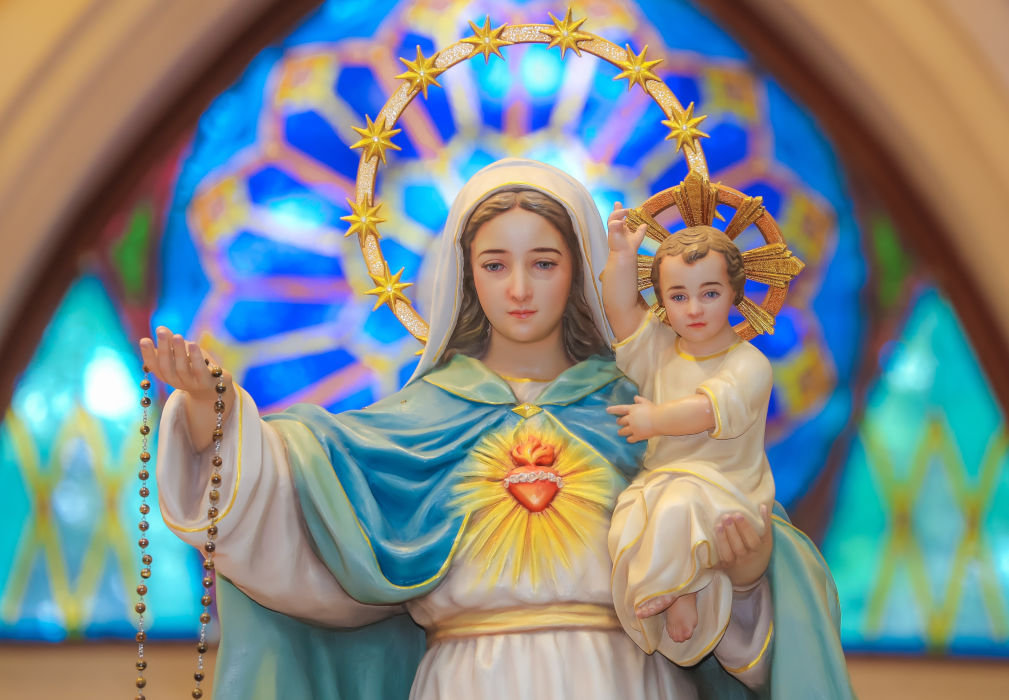
Reading time: 15 min.
October is the month of the Rosary, and for Don Bosco it was for many years the month of returning home: for more than twenty years he took the boys of the Oratory back to the Becchi to celebrate Our Lady of the Rosary in the chapel that he himself had fashioned in his brother’s house. He had learned that string of beads on his knees beside Mamma Margaret and never abandoned it: he placed it in the hands of the young, in the Constitutions of the Salesians, in his books, and we even find it in his dreams; and to a marquis who thought it a waste of time, he replied that his whole work was founded upon that practice. His story is thus intertwined with that of a prayer which the popes recommended in sixteen encyclicals, which saints taught in their writings, and which the Church has enriched with promises and indulgences.
A crown of roses, with its thorns
To understand what Don Bosco held in his hands when he fingered the beads, it is worth beginning with the name. “Rosary” comes from the Latin rosarium, which originally meant “rose bush”, “rose garden” and, by extension, also “garland” or “crown of roses”. In the Middle Ages the word acquired a religious and symbolic meaning, because prayers addressed to the Virgin were compared to spiritual roses offered to Mary, ideally forming a crown: a very beautiful crown which, however, also conceals its thorns. Before the term Rosarium became established, moreover, this form of prayer was often called the “Psalter of the Virgin” (Psalterium Beatae Mariae Virginis), since the 150 Hail Marys symbolically corresponded to the 150 psalms of the biblical Psalter.
As for its origin, ecclesial tradition holds that the Virgin herself entrusted the Rosary to Saint Dominic de Guzmán (1170–1221) as a means of preaching and of combating the Albigensian heresy; a tradition which Leo XIII repeatedly took up, going so far as to state that Saint Dominic had introduced and spread this form of prayer. But the date which, more than any other, marked its history is 7 October 1571, the day of the Battle of Lepanto. Saint Pius V attributed the victory of the Christian fleet to the intercession of Mary, invoked in those hours by the Rosary confraternities; and it was after that event that 7 October became the feast of the Rosary and that the Blessed Virgin was invoked under the title Help of Christians, Auxilium Christianorum.
This is a detail that a Salesian reader cannot overlook. The two Marian titles that marked Don Bosco’s life — Our Lady of the Rosary venerated at the Becchi and Mary Help of Christians at Valdocco — in fact arise from the same day and the same victory; and Don Bosco was well aware of it. In 1868, when publishing for the consecration of the Turin shrine the Maraviglie della Madre di Dio invocata sotto il titolo di Maria Ausiliatrice, he devoted a chapter specifically to the Battle of Lepanto. It is therefore not surprising that he always wished the feast of the Rosary to be celebrated with solemnity, and that for years he did so by going on pilgrimage with the boys of the Oratory to his birthplace. To understand the reasons for such fidelity, however, we must go even further back, to the kitchen of a farmhouse.
From the kitchen at the Becchi to the Rosary chapel
Giovanni Bosco, in fact, learned the Rosary before he could even read. Having lost his father before he was two years old, he grew up in a family in which the day began and ended on their knees, as he himself recounts in the Memoirs of the Oratory when speaking of his mother: “While I was still very small, she herself taught me my prayers; as soon as I was able to join my brothers, she had me kneel with them morning and evening, and together we said our prayers in common, including the third part of the Rosary.” The “third part”, that is, a rosary of five decades, was the daily measure of Piedmontese popular piety, and it would remain so for Don Bosco throughout his life.
What he had received at home, the boy soon began to give to others. At the age of ten or eleven, on feast days, he would stretch a rope between two trees in the meadow at the Becchi, set up his table for conjuring tricks and gather the neighbours; but before the show he set one condition, which the Memoirs recall in these words: “When everything was ready and everyone was eager to see something new, he invited them all to recite the third part of the Rosary, after which a sacred hymn was sung.” Only then came the sermon repeated from memory, the jumps and the dance on the rope. Looked at closely, the Oratory is already there in that meadow: the game that attracts the boys and the prayer that holds them together.
After becoming a priest and beginning the work at Valdocco, Don Bosco wanted to bring the Rosary back precisely to the place where he had learned it. In 1848, with the approval of the Turin Curia, he converted a room on the ground floor of his brother Giuseppe’s house into a chapel and dedicated it to Our Lady of the Rosary. Inaugurated in October of that year, it was the first Marian place of worship that he himself established, twenty years before the Basilica of Mary Help of Christians. From then until 1869 the feast of the Rosary was celebrated there every year, with the band and singers from Valdocco; the boys came from Turin as Giuseppe’s guests, with the house and barn placed at their disposal, and from the feast would then begin the famous autumn outings through the hills of Monferrato.
The little chapel thus became the devotional centre of the hamlet and the destination of a genuine annual pilgrimage; but it also witnessed some decisive pages of Salesian history. It was there, on 3 October 1852, the feast day, that Michele Rua, who would become Don Bosco’s first successor, and Giuseppe Rocchietti received the clerical habit; and at the Becchi, on 2 October 1854, the day after the feast, Don Bosco met for the first time a twelve-year-old boy, Domenico Savio, who in the following autumns would return several times to pray in that chapel.
“My institution is founded upon this”
If at the Becchi the Rosary was the feast of one day, at Valdocco it was the breath of every day. Don Lemoyne, collecting the testimony of those who had known Giovanni as a boy, observes that “the holy Rosary must have been familiar to him, because from the earliest days of the Oratory until the last years of his life he insisted that all the boys recite it every day: he never admitted that there could be any reason for dispensing a community from its recitation” (MB I, 90). He had the boys of the festive Oratory recite a third part on every feast day, “earnestly exhorting his young people to continue, if they could, this pious practice every day of the week in their homes” (MB III, 16); and once a year, on the evening of All Saints, the whole Rosary was said for the souls in purgatory, with Don Bosco kneeling in the sanctuary and often leading the prayer.
How much this practice meant to him is shown by an episode from February 1848. Marquis Roberto d’Azeglio, a senator of the Kingdom and personal friend of Carlo Alberto, visited the Oratory and came away impressed, with one reservation: he thought the time spent reciting the Rosary was wasted, and advised Don Bosco to abandon “that antiquated string of 50 Hail Marys one after another”. The reply has become famous: “Well, I attach great importance to this practice; and I could say that my institution is founded upon it. I would be prepared to give up many other things, even important ones, but not this.” And, with his characteristic courage, he added: “And even, if necessary, I would be prepared to renounce your precious friendship, but never the recitation of the Holy Rosary” (MB III, 294).
It was not stubbornness, nor attachment to a habit. In those fifty “strung-together” Hail Marys Don Bosco saw the Gospel placed in the hands of the poor: the mysteries of Christ’s life contemplated with Mary by boys who often could not read. That is why he did not merely defend the Rosary, but used every means to spread it. He did so first of all through the press: in the Giovane provveduto of 1847, the prayer manual which went through more than a hundred editions while he was still alive, he included the fifteen mysteries, accompanying each with a very brief contemplation so that, while the young repeated the words, they would have a scene from the Gospel before their eyes. He did so also through the Rule, asking of his religious what he asked of the boys: already in the first articles on practices of piety, drafted around 1859 for the emerging Salesian Society, we read that “every day the third part of the Rosary of Mary Most Holy shall be recited”. And, finally, he did so through the living word of the “Good Nights” and the dreams he told the young, in which the Rosary returns as a weapon and a defence.
The best-known of these accounts is the dream of the serpent. In August 1862, around the feast of the Assumption, Don Bosco dreamed that he was with all his boys at his brother’s house, right beside the Rosary chapel. A stranger showed him in the meadow a serpent seven or eight metres long and, overcoming his fear, made him stretch a rope over the reptile’s back. The serpent sprang up, was caught in the noose and, thrashing about, eventually tore itself to pieces. When the rope, which had been put away in a box, was taken out again, it had arranged itself so as to form two words: Ave Maria. “The serpent represents the devil,” the guide then explained, “and the rope the Hail Mary, or rather the Rosary, which is a continuation of Hail Marys, with which one can strike, conquer and destroy all the demons of hell” (MB VII, 238–239).
The same conviction accompanied his missionary horizon and, in the end, his old age. In the dream that preceded the first expedition to America, Don Bosco saw his sons advancing among hostile peoples with this one weapon: “the Missionaries recited the holy Rosary, while the savages, running from every direction, formed a corridor for them to pass through” (MB X, 55). And when, in his final years, headaches and eyes that were almost sightless no longer allowed him to work, Don Francesco Cerruti recalled how it was “a painful and consoling sight to see him spend long hours sitting on his poor sofa, in a place sometimes half-dark because his eyes could not bear the light, yet always calm and smiling, with his rosary beads in his hand”.
In step with the popes
In this devotion Don Bosco was not isolated, because he walked with the Church; and the Church, precisely in the final years of his life, returned to recommending the Rosary with unprecedented insistence. Sixteen encyclicals have been written on the Holy Rosary, not counting the dozens, if not hundreds, of other papal documents — bulls, constitutions, apostolic letters, exhortations and addresses — and no fewer than twelve of those sixteen are by Leo XIII, the same Pope who entrusted Don Bosco with the construction of the Church of the Sacred Heart in Rome.
The first four appeared while the saint was still alive. Supremi Apostolatus Officio, dated 1 September 1883, dealt with devotion to and recitation of the Rosary and established the special observance of the month of October; Superiore Anno, dated 30 August 1884, ordered the continuation of that solemn recitation; Quod Auctoritate, dated 22 December 1885, proclaimed an extraordinary Jubilee and particularly recommended this prayer; and Vi è ben noto, dated 20 September 1887 and addressed especially to the bishops of Italy, proposed it together with Marian devotion in the face of the religious and social difficulties of the time. The old priest of Valdocco, who would die on 31 January 1888, was thus able to see the Pope ask of the whole Church what he had been asking of his boys for forty years.
Leo XIII, however, did not stop there, and after a pause of a few years he returned to the subject almost every autumn. With Octobri Mense (22 September 1891) he returned to Marian devotion and the recitation of the Rosary in October, stressing its spiritual efficacy; with Magnae Dei Matris (8 September 1892) he presented it as a school of faith, Christian life and imitation of the virtues of Christ and Mary; with Laetitiae Sanctae (8 September 1893) he proposed it as a spiritual remedy for the principal moral and social evils of the time; with Iucunda Semper Expectatione (8 September 1894) he explored more deeply the value of this prayer and of the Virgin’s intercession in Christian life. Then came Adiutricem Populi (5 September 1895), which presents Mary as Help of the Christian people and links the Rosary with prayer for Christian unity; Fidentem Piumque Animum (20 September 1896), which reaffirms its spiritual value and encourages the faithful to practise it with confidence, devotion and perseverance; Augustissimae Virginis Mariae (12 September 1897), devoted to veneration of the Virgin, common prayer and the importance of the Confraternities of the Holy Rosary; and finally Diuturni Temporis (5 September 1898), which offers a synthesis of Leo XIII’s entire teaching on the Rosary and recalls the privileges and practices of the Confraternities.
His successors took up this inheritance whenever the times became more difficult. Pius XI, the Pope who had canonised Don Bosco in 1934, in Ingravescentibus Malis (29 September 1937) presented the Rosary as a spiritual remedy in the face of the evils of the time and especially recommended its recitation in families — the very prayer of the home at the Becchi. Pius XII, in Ingruentium Malorum (15 September 1951), urged that it be recited especially during October, emphasising its value for the family, peace and Christian life; John XXIII, in Grata Recordatio (26 September 1959), recommended it for the missions, for the Church, for peace and for the needs of peoples; and Paul VI, in Christi Matri (15 September 1966), invited the faithful to recite it, especially in October, to obtain from God the gift of peace.
To this list must be added two documents which are not encyclicals but remain fundamental. The first, which lies behind everything, is Consueverunt Romani Pontifices of Saint Pius V, dated 17 September 1569, which explains and substantially defines the traditional form of the Rosary, with the Our Father, the Hail Marys and meditation on the mysteries, and which Paul VI explicitly regards as the document in which Pius V “defined the form of the Rosary still in use today”. The second, the one nearest to our own time, is the Apostolic Letter Rosarium Virginis Mariae of Saint John Paul II, dated 16 October 2002: probably the most important modern papal document devoted entirely to the Rosary, not least because it introduced the Mysteries of Light.
The books of the saints and a meeting in Turin
Alongside the voice of the popes stands that of the saints, who wrote a great deal about the Rosary; among the many texts, some deserve particular mention. The oldest is The Most Holy Rosary. The Psalter of Jesus and Mary by Blessed Alan de la Roche, composed around 1475, in whose title the ancient name “Psalter” still echoes. More than two centuries later, around 1710, Saint Louis-Marie Grignion de Montfort wrote The Admirable Secret of the Most Holy Rosary for Conversion and Salvation (Le Secret admirable du Très Saint Rosaire pour se convertir et se sauver), probably the principal spiritual treatise on the Rosary written by a saint, dealing with its origin, prayers, mysteries, spiritual fruits and the manner of reciting it. Alongside it, by the same author, are the Methods of Reciting the Rosary (Méthodes pour réciter le Rosaire), its practical complement, since they propose different meditative methods for accompanying the decades with intentions and reflections on the mysteries of Christ and Mary; in editions of Montfort’s works they are normally published together with, or as an appendix to, the Secret. Closer to our own time, Saint Josemaría Escrivá published his Holy Rosary in 1931, with brief contemplative meditations on the mysteries and the Litany of Loreto: a good text for anyone seeking not so much a history or systematic theology of the Rosary as a concrete method of Gospel contemplation of the mysteries.
Between Montfort and Escrivá stands the work of a contemporary of Don Bosco, Saint Bartolo Longo, who in 1877 published The Fifteen Saturdays of the Most Holy Rosary. A Most Efficacious Devotion for Obtaining Any Grace, with meditations on the Gospel of each mystery, the fundamental Rosary work of the apostle of Pompeii. Don Bosco also met him in person: in May 1885 the lawyer Longo went to see him in Turin and asked how he had managed to conquer the world. “Dear lawyer,” Don Bosco is said to have replied, “my secret is this: I send my newspaper to those who want it and to those who do not.” The newspaper was the Bollettino Salesiano, and Bartolo Longo took the advice to heart for his own periodical, Il Rosario e la Nuova Pompei. Don Bosco, for his part, never wrote a treatise on the Rosary: he preferred to put it into the pages of the Giovane provveduto and, above all, into the hands of his boys.
Fifteen promises
Tradition also links Blessed Alan de la Roche, the fifteenth-century Dominican already mentioned, with the fifteen promises which the Virgin Mary is said to have made to those who recite the Rosary, known precisely as “the promises of the Holy Rosary”. Read in sequence, they trace a path that accompanies the faithful from everyday life to eternity. Here they are:
1. Those who faithfully recite the Rosary will receive special graces.
2. Those who recite it are promised special protection and an abundance of graces.
3. The Rosary will be a powerful defence against evil, against sin, vice and error.
4. It will foster growth in virtue and good works, draw down God’s mercy and direct the heart towards eternal goods.
5. Those who entrust themselves to Mary through the Rosary will not be lost.
6. Those who recite it devoutly, meditating on the mysteries, will be sustained in trials; sinners will be called to conversion and the just to perseverance in grace.
7. Those who have a true devotion to the Rosary will not die without the sacramental help of the Church.
8. Those who faithfully recite it will receive light and grace from God during life and at the hour of death.
9. Mary promises particular help to souls devoted to the Rosary in their purification after death.
10. The faithful who are devoted to the Rosary will receive a particular glory in heaven.
11. Persevering prayer of the Rosary will obtain the graces requested, according to God’s plan.
12. Those who spread the Rosary will receive particular help in their own needs.
13. Those who promote the Rosary will enjoy the intercession of the heavenly court, especially at the hour of death.
14. Those who recite the Rosary are presented as beloved children of Mary and brothers and sisters of Christ.
15. True devotion to the Rosary is regarded as a sign of predestination, that is, a sign that one’s life is directed towards salvation.
The first four concern the present; the next six accompany the devotee through trials and along the final stretch of the journey; the last four broaden the view from the person who prays to the person who leads others to pray; while the final promise regards true devotion to the Rosary as a sign of predestination, that is, a sign that one’s life is directed towards salvation.
Read alongside Don Bosco’s life, some of these promises seem almost like a commentary on what has been recounted. The third is the dream of the serpent, with the rope of Hail Marys defending against evil; the twelfth and thirteenth speak of those who spread and promote the Rosary, and it is difficult not to think of a priest who, though without means, always found the help necessary for his works and who attributed to Our Lady everything he had been able to accomplish.
The treasure of indulgences
To the promises handed down by tradition is added what the Church herself, by her own authority, has attached to this prayer. Today, in fact, she grants a plenary indulgence to those who recite the Holy Rosary according to the norms set out in the current Manual of Indulgences (Enchiridion Indulgentiarum), now in its fourth edition. It is useful to reproduce the official texts.
“17. Prayers to the Blessed Virgin Mary
§ 1 A plenary indulgence is granted to the faithful who:
1° devoutly recite the Marian Rosary in a church or oratory, or in a family, a religious community, an association of the faithful, and in general when several of the faithful gather for an honourable purpose;
2° devoutly join in the recitation of this prayer while it is being recited by the Supreme Pontiff and broadcast by television or radio.
In other circumstances the indulgence is partial. [for example, if a person recites it alone at home, outside the cases listed above]
The Rosary is a practice of piety in which the recitation of fifteen decades of Hail Marys, interspersed with the Our Father, is joined respectively to the pious meditation of an equal number of mysteries of our redemption.
For the plenary indulgence attached to the recitation of the Marian Rosary, the following norms are laid down:
a) it is sufficient to recite only a third part; but the five decades must be recited without interruption;
b) pious meditation on the mysteries must be added to the vocal prayer;
c) in public recitation the mysteries must be announced according to the approved custom in force in the place; in private recitation, however, it is sufficient for the faithful to add meditation on the mysteries to the vocal prayer.” (Manual of Indulgences, Grants, no. 17)
The general conditions
To obtain the plenary indulgence effectively, in addition to reciting the Rosary under the conditions indicated, the customary conditions are required:
“No. 20 – § 1. To obtain a plenary indulgence, besides the exclusion of every attachment to sin, even venial sin, it is necessary to perform the indulgenced work and to fulfil the three conditions: sacramental confession, Eucharistic Communion and prayer for the intentions of the Supreme Pontiff. [For this reason it is common practice to add, at the end of the Rosary, an Our Father and a Hail Mary for the Pope’s intentions]
§ 2 With a single sacramental confession several plenary indulgences may be obtained; with a single Eucharistic Communion and a single prayer for the intentions of the Supreme Pontiff, however, only one plenary indulgence may be obtained.
§ 3 The three conditions may be fulfilled several days before or after the prescribed work has been performed; nevertheless, it is fitting that Communion and prayer for the intentions of the Supreme Pontiff be made on the same day on which the work is performed.
§ 4 If full disposition is lacking, or the required work is not fully carried out, or the three conditions are not fulfilled, the indulgence will be only partial, without prejudice to what is prescribed in norms 24 and 25 for those who are “impeded”.
§ 5 The condition of prayer for the intentions of the Supreme Pontiff is fully satisfied by reciting for his intentions one Our Father and one Hail Mary; individual faithful are nevertheless free to recite any other prayer according to their own piety and devotion.” (Manual of Indulgences, Norms on Indulgences, no. 20)
A plenary indulgence can normally be obtained only once a day.
“No. 18 – § 1. A plenary indulgence can be obtained only once a day; a partial indulgence, however, can be obtained several times a day.
§ 2. The faithful may nevertheless obtain a plenary indulgence in articulo mortis even if they have already obtained another plenary indulgence on the same day.” (Manual of Indulgences, Norms on Indulgences, no. 18)
Indulgences, whether partial or plenary, may be applied to the dead by way of suffrage. They cannot, however, be applied directly to another living person.
“No. 3. Both partial and plenary indulgences may always be applied to the dead by way of suffrage.” (Manual of Indulgences, Norms on Indulgences, no. 3)
With the rosary beads in hand
Thus we return to our starting point, to that crown of roses which conceals its thorns. Don Bosco knew this from experience: in the dream of the rose pergola, which he recounted to the first Salesians, the Virgin made him walk along a path covered with beautiful roses, beneath which sharp thorns were hidden. For him, the Rosary was the way to keep walking over those roses without stopping: as a child kneeling beside his mother, as a priest among the boys, as an old man on his poor sofa, with the beads between his fingers.
To anyone who today enters the little chapel at the Becchi or the basilica at Valdocco, he therefore leaves the same charge he gave Marquis d’Azeglio: many things, even important ones, can be given up, but not this. Five decades a day are enough, recited while meditating on the mysteries and, if possible, together — in the family, in the community, in the oratory; and October, the month which the Church has devoted to the Rosary since Leo XIII, is the right time to begin again.
 St John Bosco
  Fr Bruno FERRERO