


 By Fr Bruno FERRERO
Reading time: 12 min.
Don Bosco is presented within a spirituality of work which, in harmony with the magisterium of John Paul II, affirms its dignity without making it an absolute: not an end in itself, but a place where the person expresses himself and grows in charity. From this perspective, Don Bosco appears as the saint of “doing”: he unites prayer and action, sanctifies work and takes it up as an educational path and a “mystical ladder” to God. For him, work means fulfilling the duties of one’s state in life: manual, intellectual, apostolic, and charitable. He insists on industriousness and temperance as Salesian traits, convinced that idleness fosters evil. His testimony is that of a life of colossal industriousness, to the point of exhaustion and death.
Because work and temperance will make the Salesian Congregation flourish.
The importance that the theme of work has assumed in our time is demonstrated by the impressive body of literature that explores its ever-developing aspects and values. Even when disfigured by certain ideologies, work is truly a central value in today’s society and culture. It brings to light an aspect of man’s mission in the world: that of mastering nature to humanise it and place it at the service of the person.
In his Encyclical Laborem exercens and in numerous other interventions, the Supreme Pontiff John Paul II outlines a spirituality of work that extols its value, but demythologises any idolatry of it. Work, in fact, is not an end in itself; it is not an absolute. It is instead “an important way of expressing the person as a ‘co-creator’ or ‘co-redeemer’ on earth and in time.” For us it becomes a testimony of the spiritual triad: faith, hope, charity. In this sense, it is not so much the quality of the work that makes the person great, but the motivations and the heart with which it is done, that is, the measure of the love of charity that permeates it” (E. Viganò). Don Bosco made work his banner; he sanctified himself by working, and working a great deal. Let’s take a look.
Incessant activity
The Italian academic Francesco Orestano, writing about Don Bosco, after having underlined his moral greatness and strength of will, continues in these terms: “However important the characteristics of the man and his work may be, Don Bosco’s originality does not yet lie here. Here it is. Educational and social needs, profoundly intuited in perfect relation to the new times, made him discover the great law of educating with and for work. Don Bosco felt the extraordinary edifying power of work as an educational tool for the human personality in all senses and at all times. Work, an eminent path for the ennoblement of the spirit: “I do not recommend penances and disciplines to you, but work, work, work.” And again, on his deathbed, he recommended it to all the Salesians whom he wanted to be ordered like a social militia, not engaged in ascetic practices, but completely imbued with the needs of modern life. Nor did he appreciate work only as an educational tool, but as the content of life. He felt the full dignity of work even in its most modest manual applications, sought to learn and practise them all in an exemplary manner, and thereby ennoble them. Nor did he ever consider work a means of enrichment, since, on the contrary, he judged, as his holy mother had rightly ruled, that getting rich was a misfortune; but only the fullness, health, and holiness of life.”
The quotation is pertinent because it captures, with penetrating clarity, perhaps the most original aspect of his pedagogy and his holiness, which is that of the elevation of man and of the Christian through and with work. On one condition, however: that the word “work” be taken in the range of meanings it had for Don Bosco, for whom it was, from time to time, synonymous with activity that was manual, craft, technical, professional; intellectual, school, study, culture; apostolic, catechesis, evangelisation, pastoral zeal; priestly, liturgical action, sacraments; charitable, in its various forms; duty of one’s state. “By work is meant the fulfilment of the duties of one’s state.”
It will, therefore, be the context that gives us the meaning intended, from time to time, by Don Bosco when he speaks of work.
The “mystical ladder” of work
Don Bosco intuited the supreme greatness, the divine sanctifying virtue of work understood as an apostolic, charitable, and humanising activity, and did not hesitate to make it his mystical ladder to go to God.
He did not separate work from prayer: “If there has been a saint in modern times who has so wonderfully combined and embodied in himself the two elements of the Benedictine tradition ‘pray and work’, it was precisely Don Bosco” (Card. C. Salotti). But prayer is not what is most apparent in him; it is not his motto. “What appears to the world is intense, selfless work. Don Bosco is an extremely concrete saint: to put it in a word that is a little blunt but true, he does not believe in a piety that is not expressed in life, that does not become action, active charity, that is not translated into incessant work for the love of God and of our brothers.”
We should add that in the 19th century, prayer was still a reality so strongly embedded in Christian custom that Don Bosco did not deem it appropriate to insist on it excessively, as he probably would have done in a different situation. What was urgent, instead, was to sanctify work and to divinise action. This was his charism.
He felt inspired and drawn to this. He knew that the word is not persuasive unless it becomes action, and he wanted action to become word, for his ideas to have hands, as indeed they did.
He was by temperament what is called a “man of action”, “the successful operator”, the “organisational genius”. Work was his second nature. “God,” he said, “has granted me the grace that work and toil, instead of being a burden to me, have always been a relief.”
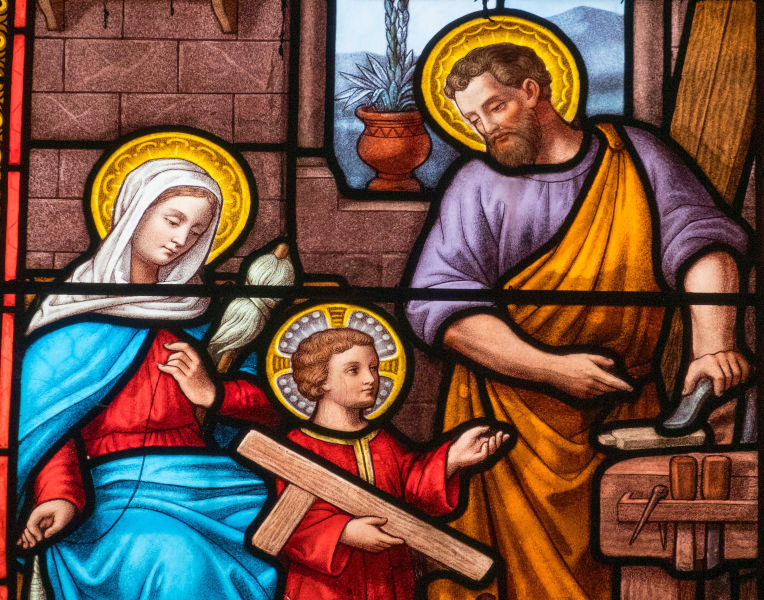
The drive to act was powerfully stimulated by the immense new needs of his century, by the miserable condition of the marginalised or neglected youth of his time. But he was especially attracted by the example of Jesus, the divine worker of the little house of Nazareth, the friend of children and the humble, the apostle of the Father continually at work for our salvation. “My Father is always at his work to this very day, and I too am working” (Jn 5:17); Jesus “began to do and to teach” (Acts 1:1). This is the model he proposes to his sons when he writes the Constitutions.
“Jesus Christ began to do and to teach,” “so the members of the congregation will begin to perfect themselves by the practice of internal and external virtues.”
When Don Bosco quotes the Word of God, he shows a marked preference for texts that highlight the “category of doing”, of proclamation, of evangelisation. In his voluminous correspondence, the mention of divine realities and prayer is almost continuous, although almost never thematised. Instead, phrases of this tenor are carefully underlined: “Opus fac evangelistae” (2 Tim 4:5: “Do the work of an evangelist”); “Tu vero praedica Verbum opportune et importune” (2 Tim 4:2: “Preach the word; be prepared in season and out of season”); “Opera Dei revelare et confiteri honorificum est“ (Tob 12:7: “It is good to reveal and publish the works of God”).
He was not, however, a pragmatist, nor did he elevate practice to a criterion of truth. He always placed both the doctrine of the faith and the Magisterium above all else: firmly acquired principles and values. But he was “God’s entrepreneur”, the realist who instinctively puts the practical before the theoretical, the lived before the abstract, facts before words, who does not believe in faith without works, nor in a Gospel that is not incorporated into life. Only “whoever lives by the truth comes into the light” (Jn 3:21). Only the language of facts and deeds seemed credible enough to him.
“The world has become materialistic,” he used to say, “therefore one must work and make known the good that is being done. If someone performs miracles by praying day and night in his cell, the world pays no attention and no longer believes. The world needs to see and touch. The world today wants to see works, it wants to see the clergy working…”.
In an era in which religious were looked upon as idle people, useless to the progress of society, he wanted his institution to be founded on the great law of work and said, not without humour, that the uniform of his religious would be that of “rolled-up sleeves.”
With the courage and daring of the entrepreneurs who made the city of Turin famous – especially in the last quarter of the 19th century – supported by an unshakeable faith, he launched his very young Salesians, formed “on the job” and with little theory, to found his charitable works: oratories, hospices, schools, colleges, missions.
In 1878, he had the audacity to write to the newly elected Leo XIII, asking him to pay particular attention to the new institutions that the Holy Spirit was raising up in the Church. “The recent religious families are called for by the needs of the times. With their firmness in the faith, with their material works, they must combat the ideas of those who see only matter in man. These people often despise those who pray and meditate, but they will be forced to believe in the works of which they are eyewitnesses.” Ancient words; they could be said today and are valid on a planetary scale, so much is the apologia vitae of believers, the authentically Christian witness, invoked and demanded everywhere.
“Where there is work, there is no devil”
The bold statements that other saints have made in praise of prayer, Don Bosco made in praise of work.
“Ninety per cent of his talks to his confreres,” writes A. Caviglia, “are about work, temperance, and poverty. Here,” he adds wittily, “is the scandal of a saint; of a saint, we might say, who is ‘American’; he says ‘Let’s work’ many more times than ‘Let’s pray’.”
- Ceria, in turn, writes, “It would be difficult to find another saint who, to the extent of Don Bosco, has conjugated and had others conjugate the verb ‘to work’.” He wanted his Salesians to be cheerful, poor, frugal, and above all, most industrious: “Work, work, work! – he would repeat. This should be the goal and glory of priests. Never tire of working. How many souls would be saved!” “He who does not know how to work is not a Salesian.”
He wanted work to have the continuity of breath, “Always working […]. This must be the aim of every Salesian and his constant sigh.” The idea of fatigue was not to be a restraining thought, but to serve as a stimulus to do more. “We do not want money, but hard work.” “We must procure for ourselves work that is beyond our strength, and thus who knows if we will not manage to do all that we can.”
Laziness and idleness inspired horror in him. He went so far as to say this extremely severe phrase, “The priest either dies from work or dies from vice.”
What for other Institutes were afflictive penances and long fasts, for Don Bosco was work: “My dears,” he would repeat, “I do not recommend penances and disciplines to you, but work, work, work.”
When he saw the great work, his sons were doing, he rejoiced inwardly. “When I go to the houses and hear that there is a lot of work to be done, I am at peace. Where there is work, there is no devil.” “It is true,” he would add, “the work exceeds our strength, but no one is dismayed, and it seems that fatigue is a second nourishment after material food.”
He was convinced that “from St. Peter to our day, the times had never been so difficult,” but he wanted that “instead of filling the air with whiny complaints,” one should react by intensifying work; “Work as much as one possibly can.”
Pius IX had told him: “I believe that a religious house where there is little prayer but much is work is done, is in a better condition than another in which many prayers are said and little or no work is done.” And again, “Do not put the novices in the sacristy, lest they become idle; but keep them busy working, working!”
This is what Don Bosco had always done, arousing perplexity and distrust in other religious and even in the ecclesiastical authority itself.
He was reproached, for example, for sacrificing the “ascetic novitiate” and the “traditional” methods of formation, by recklessly engaging the young confreres in distracting and premature apostolic activities. But Don Bosco replied in his defence, “The experience of thirty-three years teaches us that these assiduous occupations are an impregnable bulwark of morality. And I have observed that the busiest and most industrious remember their former condition better, enjoy great health, remain more virtuous, and, once they become priests, reap copious fruit from the sacred ministry.”
Confirmation of the goodness of his method also came to him from the mysterious dreams that, like cards from heaven, mark the decisive turning points of his existence.
In the “dream of Lanzo” (1876), for example, the guide who accompanies him shows him the vast field of Salesian action and says to him in a peremptory tone: “Look; you must have these words printed, which will be like your coat of arms, your watchword, your distinctive mark. Note it well: Work and temperance will make the Salesian Congregation flourish. You will have these words explained, you will repeat them, you will insist on them.”
Of extraordinary importance in the Salesian tradition has always been the dream of the “ten diamonds,” or the ten virtues, which shine with dazzling light on the mantle of the character who personifies the “model of the true Salesian.” Two of these diamonds bear the inscription: “Work,” “Temperance.” They are placed respectively on the right and left shoulder, as if to outline the figure of the Salesian.
Finally, let us recall perhaps the greatest words of his life: “When it happens,” so ends his Spiritual Testament, “that a Salesian succumbs or ceases to live while working for souls, then you will say that our Congregation has achieved a great triumph and upon it will descend the copious blessings of heaven.” Again, on his deathbed, he recommended twice to Monsignor Cagliero: “I recommend that you tell all the Salesians to work with zeal and ardour: work, work.”
The testimony
But higher than words, is the testimony of his life. A life, as Pius XI defined it, “which was a true, proper, and great martyrdom; a life of colossal work that gave the impression of oppression just by looking at it.”
It is hard to believe that one man alone could have worked so much and attended to so many things at once. A. Caviglia writes that in Don Bosco, several people seem to be at work simultaneously: “The educator and the pedagogue, the father of orphans and the gatherer of abandoned children, the founder of religious congregations, the propagator of the cult of Mary Help of Christians, the establisher of lay unions spread throughout the world, the instigator of operative charity, the herald of distant missions, the popular writer of moral books and religious apologies, the champion of the honest and Catholic press, the creator of Christian workshops and book collections, the man of religious piety and charity, and the man of human affairs or public interest. They operate simultaneously and advance as if they were many people born or destined for that alone, and they merge into the single person of a priest without airs, who never disturbs the serenity of his appearance nor the composed modesty of his manner with grand decorative gestures, nor enriches his vocabulary with the rhetoric of grand phrases.”
Such a multiplicity of aspects was, however, unified at a deep level by the idea that dominated his life, that, as we have seen, of the salvation of souls and the glory of God.
Providence had tempered Don Bosco for work through the deprived and poor years of his childhood. We know that he did everything, having been a shepherd, a farm labourer, a servant, a tailor, a blacksmith, a coffee-house keeper, a pastry chef, an acrobat, a tutor, a student, a sacristan, a barber; he went from one master to another, experiencing how “salty” another’s bread tastes.
This experience would leave an indelible mark on him. He would forever be highly sensitive to the problems of poor and marginalised youth as well as those of the humble working classes, and he would forever be a formidable worker and achiever. “Things are not just moving by steam,” he wrote in 1878 to Countess Uguccioni, “but like the telegraph. In one year, with the help of God and the charity of our benefactors, we have been able to open twenty houses. You see how Your family has grown.”
Faithful to an old resolution, in his maturity he allowed himself no more than five hours of sleep per night. “One can say,” testified Monsignor Bertagna in the processes, “that he spent half his nights working. And I heard him say more than once that, when he was healthier, he would often spend two nights at his desk writing. Despite this, in the morning he would be in the sacristy to say Mass and hear confessions for several hours.” In the early days of the Oratory, on certain occasions, he would also hear confessions for many hours a day.
During his most productive period, he wrote with surprising speed, even 250 letters in a single day in his own hand. “I get a lot of work done,” he would say, “[…] I have acquired a speed that I don’t know if it could be called greater.” In periods of more intense activity, he would often sit at his desk at two in the afternoon and continue until eight, only to resume again later. “For several months now, I have been sitting at my desk at two in the afternoon and getting up at half past eight to go to dinner.”
The “mortal fatigue” to which his daily worries subjected him comes through in his letters in sudden outbursts that are still moving. “The work is driving me mad”; “I find myself so tired I can’t go on”; “I am very tired.”
And it was true. It can be said that he knew no rest other than that of the grave. “I do not remember,” testified Monsignor Cagliero, “that in his entire life he ever took a day’s holiday for leisure or to rest, and often finding us tired and worn out from work, ‘Courage,’ he would say to us, ‘courage, let us work, let us always work because up there we will have an eternal rest’.”
He died broken by an excess of work, a martyr—not metaphorically—of a toil that knew no respite. His “exaggerated vigils and material labours,” we read in the brief and curious biography by his personal physician, “wore out his life, at first almost imperceptibly, after about 1880 [eight years before his death] it can be said that his organism was almost reduced to a walking pathological cabinet, in the midst of which, however, still shone a mind always active and always anxious to reach its glorious goal.”
The industriousness of the “old priest,” of the “philanthropist of the 19th century,” of the “most intransigent Catholic” seemed, to the people of the time, incredible and legendary. At Don Bosco’s death, the newspapers of the time described his toil and industriousness as “prodigious” (L’Illustrazione popolare), “gigantic” (La Patrie), “enormous and to the highest degree” (La Perseveranza), “phenomenal” (Il Fanfulla). “If Don Bosco,” the same newspaper reads, “had been minister of finance, Italy would be economically the first nation in the world.” At the Apostolic Processes, the Promoter of the Faith did not hesitate to call him one of the greatest apostles of the Church in the 19th century. “The multiplicity and fruitfulness of his works is prodigious; his zeal for the salvation of souls and for the spread of the Kingdom of Christ on earth was so intense and continuous that history, rightly, proclaims him a very great apostle—’maximum‘—of the 19th century.”
Pietro BROCARDO, Don Bosco profoundly man, profoundly saint, p. 119
 BSOL Editor