


 By Fr Bruno FERRERO
Reading time: 6 min.
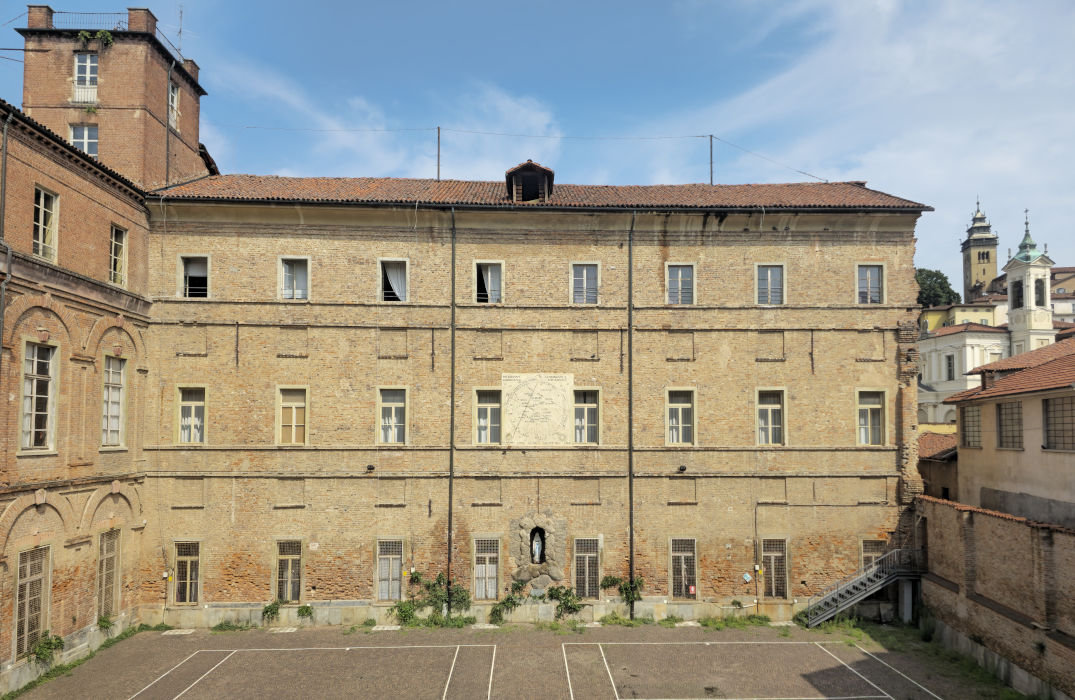
The seminary in Chieri, where Don Bosco studied
The testimony of Fr. Giovanni Francesco Giacomelli, a fellow seminarian and then Don Bosco’s confessor for the last fourteen years of his life, offers an intimate and authoritative portrait of the Saint. He shared with him years of formation, periods of life at the Oratory, and a long spiritual familiarity. He recalls Don Bosco’s gentleness, his strength of character, his fatherly care for the young, and his suffering when he saw them mistreated or straying. He emphasises the centrality of the sacraments, religious education, and the “exercise of a happy death” as the secret to the Oratory’s success. Also, a witness to his ministry in prisons and the great initial difficulties, he confirms Don Bosco’s unwavering trust in Providence and his boundless charity.
Because everyone thought he was mad.
His testimonies are contained in the manuscript of the ordinary process, public copy, on pages 656-690.
Giovanni Francesco Giacomelli was born in Avigliana (Turin) in 1820. He was a fellow seminarian of Don Bosco’s in Chieri for 5 years. Ordained a priest, he lived with him for a year at Fr. Cafasso’s Ecclesiastical College. He lived for several months in the Oratory. In the last 14 years of his life, Don Bosco chose him as his confessor and confided his most intimate matters to him. Fr. Giacomelli lived a few steps from the Oratory, in the Opera Pia Barolo.
My name is Fr. Giovanni Francesco Giacomelli, a native of Avigliana, 72 years of age, a priest, residing in Turin, chaplain of the Ospedaletto di S. Filomena of the Opera Barolo.
I met Don Bosco in the year 1836, in the seminary of Chieri, where I was taking the first year of philosophy and Don Bosco the second. I spent five years with him in that seminary, then one year in the Ecclesiastical College of Turin for the study of moral theology. For 38 years, I have been the spiritual director of the Ospedaletto di S. Filomena of the Opera Barolo, a place almost adjoining Don Bosco’s Salesian Oratory. I can say that I was always on very intimate terms with Don Bosco. I went to confession to him, and from 1872 until his death (in the year 1888), I was his confessor.
I knew his mother
I knew Don Bosco’s mother, who was a very shrewd and prudent woman, and of great piety. I lived with Don Bosco and his mother for several months in the early days of his Oratory in Turin, and I also knew a sister of hers who helped with the household chores. Don Bosco’s family owned a small house and some small plots of land in Castelnuovo d’Asti. His parents enjoyed a good reputation among their fellow countrymen.
Finding myself in the seminary (in Chieri), from the very first day I was placed in the study hall opposite the cleric Bosco. I looked at him with compassion, because he seemed to be suffering; and he too looked at me with compassion, because I was being made fun of by my companions for a cap that was disproportionately tall. He offered to fix it for me and to make me a new one, which he indeed did. Then, entering into conversation with him, I learned that he had been somewhat ill during the holidays.
Ordinarily, during recreation time, he would be surrounded by some companions and myself, to whom he would tell edifying things and little stories that had happened in his youth. I remember he told us that years before in Chieri he had made a bet with a street performer as to which of the two could climb higher up the trunk of a tree on the town’s avenue… and he won the bet. We companions would not believe this feat of his, and he said, “You don’t want to believe it? Watch me!” He took a heavy chair, lifted it by placing one leg on his chin and held it there for some time. Then, after that, we admired his dexterity and muscular strength.
Young friends
I remember with pleasure that Don Bosco, on holidays, would receive visits from several of his colleagues, young day students who came to see him at the seminary, and who had been his companions in his Latin studies. He enjoyed spending time with them, talking and giving good advice.
At the spiritual exercises in preparation for ordination, I heard from him that he had been very struck by the sermons, especially by the words, “Who shall ascend the mountain of the Lord?” He showed that he was penetrated by the importance of the words that follow, “He who has innocent hands and a pure heart”.
Don Bosco loses his patience twice
He had a gentle, sweet, and meek way of drawing boys to goodness and virtue, and he felt great displeasure and grave sorrow when he saw others being severe with the young. On this subject, he told me one day that from his balcony he had seen an older youth mistreating one of his younger companions. He told me that he trembled at this act, forced himself not to speak, but the next day he gave that youth a fatherly correction.
Another time I saw Don Bosco with his hand raised as if to strike two quarrelling youths. He separated them, but did not strike them, as they had immediately stopped all quarrelling. One day, I saw him running after two youths who were fleeing to avoid going to church with the other companions (it was in the early years of his Oratory). Seeing him, I said to him, “Hey, that’s the second time I’ve seen you worked up”. And he replied, “What can you do! These blessed boys are trying to run away to avoid coming to church…”.
Seeing so many young people who had neither relatives nor a permanent home, he conceived the idea of opening a hospice between 1846 and 1847. Little by little, the number of young people increased. At the end of 1849, when I had stayed with Don Bosco for a few months, the number of these youths was about thirty. He took great care of them. He himself would go to ask for information about their conduct from their masters, or if he could not go, he would send others he trusted. I myself was sent by him to plead for a son with his father. I found the father harsh, whereas Don Bosco was very compassionate. Thus, Don Bosco had more of a father’s heart than that young man’s own father.
The secret of the Oratory’s success
Having been in Don Bosco’s house for several months, and then having always frequented the Oratory until his death, I can testify that he always took care to instruct the young in religion and to guide them towards solid piety (= Christian life). He promoted frequent reception of the sacraments, believing this to be the best means of keeping them from vice and setting them on the path to Heaven. He had them do the exercise of a happy death every month, and one day he told me, “If the Oratory is doing well, I must attribute it especially to the exercise of a happy death”.
I once saw Don Bosco very distressed because one of his first clerics had left the Oratory, when he was in great need of him. On that occasion, I heard him exclaim, “Vain is the help of man”, showing that he had to trust more in God than in men.
So great was the esteem that the young had for him, that they refrained from causing him the slightest displeasure almost more than they would God. But he, noticing this, would reprimand them, saying that God was something more than he was.
I accompanied him to the prisons
His charity was not restricted to the young people of the Oratory, but extended elsewhere as well. I accompanied him to the prisons where he taught catechism and heard confessions. He had me buy white bread and sometimes fruit, which he had distributed to the young to encourage them towards goodness.
I know that, many years before he died, he disposed of the few things he possessed by will, so as not to cause any trouble, and so that the many alms and offerings of money he had received would not fall into the hands of his relatives.
Many judged him to be a bit reckless
To bring all his charitable works into being, he had to endure great conflicts and difficulties. I myself, upon examining the grandiose plan for his Oratory that he had shown me, was at first convinced that it was reckless. The priests themselves, including Fr. Cafasso, who helped him at the beginning, considered Don Bosco somewhat reckless. But then, seeing that he always succeeded in his intent, they too approved of his work and admired his strong perseverance.
“I must depart first”
In 1885, I was gravely ill. My sister went crying to commend herself to Don Bosco for my recovery, and Don Bosco cried too and said to her, “He is not dying yet. I must depart first.” And this indeed came to pass.
Giovanni Francesco GIACOMELLI, diocesan priest
 BSOL Editor
 St John Bosco