


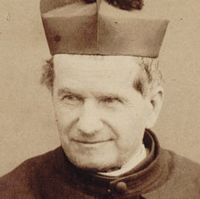
 By St John Bosco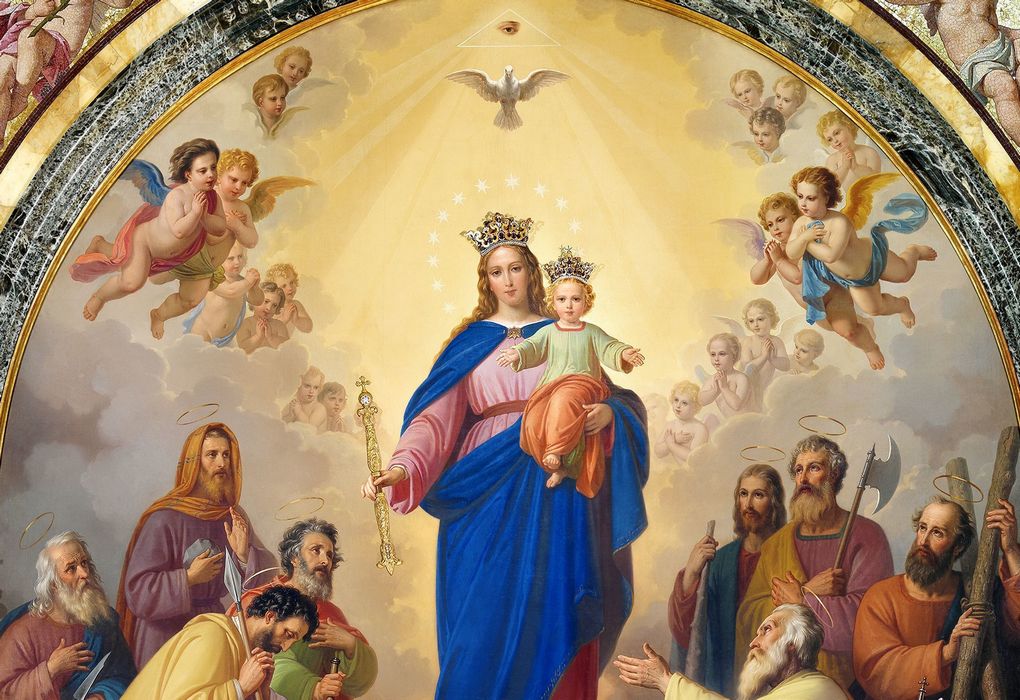
Reading time: 57 min.
The name Mary Help of Christians echoes a long history of the Christian people’s trust in the protection of the Mother of God. In the sixteenth century, the invocation Auxilium Christianorum was already part of the Loreto tradition, but after the victory at Lepanto on 7 October 1571, attributed to the special intercession of the Virgin invoked through the Rosary, the title took on a much more vivid significance in Christian memory. St Pius V attributed the victory to Mary’s intercession: from that day came the feast of Our Lady of the Rosary and, according to tradition, the invocation “Auxilium Christianorum” entered the Litany of Loreto. Our Lady of the Rosary and Mary Help of Christians are therefore not two separate devotions: they are the same Mother, whom the Church contemplates as the one who accompanies, sustains and helps her children in times of trial.
When, in 1870, St John Bosco published Nine Days Dedicated to the August Mother of the Saviour under the Title of Mary Help of Christians, he took up this legacy and expressed it in the simple, practical language of Christian life. His novena does not merely ask for graces, but offers a genuine spiritual journey: nine days to grow in trust in Mary, faithfulness to the sacraments, prayer, charity and union with Jesus.
Index
Mary Help of Christians in the needs of life
Honouring Mary on solemnities and days consecrated to her
Promoting the sanctification of feast days, the avoidance of profanity and bad language
Excuses against frequent Communion and its advantages
Consolations for devotees of Mary at the point of death
Feast of Mary Help of Christians
Association of Devotees of Mary Help of Christians
Spiritual advantages of the members
To the reader
In addition to the works published on the cult and wonders of Mary invoked under the title of Help of Christians, many requested a novena which, while explaining the purpose of this devotion, could serve as a guide to devoutly celebrate the solemnity instituted in honour of this august Queen of Heaven. To satisfy these pious desires, I have endeavoured here to set out a novena in nine considerations, which, while serving as a preparation for the feast of Mary Help of Christians, can equally benefit those who, during the course of the year, wish to consecrate nine days to this common Benefactress of the human race.
Since the association of devotees of Mary Help of Christians has as its purpose to procure for its members the special protection of Mary at the hour of death, through devotion to Jesus in the Blessed Sacrament and to his Immaculate Mother, care has been taken to treat the topics and collect those pious thoughts that seemed most appropriate for this purpose.
As for the examples added to each consideration, I have decided not to mention the names of the people to whom they refer, in order to spare them questions from some indiscreet readers. However, the sources from which they are taken are cited, and an authentic manuscript account is kept for anyone who wishes to satisfy their devotion even more.
Finally, there is an appendix on the statutes of the pious association of devotees of Mary, which the Supreme Pontiff deigned to establish as an archconfraternity with a Brief dated 5 April 1870.
May Mary Help of Christians, who in these times manifests herself in so many ways as a generous benefactor of poor humanity, help me and help you too, O Christian reader, so that we may live and die in the grace of the Lord and one day be worthy to sing his praises eternally in heaven. So be it.
Author’s Protest
In obedience to the decrees of Urban VIII, I protest that I do not intend to attribute any authority other than human to what will be said in the book about miracles, revelations, or other facts; and in giving anyone the title of Saint or Blessed, I do not intend to give it except according to opinion, except for those things and persons that have already been approved by the Holy Apostolic See.
FIRST DAY
Before reading each day, the following shall be said:
V. Deus, in adiutorium meum intende.
R. Lord, hasten to help me.
V. Glory be to the Father, and to the Son, and to the Holy Spirit.
R. As it was in the beginning, is now, and ever shall be, world without end. Amen.
V. Mary, help of Christians.
R. Ora pro nobis[1] .
Mary Help of Christians in the needs of life
1. A good mother is always a true treasure and a great comfort to her family. Thus Mary, our merciful mother, will certainly be a source of grace and blessings to Christian families throughout the world. We live as if on a stormy sea, as if in exile, as if we were in a valley of tears. But Mary is the star of the sea, the comfort of our exile, the light that illuminates us, the way to heaven; in short, she is our life, our sweetness, our hope: vita, dulcedo, et spes nostra. She shows herself to us as such by obtaining continuous spiritual and temporal help for us. Mary, says St Jerome, has such a merciful and tender heart towards men that there has never been a person who was so afflicted by her own pains as Mary was by the pains of others[2] . Therefore, as soon as she sees a need, she immediately brings us help. Thus, as soon as Mary learned from the Archangel that the family of Zechariah, and especially Elizabeth, needed help, she hurried to her, travelling about seventy miles through rugged mountains: abiit in montana cum festinatione[3]. When she arrived at that blessed house, Mary served her as a humble handmaid for three months, and did not leave her until she no longer needed her service. She did the same in Cana of Galilee. Mary was invited to a wedding with Jesus and other distinguished persons, when, at the height of the meal, the wine ran out. Mary, with her maternal eye, noticed that the bride and groom were distressed and now covered with shame. At that sight, Mary was moved and, without being asked, thought to bring them help. She immediately took on the role of pious helper, as St. Bernardino of Siena reflects: officium piae auxiliatricis assumsit non rogata[4] . “Son,” she whispered to Jesus, “they have no wine.” Mary uttered these words with such an expression that it was clear she desired a miracle in favour of her devotees, and she obtained it and consoled them[5].
2. Mary’s tender solicitude did not diminish when she was assumed into heaven by the angels; on the contrary, it increased even more. Oh, yes, she still remembers that on Mount Calvary Jesus made her our mother. Mulier, ecce Filius tuus, and then to the beloved disciple: Ecce mater tua[6] . At that moment, Jesus touched her heart so deeply and filled it with such tenderness for us that it is impossible for the human mind to imagine. Let us put together all the love that mothers have for their children; but the fullness of affection of all these mothers will never equal the love that Mary alone has for each of us. O dear thought, O sweet comfort! To have such a tender and loving Mother in heaven!
This is the reason, O devout Christian, why we read that throughout the centuries Mary has always come to the aid of Christians in all their needs. Oh no, St Augustine and St Bernard exclaim with one voice, never has it been heard in the world that anyone in need has confidently turned to Mary and been abandoned by her[7] . Turn the pages of the holy books and all the histories, travel throughout the Christian world, ask the peoples, kingdoms, cities, villages, and families, and ask if it has ever happened among them that Mary failed to come to the aid of her children in need. To your question, all will answer with one voice: no, never.
To better persuade them of this truth, enter, O my reader, into some sanctuary dedicated to Mary, and you will soon be convinced that she is the Help of Christians in the needs of life. Behold, hanging on those sacred walls, the signs of her goodness and power. There you see a sick person who had been given up by the doctors, but who instead gained his health through Mary; here one freed from fever, another from epilepsy, a third from gangrene. You will see others who, through her intercession, escaped from the hands of murderers, or from water, or from fire, or from a fall, and so on. When you leave there, you will not be able to help but exclaim: O Mary, how powerful and how good you are, how true it is that you bring help to those who invoke you in the necessities of life.
3. If Mary comes to our aid in temporal needs, she helps us with even greater urgency in spiritual needs. It would be necessary to write large volumes to enumerate all the great benefits that Mary has bestowed upon her devotees. St. Bernard expresses this truth by saying: God wanted all good things to come to us through Mary; totum nos habere voluit per Mariam; and St. Bernardino of Siena adds: All the graces we receive from God are dispensed through Mary’s intercession, and they are dispensed to whomever Mary wants, when she wants, and how Mary wants[8]. And oh! How many virgins owe their virginal purity to Her protection! How many young people owe their victory over their passions to Her! How many fathers and mothers owe the eternal salvation of their children to Her! It can be said that in the new law there is no saint who does not acknowledge his or her holiness through Mary’s intercession. History tells us that the most distinguished of them were also the most devoted to Mary.
Mary is not only the help of Christians in particular, but the support of the universal Church. With Mary’s help, the apostles, the martyrs, and the early Church defeated their persecutors; with Her help, idolatry was eradicated; through Her, the banner of the Cross flew throughout the world and triumphed[9]. Through Her, the barbarians were overcome; through Her, the heretics were confounded; through Her, heresies were eradicated. Therefore, St. John Chrysostom rightly called Mary the adornment, glory, and strength of the Church: Ecclesiae nostrae decus, gloria et firmamentum[10] . Therefore, dear reader, let us say with St. Bernard: In dangers, in anxieties, in doubts, think of Mary, invoke Mary. May Mary never leave your mouth; May Mary never leave your heart. In periculis, in angustiis, Mariam cogita, Mariam invoca; non recedat ab ore, non recedat a corde[11] .
Practice. – In times of trouble and sorrow, I will often invoke Mary.
Example
History provides us with many examples to prove how eager Mary is to bring help to Christians in their needs. One example that stands out is the victory She gave to Christians against the Turks. These enemies of the Christian name, after many victories, put twenty thousand Christians to the sword in the city of Nicosia alone, flayed others, and tore several to pieces alive. Not content with this, nor with their conquests, they threatened all of Christendom with bloodshed and slaughter. Who would dare to oppose these formidable enemies? Pope St. Pius V, who then governed the Church, tried to unite the Christian princes in a holy league; inviting them and begging them to take up arms against the common enemy, but only King Philip II of Spain, Duke Emmanuel Philibert of Savoy, and a few other Italians were moved by the voice of the Vicar of J. C. Then the Pope, seeing that the forces of the Christians were too inferior to those of the infidels and that, humanly speaking, victory was impossible, placed all his trust in Mary. He therefore ordered public and private prayers for all Christendom, and he himself, full of confidence, abandoned himself into Her arms. He then commanded the generals of the Christian army to send away from their army all people of ill repute and to demand from the remaining soldiers irreproachable conduct and tender devotion to Mary. The combatants confess, receive Holy Communion, and, blessed by the Vicar of Christ, set sail under the protection of the Queen of Heaven in search of the enemy. On the eighth of October, the two fleets meet near Lepanto, a city in Greece. It is four o’clock in the afternoon. The sound of trumpets signals the start of the battle, and the Christians, shouting “Long live Mary,” rush against the infidels. They had already fought fiercely for a whole hour, and victory was still undecided, when the leader of the Turks fell dead. At this news, the barbarians lose heart, become confused, and flee; their ships were stopped, sunk or burned. The slaughter was general, the defeat complete. In short, the Turks lost thirty thousand men, two hundred and twenty-four ships, and four hundred and twenty-seven cannons. These losses led to the collapse of Muslim power, which from that day on continued to decline, reaching its lowest point today. Everyone recognised that such a portentous victory was due to Mary, who, at the very moment she brought it about, also deigned to reveal it in Rome to her most devoted Pius with a heavenly vision. As a sign of gratitude and affection, Pius V decreed that the invocation ‘Maria, auxilium Christianorum, ora pro nobis’ be included in the Litany of Loreto.
SECOND DAY
V. Deus, in adiutorium meum intende.
R. Domine, ad adiuvandum me festina.
V. Glory be to the Father, etc.
R. Sicut erat etc.
V. Mary, help of Christians.
R. Ora pro nobis.
Honouring Mary on solemnities and days consecrated to her
1. If we want Mary to help us in our needs in life, we need a sincere willingness, a lively desire to please her and do everything we know will be pleasing to her, honouring her especially on solemnities and other days dedicated to her. On these days, the angels and saints in heaven rejoice with joy; they multiply their praises to their Queen, and gather around Her throne to honour Her and proclaim her power and glory. Therefore, on the days consecrated to Her, let us endeavour to cleanse our souls from every stain of sin by means of a good confession, and then approach Holy Communion. This is the most fitting way to please Mary and celebrate Her solemnities. Let us not fail to go and listen to Her praises in some church, and if we cannot, let us at least read and meditate on some of Her virtues, especially those facts and mysteries that are remembered on those special solemnities.
2. But in order to make ourselves more pleasing to Mary on the days dedicated to Her glories, let us, O devout Christian, prepare ourselves with a pious novena, or at least with a triduum. What does a good son do when he knows that his mother’s feast day is approaching? In the days leading up to it, he prepares a gift for her; he thinks about the flowers with which to make a beautiful bouquet worthy of his mother; he prepares a letter or a little sermon with which he can better express the filial affections of his heart at the appropriate time. In addition to this, during those days he makes a great effort to fulfil all his duties more precisely; he is more careful than ever not to cause her even the slightest displeasure; in short, he tries to please her in everything. Thus, in the days leading up to the feast of Mary, we are more exact in the fulfilment of our duties, more patient, more charitable. In the morning, throughout the day, and in the evening, we try to lift our minds and hearts to Mary with warm ejaculations: we try to live in close union with Her, doing everything to please Her. These acts of virtue are like a vague bouquet of spiritual flowers to be offered to Mary on her feast day. Come, my children, She says, make me garlands of flowers, surround me with fruits, for I languish with love for you: fulcite me floribus, stipate me malis, quia amore langueo[12] . The most devout usually practise mortification in food or drink every day of the novena, or give alms, or attend Mass, or even receive Holy Communion every day. If the novena or triduum takes place in a church, they attend the services there punctually. On the feast of the Assumption, Saint Gertrude saw Mary with a choir of beautiful young girls under her mantle; and she understood that this fortunate group was made up of those souls who had devoutly prepared themselves for that sacred solemnity; and that therefore Mary looked upon them with a more benevolent eye from then on, and the angels guarded them with greater affection.
3. In addition to the homage we pay to Mary throughout the year, during novenas and on Her feast days, the Holy Church exhorts us to consecrate every Saturday to her worship. Therefore, on that day, we too practise some act of virtue and piety in honour of this august Queen of Heaven. St. John of the Cross, St. Teresa, St. Alphonsus Maria de’ Liguori, and many others used to fast on that day; and so do many good Christians today. Others visit the church or recite some prayers at home before an image of Mary; others offer all their actions of that day in Her honour.
But this is not enough, my brother. Let us not let a day go by without honouring Mary. Let us greet Her often with loving ejaculations. St. Bernard, greeting the Virgin one day with great affection with the words Ave Maria, heard her reply: Ave Bernarde. Let us also strive to take part in the solemn processions usually held in honour of this heavenly Queen. Let us enrol in some pious confraternity, and then fulfil the practices of devotion prescribed therein. Speak often of Her to young people and adults, distribute images, medals, and books that deal with Her greatness and inspire tender confidence and love for Her. Oh! Then Mary will protect us as a true Mother in this life and prepare a distinguished seat for us in heaven, for it is written: those who honour me will have eternal life: qui elucidant me, vitam aeternam habebunt[13] .
Practice. – I propose to make some abstinence every Saturday in honour of Mary.
Example
God, especially in recent times, takes pleasure in working the greatest wonders to relieve the afflicted through the intercession of Mary Help of Christians. During this novena, we will recount some of them for our common edification. For now, let the following fact serve as an example.
On 10 June 1868, around midday, a man of distinguished appearance arrived at the Church of Mary Help of Christians in Turin. He alighted from the carriage that had brought him there at great speed, entered the church, and asked to make his confession. Then, with exemplary devotion, he approached Holy Communion. After giving thanks, he went to the sacristy and made an offering to the church director, saying: Pray for me, and tell the whole world of the wonders of the Lord through the intercession of the Blessed Virgin. When asked who he was and what had brought him there, he replied, ‘I come from Faenza; I had a child, the only object of my hopes. He fell ill at the age of four, and I was given no hope for his life. I wept inconsolably for him as if he were dead. A friend, to console me, suggested that I make a novena to Mary Help of Christians, with the promise of making some offering to this church. I promised everything, and added that I would come personally to make my offering and receive the Holy Sacraments if I obtained the grace. God answered my prayer. Halfway through the novena, my son was out of danger, and now he is in excellent health. He will no longer be mine, but I will always call him a son of Mary. I have walked for two days. Having now fulfilled my obligation, I leave comforted, and I will always bless the Mother of Mercy, Mary Help of Christians[14] .
THIRD DAY
V. Deus, in adiutorium meum intende:
R. Domine, ad adiuvandam me festina.
V. Glory be to the Father etc.
R. Sicut erat etc.
V. Mary, help of Christians.
R. Ora pro nobis.
Promoting the sanctification of feast days, the avoidance of profanity and bad language
1. Three grave disorders have penetrated among Christians today; disorders which, while insulting the Majesty of God and destroying souls, tear at the sweetest Heart of Mary. The first of these is the profanation of holydays. We have now reached the point where, in many cities and towns, no distinction is made between feast days and working days. On feast days, people work in the countryside, in workshops, in public, and in private. It seems that the enemies of God have united, crying out: let us put an end to feast days on earth[15] . The second disorder is profanity, which is spreading terribly. Unfortunately, the devil has taught many Christians the wicked craft that he practises in hell: cursing and blaspheming. Thus, blasphemies of all kinds flow from the mouths of many, great and small, men and even women. They blaspheme God and His Providence, His attributes, the Holy Sacrament, and all that is religious and holy. As if these two disorders were not enough to devastate the earth, a third is added, no less fatal to souls, namely irreligious and dishonest speech. The former attacks the purity of the faith, the latter the purity of morals; the former causes the Church and its ministers to lose respect, the latter corrupts morals, minds, and hearts. Corrumpunt bonos mores colloquia prava[16] . For these three crimes, hell has, so to speak, widened its jaws, because an innumerable number of Christians fall into it every day, unfortunately. Oh, what deplorable times! Hell laughs; Heaven weeps.
2. Cristian, if we want to do Mary a great favour, not only must we not stain our souls with any of these sins, but we must also zealously strive to eradicate them from the world, or at least diminish them. Let us strive to achieve this through example and words with all those with whom we have dealings, especially our employees. Therefore, in your home, be the first to sanctify the feast days. On Saturdays and on the eve of feast days, try to complete all urgent work, so that the next day the devil will not find some excuse for you to work or to make others work. Let your family know that this is your wish; let your servants know so that they may hurry to complete all their tasks the day before. Remember, says God, to keep the Sabbath day holy; and do no servile work on that day: memento ut diem sabbati sanctifices, nec facies in eo omne opus[17]. Therefore, let us remember that the Sabbath is the Lord’s day, and that in addition to refraining from servile work, we must occupy ourselves with things that bring honour and glory to Him and benefit our souls. If we duly sanctify the feast, we will be blessed. In several places in Holy Scripture, God promises great prosperity to those who faithfully observe the feasts[18]. On the contrary, those who profane them must expect the most serious misfortunes. In the ancient law, they were threatened with death by stoning: qui polluerit illud morte morietur[19] . The venerable Curé d’Ars said quite rightly: I know of two ways to ruin oneself: stealing and profaning the feast days.
3. Let us also beware, devout reader, of uttering blasphemies of any kind. Blasphemy is a solemn injustice and a black ingratitude against God; it is an act of desperation. St. Augustine, speaking of those who blaspheme Jesus Christ, says that their sin is no less great than that of the Jews who crucified him: non minus peccant qui blasphemant Christum regnantem in coelo, quam qui crucifixerunt ambulantem in terris[20] . If you are a father, mother, or enjoy some other position of authority, warn and punish the guilty with proportionate penalties. Oh no, never allow anyone to have the audacity to desecrate your home with this sin. In the ancient law, God commanded that blasphemers be condemned to death and stoned to death: qui blasphemaverit nomen Domini, morte moriatur: lapidibus opprimet eum omnis multitudo[21]. Although this criminal law is no longer in force today, God nevertheless sometimes punishes those who profane His name with the most terrible punishments. Often, a single blasphemy is enough to bring down divine damnation. For blasphemy in the camp of Sennacherib, 180,000 soldiers fell in a single night. Pharaoh blasphemed, crying out, “I do not know the Lord,” and was buried in the sea with his army. Julian the Apostate died pierced through for blaspheming. Arius, blasphemer of the divinity of Jesus Christ, perished in a latrine. Olimpio Ariano, having publicly blasphemed against the Holy Trinity, came before many who were listening to him and was struck and incinerated by three bolts of lightning[22]. Yes, it is difficult for blasphemy to go unpunished here below. Let us flee from it for charity’s sake. What I recommend to you with regard to blasphemy also applies to bad language. Never allow yourself to be led into speaking ill of religion, its practices, and its ministers. Respect the Pope and his decisions; honour the bishop, the parish priest, and every sacred person, and be subject to them in mind and heart: obedite praepositis vestris, et subiacete eis, said St. Paul[23] . As for good morals, let your words always be honest, chaste, and modest. Know that what is not lawful to do is not lawful to think, much less to say in the presence of others; indeed, even what you are lawful to do is often a crime to talk about with others. If God will judge idle and useless words strictly, what will become of bad and scandalous ones? Sometimes a single one of these words is enough to bring ruin to a soul, because, as has been said, bad speech corrupts good morals: corrumpunt bonos mores colloquia prava. Do not say: If I speak a little freely, I do so with people of good judgement, whom you need not fear. This is a deception. To commit a mortal sin, a single evil thought is enough. How can you be sure that the person who listens to you will not fall victim to your words? And then, you are a Christian, and that is enough. Your tongue is consecrated by the body of Jesus Christ, which you have received so many times in Holy Communion. Please, do not profane it with filthy talk. St Paul tells Christians that certain vices should not even be mentioned among them: impudicitia nec nominetur in vobis. Never tolerate irreligious or obscene talk in your presence, and when this happens, know how to show courage, raise your voice to your inferiors, warn your equals, and to those superior to you, if prudence advises you to remain silent, nevertheless show an air of disgust to make it known that you refuse to take part in such conversations. Oh yes, may Mary help you to always flee from the three evils mentioned, and grant you the grace to lessen the offences against her and her divine Son, and to close hell to so many unhappy souls!
Practice. – I will sanctify feast days and avoid blasphemy and evil speech.
Example
If God protects and rewards Mary’s devotees even in this life, He does not fail to punish, sometimes terribly, those who dishonour and blaspheme Her. Let us report some facts.
Nestorius, a heretic of the fifth century, blasphemed Mary, saying that She was not the mother of God; but he did not end his days in peace. Shortly afterwards, he was struck down by a terrible disease and died with his tongue rotten and eaten away by worms. In the eighth century, Constantine Copronymus also blasphemed the Blessed Virgin; but Jesus Christ did not leave the blasphemer of his Mother unpunished. Constantine is struck by a shameful infirmity; ulcers and fiery pustules form on his body, causing him to cry out in pain, while a burning fever consumes him. Finally, amid the most horrible torments, he gasps for breath and cries out, breathing his last. His son follows in his father’s footsteps, adding deeds to words. One day, he sacrilegiously had the crowns of gems and diamonds that adorned Mary’s head in church torn off and placed them on his own head. But instantly his forehead was covered with pestilential carbuncles, which killed him that very day. A knight from Holland, mocking the devotion of Catholics to the Blessed Virgin, said one day: If this Madonna performs miracles, why does she not restore sight to my blind horse? The blasphemer’s wish was granted. The horse regained its sight, but the knight lost his instantly.[24] I could go on and on if I wanted to. These few facts are enough to convince us that God wants us to respect and honour his Most Holy Mother.
FOURTH DAY
V. Deus, in adiutorium meum intende.
R. Domine, ad adiuvandum me festina.
V. Glory be to the Father and to the Son, etc.
R. Sicut erat etc.
V. Mary, Help of Christians,
R. Pray for us.
Frequent confession
1. One of the greatest mercies of Jesus Christ is the Sacrament of Confession. Woe to us if Jesus had said, “I give you the gift of baptism; I cancel your original and actual sin if you have it; I make you heirs of my kingdom; but I demand that you remain innocent until the end of your life. If anyone ever dares to stain himself with grave sin, know that there will be no hope of salvation for him.” Jesus could have spoken thus, and yet His mercy would have been great in giving us the grace of holy baptism. But knowing our weakness and knowing that after baptism many would sin gravely, He established another Sacrament, through which we could recover His divine grace, the right and hope of Paradise. He therefore gave his ministers the power to forgive sins in His name: quorum remiseritis peccata remittuntur eis[25], and he commanded them to forgive not only seven times, as St. Peter asked Him, but up to seventy times seven: usque ad septuagies septies[26] , that is to say, every time the repentant sinner confessed his faults.
By the will of Jesus Christ, confession is therefore the second means of reconciliation with God; it is the second plank after the shipwreck. Anyone who has committed a mortal sin after baptism has no other escape than to confess, that is, to repentantly tell all his sins to an approved priest and receive absolution from him. Secret confession of sins has been practised throughout the ages; in all ages it has been judged necessary in order to obtain forgiveness from God. In the fifth century of the Church, St. Augustine exhorts the faithful to do penance for their sins in good time, and gives the reason for this in the following words: ‘For if anyone comes to the end of his life, he does not know whether he will still be able to receive it, and he does not know whether he will still be able to confess his sins to God and to the priest[27] . In the third century, St. Cyprian likewise recommended that sinners confess their crimes while they are still alive, while their confession can be received, while penance and forgiveness can be obtained through priests[28]. Shortly before, Origen compared the sinner to someone with severe indigestion, saying that if he does not want to suffocate, he must expel his sin by confessing it to his spiritual doctor, that is, to the priest[29]. For these reasons, the Church gathered at the Council of Trent condemned as heretics those who deny the divine institution and necessity of confession[30]. Therefore, rich and poor, servants and masters, kings, monarchs, emperors, priests, bishops, even the supreme pontiffs themselves, all must bow their heads before a priest to obtain forgiveness for the sins they have committed since baptism.
2. Confession not only has the advantage of restoring God’s grace to us when we have lost it, but also of increasing it when we approach it with only venial sins. It brings us other benefits as well: it prevents vice from taking root in our hearts; it diminishes sins, giving us the strength to avoid many serious and minor ones; it makes our souls ever more beautiful in the eyes of God. Hence St. Bernard exhorts us with these words: Love confession if you wish to appear beautiful in the divine presence: ama confessionem si affectas decorem[31] . Through confession, we also obtain perfect peace of conscience. Through confession, we receive wise advice from a faithful friend of the soul, greater strength to fight and defeat the devil, greater confidence for the day of death, and greater merits for heaven.
In view of so many spiritual advantages, every Christian should take great care to approach this Sacrament frequently, since to enjoy the aforementioned benefits, it is not enough to approach it only once a year, or rarely. If someone were to wash only once or twice a year, oh, how ugly and deformed their face would become! If they were to clean their clothes only once or twice a year, they would certainly give off a horrible stench. The same thing happens to the soul of those who rarely go to confession. Therefore, my reader, let us try to go to confession on all the solemnities of our Lord and of the Blessed Virgin, and even better every fortnight, or once a month as all catechisms recommend, or every eight days, as St. Philip Neri advised. Some may say: I would like to go to confession often, but my business prevents me from doing so. This is a vain excuse; it is a deception of the devil. It is a vain excuse because, in order to go to confession, you could choose the feast days, when temporal affairs must necessarily be put aside. That being said, it is impossible for a Christian not to find at least an hour on a holiday to perform an act of such great benefit. It is still a deception of the devil, because the first, most important, indeed the only business is to save yourself. Oh! cries the Lord: what good is it for a man to gain the whole world, if he then loses his soul[32]?
3. The devil, the enemy of all holy works, when he cannot keep us away from confession, tries to make us approach it without the necessary dispositions, so that we derive little or no benefit from it. Therefore, O devout Christian, put into practice the following two pieces of advice, which I consider to be of the utmost importance.
1. In Consider each confession as if it could be the last of your life. Believe me, dear reader, a great number of Christians confess, but they confess badly. Saint Teresa had a terrible vision in this regard. God showed her the multitude of souls who presented themselves before the divine tribunal to be judged, and she saw, she says, that those souls fell into hell as snow falls on the mountains in winter. Frightened, I asked why, and God replied that they were going to perdition not because they had refused to confess, but because they had confessed badly. Therefore, confess throughout your life as if you were at the point of death, that is, painfully and sincerely, trying to put into practice the resolutions you make in your confession.
2. When examining your conscience, always look back on your past life, and if you find any confusion of conscience or have any fears about confessions you have already made, confide this immediately to your confessor. Do not put it off from time to time, because you would be in danger of making sacrilegious confessions, or at least causing serious harm to your soul.
Take courage, therefore, devotee of Mary, observe what I have told you, and when you approach this Sacrament of mercy, remember to pray to Mary to obtain for you true sorrow for your sins and a firm resolution to flee sin and occasions of sin always and everywhere. By doing so, you will become ever dearer to this Queen of Heaven, and with each confession you will gain an increase of grace on earth and an increase of glory in heaven.
Practice: I will prepare myself to make a good confession in honour of Mary, and if the confessor sees the need, I will also make a general confession.
Example
Mary Help of Christians makes the sweet effects of her power and maternal love felt everywhere. On 26 July 1868, a person wrote the following account from Austria.
A few days ago, oppressed by fear, I invoked the help of Mary Help of Christians on behalf of my son-in-law, and now I do not know how to thank her. After a serious illness, the sick man was at the end of his life. He received the holy sacraments in an exemplary manner and showed the resignation and fortitude of a true Christian in agony. But my daughter, myself, and all the family were terrified at the thought of losing him. In this terrible situation, we began a novena in honour of Mary Help of Christians, our only hope. On the 18th, we began the memorable novena, and I placed the miraculous medal of Mary Help of Christians around the neck of the sick man. It is marvellous to tell! On that very day, the sick man gained so much strength and his illness diminished so much that the doctors considered him out of danger. Today (26 July), the sick man is talking, laughing, joking and has already been able to regain his strength with drinks and food of various kinds. May the name of Mary Help of Christians be blessed, exalted and invoked by everyone, everywhere, now and forever.
To the above-mentioned event, we add another that took place in Huete, Spain, on 29 May 1867. A poor mother had a seven-year-old son who had completely lost his sight three months earlier as a result of smallpox. Having tried everything to no avail and having lost all hope in human remedies, she placed all her trust in the protection of Mary Help of Christians. Leading the little blind boy by the hand, she went to church that day. After making her confession, she prostrated herself weeping at the feet of the image of Mary and said to the child, “Son, commend yourself to Our Lady of Help and ask her to heal you and restore your sight.”
The little boy, obedient to his mother’s invitation, began to pray with these words, ‘Virgin Help of Christians, heal my little eyes.’ As soon as he had uttered these words, he cried out, ‘Mummy, Mummy, I can see the image of the Blessed Virgin; oh, how beautiful she is! I can see you too, and I can see my little hands. The miracle had been performed, and his mother, beside herself with joy, burst into tears, accompanied by all those around her. She gave loud thanks to her Deliverer and proclaimed her goodness and power far and wide.[33]
FIFTH DAY
V. Deus, in adiutorium meum intende.
R. Domine, ad adiuvandum me festina.
V. Gloria Patri etc.
R. Sicut erat etc.
V. Mary, Help of Christians,
R. Pray for us.
Frequent Communion
1. The love that Jesus Christ has for mankind is most tender.
Throughout his mortal life, he made it known through his words and deeds that mankind is the delight of his heart: deliciae meae esse cum filiis hominum[34] . Despite all that he had already done, his heart was not yet satisfied. He wanted to perform a miracle that can be called the compendium of all his miracles: memoriam fecit mirabilium suorum[35]. In his infinite wisdom, he found a way to unite himself with us in the most ineffable union, to come within us with his Body, Blood, Soul, and Divinity, to unite our body and soul so closely to himself that we became one with him and almost one body[36] . He found a way to be eaten by us without ceasing to live gloriously and immortally: Escam dedit timentibus se[37] . And how did He do this? Through the admirable institution of the Most Holy Eucharist.
2. Our good Jesus, at the Last Supper, after telling his Apostles that he had desired that moment with the most ardent desire[38]; after reminding them of the promises he had already made to give them his Flesh and Blood as food and drink[39], explained to them how he had found a way to satisfy his desires. He therefore takes bread in his hands, raises his eyes to Heaven, blesses it, breaks it, and hands it to his disciples, pronouncing these venerable words: Take and eat: This is my Body. At these words, that bread ceases to be bread and becomes the real Body of Jesus Christ. At this unheard-of miracle, the Angels look on in astonishment; the Apostles, filled with faith and moved to tears, obey the invitation of the good Master, take and eat that divine food, draw closer to Jesus, and enjoy for the first time a consolation they had never experienced before.
Jesus then takes the chalice, pours wine into it, blesses it, and hands it to them with these words: Take this and drink it, all of you: This is my Blood[40]. At that moment, the wine ceases to be wine and becomes the most precious Blood of Jesus Christ. But Jesus is not yet satisfied with having given this great gift to his Apostles and having united himself so closely with them. He still longs to unite himself with the many souls who, from century to century and in all places on earth, would believe in him and love him tenderly. Therefore, at that moment, he himself ordains his Apostles as priests, giving them the power to do what he himself has done, pronouncing his own words over the bread and wine. He commands them to create other priests endowed with the same power, so that they may succeed one another until the end of the world, so that through their ministry, multiplied in all times and in all places, He may unite Himself with all souls and find His delight in them; hoc facite in meam commemorationem: do this in memory of me. Oh! Inexpressible gift! The Council of Trent rightly said that Jesus Christ, in instituting this Sacrament, has, so to speak, exhausted all the riches of his divine love for mankind: Sacramentum hoc instituit, in quo divitias divini sui erga homines amoris velut effudit[41]. By giving himself entirely as our food, says St Augustine, Jesus gave everything he could give as the Almighty; everything he knew how to give as the Wisest; he gave everything he possessed as the Infinitely Rich[42]. But why give us such a great gift? Because the love of Jesus knows no bounds. Oh! Incomprehensible love! O good Jesus, I admire you, I thank you, I adore you.
3. What prompted Jesus Christ to institute this divine sacrament was his great desire to unite himself closely with us in order to enrich us with graces and save our souls. To encourage us to receive him frequently in Holy Communion, he made us great promises. He promised paradise to those who received it; he promised eternal life, a glorious resurrection at the end of the world: ‘I am the bread that came down from heaven,‘ he said, ‘whoever eats this bread, which is my flesh, will live forever, and I will raise him up on the last day[43]‘. And so that no one would refuse to approach this heavenly table, He went so far as to threaten eternal death to those who would keep their distance: ‘Amen, amen, I say to you, unless you eat the flesh of the Son of Man and drink his blood, you have no life in you’ ([44] ). Come! Come to me, all of you, continues this tender Father, come to me, all of you who are weary and burdened, and I will give you rest[45]. Come, you who are righteous and innocent, and I will give you perseverance; come also, you sinners, provided you are repentant of your sins and resolved never to commit them again, and I will welcome you as a tender father; Come to me, all of you, and I will refresh you. Could he say more to show us his desire to be received in Holy Communion? Mary, who knows the heart of Jesus so well, also ardently desires to see his devotees seated often at the table of the angels. After His Ascension into heaven, she gave this advice and example to the early Christians, who, following in His footsteps, approached Holy Communion every day; erant perseverantes in communicatione fractionis panis[46] . Frequent Communion was the desire, support, and sweetest consolation of the faithful in times of bloody persecution. On this occasion, the Church also allowed them to take home a consecrated host in a precious box, so that in the danger of being caught by their executioners and led to martyrdom, they could receive Communion on their own. All the saints have always recommended and frequented Holy Communion.
The Holy Church has always encouraged the faithful to receive Communion frequently. Here are the words recorded in the Council of Trent: “It would be most desirable for every Christian to maintain such a state of conscience that they could receive Holy Communion every time they attend Holy Mass[47].” Finally, Pope Clement XIII, in order to encourage Christians to approach confession and Communion frequently, grants a plenary indulgence to all those who have the praiseworthy habit of going to confession every week, every time they receive Holy Communion.
If, therefore, Jesus Christ established Communion for us; if he ardently desires that we receive it often; if the early Christians by example, if Mary by counsel, if the Catholic Church by authority urge us to frequent Communion, would we perhaps seek excuses to keep ourselves from it?
Practice – I will approach Holy Communion often, especially during novenas and feasts of Mary.
Example
Around the year 552 AD, a very remarkable event concerning Communion took place in Constantinople. It was customary in that city to seek out innocent children in schools to consume the sacred particles of the Body of Jesus Christ that were left over from the Communion of the faithful. One day, the son of a Jewish glazier was brought in by chance with the others. When questioned by his father as to why he had returned home later than usual, the boy naively recounted what he had done and eaten with the Christian children. Enraged by this, his father attacked his son, tied him up and, without saying a word to anyone, threw him into the furnace where glass was melted. The mother, unaware of what had happened, was worried and distressed at not seeing her dear son, and went looking for him throughout the city. After three days of fruitless searching, she returned home crying and shouting desperately, when, passing near the furnace, she heard the boy responding to her cries from within the flames. Between fear and hope, she ran quickly, broke down the door, called for help, and to everyone’s immense amazement, the lucky boy was pulled out safe and sound. When asked how he had been able to remain unharmed by the flames for so long, he replied that a woman dressed in purple often approached him, bringing him water to extinguish the fire around him and excellent food to satisfy his hunger. This miracle moved the whole city. The mother and son embraced the Catholic religion, and the father, in punishment for his crime, was sentenced to death by order of Emperor Justinian[48].
If Mary (who was undoubtedly the woman dressed in purple) brought such extraordinary help to a child who, without knowing what he was doing, had received Holy Communion, what graces will she not bestow upon those devotees who frequently and with the proper disposition approach this divine Sacrament?
SIXTH DAY
V. Deus, in adiutorium meum intende.
R. Domine, ad adiuvandum me festina.
V. Glory be to the Father and to the Son, etc.
R. Sicut erat etc.
V. Mary, Help of Christians,
R. Pray for us.
Excuses against frequent Communion and its advantages
1. The devil with his deceits and the world with its excuses are what keep the faithful from frequent Communion.
Some people say: To receive Communion frequently, one must possess holiness; but I do not possess it.
I reply: To receive Communion frequently, one must possess holiness; but not the perfect holiness found in the most distinguished saints and martyrs, but that which is within the reach of all Christians; that holiness which consists in the state of God’s grace, united with the good will to flee from sin and serve God. God requires this holiness from everyone, even if they do not receive Communion frequently; and if you do not possess it, you should strive to acquire it. If you already possess it, you are holy enough to receive Communion; indeed, possessing this sufficient holiness, you should receive Jesus Christ frequently in order to strengthen and increase it in your soul. In this regard, and in order to avoid other deceptions, remember that Communion was not only established by Jesus Christ as a reward for acquired virtues, but also as a means of acquiring them.
Another says: I dare not go to Communion without first going to confession, and I do not have time to confess every time.
To this person we reply. It is not necessary to confess every time you want to receive Communion. There is only one case in which there is an obligation to confess before receiving the Holy Host, and that is when you are conscious of having committed a mortal sin[49]. Now Christian souls who frequently approach the Holy Sacraments either never fall into serious sin or do so very rarely. For venial sins, confession is not necessary, and to cancel them it is enough to perform an act of charity or contrition, make the sign of the cross with holy water, recite the Pater noster, listen devoutly to Holy Mass, and the like. And even if you have some slight sin on your conscience, you should not be distressed, because the Church has declared that Communion preserves us from mortal sin and cancels venial sins: quo liberemur a culpis quotidianis, et a mortalibus praeservemur[50]. However, since many graces and aids are also received from a well-made confession, it would be good for us to approach it from time to time, such as every eight or fifteen days.
2. Another will say: I do not feel fervour; indeed, I am without devotion.
The answer is: In order to receive Communion well and fruitfully, even frequently, it is not at all necessary to feel fervour; on the contrary, Communions received in dryness, but to please God, are the most meritorious. Many saints, such as St. Vincent de Paul and St. Teresa, were subject to the same lack of fervour and distractions; yet they never neglected their practices of piety, especially Holy Communion. Even if you are lukewarm, says St Bonaventure, approach with confidence, because the more infirm you are, the more you need the doctor: Licet tepide, accede fiducialiter, quia quo magis aeger, magis indiges[51].
Others add: I no longer dare to receive Communion often, because I always fall back into the same faults.
But if you refrain from receiving Communion, you will fall more easily, and perhaps into greater faults: because by abstaining from the bread of the strong, you will increase your weakness more and more, and you will end up dying from it. Listen, therefore, to what St Ambrose says on this subject. I sin every day, so every day I need to take the remedy; quotidie pecco, quotidie remedio indigeo[52] . We must not forget that even daily Communion preserves us from mortal sins, but does not make us impeccable. Therefore, let us strive to have a heart detached from sin, a good will to love and serve God, and then let us not be troubled by our daily faults. Holy Communion will purify us little by little, giving us the strength to avoid most of them.
3. Some people say: It is not necessary to receive Communion often; the Church commands it once a year.
Listen to the answer. Jesus Christ, King of heaven and earth; Jesus Christ, Love, Delight of all saints, desires that we receive Communion often. Why then should we seek to know whether this frequency is necessary or not? Do you know and love Jesus? Then satisfy his desires.
It is true that the Church commands us to receive Communion at least once a year, but she does not forbid us to do so more often; on the contrary, she desires it. Pay attention to the word ‘at least‘, with which she expresses her commandment, and you will understand her intention better. The Church is like a mother who knows that her child needs to eat frequently to keep his strength and not die, but she cannot force him to do so. What does she do then? Under penalty of severe punishment, she requires him to eat at least once in a while, in the hope that he will then develop an appetite, be induced to eat more often, and thus keep himself alive. Therefore, the commandment of annual Communion is made for the lazy and the indolent.
We must imitate so many fathers and mothers of families, servants and maids, so many craftsmen and farmers who sweat all day at their work; who get up early in the morning, go to church, receive Communion, give thanks as is fitting, and then go home to their chores without anything being disrupted. Could we not do what they do?
But what rule should you follow in attending Communion? Ask your confessor about this, who cannot fail to give you wise advice. There are very few Christians to whom Communion cannot be recommended and permitted every week. St. Philip Neri recommended going to confession every eight days and receiving Communion even more often, according to the advice of one’s spiritual director. St. Augustine says on the same subject that the Eucharist is our daily bread; therefore, receive it every day, so that it may benefit you every day. However, live in such a way that you may receive it every day. St. Thomas adds: “When one knows from experience that daily Communion increases the love of God in one’s heart, one must receive Communion every day”[53].
This is what the Blessed Virgin did after her Son’s Ascension into heaven. She attended Holy Mass every day, which was mostly celebrated by the Apostle John, and then received her beloved Jesus from his hands.
Practice. – I will set aside a few days of the week or month to receive Holy Communion in honour of Mary.
Example
Countless graces have been obtained by making a novena in honour of Mary Help of Christians and by receiving Holy Communion to make it more pleasing and effective. Here is a fact that the proves this. On 8 August 1858, they wrote the following from Carignano, “Five months had passed since my mother had been suffering from acute headaches. At times she felt so oppressed that she lost the use of her intellectual faculties and became delirious. In that miserable state, she would cry or sigh, or invite us at home to help her with some comfort. There was nothing left to do but to turn with confidence to Mary Help of Christians, as other relatives and friends of ours had done. Therefore, we decided to make a novena, which we began immediately by approaching the Holy Sacraments of Confession and Communion. This was on 24 June. From that day on, my mother improved so much that she could be said to be cured. The novena was not yet over, and she had already been restored to perfect health. Invited by my mother, my family, my neighbours, and other wise and authoritative people, I hasten to express our common gratitude to the Lord with this account, praying that it may be published, so that the power of Mary Help of Christians may be known and invoked everywhere[54].
SEVENTH DAY
V. Deus, in adiutorium meum intende.
R. Domine, ad adiuvandum me festina.
V. Gloria Patri etc.
R. Sicut erat etc.
V. Mary, Help of Christians,
R. Pray for us.
Holy Mass
1. Do you want to know, O devout Christian, what the Mass is? The Holy Mass is the greatest action that can be performed in this world; it is the most sublime and excellent act in itself, the most pleasing to God, the most beneficial to us. The Mass is the continuation and renewal of what Jesus Christ did at the Last Supper, when with his almighty word he changed bread into his Body and wine into his most precious Blood. On the evening before his death, Jesus celebrated the first Mass with his apostles, with the order that it be renewed until the end of the world: Hoc facite in meam commemorationem. – Holy Mass, in addition to being a continuation and renewal of the wonderful miracle performed on that memorable evening, is also the continuation and renewal of the sacrifice of the cross, which Jesus Christ made of himself to appease Divine justice, which was angry with us, to close the gates of hell to us and open the gates of Paradise. Yes, there on the altar is the same body, blood, soul and divinity of Jesus Christ, made present by the words of consecration spoken by the priest over the bread and wine; and there, just as on Calvary, Jesus is found in the act of offering himself as a victim to the Eternal Father for our salvation. There is only one difference, not in substance, but only in manner, between the sacrifice of the cross and that of the altar, and that is that the former was bloody, that is, with the shedding of blood, while the latter is bloodless, that is, without the shedding of blood. But the victim is the same, and the value is equal. Therefore, when Holy Mass is celebrated, it represents what all of Jerusalem saw on Good Friday, what the Jews saw, what Mary, full of sorrow, contemplated at the foot of the cross amid so much agony, what caused the sun to darken, the earth to tremble, and the mountains to split; in short, what closed hell and opened the gates of Paradise, which is to say Jesus Christ, true God and true man, who died on the cross for our salvation. Oh! Who can ever explain the excellence of the Mass? Even the angels are incapable of doing so, and they remain silent, filled with reverence.
2. Since the sacrifice of the Mass is identical to that of the cross, it follows that a single Mass renders to God a homage, praise and glory superior to all the homage, honour and praise that have been and will be paid to Him by the angels in heaven and by men on earth until the end of the world. It has now been six thousand years since there have been pious and holy souls in the world. Who can say how much honour they have given to God in all this time with their adoration? It has been more than eighteen hundred years since Jesus Christ opened the gates of heaven and brought in the souls of the early righteous, and since then he has continued every day to gather the good who pass from this life. How much praise all these blessed spirits have already given to God! Let us also add together the homage, praise and adoration that the nine choirs of heavenly spirits, the Cherubim, Seraphim, Virtues, Principalities, Powers, Thrones, Dominions, Archangels, and Angels, have already given and will continue to give to God. Let us add to them the praises of all the saints who were and will be, of the patriarchs, prophets, apostles, martyrs, confessors, virgins, and all the righteous. What sublime honour! What immense glory to God! Yet greater than all this is the honour and glory that even a single Mass gives to God. And why? Because all these angelic spirits, all these saints, being finite creatures, the honour they give to God with their adoration and praise cannot exceed the limits of creation and the finite; whereas in the Holy Mass, the One who adores, honours and glorifies God is Jesus Christ, God himself, and therefore the honour and glory he gives him has infinite value. Oh! So why fear if we do not know how to praise and honour God as we should with our prayers? Let us celebrate or at least listen devoutly to Holy Mass, and we will be sure to honour and glorify God as our duty requires and His infinite Majesty demands.
3. But if, on the one hand, Holy Mass gives infinite honour to God, on the other hand, it brings us all kinds of good things. It is the mysterious channel through which Jesus Christ applies to us the fruits of his passion and death, and communicates to us all the graces he has merited for us; it is the arch of peace that appeases God’s wrath; it is the golden key that opens for us the treasures of every heavenly blessing: omni benedictione coelesti et gratia repleamur, as the Church expresses it in the celebration of Holy Mass. The sacrifice of the Mass is propitiatory, that is, it makes God propitious to us even though he is angry with our sins, and causes him to drop, so to speak, the thunderbolts he was about to unleash upon our heads. How many sinners have received the gift of penance and conversion for having celebrated or devoutly listened to Holy Mass! The Church rightly teaches us that God, appeased by Holy Mass and granting the grace and gift of penance, forgives crimes and sins, even the most enormous ones: Huius quippe oblatione placatus Dominus, et gratiam et donum poenitentiae concedens, crimina et peccata, etiam ingentia, dimittit[55]. For the righteous, the sacrifice of the altar, in addition to venial sins, also remits the temporal punishment due to their sins.
Furthermore, Holy Mass not only obtains spiritual goods for us, but also temporal goods, when they are beneficial to the health of the soul. Per auditionem Missae, says St. Gregory the Great, homo liberatur a multis malis et periculis. Therefore, through this holy sacrifice, the sick obtain health, the poor and destitute obtain appropriate help, and all kinds of afflicted people obtain relief from the evils that continually assail our lives. St Augustine recounts many temporal favours obtained in his time through the Mass, and adds that those who listen to it devoutly will not perish by an evil death: Qui Missam devote audierit, subitanea morte non peribit. And St. Leonard of Porto Maurizio exclaims: “I believe that if it were not for the Holy Mass, the world would already have sunk into its iniquities. The Mass is the powerful support that keeps it standing[56].”
This sacrosanct sacrifice also benefits the souls in purgatory; indeed, it is the most effective means of relieving those souls of their sufferings, shortening the time of their exile, and bringing them sooner into the blessed kingdom[57]. Therefore, we will do something very pleasing to Mary if, by frequently attending Holy Mass, we apply its merits to the souls in purgatory, who in their mortal life were more devoted than this august Queen of Heaven.
Practice. – I will devoutly attend Holy Mass every feast day, and also on weekdays, if the duties of my state permit.
Example
In 1868, a lady from Milan was struck by paralysis, which left her on the verge of death with the threat of further attacks. Reduced to the extreme of life, her relatives, inspired by other stories they had heard, and no longer hoping for comfort from human means, turned to Heaven for help, to the protection of Mary, Help of Christians. To this end, special prayers were requested, which in serious cases are usually said in the church of Mary Help of Christians in Turin, and it was decided that the next day Holy Mass would be celebrated there at her altar for the sick woman. At about seven o’clock in the morning, Holy Mass began in Turin, and the relatives and friends of the sick woman knelt around her bed with the intention of joining the celebrating priest and listening to Holy Mass from a distance. They prayed that the poor sick woman would recover at least enough to be able to receive the Holy Sacraments. Their prayer reached the throne of God. At about half past seven, just as Holy Mass was ending, the sick woman came to her senses, opened her eyes, began to speak, and started to move her paralysed arm, then her leg, and finally her whole body. At first, those present feared that this was a momentary effort of nature or a sign of delirium. But their fear quickly turned to great joy when the sick woman sat up in bed and said clearly, “I am completely healed.” She then asked for her clothes, and that same morning she got up, went to church to thank God and His Most Holy Mother, and received Holy Communion. The fortunate lady herself wrote an account of this event, ending with the following words, “I wish this event to be given the widest possible publicity, so that the whole world may know of the grace I received from Mary Help of Christians, and so that her holy Name may be ever more invoked and blessed.”[58]
N.B. As we are printing this booklet, a letter arrives from the parish priest of Arosio, a village in Lombardy, which refers to this matter. It reads as follows.
Arosio, 23 March 1870.
Forgive me, Mr Editor, if I dare to write to you to give you the good news of my recovery.
On the 29th of this month, it will be a year since I was suddenly struck by an illness that deprived me of all my senses. The doctors immediately judged it to be fatal and said that a miracle was needed to cure it. But one person, as soon as she heard of my misfortune, hastened to inform you of my case, begging you to remember me in the prayers offered in the church of Mary Help of Christians and to celebrate a Holy Mass there in her honour and glory, in order to obtain from God, the graces I so badly needed. She undertook the tasks she had been given, and on the third day of my illness, during the celebration of Holy Mass, I began to show signs of life by exclaiming: ‘Oh Mary! Here is the miracle’. This is what my assistant, who was at my side, told me. From then on, things went well, so now I can say that I am healed enough to celebrate Holy Mass. I thanked and continue to thank Almighty God, who is good and merciful, for the precious gift of health he has given me. I thanked Mary, Help of Christians, and all the good people who prayed for me. Thank you all. Thank you for every day of my life!
EIGHTH DAY
V. Deus, in adiutorium meam intende.
R. Domine, ad adiuvandum me festina.
V. Glory be to the Father, etc.
R. Sicut erat etc.
V. Mary, Help of Christians,
R. Pray for us.
Honouring Jesus in the Blessed Sacrament on solemnities, in processions, in accompanying the Holy Viaticum, and in visits to the church
1. To honour Jesus in the Blessed Sacrament, the Holy Church celebrates throughout the year great solemnities, such as Holy Thursday and especially Corpus Christi with its octave, as well as the Forty Hours. On these days, she strives to honour her heavenly Spouse and wishes to pay him all the honour and glory that is due to him. But like a loving mother, she invites all her children to join her, so that the homage paid to the divine Majesty exposed in this august Sacrament may be greater. During these days, the Church adorns the temples and altars with the richest ornaments; she burns the most fragrant incense; she multiplies the lights and lamps. But she knows that for Jesus the most beautiful ornaments are souls in grace, the most pleasing incense is their prayers, and the most resplendent lights and lamps are hearts beating with love for Jesus. Therefore, Christians, in order to respond to the maternal desires and invitations of the Holy Church, we must unite to honour and adore Jesus in the best way possible, and show how much veneration and love our hearts are filled with towards Him. The solemnities of the Blessed Sacrament are to Jesus what feasts are to temporal princes. At the feasts of an earthly prince, observe what good subjects do; look at the acts of homage they pay him. Joy and enthusiasm are especially evident among them in the capital and around the royal palace. And will we do less for Jesus, King of kings, Prince of Heaven and earth, our friend, our brother, our father? This would be too serious and dishonourable a failing for a Christian, too painful for the heart of our most lovable Jesus.
Therefore, during these solemn days, let us go to adore him at his throne, and in the morning let us seek to receive him in our hearts through Holy Communion.
2. In addition to solemnities, there are other occasions when it is appropriate to honour Jesus in the Blessed Sacrament, such as during solemn processions or when He is taken as viaticum to the sick. A good Christian should therefore make a point of accompanying Him and forming a procession. Yes, let us willingly accompany him in processions, which are like his triumphs in this world, and let us devoutly join with the angels who surround him. Let us also accompany him when, full of goodness, he is carried by the hands of his minister to visit his sick friends, to console them in their sufferings, and to help them in the great passage to eternity[59]. In a kingdom, those who are destined to accompany the prince on his travels and visits consider themselves greatly honoured. Why should we not do the same with the King of heaven? Let us imitate the two disciples of Emmaus. They accompanied Jesus for a good part of the way, conversing with him in holy conversation, listening attentively and with pleasure to his words, even though they did not know him. What more would they have done if they had recognised him from the beginning as their good Master[60] ? Those who devoutly accompany Jesus in the Sacrament imitate that glorious choir of Virgins, seen by St John, who follow the divine Lamb wherever he goes in Heaven: sequuntur Agnum quocumque ierit[61].
3. But it is not enough to show our devotion to Jesus in the Sacrament on his solemnities, to accompany him when he moves to bless our homes or console the sick. We must also go and worship him in the churches, where he waits for us day and night. He could have allowed himself to be present only in the Host during Holy Mass, or when we go to receive him in Communion; but no, he wanted to be continually present in our churches, so that, as we would run into the arms of a tender mother, we could run into his arms, if possible, at every moment; He is there to lavish upon us the most remarkable graces; in short, He is there to draw us to His love on earth and then have us with Him in Paradise. Let us therefore visit Him often. Friends in the world find so much joy in each other’s company that they sometimes spend whole days together. Why should we not find a few hours of the day to spend with the best of friends? Oh, how sweet is the company of Jesus! Mary and Joseph were the first to experience this. In the company of Jesus, they tasted Paradise; and, on the contrary, they were immersed in the most afflicting desolation during the three days when he was hidden from them: Ecce, said Mary to him, pater tuus et ego dolentes quaerebamus te[62]. Who can express the joy that St John felt at the Last Supper, when, in the company of Jesus, indeed closer to Him, he was able to rest his head on His divine breast, like a child in its mother’s bosom? “[63] ” Well, the joy one feels in keeping company with Jesus in the Sacrament is similar to that. In fact, all the saints have always found the most exquisite consolations there. Due to his poor health, St. Aloysius Gonzaga was forbidden to remain before Jesus in the Blessed Sacrament. The young saint obeyed, but when he had to pass before the Sacrament, he felt such a strong urge to stop that he was compelled to burst out in this prayer, O Jesus, let me go, let me go. St Francis Xavier, when he was in India, after spending the day helping souls, would then spend most of the night before the Blessed Sacrament, where he found his refreshment, indeed a foretaste of Paradise. St John Francis Regis did the same. When he sometimes found the church closed, he consoled himself by kneeling before the door, even in the cold, wind, and rain. How many good souls today find the sweetest pleasure in spending hours before the Blessed Sacrament! One day, a pious young man was asked why he went to church so often and spent most of his free time there. He replied, “In church, where Jesus is, there is Paradise; therefore, I prefer to be in Paradise rather than anywhere else[64].” Oh yes, my Jesus, you and Mary Help of Christians will henceforth be my only Good, my only Delight.
Practice. – I will devoutly accompany the Blessed Sacrament and visit it often in churches.
Example
The name of Mary Help of Christians now resounds gloriously even in the most distant countries. China is one of these. It truly seems that God wants to draw the whole world to Himself through the wonders worked in favour of the infidels through the intercession of His divine Mother. Here is what we read in the Museum of Catholic Missions in Turin[65], “The Blessed Virgin, always favourable to those who pray to her, shows that she is most pleased to be invoked under the title of Mary Help of Christians. Here are two facts that demonstrate how powerful is the intercession of Mary invoked under this title. A Christian woman had been paralysed in one arm for a long time. She had tried every remedy prescribed by doctors, but without obtaining any relief from her ailment. Last year, at the inauguration of the chapel of Zoo-Sai, the husband of this poor invalid made a pilgrimage there on her behalf, while she began a novena at home with the same intention. Her hope was not disappointed, for at the end of the nine days she immediately felt better, and in a short time she was completely healed. Another Christian woman had been unable to eat anything for several weeks. In May, she made a pilgrimage to the chapel of Zoo-Sai in honour of Mary, and as soon as she heard Mass and received Communion, she regained her lost strength and was able to eat heartily. From then on, her condition improved day by day, and she went on to enjoy excellent health[66] .
NINTH DAY
V. Deus, in adiutorium meum intende.
R. Domine, ad adiuvandum me festina.
V. Gloria Patri etc.
R. Sicut erat etc.
V. Mary, Help of Christians,
R. Pray for us.
Consolations for devotees of Mary at the point of death
1. Among the surest means of obtaining a good death is devotion to Mary. Mary comforts her devotees at the point of death by relieving them of their sufferings, comforting them by freeing them from their fears, and comforting them by instilling exquisite sweetness in their hearts.
You know, O devout Christian, that Mary is a most tender mother, a mother given to us by Jesus in an excess of love for us. Therefore, she lovingly assists us in all the events of life, defending us from many dangers of soul and body. But if Mary protects her devotees during their lives, she protects them even more when she sees them nearing the great passage into eternity. Oh! Then, with due proportion, she does with them what a good mother does with her sick child. This earthly mother assists him during the day, watches over him at night, caresses him, tries in every possible way to alleviate his pain, and if she could, she would die herself to save his life. Now, if an earthly mother shows such concern for her sick child, what will Mary, the most loving and tender mother, do for her devotees? Oh yes, not only for the soul, but also for the body, she assists them, lifts them up, and consoles them in that terrible moment. If illnesses were not a means of health and merit, if death itself were not a necessary condition for entering Heaven, oh no, no devotee of Mary would ever fall ill or die. However, this cannot happen, because since the Son of God himself suffered and died, and since Mary herself suffered and died, it is necessary that her devotees also suffer and die in the end. But their death is rather a very sweet sleep, because it is free from anxiety and full of joy.
2. There are three things in particular that usually distress a dying person: the sins of their past life; the attacks of their present enemies; and their imminent appearance before the divine tribunal. These three causes of fear cannot occur for a devotee of Mary. The sins of past life cannot afflict him, because, having been sincerely devoted to Mary, he has confessed them, and through her powerful intercession he has certainly obtained complete forgiveness. She herself revealed this to St. Bridget with these words: “However much a person may have sinned, if he returns to me with true repentance, I am ready to receive him. I do not look at the sins he brings, but only at his good will, because I am called, and truly am, the Mother of Mercy.” Oh! Let us be convinced that it is not without reason that Mary is proclaimed by the Church as the sweet, merciful and pious Virgin, o clemens, o pia, o dulcis Virgo Maria; it is not without reason that she is invoked as the Refuge of sinners; Refugium peccatorum. Mary is that happy ark, where those who take refuge, says St. Bernard, will not suffer the shipwreck of eternal perdition: Arca in qua naufragium evadimus. Devotion to Mary, proclaims St. Bernard, is a most certain sign of eternal salvation: certissimum signum salutis aeternae[67]. And St. Alphonsus Liguori often repeated: “If I am devoted to Mary, I am sure of Paradise.” What more? The power and goodness of Mary, says St. Bridget, is so great that she would obtain forgiveness even for Lucifer himself, if he were able to commend himself to her. What, then, can her devotees fear, even if they have been sinners? If, at the point of death, he had some just reason to fear, Mary would know how to provide him with the means to settle the accounts of his soul; and if vain fears came to besiege his heart, she would know how to dispel them and instil in him the sweetest confidence. We have seen great sinners die so content, as if they had been angels of innocence during their life. And why? For having returned to God through Mary, they then continued to show themselves to be truly His devout children.
Nor can the devotee of Mary be distressed by the attacks of present enemies. It is true, as St. John the Apostle says, that the devil will come to us at the point of death with great wrath, knowing that he has little time left: descendit ad vos diabolus habens iram magnam, sciens quod modicum tempus habet[68]; but at our side he will find Mary, from whose presence he will be terrified and will have to depart. The devotee of Mary, who during his life was accustomed to entrust himself to her, will throw himself with greater confidence into her loving arms at the end of his life, like a child in his mother’s arms. And if Mary is with us, says St Antoninus, who can be against us? Oh yes, in the bosom of this loving Mother we will fall asleep peacefully, to wake up with her in Heaven.
Not even the devotee of Mary on his deathbed will fear the imminent appearance before the divine Judge. For the Judge is Mary’s own Son, and Mary is the advocate of her devotees before the divine tribunal: Advocata nostra. Certainly, Jesus Christ will never condemn a soul defended by Mary, his beloved mother.
3. With every cause for fear banished from the deathbed, there will only be room for joy. Yes, Mary, with her loving kindness, will know how to give her devotee a taste of Paradise even then. It is not uncommon for Mary to console her devotees at the point of death by showing herself to them visibly. This is the sentiment of St. Bonaventure, St. Charles Borromeo, St. Alphonsus and many others. Among others, St. Clare, St. Philip Neri, St. Felix the Capuchin, St. Teresa, St. Peter of Alcantara and St. John of God experienced how true this is. The latter awaited death with filial trust in a visit from Mary, his tender mother, and when he did not see her appear, he was already somewhat distressed, when Mary appeared to him in the likeness of Paradise and said to him: O John, it is not my custom to abandon my devotees at this hour: Ioannes, non-est meum in hac hora meos devotos derelinquere. Shortly afterwards, the saint breathed his last in the arms of the One whom he had loved so much in life[69].
But although Mary does not show herself visibly to all her devotees, it is certain that she is with them at the point of death. Mary herself assured St. Bridget of this with these words, “I, as a most loving Mother, want to be present at the death of all those who have served me, I want to protect them, I want to console them[70].” She makes them feel her closeness by instilling the sweetest consolations in their hearts. “O my Father,” said a devotee of Mary on his deathbed, “O my Father, if you only knew what joy I feel for having served and loved the great Mother of God! I cannot explain the joy I feel at this moment.” Therefore, O Christian, let us strive to love this heavenly Benefactress; let us often commend ourselves to her protection in life, and then we can be sure that our death will be sweet, followed by a blessed eternity.
Practice. – I will prepare myself to receive Holy Communion tomorrow in honour of Mary, asking her for the grace to be able to receive the Holy Sacraments at the point of death.
Example
I could cite many examples that confirm how eager Mary is to come to the aid of her devotees at the point of death. I will choose one among a thousand, narrated by St. Alphonsus Liguori[71]. Adolphe, Count of Alsace, after having lived a somewhat dissolute life, was enlightened one day by divine grace, converted, abandoned the world and its pleasures, and became religious. He often protested that he wanted to live and die in the love and service of Mary, Hope and Refuge of sinners. But reduced to the end of his days, and in view of death, he was seized with great terror. The sins of his youth came to mind, the severity of divine judgement, and at this thought he began to tremble greatly for the doubt of his eternal salvation. But the Blessed Virgin, who does not sleep in the anguish of her devotees, did not leave us in that painful state. Accompanied by many saints, she appeared to the dying man, cheered him with her heavenly beauty, and comforted him with these words: Adulphe, my dearest, mors cur times, meus cum sis? My dearest Adolphe, you are mine, you have consecrated yourself to me, so why do you fear death? At this sight and these words, Adolphe felt his heart flooded with peace and joy. He made an effort to throw himself into Mary’s bosom, and in that act of love, his soul departed. Oh! Happy death! Oh! May my death be like this!
Feast of Mary Help of Christians
V. Deus, in adiutorium meum intende.
R. Domine, ad adiuvandum me festina.
V. Gloria Patri etc.
R. Sicut erat etc.
V. Mary, Help of Christians,
R. Pray for us.
1. So that you, devout Christian, may better participate in the solemnity of this most auspicious day, I think it best to briefly recount its history. The Supreme Pontiff St. Pius V, since the1571 in memory of the prodigious victory of Lepanto, had proclaimed Mary: Help of Christians. Subsequently, various pontiffs confirmed the same title and, with apostolic zeal, worked to spread devotion to Mary Help of Christians. Thus, in 1684, Innocent XI approved a confraternity established in Munich under the title of Mary Help of Christians. In 1798, Pius VI approved a new company under the same title, established in Turin, a city always very devoted to Mary.
But one thing was still missing, and that was a day of the year specially dedicated to honouring Mary Help of Christians, that is to say, a feast with a rite, Mass and office approved by the Church. In order for the Supreme Pontiffs to decide on this important institution, something extraordinary was needed, which was not long in coming. The marvellous way in which Pope Pius VII was freed from his imprisonment is the great event that gave rise to the establishment of the feast of Mary Help of Christians.
2. Emperor Napoleon I, after oppressing the sovereign Pontiff in many ways, asked him for things that he could not in conscience grant. The emperor responded to his courageous refusal with violence and sacrilege. The Pope was arrested and taken to Savona, where the glorious Pontiff spent more than five years in severe imprisonment. But since where the Pope is, there is the Head of the Church, Savona became, in a certain sense, another Rome. So many demonstrations of affection aroused the emperor’s envy that, wanting to humiliate the Vicar of Jesus Christ, he ordered him to be moved to Fontainebleau, a castle not far from Paris. While the Head of the Church groaned in captivity, Christians had no choice but to imitate the faithful of the early Church when St. Peter was held prisoner, that is, to pray. The venerable Pontiff prayed, and with him all Catholics prayed, imploring the help of She who is called the great protector of the Church, magnum in Ecclesia praesidium. It is commonly believed that the Pontiff promised the Blessed Virgin at that time to establish a feast in her honour under the august title of Help of Christians, if he were able to return to Rome to the papal throne. Meanwhile, the fortune that had hitherto smiled on the terrible emperor began to turn against him. After making his feared name resound throughout the earth, Napoleon wanted to take his arms to the coldest regions of Russia. He believed he would find new triumphs there, but instead he met his ruin. Mary, moved by pity for Pius’ groans and the prayers of so many of her children, changed the fate of Europe and the whole world in a few days. The severity of winter, the strategy of the Russians and the disloyalty of many French generals dashed Buonaparte’s hopes, and within a few days he saw his army defeated. Of the more than six hundred thousand soldiers that made up his army, barely fifty thousand were able to save themselves; the rest perished. The emperor himself had to flee in haste, retreat to Paris, and shortly afterwards surrender himself into the hands of the British.
With Napoleon fallen, justice could once again take its course. Pius VII was immediately set free, and Rome welcomed him with the greatest joy. The Holy Father, seeing his prayers answered and filled with gratitude towards his heavenly Liberator, wanted to give her a public and perpetual sign of gratitude. To this end, he instituted the feast of Maria Auxilium Christianorum, to be celebrated every year on 24 May. This day was chosen because it was on this day in 1814 that he was set free and was able to return to his See amid the applause of all Catholics.
3. The glorious Pope Pius VII promoted the cult of Mary Help of Christians throughout his life; he approved associations and confraternities dedicated to her; he granted many indulgences to practices of piety in her honour. His successor popes continued to promote the cult of Mary under the beautiful title of Help of Christians. Pius IX himself, a zealous promoter of the honour due to the august Mother of God, worked to have a church dedicated to Mary Help of Christians built in Turin under her special protection. By decree of 22 May 1868, he deigned to grant a plenary indulgence to anyone who, having repented, confessed and received communion, visited the aforementioned church, either on the feast day of 24 May or on a day of their choosing. Later, with the authorisation of the Archbishop of Turin, a Pious Association of Devotees of Mary Help of Christians was established in the same church, and he granted its members many plenary and partial indulgences. Finally, with a decree dated 5 April 1870, the same Pontiff extended these heavenly favours, granting that the same indulgences could also be gained in other churches, establishing the Pious Association as an Archconfraternity, with the privilege and faculty of aggregating other associations that were canonically established under this title. Behold, O devout Christian, the great treasures that are offered to us.
Practice. Today I will consecrate myself to Mary, promising to love her with all my heart in the future and to serve her in the best way possible.
Act of consecration to Mary
Most Holy Virgin, Mother of God, I, N. N., though an unworthy sinner prostrate at your feet, in the presence of Almighty God and the whole heavenly court, present and offer you my heart with all its affections; I consecrate it to you, and I want it to be yours and your dear Jesus’s forever. Accept, O most gracious Mother, from this poor servant of yours, this humble offering united with the hearts of all the saints; and grant that from this moment on I may begin to live solely for you and for your divine son Jesus. With his divine help and loving assistance, I hope to do so, and for my part I promise it. Place my poor heart between your two hearts, Jesus and Mary, so that it may be inflamed with your holy love. So that, living in your love, I may one day bless and praise you up there in heaven in the company of the angels and saints for eternity. Amen.
Association of Devotees of Mary Help of Christians
1. In the Church dedicated to Mary Help of Christians in Turin, with the authorisation of His Excellency the Archbishop of Turin, an Association of her devotees has been canonically established, whose purpose is to promote the glories of the divine Mother in order to merit her protection in life and especially at the hour of death.
2. Two special means are proposed: to spread devotion to the Blessed Virgin and veneration of Jesus in the Blessed Sacrament.
3. A To this end, they will use words, advice, works, and authority to promote decorum and devotion in the novenas, feasts, and solemnities that are celebrated throughout the year in honour of the Blessed Virgin Mary and the Most Holy Sacrament.
4. The dissemination of good books, images, medals, report cards, participating in and recommending participation in processions in honour of Mary Most Holy and the Blessed Sacrament, frequent Communion, attendance at Holy Mass, and accompaniment to Viaticum are the things that the Aggregates propose to promote by all means compatible with their status.
5. The Associates shall take the utmost care for themselves and those dependent on them to prevent blasphemy and any speech contrary to religion and, as far as they are able, to remove any obstacle that may prevent the sanctification of feast days.
6. Every Member, according to the advice of catechisms and spiritual masters, is strongly urged to approach Holy Confession and Communion every fortnight or once a month and to attend Holy Mass every day, provided that the obligations of their state permit it.
7. In In honour of Jesus in the Blessed Sacrament, the Associates shall recite the ejaculatory prayer every day after their usual morning and evening prayers: May the Most Holy and Divine Sacrament be praised and thanked at all times. And in honour of the Blessed Virgin Mary: Maria Auxilium Christianorum, ora pro nobis.
For priests, it is sufficient that during Holy Mass they include the intention to pray for all the members of this pious Association. These prayers will serve as a bond to unite all the members in one heart and one soul to give due honour to Jesus hidden in the Holy Eucharist and to his august Mother, to participate in all the works of piety that will be performed by each member.
Spiritual advantages of the members
1. All members, in order to help one another walk the path of salvation, intend to share in all the good works that each one does in private or in the Church of Mary Help of Christians or elsewhere.
2. They will also participate in the acts of piety performed at the altar of the Association, which is the high altar of this Church: a privileged daily altar according to the Decree of the Sacred Congregation dated 22 May1868. Among other things, Mass will be celebrated at this altar every morning at about six o’clock on weekdays and at about seven o’clock on feast days, with the recitation of the third part of the Holy Rosary, with special prayers and Communion for all those who can attend.
The reigning Pius IX graciously grants 100 days of Indulgence to all and for each time they take part in this exercise of piety.
Every evening there will be sacred hymns, spiritual readings, prayers, and benediction with the Blessed Sacrament, followed by the recitation of the Holy Rosary as in the morning.
3. Everyone can gain a plenary indulgence on the day they enrol in the association. Decree of 11 March 1870.
4. Plenary indulgence on the solemnities of the Nativity of the Blessed Virgin Mary, the Circumcision, the Epiphany, the Ascension of Our Lord Jesus Christ, Pentecost, and Corpus Christi.
5. A plenary indulgence is also granted on the Feast of the Immaculate Conception of the Blessed Virgin Mary; on the Feast of her Nativity, Presentation in the Temple, Annunciation, Purification, Visitation, and Assumption into Heaven.
6. The same plenary indulgence can be gained on any day of the novena or on the feast of Mary Help of Christians; on the feast of St. Francis de Sales, St. Aloysius Gonzaga, and on that day of each month which they choose to do the Exercise of Good Death. The indulgences noted in this number can also be gained by those who are not enrolled in the pious Association.
7. Every member who participates in the devotions that take place in this church throughout the year on the occasion of triduums or novenas can gain the indulgence of seven years and as many quarantines once a day. – It should be noted here that in order to obtain the above-mentioned plenary indulgences, sacramental confession and communion are required, unless the member has the praiseworthy practice of going to confession every week. In this case, only the state of grace is required.
8. Every year, on the first day after the feast of Mary Help of Christians, a Requiem Mass is sung with other special suffrages for the souls of deceased Confreres, especially those who have been called by God to eternal life during that year.
9. Should a Brother or Sister fall ill, or should God wish to call them to a better life, they will be specially recommended in the prayers that are said every day at the altar of Mary Help of Christians, provided that the Director of the church is notified.
Acceptance
1. Anyone who wishes to join this pious Association shall have their name and surname; place of residence and domicile entered in the appropriate register kept in the sacristy of the Church of Mary Help of Christians. On that occasion, if they so desire, they will be given an image, a medal and the Association’s booklet.
2. Parish priests and anyone else who cares for souls, directors of colleges or educational establishments or charitable institutions may enrol any of their employees, provided they send the names of those enrolled to the Director of the church, who is also Director of the pious Association.
3. There is no annual fee; each member may make an annual donation to cover the expenses incurred during the novena and feast of Mary Help of Christians, and for all the functions performed throughout the year in the church of the Association.
These regulations were approved by the ecclesiastical authorities on 18 April 1869, when the Association was canonically established. On 5 April of this year1870, the same Supreme Pontiff, by special decree, established the Association as an archconfraternity with various privileges, with the faculty of affiliating other canonically established Associations.
by the priest John Bosco
Turin, Printing House of the Oratory of St. Francis de Sales, 1870
With the approval of the Ecclesiastical Review
-
- Pope Pius IX grants 300 days of Indulgence each time this ejaculation is said. (14 February 1869). ↑
- Epistle to Eustochium. ↑
- Luke I, 39. ↑
- St. Alphonsus Liguori Gl. Di Maria. ↑
- John II, 3. ↑
- John XIX, 26, 27. ↑
- See St. Alphonsus Novena of Meditations. ↑
- See St. Alphonsus Gl. di M. ↑
- See St. Cyril of Alexandria, Homilies against Nestorius – Oct. Nativ. B. V. ↑
- Sermon apud Metaph. Die 5, Nativ. B. V. in Off. ↑
- Hom. 2 super Missus est. ↑
- Cant. II, 5. ↑
- Eccl. I, chap. 24. ↑
- V. Remembrance of a solemnity in honour of Mary Help of Christians, Turin, printed by the Oratory of St. Francis de Sales. 1868. ↑
- Psalm 73. ↑
- I Corinthians 15. ↑
- Exodus 20. ↑
- Leviticus, chapter 26. ↑
- Exodus 31. ↑
- In chapter 26 Matt. ↑
- Leviticus Chapter 24. ↑
- Year 510. ↑
- Hebrews, 13. ↑
- See Apologista, No. 10, year XII. ↑
- John 20. ↑
- Matt. 18. ↑
- Sermon 393. ↑
- De lapsis. ↑
- Hom. II in psal. 37. ↑
- Sess. XIV, can. 6, 7. ↑
- Epistle 93, to Virgil Soph. ↑
- Matt. 16. ↑
- See Apologist, No. 10, year XII. ↑
- Prov. 8. ↑
- Psalm 110. ↑
- V. St. John Chrysostom, Homily 61, ad pop. ant. ↑
- Psalm 110. ↑
- Luke 22. ↑
- John 6. ↑
- Matt. 26. ↑
- Sess. 13, 2. ↑
- Tract.84 in n John. ↑
- John 6. ↑
- John 6. ↑
- Matt. 11. ↑
- See Cyprian, Book 6, De Lapsis. ↑
- Sess. 22, chap. 6, V, also sess. 13, chap. 8. ↑
- Ecclesiastical History, year 552. ↑
- Conc. Trid. Sess. 13, chap. 2. ↑
- Ibid. ↑
- De perf. Relig. Chapter 21. ↑
- See Summa of St. Thomas. Part 3, q. 80, art. 10. ↑
- See Tom. IV Sent. – See Holy Communion by Monsignor Segur. ↑
- See Remembrance of a solemnity, etc. Appendix. ↑
- Conc. Trid. Sess. 22, chap. 2. ↑
- Hidden Treasure, etc., art. IV. N. VII. ↑
- Conc. Trid. Sess. 22, chap. 2. Sess.25 in principle. ↑
- See Remembrance cited. ↑
- Those who devoutly accompany the Blessed Viaticum with a light or candle obtain an indulgence of 7 years and 7 quarantines; those who accompany it without a light obtain 5 years and the same number of quarantines; and those who are legitimately prevented from doing so and send another person in their place with a light or candle obtain 3 years. All these indulgences are applicable to the faithful departed by concession of Benedict XIV. ↑
- Luke 24. ↑
- Apoc. 14. ↑
- Luke 2. ↑
- John 13. ↑
- Life of the young Ernesto Saceardi. Letture Catt. year XVI, fasc. 9. ↑
- No. 48, year XII, 88 November 1869. ↑
- See Apologista, no. 10, year 12. ↑
- See St. Alphonsus, Glories of Mary. ↑
- Apoc. 12. ↑
- V. S. Alfonso, Gl. Di Maria. ↑
- Ibid. ↑
- See St. Alphonsus, Gl. of Mary. ↑
 BSOL Editor