


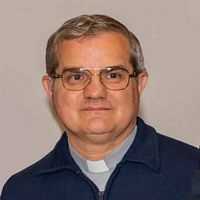
 By Fr Pierluigi CAMERONI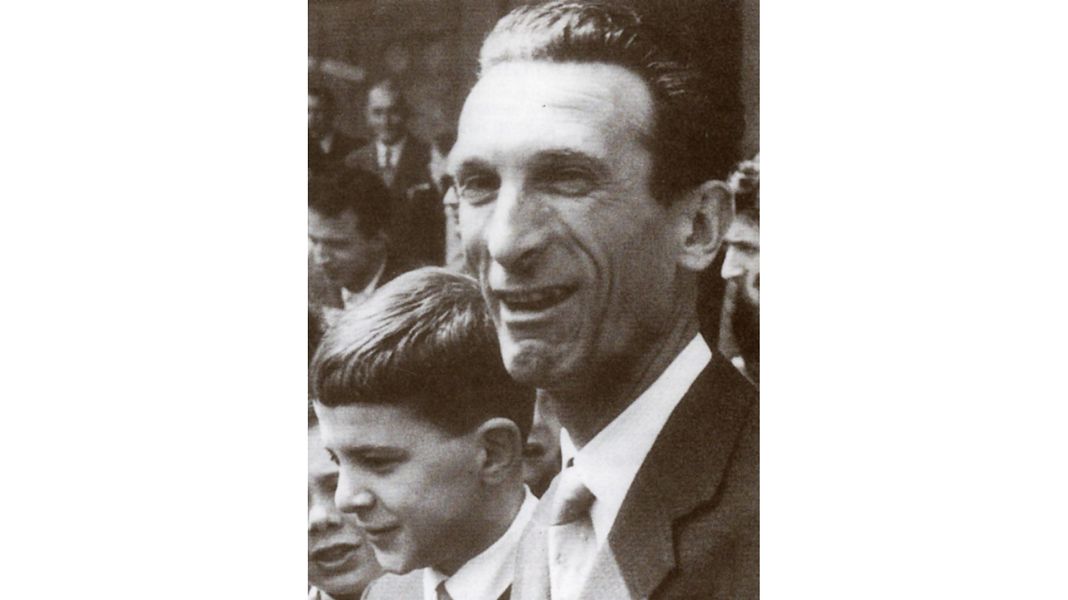
Reading time: 9 min.
The figure of the Venerable Attilio Giordani (1913–1972) bears witness to how the charism of Don Bosco can be fully lived out in lay life, within the family, at work, and in educational commitment among the young. A husband, father, catechist, and Salesian Cooperator, he made Christian joy the hallmark of his presence among people. Formed in the Salesian oratory in Milan, he dedicated a large part of his life to youth work, creatively translating the Preventive System into his catechetical service and daily apostolate. His existence was marked by a simple and profound faith, nourished by the Eucharist and prayer, culminating in the missionary choice he shared with his family in Brazil. In him, Salesian holiness appears as an ordinary life lived with evangelical enthusiasm and love for the young.
“Rejoice in the Lord always; again I will say, Rejoice. Let your gentleness be known to everyone. The Lord is near.” (Phil 4:4-5).
This Pauline text, which is also proclaimed in the Mass in honour of Don Bosco, best interprets the Word of God that Attilio embodied in his life as a husband, father, employee, educator, catechist, Salesian Cooperator, missionary: to proclaim the Gospel of joy and bear witness to the joy of the Gospel. His face, his smile, his goodness, his humour, his words, expressed the joy of one who has met the Lord Jesus, infecting everyone and communicating the positive meaning of life and the beauty of faith.
- Biographical sketch
Layman, husband and father of a family, constantly dedicated to pastoral work for young people, Salesian Cooperator and missionary in Mato Grosso (Brazil), effective animator of vocations to consecrated life, evangelically detached from earthly goods, Attilio Giordani is an inspiring model for the Church and the world.
He was born in Milan on 3 February 1913, into a family of modest economic conditions and deep religious convictions. After primary school he enrolled in technical school. As a boy he regularly attended the parish St Augustine Oratory in Milan, run by the Salesians, who made him know and love Don Bosco. It was in the oratory that he received his first formation and began to engage perseveringly in the joyful animation of the groups. For decades he would be a diligent catechist and a brilliant, simple and serene animator in the light of Don Bosco’s preventive method. Attilio showed extraordinary vivacity in his educational activity, at the centre of which he always placed the proclamation of the Gospel witnessed with creativity and credibility.
Over the years he joined the Association of Salesian Cooperators and Catholic Action. In 1934 he was called to military service. Even under arms he showed a generous availability for the apostolate. His service in uniform continued, intermittently and in different places, from France to Greece, until the armistice of 8 September 1943, when he took refuge in Vendrogno (Lecco) and there continued his commitment to the apostolate among the boys.
In the meantime Attilio had become engaged to a young woman, Noemi Davanzo, whom he had met at the oratory and who, like him, was engaged in educational service among the children. On 6 May 1944 they were married. Three children were born of their union: Piergiorgio, Maria Grazia and Paola. In the family, Attilio was a husband and father, ever present, full of great faith and serenity; he chose to live in austerity and evangelical poverty for the benefit of the most needy.
After the war he found employment in an industry, where he worked with a great sense of duty and justice, spreading joy and a spirit of solidarity. He resumed his work as catechist and animator of the oratory at full speed, working harder and harder to involve the boys in charitable service.
In the meantime, his health was being severely tested: in 1962 a first heart attack forced him into a long convalescence, but it did not stop his missionary drive, to the point that, on the verge of sixty, when his three sons left for Brazil for a period of missionary voluntary work, Attilio decided to join them together with Noemi. In this way he wanted to live his fatherhood totally and share with his children the project of committing himself to others within new horizons. Even in Brazil, he continued to be a catechist and youth leader.
He lived a deep communion with God. His day began with Holy Mass and a time of meditation; this was followed by work, and finally attendance at the Salesian oratory. Attilio loved the Lord with all his heart and found the resources for a life of grace in daily Eucharistic adoration, participation in the sacraments, prayer, devotion to the Virgin Mary and reliance on spiritual guidance. This was the secret of his generosity. Several times, Atilio had said: “Death must find us alive.”
On 18 December 1972, in Campo Grande (Brazil), during a meeting he was enthusiastically talking about the duty of giving one’s life for others, when suddenly he felt himself failing. He was just in time to say to his son: “Pier Giorgio, you continue…” and died of a heart attack. His body, transported to Italy, now rests in Milan’s basilica of St Augustine, so dear to him.
- Attilio Giordani model of family life
Marriage to Noemi, in May 1944, for Attilio was not just a word “given” but above all a “sacrament” of Christ whose holiness and indissolubility he strove to express through his daily life and the upbringing of his children. The family remained united because Attilio and Noemi supported each other with prayer and practised charity. A family not closed in on itself but open to parish and oratory life, the practice of charity and missionary witness.
The work of redemption begins with the family, where fundamental relationships are built, where the sense of belonging and custody is learned, where one is generated to faith. Today “The family is experiencing a profound cultural crisis, as are all communities and social bonds. In the case of the family, the weakening of these bonds is particularly serious because the family is the fundamental cell of society, where we learn to live with others despite our differences and to belong to one another; it is also the place where parents pass on the faith to their children. Marriage now tends to be viewed as a form of mere emotional satisfaction that can be constructed in any way or modified at will. But the indispensible contribution of marriage to society transcends the feelings and momentary needs of the couple.” (Evangelii Gaudium 66). The crisis of faith has also produced a crisis in the family and in the understanding of the true nature of man and woman.
During their engagement Attilio wrote to Noemi, his future wife: “I dream of a little family where the whole Christian peace and the innocent smile of the children (if the Lord grants such great grace) is not disturbed by any clouds” (9 October 1942). And the children had to say of their father. “When daddy came into the house he was all ours; he did not bring the tensions from outside into the house. He was serene, helpful, not closed; he was something ‘ours’ Conversation in the home on vital topics was not sitting down at the table and saying: ‘Tonight, let’s talk about our problems.’ It was rather mutual listening experienced together. We often got up late from the table because we sang and conversed. More than his ability to prod us to say our own things, it was an atmosphere created in the home where parents and children understood each other beyond words.” In his task as a father and educator of his children, Attilio taught them how to love and worship God: “We pray to you, Lord, for our family and our children: be with us always with your blessing and your love. Without you, we cannot love each other with a sincere love.”
- Attilio Giordani a model of the practice of the Preventive System lived in the Oratory
When he was nine years old he began to attend the St Augustine Oratory run by the Salesians in Milan. There, as a young man for the young people, he devoted himself constantly to the joyful animation of the groups: for decades he was a diligent catechist and a brilliant, simple and serene Salesian animator. He knew and used all the educational tools of the Preventive System to animate his young people: care of the liturgy, formation, presence and games in the playground, use of free time, theatre; he organised walks with the young people of the oratory, composed songs, skits, invented charity lotteries, parish treasure hunts and olympiads for young people, without ever forgetting the centre of Christian joy: love of God and neighbour. He revealed the art of the educator, placing the proclamation of the Gospel and catechetical service, lived with creativity and credibility, at the centre of his educational mission. A particular merit of Attilio Giordani is that he translated in a simple and convincing way the kind of evangelisation desired by Don Bosco who evangelised by educating.
Throughout his life Attilio showed a commitment to the work of education, distinguishing himself in the Salesian Family’s history of holiness for having embodied Don Bosco’s Oratory charism in an original way. In a special way he stands out for his work as a catechist, understood not only as the transmission of doctrine, but vital and experiential communication of the encounter with Jesus and a Christian life consistent with the Gospel.
There is a term that contains an entire biography: it is ADSC, which means Angelo Di Seconda Categoria (Second Class Angel). It is worth listening to the story. It sounds like an evangelical parable. And within it is the very identity of Attilio Giordani. “You have to know that many, many years ago, while the Eternal Father was modelling angels” just think, they were as many as as the stars in the firmament “he happened to make one who was a little thin and had a long nose. He observed it and, having ascertained that it did not conform to the strict canons of angelic aesthetics, kept it aside. If he had put it out into the angelic world, it was clear that its angelic colleagues would have treated it as a second-class angel. To be precise, an ADSC, a Second Class Angel. The poor guy would have suffered and so God thought of sending it to another world. When he saw that in at the OSA (Oratorio Sant’ Ambrogio) Fr Acerbi had successfully passed the running-in period, and when, from the small rectangles of the courtyards that bordered the Naviglio, he heard the festive cries of the sparrows and the joyful voices of hundreds of boys rising to the sky, he decided to employ the ADSC, whom he had also grown fond of, at the OSA. The OSA was not a throw-away place, far from it. As mentioned, there were hundreds of boys there and good work could be done. So ADSC started attending the OSA and, although he presented himself as a boy similar to the others, he had retained his primitive unmistakable thinness, his long nose and – most importantly – his guardian angel instinct. That invincible instinct that watches over, reassures and purifies, that invites to prayer and the joy of small sacrifices, that spurs to the courage of consistency and patience with one’s companions. That invincible instinct that urges us to the love of God. Those who have spent the last forty years at OSA cannot have failed to see and appreciate ADSC’s ork. He was, and still is, the key figure and animator of the feast days and at the same time the planner and organiser of Mondays, that is, that type of Christian made to annoy the “Don Abbondio” in us. The Don Abbondio, in other words, who wants to be left in peace to doze off, to relax or to sip on the pious memories of Sunday.”
- Attilio Giordani model of Salesian lay holiness, lived in joy
He became a Salesian Cooperator, living the faith within his own lay circumstances, inspired by Don Bosco’s project of apostolic life. He built his personality as a man and as a Christian, joyfully. His humour was the direct expression of a conscience dominated by faith in Christ. He also testified with courage and joyful goodness to his Christian faith even in difficult environments or situations such as during his military service and war, or in his profession as a clerk, living in the world without being of the world, going against the tide. He ended his earthly life by sharing his missionary choice with his family, leaving as his testament the enthusiasm of a life given for others: “Our faith must be life and the measure of our belief is manifested in our being.”
Venerable Attilio Giordani is a clear embodiment of Salesian spirituality as a lay person. This aspect has always aroused particular admiration, especially in consecrated Salesians who felt the providential presence of such a model and did not fail to seek his advice.
Attilio is truly the embodiment of Pope Francis’ apostolic exhortation, Evangelii Gaudium, which states in the very first paragraph, “The joy of the gospel fills the hearts and lives of all who encounter Jesus. Those who accept his offer of salvation are set free from sin, sorrow, inner emptiness and loneliness. With Christ joy is constantly born anew. In this Exhortation I wish to encourage the Christian faithful to embark upon a new chapter of evangelization marked by this joy, while pointing out new paths for the Church’s journey in years to come.”
Attilio was a true Christian layman, an authentic Salesian Cooperator, who points us to the great challenge of a mature and responsible laity through great fidelity to the commitment of charity, catechesis, witnessing and celebrating the faith, which are born from Baptism and Confirmation.
A young Oratory boy testified: “We boys had long understood that Attilio felt sincere admiration and had a special admiration for Don Bosco. Basically, the things for which we liked this saint were pretty much the same things that made us like Attilio.” There must have been some sort of affinity if both had managed to enter so gently and deeply into the lives of the boys they had approached. There is no doubt that, compared to Don Bosco, Attilio had a more limited and modest sphere of influence, but there is equally no doubt that his educational passion was very generous and never ceased to expand and bear fruit in the wake of the primitive Salesian tradition.
Perhaps it is difficult to say more about a Salesian Cooperator: “the things for which we liked this saint were pretty much the same things that made us like Attilio”! And another one said, “There were many of us who smiled, even laughed out loud on many different occasions because of him. The laughter he provoked was never polluted by vulgarity or double entendres. When he acted, his serious face or his gait, his scruffy attire or his awkward Italian were enough to trigger laughter in the audience. But how much restraint and discretion he showed when dealing with serious or painful matters!”
 P. Wirth MORAND