


 By Fr Francesco MOTTO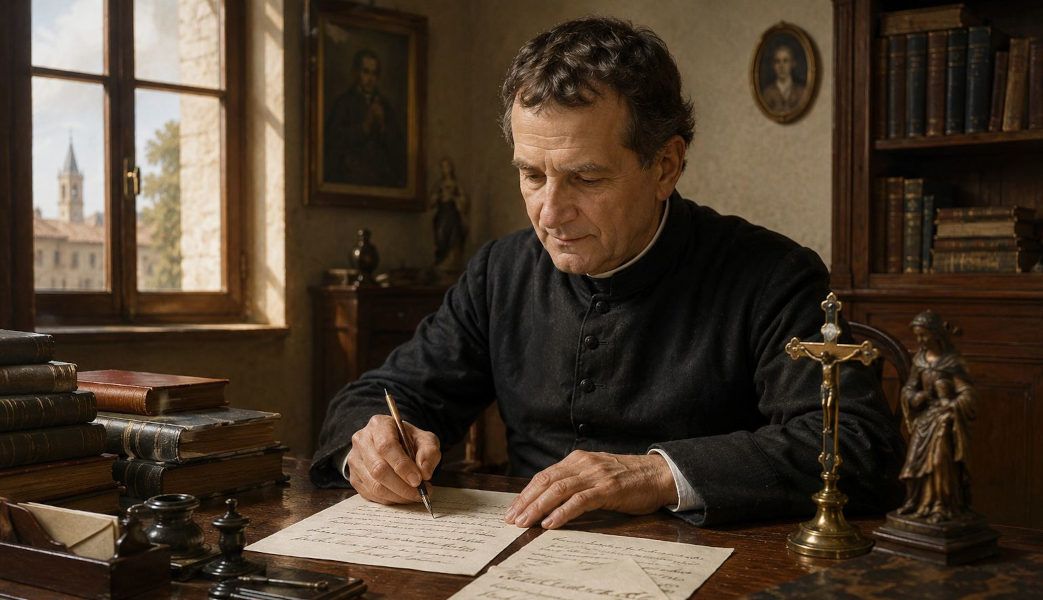
Reading time: 4 min.
And what name days! Don Bosco never forgot the name-day of religious authorities and benefactors, but it was not a matter of the traditional and generic formal expressions.
*In many Christian cultures (though less so in our secularised world!) the name day (after the name of the Saint whose name we were given at Baptism) is regarded as important as our birthday.
Don Bosco never forgot the name day of religious authorities and his great benefactors in particular, sending them his best wishes. But it was not a matter of traditional and generic formal expressions, perhaps written on an elegant card. There was much more in those little letters! Let us look at some of them over ten days in August 1884.
7 August: St Gaetano (Cajetan)
Don Bosco had been a guest of the Bishop of Pinerolo for a few days. The heat of Turin was unbearable for him, tired and old (69 years old!) as he was. Here he was, however, taking pen, paper and inkwell and writing to his archbishop, Cardinal Gaetano Alimonda: “Your Eminence and all my dear Salesians. Today St Gaetano, Your Eminence’s Name Day, I would have liked not just to go but to fly to you to express the filial affections of this poor heart of mine, but I must limit myself to sending you two messengers to do my bidding. They cannot bring you material treasures because you do not desire them, and our circumstances makes us incapable of offering them. Instead, they will tell you that the Salesians bring Your Eminence all the affection that children can bring to the most benevolent of fathers.” After further expressions of best wishes and promises of prayers, Don Bosco continued with a confidence that he certainly had not been able to cultivate with the previous Archbishop Gastaldi: “In particular then, we unanimously ask and pray that You make use of us in any work, in any spiritual or temporal service which You judge us capable of. You will certainly do that will you not?” Having thus won the Cardinal over, he concluded in the name of the entire Salesian family scattered throughout the world: “May the graces of Heaven descend abundantly upon You and upon all Your revered family, while all of us Salesians, Cooperators and pupils scattered across the various countries of Italy, France, Spain and America humbly kneel and invoke Your holy blessing. In the name of all your humble servants … Fr. John Bosco’. Having signed the letter, he realised that with his bad handwriting – he had serious problems with his eyesight – he had perhaps been disrespectful towards his illustrious correspondent, so he added a moving postscript: “Please forgive my poor handwriting.” What must His Eminence have thought? Most likely he would have been moved.
10 August: Saint Lawrence
A few days later it was the turn of Cardinal Lorenzo Nina, protector of the Salesian Congregation, with whom Don Bosco had had correspondence for years: “Your Eminence, at all times, but especially on Your Eminence’s name day, the Salesians join in one heart and soul to present to Your august personage the sentiments of their common gratitude for so many favours which You have deigned to bestow on us this year. The greatest favour was certainly the communication of the privileges of the Redemptorists. This concession has placed our humble Congregation in a normal state, and made my heart feel so at peace that I can sing the Nunc dimittis... I beg you to appreciate an Album in which the houses of the Congregation are described both in Europe and in America. An identical copy will be presented to the Holy Father on his name day.” Once again Don Bosco associates his good wishes with sincere thanks for all that the Cardinal has done for the Salesians and especially the extremely positive results of their activities, thanks to his protection.
12 August: St Clare
It was the name day of a French benefactress, the wealthy Miss Clara Louvet, whom Don Bosco met in Lille and Turin and whom he directed spiritually through dozens of letters. Two days earlier – clearly mail travelled quickly from Italy to France – he wrote to her: “Miss Clara, I am here in Pinerolo to relieve my tiredness a little. The Bishop is a worthy father to me…. On the 12th of this month, all the children and priests will pray for you. May God bless you, may the Blessed Virgin protect you, Father Engrand, your parents and your friends. So be it. Please pray for this poor priest.” Few but intense words these ones of Don Bosco who was ill, but welcomed kindly by a generous bishop for a period of rest, united with his young people, he prays for the young French girl and all her loved ones whom he had met the previous year in Lille. Friends, however far away, he would never forget.
17 August: Saint Joachim
It was the name day of Joachim Pecci, Pope Leo XIII. Don Bosco offered him his most affectionate good wishes: “Most Holy Father, On this most auspicious day, dedicated to the glories of the Saint who recalls your venerable name, the most affectionate Salesians, your sons and daughters, feel the grave duty of expressing their profound gratitude and unalterable gratitude to You their distinguished benefactor. You know very well, Most Holy Father, how our humble Congregation lacked a marked favour, that is, it lacked a strong bond that unalterably bound it to the Holy See, and you deigned to perform this act, so glorious for us, on the 9th of May last.” His duty of gratitude fulfilled Don Bosco once again followed up with a demanding promise: “Now all that remains is for us, your Salesians, to join in one heart, one soul to work for the good of Holy Church. It is true that in the difficult times that we are going through and in the great harvest that is presented to us, we are but a pusillus grex. Nevertheless we will gladly place our resources, our strength, our lives in the hands of Your Holiness so that, as if they were his own, he may deign to use them in everything that he judges to be useful for the greater glory of God in Europe, in America and above all in Patagonia.”
Pope Leo XIII took him at his word. Several times he would not fail to “force the hand” of the Salesians, and the new Rector Major Fr Rua in particular, to accept works requested by governments in “mission lands”. Even though they had a thousand reasons for postponing, they made every effort to accept the papal invitations. Besides, how many times had Don Bosco told them: “every wish of the pope is an order for us”?
Don Bosco’s letters of good wishes were an act of exquisite courtesy to the recipient. The correspondent was moved by the idea that Don Bosco had thought of him, had taken care to express his feelings to him, anticipating the moment when the sheet of paper would arrive in his hands and imagining his reactions.
 Fr Bruno FERRERO
  BSOL Editor