


 By Fr Bruno FERRERO
Reading time: 8 min.
The vocational discernment of John Bosco, initially attracted to the Franciscan religious life as a path of perfection and inner struggle, was not clear from the beginning. Amidst dreams, uncertainties, and a lack of stable guides, the desire to consecrate himself totally to God matured in him. After a first attempt to enter the Franciscans, a dream and above all the decisive intervention of Fr. Joseph Cafasso guided him towards the seminary. Entering the clerical state marked a spiritual “stripping away” and “clothing” for him. In the seminary, he distinguished himself by his piety, balance, and charity, until the definitive confirmation that his mission would not be the cloister, but the educational apostolate among the young.
Because, like everyone, he struggled to find his true path.
Because this young “dreamer” [John Bosco] is a positive person, and if a divine ideal shines in the eyes of his heart, the Holy Spirit has not yet opened the way for its concrete realisation. He has only placed in his heart an ardent desire to go beyond duty and to enter, with a greater and more perfect sacrifice, into the way of the evangelical counsels.
Probably his friend, Father Giacinto, intended to respect the invitation made earlier by others, because John “in Chieri had frequented the Franciscan convent and some of those Fathers, having known his rare qualities, had invited him to enter their order.” Therefore, the Dominican, while maintaining and preserving a friendship that the Blessed always highly appreciated, completely removes himself.
There remains in John’s spirit the almost inevitable clash between the ideal seen and savoured, and the means to be judged in conformity with it and to be ordered to the implementation of the divine programme. And this is a page of anguish in which John reflects all the wisdom of his heart. “The dream of Morialdo” (in which he had seen that he would continue to study and that he would become a priest-educator of youth), “was always impressed upon me. Indeed, it had been renewed at other times in a very clear way, so that if I were to believe it, I had to choose the ecclesiastical state, to which I felt an inclination, but I did not want to believe in dreams and my way of life and the absolute lack of the virtues necessary for this state made that decision doubtful and very difficult. Oh, if only I had had a guide who had taken care of my vocation, it would have been a great treasure for me, but I lacked this treasure.” (Fr. Joseph Calosso had died on 21 November 1830. Father Giacinto Giusiana does not seem to have noticed this aspect of his friend’s heart, known in “school” as an excellent “scholar”; the confessor then did not concern himself with it). “I had an excellent confessor who thought of making me a good Christian, but he never wanted to get involved with vocation.
Consulting with myself after reading some books that dealt with the choice of state, I decided to enter the Franciscan order. — If I remain a cleric in the world, I said to myself, my vocation runs a great risk of shipwreck.
I will embrace the ecclesiastical state; I will renounce the world; I will go to a cloister. I will devote myself to study, to meditation, and thus, in solitude, I will be able to fight the passions, especially pride, which had put down deep roots in my heart.”
We already know the wise response of Mamma Margherita when, despite the observations of the parish priest of Castelnuovo, she, with perfect self-denial, clearly showed that she would sacrifice everything to the good pleasure of God. But what has perhaps not yet been considered, is the way in which John intends to carry out what he knows to be God’s will and the different way in which the Holy Spirit ends up carrying out the same desire for greater perfection, for His supernatural purpose; the former is Christianly human; the latter is spiritually divine.
John’s way is to unite together, in a state of already approved perfection — the religious order of the Franciscans — the priestly office and the desire to realise the perfection of charity in the perfection of sacrifice. The following year “as the feast of Easter approached, which in this year 1834 fell on 30 March” he made “application to be accepted among the Reformed Friars”. He went… “to the convent of Santa Maria degli Angioli in Turin”; underwent “the examination”, was “accepted in mid-April and everything was prepared to enter the convent of Peace in Chieri”.
The way of the Holy Spirit is to act differently, and John is warned in a dream, “one of the strangest dreams”. “It seemed to me that I saw, he says, a multitude of those religious with worn-out habits on, running in opposite directions to one another. One of them came to me and said, — You seek peace and here you will not find peace. See the attitude of your brothers. Another place, another harvest God is preparing for you.”
This is a painful manifestation, irradiated by a consoling light, only in the last words… The Blessed runs to his director to conclude something positively, but the latter “did not want to hear talk of either dreams or friars. — In this matter, he replied, each one must follow his own inclinations and not the advice of others.”
The signpost
John collects himself; a simple and good soul, “Evasio Savio, a blacksmith” from Castelnuovo, “who had long loved John” after giving him the affectionate testimony of his heart, inviting him to lunch, “it seems he exhorted him to ask for advice from Fr. John Cafasso, the holy priest of Turin.”
And this “man of God” was very precise. He dissuaded him from joining the Franciscans, telling him, “Go on calmly with your studies; Enter the seminary; and follow what Divine Providence is preparing for you.”
Divine Providence is the third factor that acts in history, the one that not only allows for a better understanding of the chain of events and the tangled workings of human freedom, but when the mind rises to the consideration of this supreme cause, it also acquires the intelligence of that which escapes human reason. Life becomes wisely ordered, according to the divine programme, which the providential regime implements in history.
John thus found his inner aspiration in a very precise external determination and had it confirmed by a heavenly warning that enjoined him to put himself at the head of a group of boys and to become their “guide”.
But it is not a given that an external word, even a wise one, immediately becomes a rule of life, without a real and proper stripping away of one’s own way of seeing things.
“At the end of that last year of school (1834-1835), John was again in distress about his vocation. Terrified by the dangers encountered in the world, he was again doubtful about the choice of the seminary or the cloister, and after much reflection, he decided to enter the meritorious order of the Franciscans, convinced that this could not prevent the unfolding of the destinies that God had set for him.”
This new attempt did not find John alone. His friend Comollo — a holy soul of a young student — assists him, inviting him to pray to the Virgin Mother, seat of wisdom, and while he himself writes to his uncle, the parish priest of Cinzano, he prays fervently.
Fr. Comollo expresses in his reply letter the same sentiments as Fr. Cafasso: to enter the seminary “waiting to decide on a religious order at a more mature age”. The parish priest of Castelnuovo, Fr. Michele Antonio Cinzano, who so loved that holy young man, had also given the same advice.
The wise suggestion
John, while remaining internally decided to embrace the state of perfection of the religious life, at the moment when the Lord would open the way for him, enters the seminary. On 25 October 1835, “in the parish church of Castelnuovo, before the solemn mass”, he is clothed in the clerical habit.
This external ceremony marks a characteristic stage in the spiritual life of the Blessed, because if John, following the “wise suggestion” of his counsellors, allows himself to be guided by the Holy Spirit along the path that will lead him to the priesthood, in taking the first step he feels the full meaning of the external stripping away symbolising the internal one, and he also feels the full meaning of the external clothing, symbolising the internal one.
“When the parish priest commanded me to take off my secular clothes, with those words: May the Lord strip you of the old man with all his acts, I said in my heart: — Oh how much old stuff there is to take off. My God, destroy in me all my bad habits,” expressing with this prayer, the desire for a total purification of the spirit.
“Then when, in giving me the collar, he added: May the Lord clothe you with the new man who according to God has been created in justice and in the holiness of truth, I felt very moved and added to myself: — Yes, O my God, grant that at this moment I may put on a new man, that is, that from this moment I may begin a new life, all according to the divine will, and that justice and holiness may be the constant object of my thoughts, my words and my works. So be it. O Mary, be my salvation!”
Stripping away the old man! If it is easy to take off a used garment and put on a new one, things are not so smooth when it comes to the spiritual life, because the total purification of the mind and heart, of the higher and lower faculties, through what Saint John of the Cross called the “night of the senses” and the “night of the spirit”, is very painful.
We will have the opportunity to study this gradual perfecting of the Blessed’s charity by examining the action of other gifts of the Holy Spirit in him, but we cannot omit some testimonies from his professor of theology, Monsignor John Battista Appendini, and his seminary companions.
The former noted that “the cleric Bosco, in piety and study, made much progress in the seminary, without having the appearance of it, because of that good-naturedness of his which was then the character of his whole life.”
“Fr. Giacomelli attested, — From the first days I knew him in the Seminary, I considered him as if he were already a priest for his prudence and good conduct —”.
“Dr. Carlo Allora: — In the seminary he gave outstanding examples of piety and obedience. Such was the esteem that the clerics had for him, that they considered him more than a companion, a superior. We, even from those times, held him as a saint —”.
“Fr. Grassini, parish priest of Scalenghe: — Don Bosco was a peacemaker between companions —”.
“Many others” bore witness to his amiability and his holiness, “This amiable companion of ours in the seminary was held in high regard, for holiness of life”.
Clothing of the new man! Without doubt the infusion of grace, of the theological virtues, of the gifts of the Holy Spirit, of the other virtues that perfect our organism is a first enabling to do good. But it is also necessary that man cooperates with sustained effort, so that the seeds do not remain sterile, the good qualities produce good actions, and life is moulded according to the divine Model, all ordered in God. Our spirit, ever more perfectly refined and purified, loses its hardness and acquires a great supernatural sensitivity that makes it pliable and internally always docile to the inspirations of the Holy Spirit.
Nor is it, perhaps, without profound meaning that word spoken by the cleric John Bosco, in his second year of seminary, when, to distinguish himself from a companion who bore the same name and who had chosen for himself the nickname Bosco d’ puciu (loquat wood, very hard), he added, with a fine sense, “And I am called Bosco d’sales, deliberately opposing the hardness and rigidity of loquat wood with the pliability and flexibility of the willow.”
There remained, however, always a personal decision of his, the last residue of his way of understanding the Lord’s call, that of his definitive state of life. The last recurrence occurs in 1844, nine years after the obedience of 1835, when he, already a priest, has begun his youth apostolate, and is about to finish the third year of pastoral preparation, in the ecclesiastical college of Turin.
Only that in that last recurrence of cloistered nostalgia, he has a saint beside him: Fr. Joseph Cafasso, who had already expressly declared the Lord’s will to him, leaving him, however, a possibility of further choice.
Now instead the ‘no!’ is “blunt and resolute”. Neither Franciscan, nor Oblate of Mary, nor outside Italy, as a missionary, nor outside Turin, as a curate or parish priest.
“My dear Don Bosco, abandon all idea of a religious vocation; go and unpack your trunk, if you have even prepared it, and continue your work for the young. This is the will of God and no other!”
Ceslao PERA, The Gifts of the Holy Spirit in the Soul of Blessed Giovanni Bosco, p. 61
 BSOL Editor
 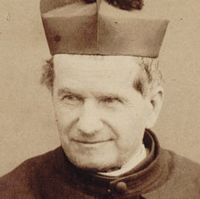 St John Bosco