


 By BSOL Editor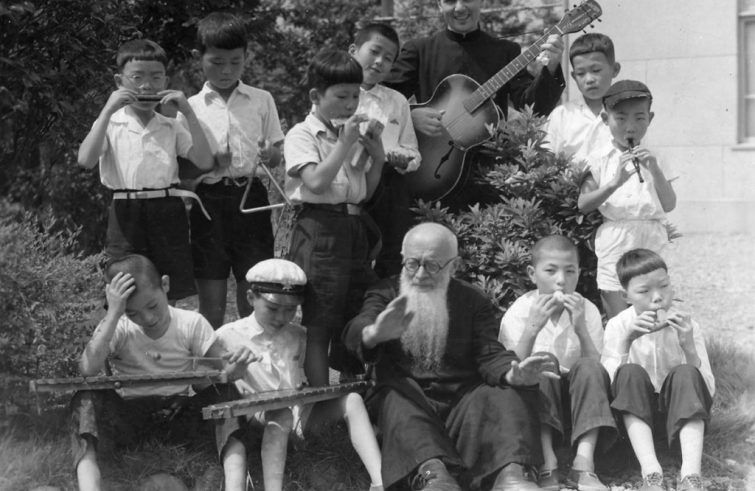
Reading time: 6 min.
Don Vincenzo Cimatti, SDB, leading a group of young disciples
The year 2026 marks an extraordinary anniversary: one hundred years ago, a group of nine courageous Salesian missionaries left Italy to embark on a journey into the unknown, towards a country distant in culture, language, and religion. Japan awaited them. With them travelled faith, the spirit of Don Bosco, and an unshakeable certainty, that the love of Christ would also find a home in the hearts of the Japanese people. A century of mission, love, and service in the spirit of Don Bosco.
The Departure: A Legacy Entrusted
It all began in a climate of missionary enthusiasm. To commemorate the fiftieth anniversary of the Salesians’ arrival in Argentina, the Rector Major, Fr. Philip Rinaldi, decided to broaden the Congregation’s horizons by sending new missionaries to different parts of the world. It was he who invited Fr. Antonio Cavoli to become a missionary, and it was also he who gave the nine departing missionaries words that would become a beacon for the entire mission.
“The only way, or at least the indispensable way, to enter the hearts of people is through charity,” said Fr. Rinaldi. He added, “This country can boast a civilisation that rivals the standards of the most advanced nations, but it does not know the charity that Jesus Christ taught the world. The success of your apostolate will depend on how well you can make the love of Christ shine among the Japanese people.”
Fr. Cavoli received those words as a sacred inheritance. He wrote in his autobiography, “I have always kept them in mind. Over time, these words have become the foundation of my life and my actions.” He could not have imagined then how profound the fruits of that silent promise would be.
The group was led by Monsignor Vincent Cimatti, a musician, educator, and man of God; a figure destined to leave an indelible mark on the history of the Church in Japan. At his side were Fr. Cavoli and seven other confrères, all animated by the same Salesian dream: the salvation of souls, in the spirit of Don Bosco.
First Steps on Japanese Soil
After a year of intense preparation – studying the language, learning local customs and traditions – from 1 February 1927, the Salesians were officially entrusted with the pastoral care of the prefectures of Miyazaki and Oita. The parishes of Miyazaki, Oita, and Nakatsu became the three centres of the mission. The nine missionaries divided into groups of three, spreading out among the communities, thereby multiplying their presence and service.
Shortly after, during the official visit of the Vicar General, Fr. Ricaldone, in June 1927, Fr. Cimatti outlined a clear programme for his confrères: to understand the reality of the land and its people; to personally approach all Christian families, especially those who had drifted from the faith; and to start an oratory open to all, everywhere.
These three directives – to know, to meet, to educate – would remain the beating heart of Salesian action in Japan for the entire following century.
The Oratory: A Home for All
As in Turin, as in Argentina, as wherever the sons of Don Bosco set foot, in Japan too the first act was to open the doors. The Salesian oratory was not simply a place of prayer; it was an educational centre, a meeting point, a space of joy open to all young people, Catholic and non-Catholic alike. The goal was to give the youth a good education so they could live as good citizens. And through the children, to reach the families.
The numbers speak for themselves: in 1927, only 80 children attended the three oratories. By 1931, there were 765 in five oratories. By 1934, the number reached 1,700 children across ten oratories. This was extraordinary growth that reflected not only the effectiveness of the method, but above all the depth of a love that people recognised as authentic.
Communities, Churches, and a Widespread Presence
Alongside the oratory, the missionaries tirelessly travelled the territory to find believers, visit them, preach the Gospel, and build churches. After the first parishes, the communities of Tano, Takanabe, Beppu, and Miyakonojo were established. Fr. Cavoli would walk the thirty minutes from Tano station to the church, come rain or shine, without ever complaining.
The Salesian priests ventured into the most remote mountain villages, always accompanied by local catechists. The faithful, who numbered 490 in 1927, grew to 856 in 1930, and 1,053 in 1932: a doubling in five years, the fruit of a continuous, respectful, and deeply human presence.
Evangelising with Beauty: Print, Music, and Images
The Salesians have always believed that faith is also communicated through beauty. In Japan, this intuition translated into creative and surprisingly effective tools. In Oita, on 24 May 1928, the first issue of the newspaper Don Bosco was published, a monthly diocesan bulletin with a circulation of one thousand copies, a tool to unite the faithful and also reach non-believers with the written word.
Magic lantern projections drew curious crowds to the churches. The film, The Life of Jesus, attracted around 800 people, including several journalists. At the end of the screening, many spectators stayed behind to ask for information about Jesus, and quite a few signed up to begin catechesis and receive Baptism.
Fr. Cimatti, a refined musician, held around 2,000 concerts throughout the Country, together with Fr. Margiaglia and Fr. Liviabella. Music was prayer; it was proclamation; it was a dialogue with a culture that deeply loved harmony. After each concert, they distributed pamphlets, spoke of Christ, and sowed seeds.
The Laity: Protagonists of the Mission
One of the most original and fruitful aspects of the Salesian mission in Japan was the active role entrusted to the laity. Fr. Cimatti and Fr. Cavoli did not see the faithful as passive recipients of pastoral care, but as full collaborators in the missionary work.
The “Fathers’ Group” and the “Mothers’ Group” were born, accompanying the priests on visits to distant families, making up for the missionaries’ language difficulties with their presence and their words. The Company of St Aloysius, the Company of St Dominic Savio, the Daughters of Mary, and the Little Teresians were formed, each group with its own rules, its own goals, its own mission. It was Valdocco on the Pacific.
It is no coincidence that, like Don Bosco’s first house in Turin, the one in Miyazaki, was also located in a marginalised neighbourhood. It was near a prison, a psychiatric hospital, a cemetery, and a crematorium. A choice – or a Providence – that said everything about the Salesian vocation; to be where no one else wants to be.
The Sisters of Charity of Jesus: The Seed of a September
One day in September 1929, during a meeting of the Immaculate Circle, Fr. Cavoli asked the young women to go out and find the poor and the sick, to bring comfort to the lonely elderly, to orphans, to the abandoned. He collected twenty-two cents from them as a concrete gesture of faith in Divine Providence. From that small gesture, something great was born.
Three years later, in December 1932, the Hospice for the Poor was inaugurated in Miyazaki. At the beginning of 1933, it welcomed its first elderly residents. In 1935, a wing for neophytes and children and a nursery were added, with a chapel at the centre to remember where it all came from, from prayer and charity.
As Japanese nationalism grew and with it the fear that foreign missionaries might be expelled, Fr. Cimatti proposed to Fr. Cavoli that he found an indigenous religious congregation. After a long discernment, Cavoli gave his “yes” with the words of the Gospel, “At your word, I will let down the nets” (Lk 5:5).
On 15 August 1937, the feast of the Assumption of Mary, the Congregation of the Sisters of Charity of Miyazaki was born, known today as the Sisters of Charity of Jesus. The young sisters immediately set to work, caring for the elderly and children, sharing every hardship.
The war years were extremely difficult. Donations stopped, and food became scarce. But Fr. Cavoli and the Sisters did not give up. They grew rice, raised chickens and cows, and started small craft businesses. Six sisters died of hardship, consumed by illnesses contracted while caring for the sick. Their sacrifice was silent, total, and luminous.
One Hundred Years Later: The Mission Continues
A century of Salesian history in Japan is a story of faithfulness. Faithfulness to the words of Fr. Rinaldi, who pointed to charity as the only possible way. Faithfulness to the spirit of Don Bosco, who wanted his sons on the streets, among the young, alongside the poor. Faithfulness to a Country that was able to recognise in those foreign missionaries not cultural invaders, but sincere friends.
Like Mary who, after her “Fiat”, hurried to the hill country to visit Elizabeth, the Salesians in Japan also wasted no time. They went, they met, they loved. And the fruits of that love – churches, oratories, schools, hospices, a religious congregation born from twenty-two cents – are still alive and still growing.
This centenary is not just a moment of remembrance. It is an invitation to look forward with the same courage as those who, one hundred years ago, crossed the sea with nothing but faith and charity. Because Japan, like every corner of the world, still needs those who can make the love of Christ shine.
“The success of your apostolate will depend on how well you can make the love of Christ shine among the Japanese people.” – Fr. Philip Rinaldi, Rector Major, 1925
Don Bosco in Japan. Silent documentary film about the Salesian missions in Japan: Tokyo, Osaka, Vita, Miyazaki (1963-1965).