


 By BSOL Editor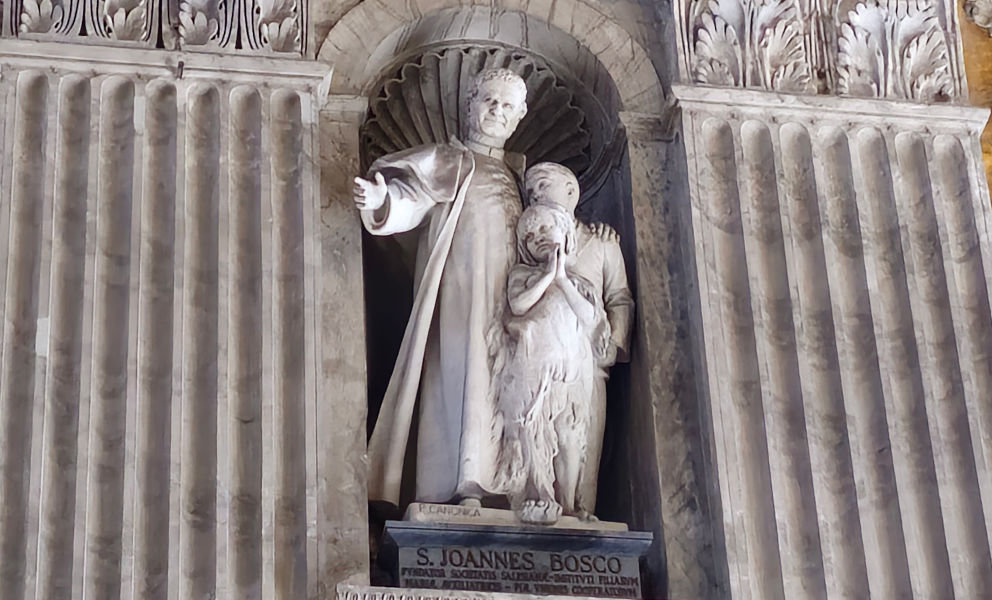
Reading time: 7 min.
On 31 January 1936, the Vatican Basilica welcomed the monument to St John Bosco. A sea of young people filled the naves that day. 2026 marks the ninetieth anniversary of an event that left the world a powerful image. The father of the young who, from the most visible point of the Basilica, shows two boys the tomb of Peter. A gesture carved in marble that continues to speak.
The visitor who today crosses the central nave of St Peter’s and looks up to the right, just before reaching the altar of the Confession, finds themselves observed by a figure that every Salesian would recognise with their eyes closed. It is Don Bosco. Not alone; he keeps two boys beside him, and his right arm is stretched towards the centre of the Basilica, towards the tomb of the Apostle St Peter. That arm has been there for exactly ninety years, and has never stopped pointing.
It is worth returning to that winter morning in 1936, it was the forty-eighth anniversary of the Saint’s death, when the great marble group was unveiled and blessed.
Twenty thousand hearts under the dome
On paper it was a short and sober rite, a blessing. In fact, the Basilica experienced one of its memorable days. Those present compared that atmosphere to Easter 1934, the day Pius XI had enrolled Don Bosco in the register of saints: the same enthusiasm, the same human tide, the same festive atmosphere.
Those present exceeded twenty thousand people. Half were young people: ten thousand students from Roman institutes, arranged in five long rows along the main nave, who had come to honour the man who had made education his life. Around them, under the side arches, gathered the pupils of the Salesian houses of Rome and the Castelli, together with past pupils, cooperators, and Daughters of Mary Help of Christians. The minor naves overflowed with pilgrims and simple devotees who had flocked without an invitation, out of affection.
No one was missing even among the authorities. Sitting in the front row were Cardinal Carlo Salotti, who had dedicated years of work to Don Bosco’s cause, the Nuncio to Italy Monsignor Borgoncini Duca, numerous bishops, the Governor of Vatican City, and the Pope’s family members. What was particularly striking was the long line of diplomats accredited to the Holy See: Italy, Argentina, Peru, Brazil, Belgium, Hungary, Venezuela, Nicaragua, and other nations besides. As if the whole world had sent its delegates to testify that the work of that Piedmontese priest no longer belonged to a single Country. In the midst of everyone, visibly moved and sought after from all sides, was the sculptor: Pietro Canonica, one of the most illustrious names in Italian art of the time.
At half past eleven, Cardinal Eugenio Pacelli entered, the Secretary of State, Archpriest of the Basilica and Protector of the Salesian Society. Three years later, he would become Pius XII. The choirs of the four Salesian institutes in Rome, almost two hundred voices led by Fr. Raffaele Antolisei, filled the Basilica with music. Then the awaited moment: the Sampietrini let the large cloth hiding the niche slide to the ground. When the white marble emerged into the light, a roar rose from the naves and refused to die down; for long minutes twenty thousand voices acclaimed their Saint.
The word of the Salesian Family
When silence finally returned, the Procurator General Fr. Francesco Tomasetti, stepped forward. The Rector Major Fr. Peter Ricaldone had not been able to attend, and it fell to him to give voice to the entire Salesian Family. His address deserves to be reread in full, because it encapsulates, better than any later commentary, the meaning of that day:
“Most Reverend Eminence,
The Salesians feel joyful today for three things at the moment when St. John Bosco takes his place among the great religious Founders, who, immortalised in marble, come from time to time to increase the splendour of the greatest Temple of Christianity.
They rejoice that the office of inaugurating with a blessing from Heaven the monument of their Father has fallen to Your Eminence, because they venerate in the person of Your Eminence the Cardinal Protector of their Congregation.
It is also a subject of ineffable joy that the kindness of the Holy Father has deigned to assign Don Bosco such a conspicuous place in the Basilica. The eye of the spectator is drawn to the niche that offers him to their gaze, ascending through two successive visions: at the foot of the pillar the majesty of the Prince of the Apostles, and in the centre the radiant figure of the Angelic Pius IX: St Peter, whose life Don Bosco narrated to the people with ardour of faith and edifying candour of style, and Pius IX who paternally loved the Saint and was filially loved in return.
A third reason for rejoicing is added to the two previous ones, and it is that the Sculptor, with the unsurpassable mastery of his art, has fixed the image of Don Bosco in the attitude that best suited the nature of his apostolate. Here he is, affectionately clasping to himself the youth of civilised countries and mission lands and pointing to the altar of the Confession, urging them in that direction and seeming to say: “Children, there is salvation, because there is Peter, and ‘ubi Petrus ibi Ecclesia’”. In times hostile to the Papacy, he kept faith with the Vicar of Jesus Christ, in whom he pointed out the teacher, the guide, the benefactor of humanity.
Before the spectacle of which we are witnesses, I cannot fail to make one more point. Don Bosco had a great dream throughout his life. For the good of souls and for the greatness of his homeland, he always longed for the happy union between the Kingdom of Italy and the Holy Apostolic See, by virtue of which now, by the will of the one who rules the destinies of the Nation, H.E. the Minister of National Education ordered that the studious youth of Rome, representing all Italian and foreign youth, should gather here to pay homage to the Holy Educator.
Heartfelt thanks are given to His Eminence Card. Salotti, and to the Most Excellent Representatives of all the Nations to the Holy See, for having wished with their presence to make this ceremony more solemn, as if to attest to the universality of Don Bosco’s mission in the world.
Special thanks also go to the Religious Congregations who, in fraternal solidarity, have participated in the feast of the humble Salesian Congregation.
May Your Eminence’s blessing now consecrate all these reasons for joy, imploring from Heaven that the memory of such an auspicious event may live forever in the memory of those present and be healthily handed down to future generations.”
The applause resumed thunderously. Cardinal Pacelli put on the stole and imparted the customary blessing. More music, more singing, but the truest prayer, that day, was not in the sheet music: it vibrated in the eyes of the thousands of boys who could not take their eyes off that smiling face up there.
Twenty-two tonnes of fatherhood
Let us now pause before the work. Canonica worked a single narrative block of white marble, the prized “Vittoria” quality extracted from the Massa quarries, for a total weight of twenty-two tonnes. The figure of the Saint alone reaches four metres and eighty centimetres; with the base, which adds another generous metre, the group entirely fills the cavity of the niche, which is almost seven metres high.
But numbers say little. The true success of the work lies elsewhere. Canonica refused to copy the photographs of the Saint, which he nevertheless knew well, and rejected the usual devotional poses. Instead, he tried to condense Don Bosco’s soul into the marble: the depth of the thinker, the intuition of the far-seeing apostle, and, at the same time, the smiling goodness that everyone recognised in him. The result convinced critics and the people: those who had known Don Bosco in life found him again before the statue.
And then there are the two boys, who are not a decorative detail but the key to reading the entire monument. The older one is Domenico Savio, the favourite pupil of the Oratory, also destined for the honours of the altars. In him takes shape all the youth that Don Bosco and his sons have educated in the schools, in the oratories, in the courtyards of half the world. The younger one is Zeffirino Namuncurà, son of the last great cacique of Patagonia, the land where Don Bosco wanted to send his first missionaries. In him is depicted the youth of the peoples that the Salesians have encountered beyond the borders of Europe. Together, the two say only one thing: that for Don Bosco’s heart there are no frontiers or distinctions of lineage, because every young person, of whatever latitude, has been redeemed by the same blood of Christ.
The most eloquent niche in the Basilica
Thirty-nine founders of religious families watch over the walls of St Peter’s. Don Bosco arrived there as the thirty-third. Yet his location has no equal, and not by chance. It was Pius XI himself, the “Pope of Don Bosco”, who wanted to reserve that precise spot in the Basilica for him.
You have to look at it from below to understand. The pillar on which the niche opens is the same one against which the famous bronze statue of St Peter seated leans, the one with the foot worn away by the kisses of generations of pilgrims. Above the statue shines the mosaic portrait of Pius IX, the Pontiff who approved the nascent Salesian Society and who maintained a friendship with Don Bosco made of mutual esteem and affection. And further up, at the top of this staircase of glances, stands Don Bosco. Peter, Pius IX, Don Bosco: three names linked by a thread that runs through the Saint’s entire life, arranged one above the other like the steps of a single ascent.
There is more. Most of the statues of the founders live, so to speak, inside their own niche. Not Don Bosco: his outstretched arm ideally emerges from the marble compartment and hooks the very heart of the Basilica, the papal altar under which the Apostle rests. It is as if the monument refused to be an ornament and claimed to perform a task: to teach. To the two boys he holds close to him, and to every young person who for ninety years has looked up at him, Don Bosco voicelessly repeats the conviction that guided his every choice: remain united to Peter, because where Peter is, there is the Church, and there is salvation. In a century in which the Papacy was the target of hostility of all kinds, this loyalty was his banner. The marble has made it perpetual.
The omen of a night
A final memory, preserved by Fr. Rua, gives the whole affair an almost prophetic flavour. In February 1858, during his first Roman journey, Don Bosco crossed the threshold of St Peter’s for the first time. He remained speechless for a long time; and among so many marvels, what caught his eye were precisely the statues of the founders, and the still uninhabited niches, which seemed to be waiting for someone.
Years later, the young people of the Oratory heard him recount a singular dream. He had found himself, without knowing how, right inside that marble cavity, high up, a prisoner of the immense silence of the temple. Frightened, he had cried out for help, and the cry had woken him up. How many times, during his stays in Rome, had he bent down to kiss the foot of the bronze Peter, resting his forehead there as the humble do! No one then, he first of all, would have been able to read that restless dream. History would decipher it, on 31 January 1936.
For ninety years, then, Don Bosco has inhabited Peter’s house. And whoever enters, in whatever language they pray, receives from him the same silent instruction: look there, where the Apostle rests. There is the centre. There we remain a family.
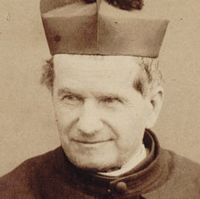 St John Bosco
  Fr Bruno FERRERO