


 By P. Natale CERRATO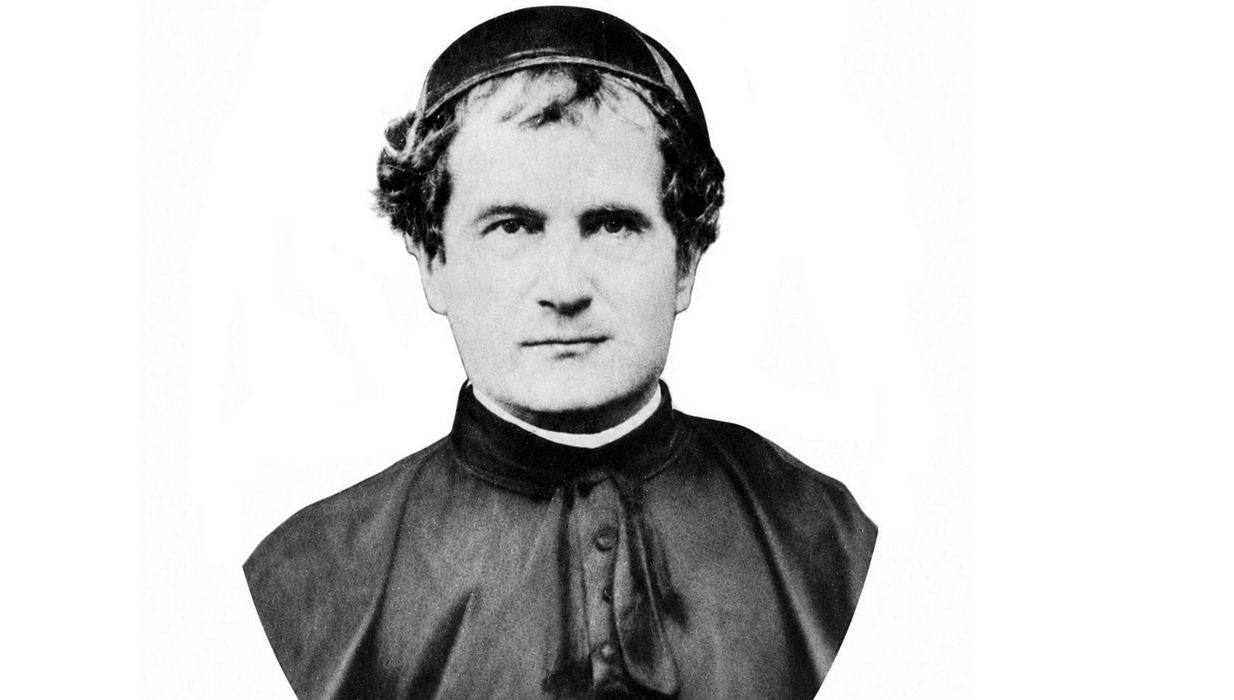
Reading time: 3 min.
Over time, there has been no shortage of caricatures and superficial judgments about Don Giovanni Bosco, including from those who sought to reduce his greatness to mere biographical or physical details. Among these, his height became a subject of irony, used by some to imply moral or intellectual limitations. Yet, a more careful historical analysis shows that for his time, Don Bosco was perfectly average, if not above. Even though, in the end, what matters is not physical stature, but human and spiritual stature.
How tall was Don Bosco? Let’s settle on a compromise: 1.66 metres.
Some years ago, a journalist, an amateur historian, described Don Bosco in a pamphlet as “the small but rigid priest of Valdocco.” With these words, he meant to attribute glaring intellectual and temperamental limitations to him, but to add insult to injury, he insisted on specifying that Don Bosco was only 1.63 metres tall.
Now, aside from the fact that a man’s height has little to do with his virtue and intelligence, what can be said about Don Bosco’s?
The Bosco’s of Becchi were known among their fellow villagers as “Ij Boschèt” or “Boschetti” (MO 119), and this nickname led some to believe they were short in stature. But Francesca Bosco, a great-niece of Giuseppe “Pin dij Boschèt,” the saint’s brother, assured in a letter dated 28 November 1980, that it was rather a typical local designation, unrelated to physical height. The Bosco’s of Becchi were called “Boschèt” just as the Cavallos were called “Cavalin,” and so on. This may have also served to distinguish them from other Bosco’s and Cavallos of different origins.
Don Bosco’s biographer, Fr. G.B. Lemoyne, who lived with the saint for 24 years, describes him as “of proper stature,” and all who knew him affirmed that he was of “average height.”
So how do we reconcile this with the 1.63 metres? Fr. M. Molineris, in the posthumously published Episodic Life of Don Bosco (Colle, 1974), provides the explanation. All information about Don Bosco’s height is primarily based on his first two passports—one from 1850, when he went to Milan, and another from 1858, when he first travelled to Rome (ASC 72-E-10-12).
The first records his height as 38 ounces. Since an ounce corresponded, according to calculations of the time, to either 4.28 cm or 4.35 cm, this roughly places him between 1.62 and 1.65 metres. The second passport, however, gives his height directly in decimals: 1.67 metres. Which of the two is more accurate? Let’s settle on a compromise: 1.66 metres.
Don Bosco was “a grenadier of ’15” and in 1835, would have been eligible for conscription. At the time, the minimum height for enlistment was 1.54 metres—a dozen centimetres shorter than Don Bosco.
Interestingly, in the Kingdom of Sardinia between 1828–37, 38% of conscripts were between 1.54 and 1.62 metres tall. In Turin, 25% fell within those limits, but a full 18% stood only between 1.41 and 1.54 metres, making them unfit due to insufficient height (U. Levra, ‘The Other Face of Risorgimento Turin 1814–1848’, Turin, 1988, p. 62).
In the cited work, Levra notes with cruel irony, “The dashing conscripts depicted in Risorgimento iconography, those who in ’48 marched off cheering for Carlo Alberto… and in ’59 sang La bela Gigogin could hardly be called models of physical prowess.”
Thus, Don Bosco could be considered, for his time, a man of more than normal height at 166 cm, if not taller. As for physical robustness, he was far from a runt. His strength is attested in his own Memoirs, “I was feared by all my companions, even those older and taller, for my courage and vigorous strength.”
He proved this when some bullies tried to harass his classmate Luigi Comollo, “At that moment, I forgot myself and, rousing not reason but brute strength, with neither chair nor stick at hand, I seized a classmate by the shoulders and used him as a club to strike my opponents,” so fiercely that Comollo, horrified, admonished him, “Your strength frightens me, but believe me, God did not give it to you to massacre your peers!” (MO 60–61).
So, Don Bosco compared to the average height of his era, was by no means small, with uncommon physical strength and vigour. Thus, the journalist who mocked his stature comes across as one who jokes about what he does not know. A far different impression was conveyed by the eminent Dominican scholar Father Ceslao Pera, “Anyone observing the portrait of Blessed John Bosco must agree with me that in that square, energetic face is reflected the image of the Piedmontese countryman, solid and unyielding as the rocks of his mountains… But there is more…” (Pera O.P., ‘The Gifts of the Holy Spirit in the Soul of Blessed Giovanni Bosco’, Turin, SEI, 1930, pp. 10–11).
 BSOL Editor
  St John Bosco
  Fr Bruno FERRERO