


 By BSOL Editor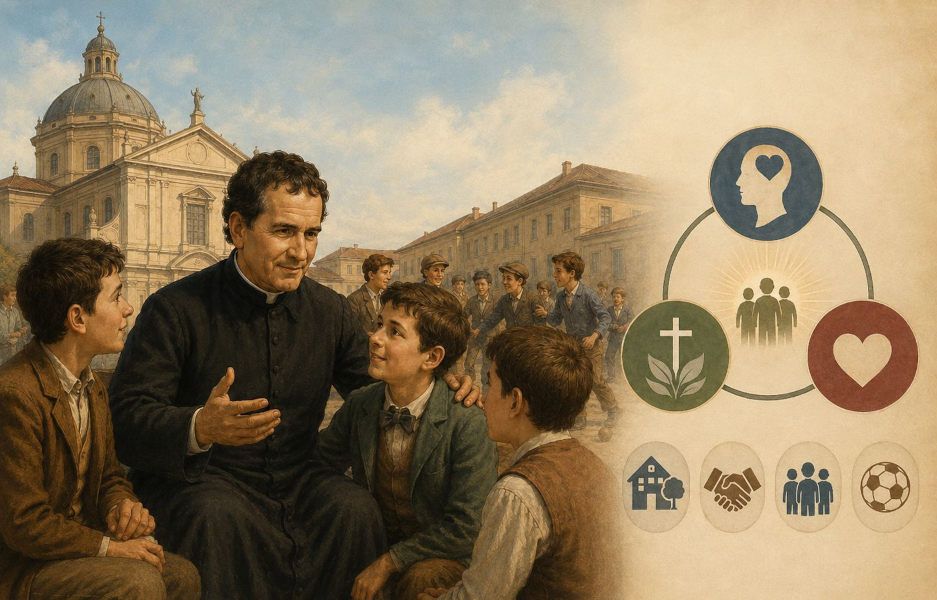
Reading time: 7 min.
Introduction to the series on the main texts of the preventive system
A method without a treatise
Don Bosco never wrote a pedagogical treatise. This is the starting point, and it is worth telling the reader immediately, because it is the key to reading the entire series that opens here. The man who educated thousands of boys and gave the Church a new word – preventive system – did not leave an organic work on his method, but a handful of pages always born from an occasion: a point-blank question, the visit of a minister, the inauguration of a house, the letter of a seminary superior who wanted to understand.
Of all the texts we will present, only one was composed and printed by him as a deliberate exposition of his method: the few pages of 1877. All the others are conversations collected by witnesses, official letters, presentation pages, private replies. It is an apparent poverty. Precisely because they each arise from a different interlocutor – a liberal minister, a primary school teacher, French benefactors, the Italian State, the educated public of Europe, a formator of priests – these texts show the preventive system as it is translated, each time, into the language of the listener. Put in a row, they do not repeat themselves: they illuminate each other.
The series we propose collects seven of these occasions, in chronological order. Each instalment will offer the text, preceded by a brief contextual note. Here we anticipate the overall map.
How to read the series
Seven texts, six different interlocutors, thirty-two years. A statesman, a country teacher, French benefactors, a minister of the Kingdom, the readers of Europe, a formator of seminarians – and finally his sons. Every time the same core, every time a new language.
Whoever reads the series from beginning to end will see three things emerge. The first: the vocabulary of the preventive system is very early, already formed in 1854, and remains extraordinarily stable. The second: Don Bosco never separates the method from its condition of possibility, that is, the presence of the educator among the boys – without that, the formula is emptied. The third: the more famous the method becomes, the more its author distrusts definitions.
It is not, therefore, a collection of documents for specialists. It is the itinerary of a conviction that had to make itself understood, from time to time, by those who did not share it.
***
Before a minister: the conversation with Urbano Rattazzi
We are in the Piedmont of the connubio. Urbano Rattazzi is Minister of the Interior in the Cavour government, and his name is about to be linked to the law suppressing religious corporations that will be approved in May 1855. It is the year in which Turin will experience the summer cholera, and in which, on 26 January, the name “Salesians” was pronounced for the first time at Valdocco. An anticlerical minister and a priest who gathers street children find themselves face to face.
Rattazzi’s question is that of a government man: how do you keep hundreds of difficult young people without guards, without bars, without punishments? It is the question of someone who has prisons and reformatories on his shoulders – the Generala first of all. Don Bosco’s answer introduces, more than twenty years before the 1877 pamphlet, the distinction between the repressive system, proper to civil authority, and the preventive system, proper to the educator. And it introduces the point that the minister finds most uncomfortable: the decisive lever is religion, and the State cannot use that lever.
It is the ideal opening text, because it shows the preventive system in its native place: not the classroom, but the confrontation with public power on the youth question.
1/7. Don Bosco’s conversation on the preventive system with the Minister of the Interior Urbano Rattazzi
(April 1854, MB V, 51-56)
“This witty opening was followed by a serious speech of almost an hour; and Rattazzi, with a string of questions to Don Bosco, had him explain in detail the origin, purpose, progress, and fruit of the institution of the Oratory and the attached Hospice. Among his various questions, one was about the means used by Don Bosco to maintain order among so many young people flocking to the Oratory.
– Does Your Reverence not have at your disposal, asked the Minister, at least two or three civic guards in uniform or disguised?
– I do not need them at all, Your Excellency.
– Is it possible? But these young people of yours are not at all unlike young people all over the world; they too must be at least unruly, quarrelsome, brawlers. What reprimands, what punishments do you use then to restrain them and prevent disturbances?
– Most of these young people are indeed ‘wide awake’, as they say; nevertheless, to prevent disorders here, neither violence nor punishments of any kind are used.
– This seems a mystery to me; please explain the secret to me.
– Your Excellency is not unaware that there are two systems of education; one is called the repressive system, the other is called the preventive system. The first aims to educate man by force, by repressing and punishing him when he has violated the law, when he has committed the crime; the second seeks to educate him with gentleness, and therefore gently helps him to observe the law itself, and provides him with the most suitable and effective means for the purpose; and this is precisely the system in force among us. First of all, we try to instil in the hearts of the youngsters the holy fear of God. They are inspired with a love for virtue and a horror of vice, through the teaching of the catechism and appropriate moral instructions. They are directed and supported on the path of good with timely and benevolent advice, and especially with the practices of piety and religion. In addition to this, they are surrounded, as far as possible, by loving assistance in recreation, in school, at work. They are encouraged with words of benevolence, and as soon as they show signs of forgetting their duties, they are reminded in a nice way and called back to sound advice. In a word, all the means suggested by Christian charity are used so that they may do good and flee evil, on the principle of an enlightened conscience supported by Religion.
– Certainly, this is the most suitable method for educating rational creatures; but is it effective for everyone?
– For ninety out of a hundred this system has a consoling effect; on the other ten it nevertheless exercises such a beneficial influence as to make them less stubborn and less dangerous; so that I rarely have to send a young man away as indomitable and incorrigible. Both in this Oratory and in those of Porta Nuova and Vanchiglia, young people present themselves or are sometimes brought who, either through bad character, or indocility, or even malice, were already the despair of their parents and masters, and after a few weeks they no longer seem themselves; from wolves, so to speak, they change into lambs.
– It is a pity that the Government is not in a position to adopt such a method in its penal establishments, where hundreds of guards are needed to banish disorders, and the inmates become worse every day.
– And what prevents the Government from following this system in its penal Institutes? Let Religion be introduced there; let the appropriate time be established for religious instruction and practices of piety. Let those in charge give these the importance they deserve; let the Minister of God enter often, and let him be allowed to converse freely with those wretches, and let them hear a word of love and peace, and then the preventive method will be well and truly adopted. After some time, the guards will have nothing or very little to do; but the Government will have the boast of restoring to families and society so many moral and useful members. Otherwise, it will spend money to correct or punish for a more or less long time a large number of unruly and guilty people, and when it has set them free, it will have to continue to keep an eye on them, to protect itself against them, because they are ready to do worse.
In this vein, Don Bosco went on for a good while; and since he had known the state of young and adult prisoners since 1841, because he made frequent visits to those wretches, he was able to point out to the Minister of the Interior the effectiveness of Religion on their moral rehabilitation. – Seeing the Priest of God, he added, hearing the word of comfort, the inmate remembers the blessed years when he attended catechism, remembers the advice of the Parish Priest or the Teacher. He recognises that if he has fallen into that place of punishment, it is either because he stopped attending Church, or because he did not put into practice the teachings he received there. By recalling these dear memories, he most often feels his heart moved, a tear springs to his eyes, he repents, suffers with resignation, resolves to improve his conduct. Having served his sentence, he re-enters society disposed to make amends for the scandals given. If, on the other hand, the amiable aspect of Religion and the sweetness of its maxims and practices are taken away from him; if he is deprived of the conversations and advice of a friend of the soul, what will become of the wretch in that hated enclosure? Never invited by a loving voice to raise his spirit beyond the earth; never encouraged to reflect that by sinning he has offended not only the laws of the State, but God, the Supreme Legislator; never urged to ask His forgiveness, nor comforted to suffer his temporal punishment in place of the eternal one, which He wishes to pardon him, he in his miserable condition will see nothing but the awkwardness of an adverse fortune. Therefore, instead of bathing his chains with tears of repentance, he will bite them with ill-concealed rage. Instead of proposing an amendment of life, he will persist in his evil. From his fellow prisoners, he will learn new malice, and with them he will find the way to commit crimes one day more carefully, so as not to fall back into the hands of justice, but certainly not to improve and become a good citizen.
Don Bosco, seizing the favourable opportunity, pointed out to the Minister the usefulness of the preventive system, especially in public schools and educational houses, where minds still virgin of crimes have to be cultivated; minds that bend docilely to the voice of persuasion and love. – I know well, concluded Don Bosco, that promoting this system is not a task devolved to Your Excellency’s department; but a reflection of yours, a word of yours will always carry great weight in the deliberations of the Minister of Public Instruction.
Mr. Rattazzi listened with keen interest to these and other observations of Don Bosco. He was fully convinced of the goodness of the system in use in the Oratories, and promised that for his part, he would have it preferred to any other in government Institutes. If he did not always keep his word later, the reason is that Rattazzi too lacked the courage to manifest and defend his own religious convictions.
The conversation having thus ended, he went away so well impressed that from that day he became an advocate and protector of Don Bosco. This was a trait of special Providence, because as the conditions of the times became more difficult year by year, and Rattazzi having very often had his hands in the Government, and having always remained an influential man, the Oratory had in him such a support, without which it would perhaps have felt very strong shocks, and even suffered very serious damage.”
Next article: The preventive system (2/7). The dialogue with the teacher Francesco Bodrato
 St John Bosco
  Fr Bruno FERRERO