


 By Fr Bruno FERRERO
Reading time: 8 min.
The story of John Cagliero begins in 1851 when, as a young boy, he asked Don Bosco to let him follow him to Turin. Welcomed into the Oratory, he grew up in a poor but family-like environment and soon became one of the Saint’s first and most trusted collaborators, taking part in the birth of the Salesian Society. An exuberant temperament, great communication skills, and a marked musical talent made him a charismatic figure among the young. During the cholera epidemic, he experienced an unexpected recovery that profoundly marked his path. In 1875, Don Bosco chose him to lead the first missionary expedition to America. His work in South America led him to the episcopate and then to the cardinalate. He died in 1926, the last direct witness of the first Salesian missionary endeavours.
Because he was happy in the happiness of others.
1 November 1851. Don Bosco arrived in his home town, Castelnuovo d’Asti, for a special sermon.
Among the altar boys was a young lad who watched him, spellbound, for the entire duration of the sermon. Back in the sacristy, Don Bosco saw that the altar boy was still looking at him in silence. He called him over. “Is there something you want to tell me?”
“Yes, sir. I want to come to Turin with you to study and become a priest.” “Good. Then tell your mother to come to the parish priest’s house after supper.” That boy’s name was John Cagliero, and his father had passed away. His mother arrived with John after supper. “So,” Don Bosco joked, “is it true, Teresa, that you want to sell me your son?”
“Oh no!” the woman replied, laughing. “Around here, we sell calves. We give boys away as gifts.”
“Even better. Pack him some linen, and tomorrow I’ll take him with me.”
The next day, at dawn, John Cagliero served Mass for Don Bosco, had breakfast with him, kissed his mother, and, with his little bundle under his arm, said impatiently, “Well, Don Bosco, shall we go?”
“To sleep in the breadstick basket”
They made the long journey on foot. John practically did it twice, because while talking to Don Bosco, he would run ahead, chase sparrows in the fields, and jump over ditches. He would later recall, “Don Bosco asked me a thousand questions during that journey, and I gave him a thousand answers. From that moment on, I never had any secrets from him again. Hearing about my mischief, he would jokingly tell me that I would have to be a better boy now. Finally, we arrived in Turin.
It was the evening of 2 November, and we were tired. Don Bosco introduced me to Mamma Margaret, saying, ‘Mamma, I’ve brought you a little boy from Castelnuovo.’ Margaret replied, ‘Oh yes, you do nothing but find boys, and I don’t know where to put them anymore.’
‘This one is so small we’ll put him to sleep in the breadstick basket. We’ll pull him up with a rope, under the beam, like a canary cage.’
Mamma Margaret started laughing and found a place for me. There really wasn’t a free corner, and for that night I had to sleep at the foot of a companion’s bed. The next day I saw how much poverty there was in that house. Our dormitories, on the ground floor, were cramped and had a floor of street cobblestones. In the kitchen, there were a few tin bowls with their respective spoons. We didn’t see forks, knives, or napkins until many years later. The refectory was a lean-to. Don Bosco served us at lunch, helped us keep the dormitory tidy, cleaned and mended our clothes, and did all the humblest chores.
We shared everything. More than in a boarding school, we felt like we were in a family, under the guidance of a father who loved us and who was only concerned with our spiritual and material well-being.”
From the very first days, John Cagliero showed a lively intellect and a cheerful disposition. He had an overflowing desire to play. Michele Rua continued to live with his mother, but in the morning, he would lead the small group of students, and together they would go to school. On Don Bosco’s instructions, Rua was to act as an “assistant,” making sure no one skipped school. Michele rarely managed to “rein in” Cagliero. As soon as he was out of the oratory, John would change his route, run to Porta Palazzo and stop, enchanted, in front of the charlatans and the fairground stalls. Then off again, still running, to school. When the others arrived, he was already at the door, sweaty but happy.
“We shall call ourselves Salesians”
26 January 1854. Don Bosco gave a strange talk to four of his young men. “You see that Don Bosco does what he can, but he is alone. If you give me a hand, however, together we will work good miracles. Thousands of poor children are waiting for us. I promise you that Our Lady will send us vast and spacious oratories, churches, houses, schools, workshops, and many priests ready to help us. And this in Italy, in Europe, and even in America. Among you, I already see a bishop’s mitre…”
The four young men looked at each other, astonished. Yet Don Bosco was not joking; he was serious and seemed to be reading the future. “Our Lady wants us to start a society. I have thought for a long time about what to call it. I have decided that we shall call ourselves Salesians.”
Among those four young men were the foundation stones of the Salesian Congregation.
In July, a cholera epidemic began to claim victims in Turin. Don Bosco rushed to help the infected and took the older boys with him. John Cagliero was one of them.
The copper-coloured giants
One evening towards the end of August, John Cagliero, aged 16, felt unwell on his way home from the isolation hospital. Two doctors, called for a consultation, declared the case hopeless. It was a terrible blow for Don Bosco. But when he arrived to give him his last Communion, Don Bosco stopped as if he saw something that the others could not see. Then he advanced towards the sick boy’s bed, but he was cheerful and smiling. John murmured, “Is this my last confession? Must I really die?” Don Bosco replied with a confident voice, “Not at all. They don’t want you up there yet. You have many other things to do; you will get well; you will become a priest… and then… and then with your breviary under your arm you will go far, far away.”
The next day, Cagliero had recovered.
Everyone wanted to know what Don Bosco had “seen” upon entering the room. Don Bosco himself gave the answer later. “It seemed to me that the walls of the room opened up and expanded into distant and mysterious horizons. Around the bed appeared a multitude of gigantic savages. Two of those giants with proud and sad faces bent over the sick boy, and trembling, they began to whisper, ‘If he dies, who will come to our aid?'”
The decisive moment came on the evening of the 9th of December. Don Bosco gathered his very young “Salesians” and asked them if they wanted to form a proper religious Congregation, complete with vows of poverty, chastity, and obedience. A murmur rippled through them. Don Bosco wants to make us friars! Cagliero paced the courtyard, torn by conflicting feelings. Then he slammed his fist against the wall, saying, “Friar or not, I’m staying with Don Bosco.”
Fr. Cagliero pronounced his three-year vows on 14 May 1862, and his perpetual vows, already a priest, on 15 November 1865.
He was the idol of the young. An exuberant temperament, full of impulses, he felt and communicated to others the joy of living with Don Bosco: working, running, giving of himself. Often, after saying goodnight to Don Bosco, the boys would approach Fr. Cagliero and greet him with spontaneous affection.
Meanwhile, John Cagliero was perfecting his musical talents. Church services, shows, and the band made him a precocious and brilliant composer. Two of his works, ‘Il figlio dell’esule’ (The Exile’s Son) and ‘Lo Spazzacamino’ (The Chimney Sweep), were praised by Joseph Verdi for their beautiful and moving music. They even reached the Court and were sung by the future Queen Margherita. The “Requiem Mass for three voices” was judged a “jewel of faith and harmony.” His teacher, Cerutti, had it performed in the Royal House at the funeral for Charles Albert.
He was volcanic in this too. On 9th June 1868, the Mass for the consecration of the church of Mary Help of Christians was sung by three choirs: one two-part choir of boys arranged on the cornice of the dome, and two three-part male choirs under the dome and in the choir loft.
Leader of the first missionary expedition
Don Bosco’s name had crossed the ocean and was beginning to be quite well known in Argentina, where there were many Italian emigrants.
One day in March 1875, after a pensive and silent pause, Don Bosco said to John Cagliero, who was beside him, “I would like to send one of our first priests to accompany the Missionaries to America and to stay with them for about three months, until they are well settled. To abandon them alone right away, without support, without a counsellor they can confide in, seems a bit harsh to me. My heart can’t bear to think of it.”
John Cagliero knew him too well not to understand the hidden meaning of those words and said, “If Don Bosco couldn’t find anyone else and thought me capable of doing it, I am ready.”
“Very well,” the Saint concluded.
A few months later, suddenly, with a paternal and diplomatic tone, Don Bosco asked Fr. Cagliero, “As for going to America, are you still of the same mind? Did you perhaps say you would go as a joke?”
“You know very well that I never joke with Don Bosco.” “Very well. Get ready. It is time.” On the eleventh of November, Don Bosco accompanied the missionaries to Genoa. He was deeply moved.
Cheerful and dynamic, leader of the upcoming expedition of 10 Salesians heading to Argentina, Cagliero, with his energy, cheerfulness, and good nature, did not limit himself to “accompanying” those who were leaving. Intelligent, authoritative, and full of fruitful initiatives, he quickly earned the esteem and goodwill of all.
He immediately expanded the plan of action, starting a vocational school in the capital and a project in the notorious “La Boca” district, and planning a school in Montevideo. His task was supposed to be settling his confreres, staying in Buenos Aires for three months or a little more, but he was forced to postpone his departure for two years.
Hymns of glory over Don Bosco’s Oratory in Turin
Seventh of December 1884. The beautiful church of Mary Help of Christians resounds with liturgical chants. With the sacred and solemn rite, Cardinal Archbishop Gaetano Alimonda consecrates Fr. John Cagliero as Titular Bishop of Magydus.
Two details. At the end of the imposing ceremony, the young bishop broke away from the procession and went towards his mother. The old woman (80 years old) came to meet him, supported by a son and a grandson. Monsignor Cagliero clasped the white head to his chest and, amidst the emotion of those present, gently led her back to her seat. Towards the sacristy, mingled in the crowd, Don Bosco was waiting for him, biretta in hand. The bishop ran and held him in a vigorous embrace. He had kept the hand with the episcopal ring hidden in the folds of his habit. The first kiss rightfully belonged to “his” Don Bosco.
On the 22nd of December, Monsignor Cagliero was received in a private audience by the Pope, who told him, “Go and make Patagonia Christian for me; pitch your tents in those distant Republics of South America.” For the energetic and passionate Salesian bishop, it was an order. He travelled his immense diocese on horseback and on rickety carts, braving swollen rivers, floods, and perilous Andean precipices to be present even in the most forbidding and inaccessible villages.
He returned to Italy in 1904, became a highly successful member of the pontifical diplomatic corps, and on 21st July 1915, Pope Benedict XV appointed him cardinal.
There was an episcopal see that no one coveted: Frascati. Cardinal Cagliero immediately offered himself, “I am old (he was almost 83), but if it is a matter of working for the Church, I will not refuse.”
The diocese, though small, was in a disastrous state. One day, having invited a foreign Cardinal to his apartment, he offered him a little Frascati wine to drink. That Cardinal found it very good and had a second glass, saying, “Good! Good!” The Cardinal, with his sense of humour, concluded, “He is my best diocesan!” With his fierce dynamism, he put almost everything back in order.
In 1925, the first fifty years of the First Missionary Expedition were celebrated. Cardinal Cagliero was the last survivor of that courageous handful of pioneers. In Turin, he blessed the Crucifixes for 172 Salesians and 52 Daughters of Mary Help of Christians who were leaving for the missions.
The following year, on the 28th of February, he serenely closed his long, beneficial, and industrious day.
 BSOL Editor
 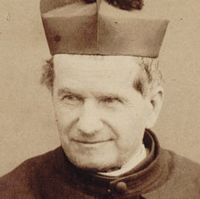 St John Bosco