


 By BSOL Editor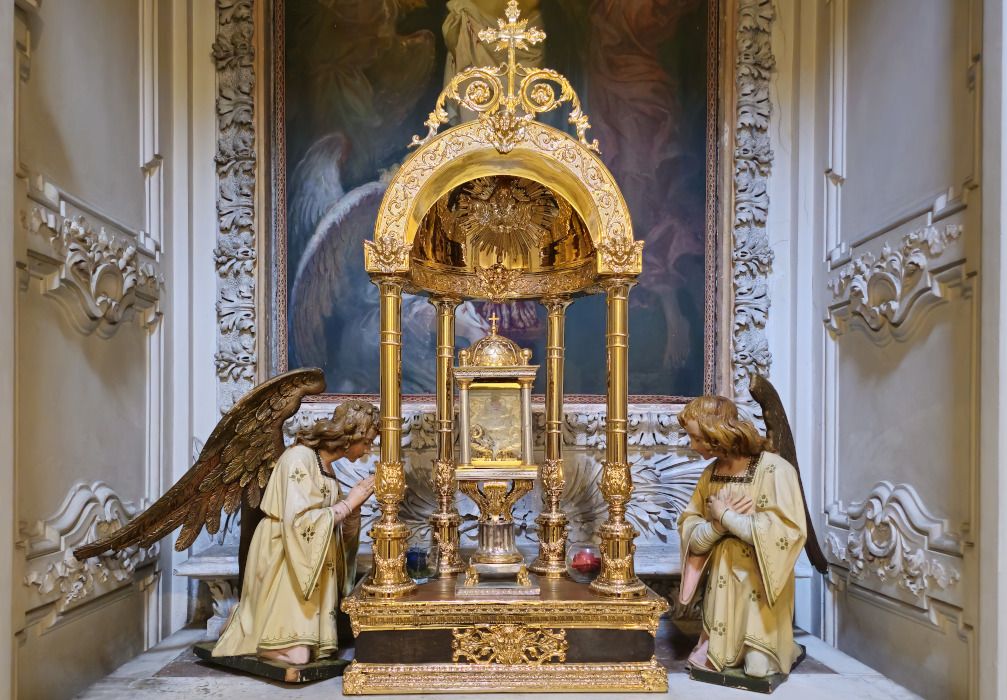
Reading time: 7 min.
The relic of the Most Precious Blood of Jesus, kept behind the altar of the Church of San Giuseppe a Capo le Case in Rome.
The Blood of Christ is the most concrete sign of God’s love: life given, mercy offered, redemption accomplished. This devotion, rooted in Scripture, in the liturgy and in the spirituality of the Church, found a new flowering in the nineteenth century and did not remain foreign to the apostolic heart of Don Bosco. For him, the Most Precious Blood was not an isolated devotional practice, but entered into the centre of Christian life: the Mass, Confession, the Eucharist, the Sacred Heart and the salvation of souls. Every young person, for Don Bosco, had an infinite value because they were redeemed by the Blood of Jesus. From this also sprang his educational passion: to lead souls to God, cooperating in the work of Redemption.
History of the devotion
Blood has always been perceived as a sign of life. It is not merely a symbolic convention: blood truly sustains the life of the body, bringing nourishment and oxygen, and its loss can lead to death. Precisely for this reason, in ancient cultures and in biblical revelation, blood is never a purely material element: it is life made visible that can be offered, poured out, given.
From this also arises the religious value of blood in sacrifices: to offer the blood of a victim means to offer life itself, recognising that life belongs to God and comes from Him. In the Old Testament, the blood of the covenant sprinkles the people and consecrates them to the Lord; in the New Testament, this meaning finds its fulfilment in the blood of Christ, “blood of the covenant”, poured out “for many, for the forgiveness of sins”.
Devotion to the Most Precious Blood of Jesus did not originate in the nineteenth century. Its roots are in Sacred Scripture, in the liturgy and in the reflection of the Fathers of the Church. The New Testament repeatedly speaks of the blood of Christ as the price of redemption, a source of purification, a sign of the new and definitive covenant. The Fathers took up these themes, especially in relation to the Passion and the Eucharist. In the Middle Ages, then, meditation on the Blood of Christ became particularly intense in mystical spirituality: one need only think of St Bonaventure, St Gertrude, St Mechtilde and, eminently, St Catherine of Siena, for whom the Blood of Christ is the measure of God’s merciful love.
On the liturgical level, the history of the feast was more gradual. One of the first concessions is a Liturgical Office, “De Sanguine Christi“, which dates back to 1582, for the diocese of Valencia, in Spain. In the following centuries, the devotion spread in various local Churches and in some religious families. In the 18th century, concessions of proper Masses and Offices multiplied; among these, the approval, in 1747, of liturgical texts in honour of the Most Precious Blood was of particular importance, also linked to the devotion to the relic venerated in Sarzana, where one of the oldest and most famous Italian relics linked to the cult of the Most Precious Blood is kept. According to tradition, the ampoule containing the Blood of Christ, collected on Calvary by Nicodemus, arrived in the port of Luni in 782 together with the Holy Face, the wooden crucifix venerated today in Lucca. While the crucifix was taken to the Tuscan city, the ampoule remained with the bishop of Luni and, after the transfer of the episcopal see, passed to Sarzana. Here it became the heart of a centuries-old devotion, kept in the co-cathedral basilica of Santa Maria Assunta and celebrated with particular solemnity on the Monday after the Holy Trinity. The Church of Luni-Sarzana also developed its own liturgical office of the Most Precious Blood, approved by Benedict XIV in 1747, thus contributing to the spread of the devotion well beyond local borders.
In Rome, the most important centre of the modern revival of this devotion was the basilica of San Nicola in Carcere. Here a relic was venerated consisting of a piece of the garment of the centurion Longinus, the soldier who pierced Christ’s side. Tradition recounts that this cloth had been soaked by the blood that flowed from the Heart of Jesus and that it had been preserved for centuries by the Savelli family, who believed themselves to be descendants of that soldier. In 1708, Prince Giulio Savelli, the last of his house, donated the relic to the church of San Nicola in Carcere, close to the family palace. The relic was placed at the altar of the Holy Crucifix, the same one that, according to tradition, had spoken to St Bridget. On the casket was engraved the inscription “De aqua et sanguine Domini Nostri Jesu Christi quae effluxerunt ex eius sacratissimo latere dum pendebat in crucem“. Around this relic, a more organised devotion to the Most Precious Blood took shape.
On the occasion of the first centenary of the donation, on 8 December 1808, Canon Francesco Albertini, rector of the church, founded a Pious Association in honour of the Most Precious Blood with some devotees. The young priest Gaspar del Bufalo, destined to become the great apostle of this devotion, was called to preach.
The birth of this movement occurred in a dramatic time. Rome and the Papal States were under the pressure of Napoleonic rule; in the night between 5 and 6 July 1809, Pius VII was arrested and deported. Fr Gaspar was also involved in the persecution: on 13 June 1810, he was ordered to swear an oath of loyalty to the new regime, but he refused with the famous words: “I must not, I cannot, I will not”. For this he was imprisoned for three years.
That trial did not extinguish his zeal, but strengthened it. Gaspar developed the conviction that, after the spiritual wounds left by persecution and indifferentism, a great apostolate of re-evangelisation was necessary. He saw in the devotion to the Blood of Christ not a marginal practice, but the very heart of the Christian proclamation: the most eloquent sign of Jesus’ redeeming love and of mercy open to sinners.
On 15 August 1815, at the abbey of San Felice di Giano (one day before the birth of St John Bosco), St Gaspar del Bufalo founded the Congregation of the Missionaries of the Precious Blood. The choice of this devotion was not for him a simple personal spiritual orientation, but the centre of his mission: to preach conversion, to renew faith, to lead souls back to the mercy of God through the contemplation of the Blood shed by Christ.
Biographical tradition also recalls a prediction attributed to Sister Maria Agnese of the Incarnate Word. She is said to have confided to her spiritual director, Francesco Albertini, that in the time of persecution a zealous priest would arise, capable of shaking many from indifference through devotion to the Blood of Christ. That priest would be called “the trumpet of the divine Blood”. Biographers saw in St Gaspar the fulfilment of this prophecy.
The Pious Association founded by Albertini was elevated to an Archconfraternity by Pius VII in 1815. Later it moved to the church of San Giuseppe a Capo le Case, in Rome, and with it also the relic which is still kept today in the reliquary coming from San Nicola in Carcere.
A decisive step occurred during the exile of Pius IX. In November 1848, due to the Roman revolutionary crisis, the Pope left Rome and took refuge in Gaeta. In February 1849, the Roman Republic was proclaimed and the pontiff’s situation became particularly difficult. In that context, Blessed Giovanni Merlini, a disciple of St Gaspar and third Moderator General of the Missionaries of the Precious Blood, had predicted to the Pope that, if he made a vow to extend that feast to the whole Church, he would soon return to Rome.
The Pope did not want to bind himself with a vow, but promised that he would act freely if the events came to pass. At the end of June and in the first days of July 1849, French troops entered Rome and the Roman Republic fell. Pius IX physically returned to the city only on 12 April 1850, but already on 10 August 1849, from Gaeta, he signed the decree “Redempti sumus“, with which he extended the feast of the Most Precious Blood to the universal Church, fixing it on the first Sunday of July.
In 1904, St Pius X beatified Gaspar del Bufalo. Within the framework of the liturgical reform of his pontificate, the feast of the Most Precious Blood was then fixed on 1 July. In 1934, Pius XI, in memory of the 19th centenary of the Redemption, elevated the celebration to the rank of solemnity. St John XXIII, very devoted to the Most Precious Blood, further promoted its cult: in 1960 he approved the Litany of the Most Precious Blood and published the apostolic letter “Inde a primis“.
The reform of the Roman Calendar after the Second Vatican Council linked the distinct solemnity of the Most Precious Blood to the solemnity of the Most Holy Body and Blood of Christ. However, the devotion has not disappeared, it has remained as a memorial: it continues in popular piety and in the proper calendars of the religious families linked to this spirituality.
The devotion in Don Bosco
Don Bosco’s devotion to the Most Precious Blood of Jesus does not appear as an isolated or marginal theme, but as part of his spirituality which was concentrated around three great poles: the Eucharist, Our Lady and the Pope.
It is inserted above all into the mystery of the Eucharist, of Confession and of the salvation of souls. It is found especially in his writings “The Catholic Provided for in the Practices of Piety”, “Association of the Devotees of Mary Help of Christians” and “The Provided Youth”.
This devotion could not be far from him who built a basilica on the site bathed by the blood of the Turinese martyrs Adventor, Solutor and Octavius.
Devotion to the Most Precious Blood is situated above all in the first of these areas, that is, in the Eucharistic mystery. For Don Bosco, in fact, the Holy Mass makes present the sacrifice of Calvary: the Body and Blood of Christ offered on the cross are made sacramentally present on the altar. For this reason, he educated young people to participate in the Mass with recollection, especially at the moment of consecration, and to understand that the Blood of Christ is the price of redemption. Don Bosco recalled that a single drop of Jesus’ Blood would have been enough to save the world, but Christ wanted to shed it all to manifest his love more clearly.
A second central point is Confession. Don Bosco presents the sacrament of Penance as the place where the soul is purified by the Blood of Christ. The sinner is invited to trust in divine mercy, because the Blood shed by Jesus is sufficient to wash away every fault. From this also arises Don Bosco’s insistence on frequent confession, on sincerity, on sorrow for sins and on the need to “set the matters of conscience right”. Here the Blood of Christ is presented as a concrete source of mercy: not an abstract image, but the real price of redemption that washes the soul and restores it to grace.
The same devotion also has a strong link with the Sacred Heart. In the “Cattolico provveduto”, Don Bosco links the Heart of Jesus to the love of the Redeemer, to his life offered on the cross and to the Eucharist, the precious “pledge” of this love. The wounds, from which the most precious blood flowed, are indicated as an object of special veneration; the Heart is like its spiritual source, because it expresses the love that drove Christ to shed his Blood.
For Don Bosco, the Most Precious Blood is the price of redemption, the source of forgiveness, the heart of the Mass, the foundation of Confession and the profound motive of his educational passion. Every young person is infinitely valuable because they have been redeemed by the Blood of Christ. In this light, the “Da mihi animas” also takes on an even stronger meaning: saving souls means cooperating in the redemptive work of Jesus, who gave his all, down to the last drop of blood, to lead man back to God.
 Fr Bruno FERRERO