


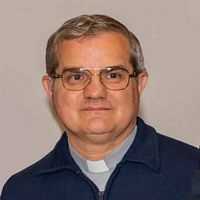
 By Fr Pierluigi CAMERONI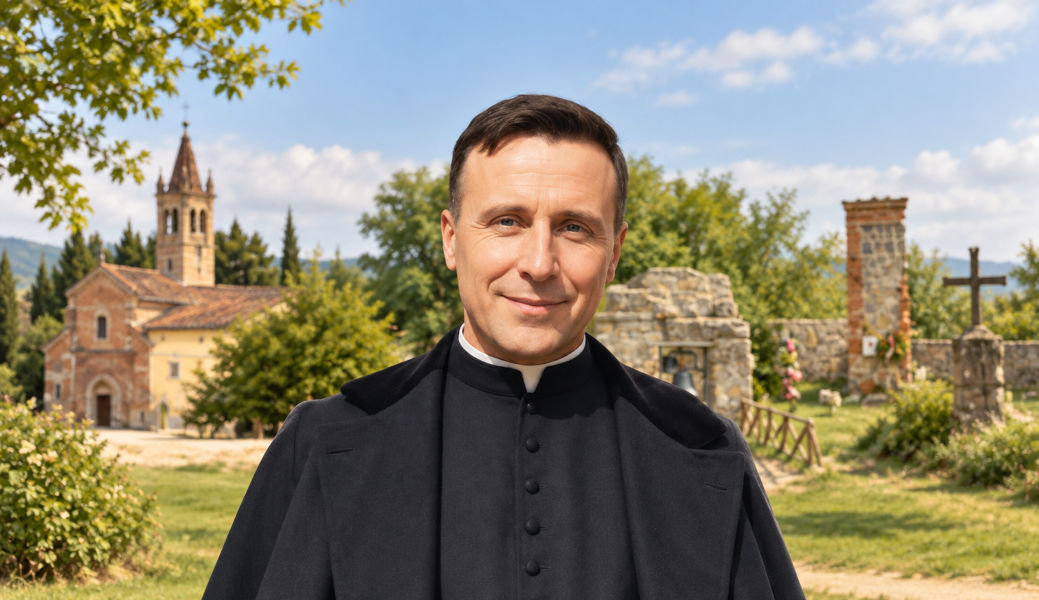
Reading time: 5 min.
In the autumn of 1944, the Bolognese Apennines became the theatre of one of the darkest chapters of the Second World War. Amidst the smoke of the fires and the horror of the Nazi massacres at Monte Sole, the figure of Fr. Elia Comini shines brightly. A Salesian priest, his martyrdom, alongside that of Father Martino Capelli, a Dehonian, and the diocesan priests Ubaldo Marchioni and Giovanni Fornasini, was not just the tragic end of war victims, but a lucid choice of heroic charity and fidelity to their priestly ministry. Like good shepherds who do not flee before the wolf, these young priests chose to remain beside the terrified population and lay down their lives for the flock entrusted to them.
A heart educated to smile
Fr. Elia Comini matured as a man and as a consecrated person through a daily life of service and dedication. His roots lay deep in the charism of St. John Bosco, a bond fostered by his encounter with Monsignor Fidenzio Mellini, the parish priest of Salvaro who guided him in his vocational choice and who had been a direct acquaintance of the saint from Turin. Fidenzio Mellini, as a young soldier in Turin, had personally known and spent time with St John Bosco, who had prophesied his priesthood. Having become the archpriest of Salvaro, Mgr. Mellini immediately noticed the profound faith and abilities of the very young Elia Comini, whose family had moved to the parish in 1914. It was he who directed Elia and his brother Amleto towards the Salesian school in Finale Emilia in 1923, where they experienced Don Bosco’s pedagogical charism and where the young Elia developed his vocation to Salesian religious life. Ordained a priest in 1935, Fr. Elia spent over ten years as an educator, teacher, and headmaster in Chiari (Brescia) and three in Treviglio (Bergamo), bringing with him an authority born not of fear, but of a disarming goodness. Among the boys, Fr. Elia was not a distant figure. A former pupil of his used an effective simile to describe the atmosphere of warmth and protection he conveyed. Around him, the boys were “like chicks around a mother hen”. His presence was inspired by the Salesian style. The students, attracted by his uprightness which was never rigid, found it natural to open their hearts in confidence, allowing him to guide their inner growth with rare depth. His educational presence was characterised by fraternity. He was always among the young, ready to share in games in the courtyard or moments of recreation. Through his tireless patience as a teacher, he never lost his temper, ready to re-explain every concept with extreme clarity to those who struggled. By his attention to the least, he had the gift of winning back the most difficult boys, transforming their crises into opportunities for maturation. This serenity and balance to reassure the youngest would soon be put to the test by the hatred of war.
Community of the Ark: the fraternity between Fr. Elia and Father Martino
On 20 July 1944, in Salvaro, Fr. Elia’s path crossed with that of Father Martino Capelli, a Dehonian religious. Together with Monsignor Mellini, they gave life to what the historian Luciano Gherardi defined as the “community of the ark”: a safe haven in the Salvaro presbytery that welcomed hundreds of displaced and persecuted people, saving them from Nazi-Fascist fury and offering them refuge. Fr. Elia and Father Martino were refined intellectuals, scholars, and teachers of classical languages, lent to the necessities of war. Despite their different backgrounds, they acted as a single heart, through generous pastoral care, burying the dead, peace mediation, and the comfort and protection of refugees. This friendship became the rock upon which the two priests built their peaceful resistance, a brotherhood that would see them always act in unison, right up to the final sacrifice. Both priests refused to abandon the population. They constantly offered themselves as mediators with the German commands and rushed wherever there were wounded and dying people to comfort. The Salvaro presbytery became a centre of material and spiritual welcome for hundreds of refugees. During the Nazi round-ups of 29 September 1944, Fr. Comini even managed to hide about seventy men in a room adjacent to the sacristy, concealing the door behind an old wardrobe to save them from capture.
The decisive choice: “we must go, the Lord is calling us”
29 September 1944 marked the beginning of the Monte Sole massacre. While the troops of the 16th SS-Panzer grenadier Division sowed death, news arrived of the atrocities perpetrated at “Creda”, a locality not far from Salvaro. At that moment, the two priests made their decision. They would not seek their own safety, but the good of the people. While the women taking refuge in the parish begged them to hide, they understood that their place was beside the wounded flock. Before leaving to help the wounded, dying, or killed, Fr. Elia spoke words that remain as a testament of faith: “we must go; the Lord is calling us”. It was not recklessness, but a lucid mission. Equipped with holy oils and the Eucharistic pyx, they set out not to fight, but to bring the forgiveness and consolation of grace. That same stole, symbol of their mandate, would become the first object of their executioners’ contempt.
Intercepted by the Nazis, they were deprived of their freedom. Once captured, the two priests suffered brutal treatment, dictated by explicit hatred against the faith. The SS had been indoctrinated with an anti-Christian “catechism” that saw the clergy as an enemy to be annihilated. They were violently stripped of their priestly insignia (stole and holy oils) to deny their identity as shepherds. They were reduced to “beasts of burden”, forced to carry loads of ammunition at gunpoint, starved, and forced to witness unprecedented violence. Their imprisonment at the “Casa dei birocciai” in Pioppe became a Calvary of humiliations.
The final act at the “Botte”: a liturgy of life and death
On 1 October 1944, Fr. Elia, Fr. Martino, and 43 other civilian prisoners were taken to the industrial cistern called “la Botte” (the Barrel) in Pioppe di Salvaro, a large industrial basin used for processing hemp. The macabre march towards death turned into a solemn liturgy. Fr. Elia led the 43 condemned by reciting the Litany of Loreto aloud. In those moments, charity became flesh. Fr. Elia acted as a human shield for a young prisoner, Pio Borgia, saving his life during the machine-gunning. Pio would survive, becoming the eyewitness to this extreme love. Fr. Martino, before falling, managed to raise himself one last time to make the sign of the cross, imparting sacramental absolution to Fr. Elia and all those present. Fr. Elia cried out “Pietà” (Mercy), an invocation that was not a plea for himself, but a cry of intercession for the executioners and the victims. Shortly before the execution, a soldier struck Fr. Elia’s hands hard to snatch his prayer book. With a gesture of supreme contempt, the soldier used the butt of his rifle to hurl the Breviary into the sludge of the “Botte”. Only after the massacre did the true ideological nature of the crime emerge. The soldiers boasted of the killing, shouting “Due Pastoren kaput!” (Two pastors dead!). For them it was a trophy; for the Church, it was proof of martyrdom. Their bodies fell into the cistern of sludge, making their death an extension of the Mass, celebrated on the altar of human suffering.
A legacy for the future
The story of Fr. Elia Comini intertwines with that of other martyrs of Monte Sole, such as the young Fr. Ubaldo Marchioni, shot at the foot of the altar in Casaglia while clutching the ciborium in his hands. These men teach us the value of sacrifice, offering their lives to break the chain of violence and hatred. Blesseds Elia Comini, Martino Capelli, Ubaldo Marchioni (beatified on 27 September 2026) and Giovanni Fornasini (beatified on 26 September 2021), young priests, teach that true strength is not running away, but staying at one’s post, especially when the danger is greatest. Being “good shepherds” means never abandoning those in difficulty and defending human dignity with the sole weapon of closeness. True fulfilment is not found in individual salvation, but in service that acts as a shield for others, especially in dark times. Remaining faithful to one’s mission means being reassuring presences and peacemakers even when the world around seems to go mad. Responding to hatred with prayer and to brute force with moral rectitude is the only way to build a genuinely civilised future. Today, the figure of Fr. Elia teaches educators the importance of being a reassuring presence even in the darkest crises, demonstrating that the Salesian charism is not limited to the oratory, but is a disposition to total sacrifice for others, bearing witness to a faith that does not surrender to hatred and violence, but pushes itself to the supreme gift of life.
 P. Wirth MORAND