


 By BSOL Editor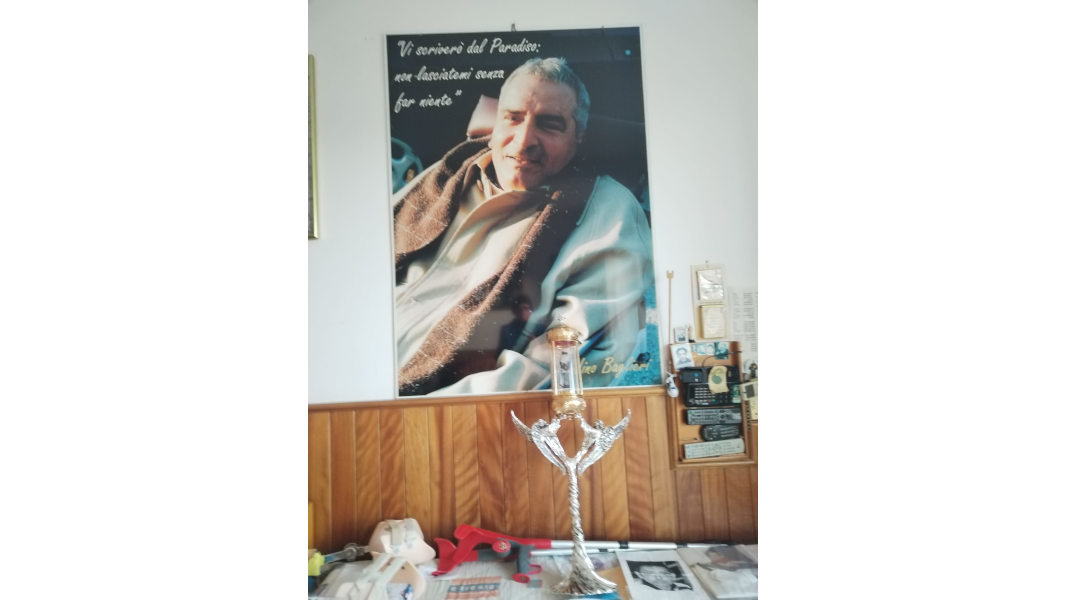
Reading time: 7 min.
Last month, the house of the Servant of God Nino Baglieri in Modica welcomed the distinguished relics of Saint John Bosco – specifically the tongue and larynx of the saint of the young – as a living sign of a charism that knows no end. A profoundly symbolic gesture: the voice of Don Bosco resonating once again within the walls of one who, like Nino, transformed suffering into mission and witness. This is not the first time this house has become a sanctuary of Salesian faith. The urn of Saint Dominic Savio stopped here in 2004, and that of Don Bosco himself in 2013. Three encounters, three stages of a journey of popular holiness that unites the founder of the Salesians with a spiritual son from Southern Italy.
On 2 February 2026, the house of the Servant of God Nino Baglieri (1951-2007) in Modica (Ragusa) welcomed the distinguished relics of Saint John Bosco. Nino was a young man like any other, with many “dreams in his drawer” and great expectations for life. At 17, his life took an irreversible and unexpected turn. During a normal working day as a bricklayer, he fell from a 17-metre-high scaffolding and, in a few seconds, everything changed; his virile body lost its vitality, reduced to “nothing”. That misfortune, however, had a different meaning in God’s plan, a call that Nino would understand after ten long years of darkness, sadness, and cursing. The sun of life dawned for Nino on 24 March 1978, when the Holy Spirit, thanks to the prayer of a group of young people from the Catholic Charismatic Renewal and the laying on of hands by Father Aldo Modica, burned away the old man and opened his heart to the grace of the Word of God. From that moment, Nino thirsted for God. He wanted to know Him, to bear witness to Him; he made it his life’s mission. He wanted to work with Don Bosco and entered the great Salesian Family, first as a Salesian Cooperator (3rd branch of the Salesian Family, founded in Turin by Don Bosco himself on 9 May 1876) and later as a Volunteer with Don Bosco (17th branch of the S.F., founded by Fr. Egidio Viganò on 12 September 1994).
Through the relics of the tongue and larynx of the saint of the young, the aim is to keep the work of evangelisation alive and relevant with the charism of “Da mihi animas, cetera tolle” (Give me souls, take away the rest). The motto is inspired by the biblical story in Genesis 14:21 and expresses the saint’s mission: to dedicate himself entirely to the spiritual salvation of the young, disregarding material or personal riches. The relics of Don Bosco’s tongue and larynx are humble but eloquent signs for the young. They recall a man who gave his voice, his word, his breath, his proclamation, his counsel, his rebuke, and the caress of a father.
Don Bosco present with the relics of his tongue and larynx
The relics remind us that Don Bosco did not save the young with spectacular miracles, but with everyday words spoken with love, patience, and faith. Don Bosco’s tongue pronounced thousands of good words, the kind that change lives. How many little words whispered in the ears of the young! He heard confessions, he preached, he advised, he listened, he prayed…
Even today, Don Bosco’s voice tells us: “God loves you, He wants you to be happy, He calls you to holiness.”
We read from the Rector Major’s Strenna for 2026: “We must have neither fear nor shame; let us foster, on a personal and community level, the audacity of faith. This is not an attitude that challenges the world, much less a senseless fundamentalism. The audacity of faith is a confirmation that we want to take seriously the call to be co-operators in God’s project for the young.” Don Bosco made this audacity his own. He lived it to the point of saying, “In matters that benefit endangered youth or serve to win souls for God, I rush forward to the point of recklessness.”
The urn of Dominic Savio also in Nino Baglieri’s house
Nino’s house had previously been hospitable to the relics of Salesian saints. It was 18 March 2004, on the occasion of the 50th anniversary of the canonisation of Saint Dominic Savio. The then Rector Major of the Salesians, Fr. Pascual Chávez Villanueva, decided to have the urn with Dominic’s remains peregrinate throughout Italy and beyond.
Dominic was represented in the effigy with his arms stretched towards the sky, his eyes open to contemplate the light of the Lord. “Oh! what a beautiful thing I see!”, were his last words before he died on 9 March 1857, as he glimpsed the beauty of paradise.
At the time, Nino did not leave the house for health reasons, phlegm and sores prevented him. However, he had a great desire in his heart to see him and thank him for what Dominic Savio had done for him. Nino was very attached to the young Salesian saint, sharing the date of 6 May, the liturgical memorial on which we honour the saint of the cradles and the anniversary of the cross, as Nino called it after accepting on that date what had happened to him at 17 when he fell from a scaffold and was left a quadriplegic. Let Nino speak directly from his mouth-writings: “After it had been in the Church of Santa Maria di Betlemme in Modica, the urn welcomed by the Bishop, by all the Priests of the city, and a great many people who came from all over the Diocese, I had the great joy of having St. D. Savio inside my little room. So many people came; first they held the welcome in the Salesian courtyard and then many young people pushed the Sacred Urn, weighing 400 kg, to my house, led by the Provincial Fr. Perrelli, Sisters and Salesians. It was a great emotion. Fr. Perrelli said that, of all the cathedrals St. D. Savio has visited, this is the most beautiful. I spoke for a quarter of an hour; I touched everyone’s hearts. It was a powerful emotion; there was silence and all eyes were on me and on Dominic Savio. You could see his whole body and underneath were His bones. The Urn is in the shape of a diamond, the Provincial explained to me, to contain this precious gem, which is Dominic Savio. It entered the door just to size; the boys were tired but happy because they had done everything with so much love. […] On that occasion, I also handed my request for perpetual profession to the Provincial and it was a great joy. Lord, help me to always say ‘Yes’ to You, especially in difficult moments, grant that I may imitate St. D. Savio.”
Dominic Savio, as Don Bosco himself told us, “was of flesh and blood like us; he had the same bad inclinations as all of us. He was educated in the oratory; he studied and went to school like you. He played and had fun like all of you, only he was a little better and left us an example.”
The urn of Don Bosco also in Nino Baglieri’s house for the bicentenary of his birth
The other occasion for hosting Don Bosco’s relics at Nino Baglieri’s house was on 4 November 2013. On the occasion of the bicentenary of the birth of the saint of the young, his mortal remains toured the world. The urn, weighing 530 kg, contained a mannequin of Don Bosco similar to the one preserved in the Basilica of Mary Help of Christians. Inside the mannequin, on the side of the heart, is a sealed case containing a relic of Don Bosco’s hand, the hand that still guides so many young people on the right path.
Nino was no longer alive on that occasion, but the stop was strongly desired as a sign of witness from a man of faith who made his suffering an altar and an oblation to the Gospel lived in its entirety. Suffering, as a “sweet bride”, was the companion of a lifetime; many people went to Nino’s house to console him, but they left consoled not by the grand speeches they heard, but by the simplicity of living each day to the full in his condition of illness and suffering. Thus Nino, despite his physical limitations, passed through many “doors”, because he was aware of the precious message he had to spread in every way and by every means. He did not spare himself until his last breath. In fact, just over a month (January 2007) before the end of his earthly pilgrimage, he went to Rome with his brother-in-law Paolo, in critical health, to give his testimony of faith to those participating in the Salesian Spirituality Days. Nino writes: “I was tired, emotional, but happy to be there and to speak of God’s love and what He had worked in my life, to the Salesian world […] I felt like Peter and Paul when they were called to Rome to witness to Christ with their Lives and I witnessed to Him with my Cross.” The Rector Major, Fr. Pascual Chávez, said: “Your testimony was listened to with the utmost attention; even if you did not speak, your presence was enough to make us reflect on the gift of Life and how much it cost you to come. You left a mark on everyone’s heart.” As a sign of gratitude, he took off the Don Bosco pin he had on his jacket and placed it on Nino’s chest.
The desire to become a saint resided in his heart and was nourished daily by the Holy Eucharist, received at home through the minister of communion, and by his suffering, offered as an oblation, an experience of God’s love. In this direction, Pope Francis’s words not to be afraid of holiness echo. It is not reserved for a select few. An invitation that we find as the main incipit that forms the backdrop to the apostolic exhortation “Gaudete et Exsultate” (c. 1, p. 7). The Pope writes: “I like to see the holiness in the patient people of God, in those parents who raise their children with so much love, in those men and women who work to bring home the bread, in the sick, in the elderly religious who continue to smile.”
The Servant of God Nino Baglieri wanted to embody this same holiness, making Don Bosco’s words his own, “If he was like that, if he managed to become a saint, why can’t we also be as well?”
Don Bosco, through his relics, continues to speak and invites us to walk the path of holiness open to all who wish to listen to him.
Roberto Chiaramonte40
 Fr Pierluigi CAMERONI