

 By BSOL Editor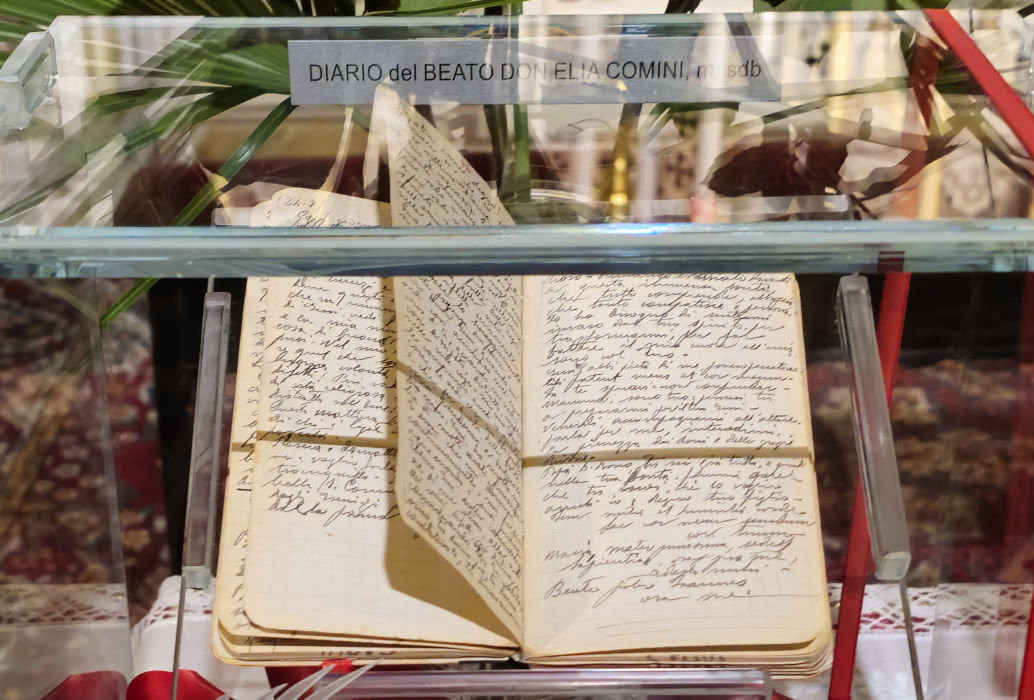
Reading time: 7 min.
Yesterday, in the Basilica of San Petronio in Bologna, the Salesian priest Don Elia Comini was proclaimed Blessed alongside the Dehonian Father Martino Capelli and the diocesan priest Don Ubaldo Marchioni, martyrs of Monte Sole in the autumn of 1944. He was 34 years old. He was not a hero suddenly made by war: his spiritual diary, the “dear little notebook” he kept for sixteen years, reveals a young man who fought every day against his own pride, put Mass at the centre of his day and young people at the centre of his heart, and prepared himself over many years to give himself completely. When the time came, he chose to stay with his people and go to those who were dying. These are the virtues of a son of Don Bosco whom the Church now holds up to everyone.
Sunday 27 September 2026, San Petronio. Cardinal Marcello Semeraro, Prefect of the Dicastery for the Causes of Saints and papal delegate, read the formula of beatification. Concelebrating were the Archbishop of Bologna, Cardinal Matteo Zuppi; Cardinal Ángel Fernández Artime; the Rector Major of the Salesians, Don Fabio Attard; and the Superior General of the Dehonians, Father Carlos Luis Suárez Codorniú. The decree recognising their martyrdom had been promulgated on 18 December 2024. At the end of a long journey, the Church recognises that the three priests were killed because they had been pastors to the very end. Their blood mingled with that of the 770 victims of the Monte Sole massacres.
Nothing remains of Don Elia’s body. The waters of the “Botte” at the hemp mill in Pioppe di Salvaro, where he was machine-gunned on 1 October 1944, carried him into the Reno. But his black notebook remains: 81 small pages, now kept in Treviglio. Pierluigi Cameroni, Postulator General, has just republished it under a title that is itself a statement of purpose: “Dear Little Notebook”. “If martyrdom is Don Elia’s final act,” he writes, “the diary is the continuation of the martyr’s voice.” It is from those pages, and from the testimonies of those who knew him, that the features of his holiness emerge.
A son of the Apennines and of Don Bosco
Elia was born on 7 May 1910 in Calvenzano di Vergato, beside the shrine of Our Lady of the Woods. His father, Claudio, was a carpenter; his mother, Emma Limoni, a seamstress. In Salvaro, the archpriest Monsignor Fidenzio Mellini, who had met Don Bosco at Valdocco when he was young, became a second father to him and directed him towards the Salesians. He went on to the aspirantate at Finale Emilia, the novitiate at Castel de’ Britti, his first profession in 1926, and philosophy studies at Valsalice, near Don Bosco’s tomb. Then came his practical training, perpetual profession at Chiari on 8 May 1931, and priestly ordination in Brescia Cathedral on 16 March 1935. In 1939 he graduated in Literature from the Royal University of Milan with a thesis on Tertullian, The Resurrection of the Flesh. He taught the aspirants at Chiari San Bernardino and then, from 1941, at the Salesian Institute in Treviglio. In the summer of 1944, he returned to Salvaro to be near his mother, who was widowed and had been displaced by the war. He thus found himself “deep in the rear area of the war”.
Humility, a lifelong struggle
The first virtue revealed by the diary is humility, won at great cost—not something that came naturally to him. When he was seventeen, his confessor, Don Antonio Cojazzi, set it for him as a resolution, and he never let it go. He writes about himself with disarming frankness: “My immeasurable pride makes me deaf, but you [Don Bosco], knock hard and you’ll see that you’ll manage to bring this stubborn little head to its senses.” He observes himself with irony: “I’m sweating humility from every pore!” In July 1930, after his final exams, he even prayed: “I am an egotist. Lord, help me, prove me wrong, make me humble of heart like You: what a grace You would grant me! Greater than passing my exams.”
When he graduated, he did not boast. On the eve of his graduation, he had promised God “humility and self-effacement, and recognition that everything comes to me from Him”. His pupils did not even know he was attending university; they only saw the results. In 1943, at the shrine of Caravaggio, he summed up his journey like this: “Ama nesciri et pro nihilo reputari […] Give me the courage and strength to stifle my ego mercilessly […] Suffer, fight, pray and be silent!”
The priest, wholly devoted to Jesus
On the eve of his ordination, in Montodine, he drew up a “Rule of Priestly Life” which he would carry close to his heart, in the breast pocket of his cassock, until his last Mass. Mass “will be the centre of my day”. The breviary “will be for me the most beautiful and most important prayer”, and he would try to recite it before the tabernacle. His motto came from his former novice master, Don Luigi Terrone: “All and always for the Sacred Heart and in the Sacred Heart.” On the day of his diaconate, he had written: “I can touch Jesus with my [hands]: the dream of my childhood.” Those pages reveal a restrained yet ardent piety, entrusted to Mary Help of Christians: “it is your task to present me to Jesus and offer me to him for ever”.
Those who saw him pray never forgot it. A former pupil in Treviglio, hiding in the chapel during a game, found him “kneeling in the last pew, absorbed in intense prayer”. To an altar boy accompanying him to visit a sick person, he confided: “See what great dignity the priest has: he can carry Jesus in his heart, and bring him, as divine consolation, to those who suffer.”
An educator with the heart of Don Bosco
“Young people, all young people, will have a special place in my heart.” His resolution of 1935 became a way of life. As a cleric, he had already chosen for himself a “gentle charity, charity in the spirit of Don Bosco, the charity of a family […] especially in dealing with boys”. The witnesses confirm it. Don Luigi Calonghi recalls their first conversation: “I was amazed because he listened to me; he made me think, he took me seriously.” Don Pietro Gianola saw in him “a constant and complete friendship”—a friendship that helped to educate. In Treviglio, he asked his pupils to keep a “personal and private diary”. If he wanted to read a page aloud in class, he always asked its author’s permission first.
No one remembers him getting angry or raising his voice. “I only ever saw him smile,” says a former pupil. And when the boys at Chiari, full of remorse, wrote to apologise, he noted: “Poor pupils—it is I who ought to do this for them.”
Obedience and faithfulness to duty
Don Elia does not hide the fact that he struggled with obedience, too: “This year I have grumbled against my superiors more than anyone.” So he resolved to practise “wholehearted docility towards all those above me, in everything, even the smallest things”. In 1942, at Treviglio, he was able to write: “The obedience I have tried to practise in faith has visibly won me the Lord’s blessings.” Faithfulness to daily duty became the ground on which holiness grew. Cameroni emphasises that his was “not a sudden reaction to the atrocities of war, but […] the logical conclusion of a careful, daily spiritual discipline”.
Self-offering, prepared over many years
The most striking thread running through the diary is his desire to give himself completely. In 1929, on the eve of renewing his vows, he wrote: “Receive me, too, as a victim of atonement, although I do not deserve it.” In 1931: “Grant that I may offer myself entirely to you in true peace.” On the day of his ordination, he asked Jesus for two graces: “death rather than fail in my priestly vocation” and “heroic love for souls”. In 1939, he added: “If, Jesus, with your grace you should ask of me a heroic act of generosity, I am ready.” In 1941: “I want to prepare myself to sacrifice my whole self: only then will I truly be victorious.”
Courage in fear, charity to the very end
The diary’s final page is dated 22 July 1944, and is moving in its humanity: “I have been plunged deep into the rear area of the war, with all its risks and dangers. I feel a great longing for my college and my fellow Salesians. If I could, I would leave for Treviglio tomorrow.” Don Elia was no fanatic seeking martyrdom. He was a man who was afraid, and who stayed all the same.
During those three months, the presbytery in Salvaro became “the community of the ark”, as Monsignor Luciano Gherardi called it. Monsignor Mellini took in refugee families, even in the baptistery. Don Elia heard confessions, taught catechism, buried the dead and acted as a go-between for the local people, partisans and Nazis. On nights of bombing, he would hum and tell the children stories about Don Bosco’s life, and their terror would pass.
On 29 September, the feast of Saint Michael, he celebrated his last Mass and led the people in the Act of Contrition. Then he hid about seventy men in a large room behind the sacristy, screened off by a wardrobe: they all survived. When news arrived of the massacre at Creda, he and Father Martino took a stole, the holy oils and the Eucharist. Deathly pale, he replied to those trying to hold him back: “We must go; it is our duty!” and again: “Let us go and bring the Lord to our brothers”. Captured, the two priests were stripped of the signs of their priesthood and forced to carry ammunition “like beasts of burden”. They were then shut in with the others rounded up in the stable of the hemp mill in Pioppe. There, they comforted the prisoners and heard each other’s confessions. From the window, Don Elia said to the nuns’ Mother Superior: “There is a price to pay for acts of charity,” and said he would meet her in Paradise. Even in his attempts at mediation, his wish was clear: that everyone should be saved, with no favouritism.
At sunset on 1 October, the two priests were taken to the Botte with the others condemned to die. Witnesses heard him begin the Litany of Our Lady. Then came the bursts of gunfire, and one last cry: “Mercy!” A soldier struck his hands, and the breviary fell into the muddy water. His body shielded Pio Borgia, one of the very few survivors, who would live to tell the story.
The sun over his heart
In a page from 1928, the young Elia noted that Saint Thomas and Saint Francis de Sales were “depicted with the sun over their hearts”. Don Cameroni chose this image to sum up his life. It is an inner light that does not go out in the night of violence: humility sought, faithful prayer, loving care in education, obedience, charity to the very end.
Today, Don Elia Comini is Blessed. He reminds the Salesians that Da mihi animas, cetera tolle, which at the age of twenty-one he wanted to make his own “for my whole life”, can lead all the way to the shedding of one’s blood. He reminds us all that it is possible to love even when we are very afraid. And that holiness is prepared in the everyday pages of a little notebook, long before the hour of trial.
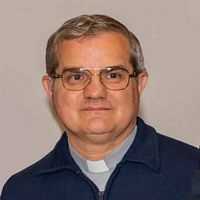 Fr Pierluigi CAMERONI
  P. Wirth MORAND