


 By BSOL Editor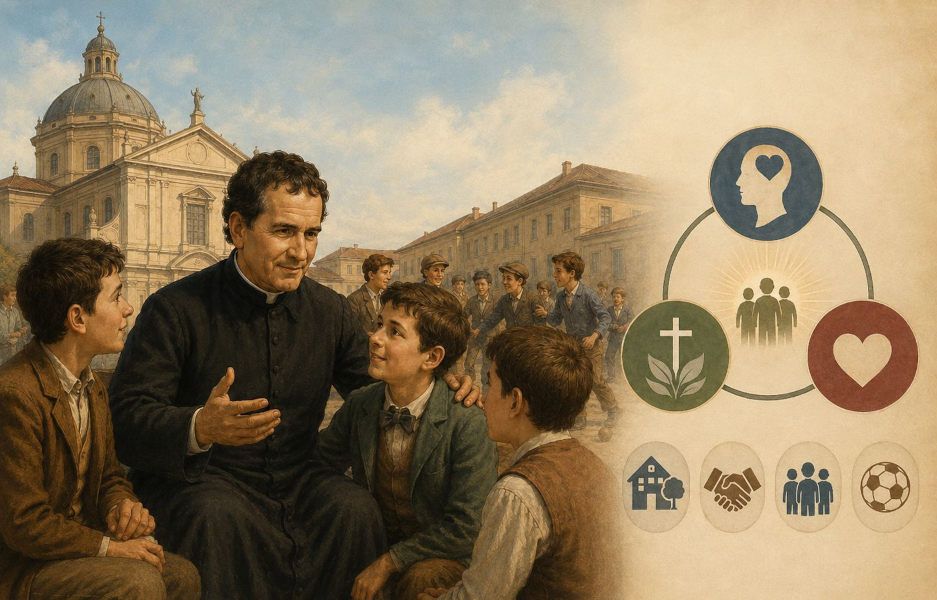
Reading time: 16 min.
We continue with the seventh and final instalment on the main texts of Don Bosco’s preventive system.
Previous article: The preventive system (6/7). To a formator of priests. The reply to the rector of the Seminary of Montpellier, Dupuy
The retrospective look: the exposition of the Biographical Memoirs
The last stage is of a different nature from the previous ones, and the series must state this openly to the reader. Chapter XLVII of the fourth volume of the Biographical Memoirs is not a text published while Don Bosco was alive. It is the systematic reconstruction that Fr. John Battista Lemoyne composed by gathering practices, testimonies, and memories of the first generation, and places it narratively in the years around 1851-1853. This is followed, in chapter XLVIII, by the word on punishments. Its value is, therefore, not as a direct source, but of reception. It tells us how the first Salesians had understood and reorganised what they had seen done. Read at the end of the series, it functions as a mirror. It allows us to measure how much of the founder’s practice had already passed into shared doctrine.
(MB IV,544-558, the entire chapter XLVII)
“CHAPTER XLVII. The Preventive System – Its application – Its advantages
From the whole of what we have set out in the previous volumes, our readers will have formed an exact criterion of the system held by Don Bosco in educating youth. This was not the so-called repressive system, but rather the preventive one, a system more in harmony with reason and Religion. Indeed, Religion teaches the charity that combats pride and selfishness, makes people sociable, grateful, and respectful towards one another, spontaneously obedient to those who have the right and duty to command, and even adorns the roughest with a certain naive gentleness because it excludes fear.
Reason then demonstrates through experience that without true affection the ministry of the educator is useless. The first happiness of a child is knowing that he is loved. And he responds to this love. He is persuaded of what the teacher asserts, loves everything the teacher teaches, likes what the teacher likes, becomes attached for his whole life to the truth and doctrine he has learned, and even feels inclined to the same profession, even priestly or religious, of his educator, and loves him as the father of his soul.
Furthermore, in these years the preventive system had become a necessity. Popular aspirations for a milder government, supported by the respective Principles, meant that the youth also demanded a more affectionate and paternal direction from their superiors. Therefore, a harsh and repressive system of education, such as had been practised in some other times, would have been repugnant to the nature of the times, and among other things, would have produced two very grave evils. It would have alienated the young people from the Oratory, where they went spontaneously, and from which they could also leave of their own free will without any law or authority holding them back. Moreover, it would have confirmed in them the malicious rumours that hired journalists, mountebanks, and actors were widely spreading, namely, that priests were so many tyrants, enemies of liberty and of the people. But by means of his system, Don Bosco prevented such a great evil from infiltrating among his young people. Therefore, the Oratory was always very well attended, making it necessary to open new ones in various parts of the city. On the other hand, if some malicious tongue came to speak ill of the priests in the presence of the young people who frequented it, it was enough for them to recall to mind the traits of exquisite goodness that Don Bosco practised, to give the slanderers a solemn lie. In fact, in the workshops it happened to them several times to bring this argument against those who were cutting wood on the backs of the priests, and several remember that then, not knowing what else to answer, the murmurers replied: If the priests were all like your Don Bosco, you would be right; but it is not so. They, however, who saw a Fr. Borel, a Fr. Chiaves, a Fr. Carpano, a Fr. Murialdo, a Fr. Vola, a Fr. Marengo and many, many other most exemplary priests forming a splendid crown around Don Bosco, and striving to imitate him in loving and treating the young people and even the urchins as friends and fathers, persisted firmly in their convictions, and judged the evil speaking as calumnies, which they were, and carried on. In this way, together with love and attachment to the Catholic Religion, they always nourished a high esteem and profound veneration towards its ministers. There is no hesitation in saying that these fruits were due to the education imparted to them by Don Bosco and his patient coadjutors.
Don Bosco had experienced such happy success with this system for the moral well-being of the young people, that after having instilled its practice in all his assistants and held various conferences on it with Fr. Eugenio Galletti, Canon of Corpus Domini, he finally wrote briefly about it, demonstrating what the two systems, preventive and repressive, consist of, adducing the reasons why the former is to be preferred, teaching its practical application and revealing its great advantages. This most useful writing later saw the light in the Regulations for Salesian Houses. We believe it is in the interest of the readers to reproduce it here for their rule and governance.
“There are two Systems,” says Don Bosco, “used in all times in the education of youth: Preventive and Repressive. The Repressive System consists in making the law known to the subjects, and then watching to discover the transgressors and inflict, where necessary, the deserved punishment. In this System the words and the appearance of the Superior must always be severe and rather threatening, and he himself must avoid all familiarity with his subordinates. Besides this, the Director, to increase the value of his authority, must rarely be found among his subjects, and mostly only when it is a question of punishing and threatening. This System is easy, less tiring, and is especially useful in the military, and in general among adult and sensible persons, who must of themselves be in a position to know and remember what is in conformity with the laws and other prescriptions.
Different and, I would say, opposite, is the Preventive System. It consists in making the prescriptions and regulations of an Institute known, and then supervising in such a way that the pupils always have the eye of the Director or the assistants upon them, who like loving fathers speak, serve as a guide in every event, give advice, and lovingly correct, which is to say: Put the pupils in the impossibility of committing faults. This System rests entirely upon reason, religion and loving-kindness. Therefore, it excludes all violent punishment, and seeks to keep even light punishments far away. It seems that this System is preferable for the following reasons:
I. The pupil, warned beforehand, does not remain degraded by the faults committed, as happens when they are reported to the Superior. The young person does not become angry at the correction given or the punishment threatened or inflicted, because there is always a friendly word that reasons with him, and which mostly succeeds in persuading him and winning his heart, so that the culprit knows the necessity of the punishment and almost desires it.
II. The most essential reason is the fickleness of the young person, who in a moment forgets the disciplinary rules and the punishments that they threaten. Therefore, a child often becomes a transgressor of a rule and deserving of a penalty, to which at the moment of the action had paid no attention at all, and would certainly have acted differently if a friendly voice had warned him.
III. The Repressive System may prevent disorders, but it will hardly make minds better. It has been observed that young people do not forget the punishments they have suffered, and mostly retain bitterness with a desire to shake off the yoke and even to take revenge for it. It sometimes seems that they pay no attention to it, but whoever follows their ways knows that the reminiscences of youth are terrible. They easily forget the punishments of their parents, but very with great difficulty those of their educators. There are facts of some who in old age brutally avenged certain punishments, justly received in the time of their education. On the contrary, the Preventive System makes a friend of the pupil, who sees in the assistant a benefactor who warns him, wants to make him good, to free him from displeasures, from punishments, from dishonour.
IV. The Preventive System treats the pupil in such a way that the educator will always be able to speak to him with the language of the heart both during the time of education and after it. With such a System, the educator, having won the heart of his protégé, will be able to exercise great influence over him, warn him, advise him, and even correct him, even when he will find himself in employments, in offices, and in commerce.
For these and many other reasons, it seems that the Preventive System should be preferred to the Repressive one.”
After this Don Bosco goes on to speak of its application and continues thus:
The practice of this system is entirely based upon the words of St. Paul who says: Charitas patiens est, benigna est, omnia suffert, omnia sperat, omnia sustinet. Also, upon these others directed to parents: “Fathers, do not provoke your children to anger, lest they lose heart”. Therefore, only the Christian can successfully apply the Preventive System. Reason and Religion are the means of which the educator must constantly make use, if he wishes to obtain his end. Here therefore, are the principal rules of application of the aforesaid System.
I. The Director must be entirely consecrated to his pupils, nor ever take on commitments that take him away from his office. Indeed, he must always be with his pupils every time they are not obligatorily bound by some occupation, except when they are duly assisted by others.
II. The masters and assistants must be of known morality. Let them study to avoid like the plague every sort of particular affection or friendship with the pupils, and let them remember that the going astray of a single one can compromise an educational Institute. Let it be done in such a way that the pupils are never alone. As far as possible let the assistants precede them to the place where they are to gather; let them remain with them until they are supervised by others; let them never leave them unoccupied even in time of recreation.
III. Let ample liberty be given to jump, run, make noise at will. Gymnastics, music, declamation, the little theatre, walks are most efficacious means for obtaining discipline, benefiting morality and health. Let care only be taken that the matter of the entertainment is well chosen, that the persons who take part in it are honest and not dangerous, and that the discourses that take place there are not blameworthy. Do whatever you wish, said the great friend of youth St Philip Neri, it is enough for me that you do not commit sins.
IV. Frequent Confession and frequent Communion are the columns that must support an educational edifice, from which threats and the whip must be kept far away. Never force the young people to frequent the holy Sacraments, but only encourage them and offer them the convenience of profiting from them. Then on the occasion of spiritual Exercises, triduums, novenas, preachings, and catechisms, let the beauty, the greatness, the holiness of that Religion be highlighted, which presents means so easy, so useful to civil society, to the tranquillity of the heart, to the salvation of the soul, as precisely are the holy Sacraments. In this way, the children become spontaneously desirous of these practices of piety; they will approach them with conviction and with fruit.
V. Let the utmost vigilance be used to prevent bad companions and books, or persons who make bad discourses, from being introduced into the Institute. The choice of a good porter is a treasure for a house of education.
VI. Every evening after the common prayers, and before the pupils go to rest, the Director, or whoever acts for him, should address a few affectionate words in public, giving some warning or advice concerning things to be done or to be avoided. Let him study to draw maxims from events that have happened during the day in the Institute or outside; but let his discourse not exceed five minutes. This little sermon well conducted is like the key to morality and to the good success of education.
VII. Let the pestiferous opinion of some be kept far away, who would like to defer first Communion to a too advanced age, when mostly the devil has already taken possession of the heart of a young person to the incalculable damage of his innocence. According to the discipline of the primitive Church, it was customary to give to children the consecrated hosts that were left over from the Communion of adults. This serves to make us know how much the Church loves that children be admitted early to holy Communion. When a young person knows how to distinguish between bread and bread, and shows sufficient instruction, let no more attention be paid to age, and let the heavenly Sovereign come to reign in that blessed soul.
VIII. Regarding Communion the catechisms recommend its frequency. St. Philip Neri advised it every eight days and even more often. The Council of Trent says clearly that it highly desires that every faithful Christian when he goes to hear holy Mass should also make Communion, not only spiritual, but sacramental, so that he may derive greater fruit from this august and divine Sacrifice”.
The usefulness of this System of education cannot escape the consideration of a sensible person. However, in order to better persuade him of it, Don Bosco continues:
“Someone will say that this System is difficult in practice. I observe that on the part of the pupils it turns out to be much easier, more satisfying, more advantageous. On the part of the educators then it contains some difficulties, which however are diminished, if the educator sets himself with all zeal to his work. The educator is an individual consecrated to the good of his pupils; therefore, he must be ready to face every trouble, every fatigue, to achieve his end, which is the civil, moral and scientific education of his pupils. Besides the advantages set out above I add also the following:
I. The pupil will always be full of respect towards the educator and will always remember with pleasure the direction he had, considering his masters and the other superiors as fathers and brothers.
II. Whatever the character, the disposition, the moral state of a young person at the time of his acceptance, the parents can live secure that their son will not be able to become worse, and it can be given for certain that some improvement will always be obtained. Certain children who were the desolation of their parents, and even rejected by correctional houses, cultivated instead according to the principles of this System, changed their disposition, altered their character, gave themselves to a well-behaved life, and presently occupy honourable offices in society, and are the support of the family and the decorum of the country.
III. The pupils who by chance should enter an Institute with bad habits cannot damage their companions. Nor will the good young people be able to receive harm from them, because there is neither time, nor place, nor opportunity, being always lovingly assisted and protected”.
Don Bosco concludes his little treatise with a word on punishments: What rule to keep, he asks, in inflicting punishments? And he answers: If it is possible, let use never be made of punishments; where then necessity demands repression, let the following be retained:
“I. Let the educator among the pupils seek to make himself loved, if he wishes to make himself feared. In this case the withdrawal of benevolence is a punishment, but a punishment that excites emulation, infuses courage and never degrades.
II. With young people that is a punishment which is made to serve as such. It has been observed that an unloving look upon some produces a greater effect than a slap would do. Praise for a fine action, blame for a culpable negligence, can serve excellently as a reward or a punishment.
III. Except in very rare cases, corrections and punishments should never be given in public, but privately and far from the sight of companions. Let the utmost prudence and patience then be used to make the pupil understand his wrong with reason and with religion.
IV. Giving rude titles, striking in any way, putting on the knees in a painful position, pulling the ears and other similar acts, must be absolutely avoided, because they are forbidden by civil laws, greatly irritate the young people, and degrade the educator himself.
V. Let the Director make well known the rules, the rewards and the punishments established by the Regulations of discipline, so that the pupil cannot excuse himself saying: I did not know that this was commanded or forbidden.
VI. Before inflicting any punishment whatsoever let it be observed what degree of culpability is found in the pupil, and where the admonition is enough let the reproach not be used, and where this is sufficient let one not proceed further.
VII. Neither in words nor in deeds should one ever punish when the mind is agitated; never for faults of simple inadvertence; never too often.” Thus said D. Bosco. The above-described system, followed by him and recommended from the very beginning of the Oratory and the Hospice, is the one that is still studied and practised today in all Salesian Houses; and the Superiors know that they flourish the most and yield good fruit precisely the more the said system is better known and more exactly executed.
The principles of this system of education gave Don Bosco the subject matter for the conferences he held for his coadjutors. He often recalled the words of Saint Francis de Sales: “You catch more flies with a spoonful of honey than with a barrel of vinegar”. And he suffered if anyone showed themselves harsh with the youths and with subordinates, wanting everyone to be won over by charity. Never forget, he continually said to anyone who had authority over the pupils, that boys fail more out of liveliness than malice, more from not being well assisted than from wickedness. One must take solicitous care of them, assist them attentively without seeming to do so, and even take part in their games, tolerate their clamour and the annoyances they cause, since even the Divine Saviour said in such circumstances: Sinite parvulos venire ad me. And he watched over them attentively wherever they were. He frequently came into the study hall and went into the workshops. Never did the slightest infraction of the rules occur without him immediately noticing it and remedying it promptly. He often conferred with the other superiors, inquiring about the conduct of the boys and always giving guidelines for the good management of discipline. He prescribed that every week each pupil should be given a mark for conduct, study, and work, and he himself read the marks publicly on Sunday evenings, encouraging the diligent and admonishing the negligent.
Don Bosco was certain that ordinarily, through reflection, all young people are brought to recognise their own failings and to correct them. Therefore, he never tired of advising and counselling; and his patience was truly heroic. When any superior was uncertain about the good outcome of a boy, whether to accept him or dismiss him, he suggested putting into practice, even in this case, the maxim of Saint Paul: Omnia probate, quod bonum est tenete; and to this end, vigilance and timely advice had to lead. At the beginning of the year, if he came to suspect that any of the newly accepted boys might cause harm to their companions, he called him to himself, warned him with the most vivid expressions of sorrow, and had him watched over in a special way. With such solicitude, he managed to correct many who, coming from the world, brought with them the bad habit, unfortunately too common, of foul language.
It is difficult to express in words the secret D. Bosco had for winning young people over to himself and drawing them to the service of the Lord. He possessed in the order of nature and grace such gifts and prerogatives that, having taken a boy aside and spoken to him confidentially in his ear, however unruly or rebellious to grace he might be, it rarely happened that he did not yield to his paternal advice and admonitions. And these could not prove ineffective, since D. Bosco would have given his life a hundred times over for souls if it had been necessary.
His words opened hearts, and he often insisted on the sincerity to be used especially with superiors in matters of the soul, described its advantages, called it the key to internal peace, the most effective weapon for driving away melancholy, the surest secret for finding contentment in life and in death, and for reaching great perfection. With such a recommendation, he aimed at nothing other than preventing sin, or destroying it along with its consequences.
He used to say to his coadjutors: We must keep sin away from the house and our boys must all put themselves in the grace of God: without this, things cannot go well. And he often added: Remember that the first method for educating well is to make good confessions and good communions. He placed all the strength of his mission among the youth in the frequentation of this sacrament. He ensured that his pupils approached it regularly, indeed very frequently, but without any sort of pressure. He exhorted them and wanted them to be exhorted, but he did not oblige them. Although he was there every morning to confess, and the desire to confess to him was general, so much so that he did not have time to satisfy everyone’s desire, nevertheless he wanted other external confessors to be found, especially on feast days and their eves. He left everyone the utmost liberty; he made no remarks and did not want any to be made about who confessed to him or who to other priests. And years later he gave as a rule to one of his priests: Act in such a way as never to give any sign of partiality towards someone who prefers to confess to one rather than another. Likewise, he never yielded to permitting that on days of general communion the boys should be made to leave the pews in an orderly fashion by row to go to the altar, so that whoever was not prepared would not let himself be overcome, to his great detriment, by human respect, or be pointed out by the others. Better liberty and a little confusion. At the daily mass of the community, communions were so numerous that several strangers asked more than once what feast was being celebrated because it seemed to them, they had attended a general communion.
Moreover, the good that D. Bosco worked by means of confession is so great that we would dare to call him the apostle of confession. He inspired such tranquillity and trust in God and in His mercies that many, having left the Oratory, almost struggled to get used to other confessors. He inculcated in penitents the maxim of St. Philip Neri: Sins and melancholy I do not want in my house, and with this he wanted them to trust fully in their eternal salvation.
And frequenting the sacraments was the powerful spring that propelled everyone along the path of obedience with peace and joy. Hence the characteristic note of the Oratory was a boisterous ease of manners, a lively distribution of games, united with the utmost religiosity and morality and diligence in one’s duties. This was personified in a large number of excellent boys, true models and exemplars for their other companions. Hundreds of former pupils, priests and laymen, attest to not remembering any grave disorder having occurred in their time.
Canon Ballesio wrote: “The restraint on evil, the incitement to good, our joyfulness and satisfaction, the order in the house, our success in study and work, everything was born from the rational, intimate, and fervent piety that the servant of God knew how to instil in us, with his example, with his sermons, with the frequentation of the sacraments at that time almost new among the young, with his talks and with his lively and edifying stories. At the same time, with certain words of his, with gestures, with glances, he dispelled the darkness, the anxieties of the spirit, flooded our souls with joy, and filled us with fervour for the love of virtue, sacrifice, and obedience”.
Oh! how dear those expressions so familiar to him sounded on his lips while the faith he had in his heart shone through his face: How good the Lord is to us that He never lets us lack anything! Let us serve Him willingly! Let us love God; let us love Him because He is our father.
Everything passes: that which is not eternal is nothing!
It therefore stands out clearly, and we shall speak of it again in many other pages, how the method of education chosen by D. Bosco was goodness wisely and gently adapted to the youthful age. But oh, how desirable it would be that such a system be introduced into all Christian families, into all public and private educational institutes, male and female! How much easier the exercise of good towards the young would become, how prompt the medicine would be at the first appearance of evil, what security for honest and innocent children against the bad examples of the perverted. Then we would not delay in having a more well-behaved and pious youth; a youth that would be the consolation of families and a valid support for civil society. And so, it was understood by a large number of educators of various nations and especially of England. Here many colleges, destined for poor and Catholic youth, took as a model, after the death of D. Bosco, the Oratory of Turin and its regulations. The founders studied the life of D. Bosco and his practical system of education, followed his examples with great fruit for ecclesiastical vocations, and the portrait of the man of God occupies the place of honour in those institutes and also in the seminaries.
Even among Protestants, D. Bosco had imitators. Fr. Giovenale Bonavia wrote to us on 12 June 1903, from our House in London. “I am sending you two periodicals that contain some observations on D. Bosco. They are not Catholic, but belong, it seems, to the Anglican section called the High Church, that is, ritualist or Puseyite. The writer, a certain Norman Potter, I believe is the same person with whom one of our priests made personal acquaintance months ago. He is the Director of a boys’ Hospice not very far from us and whoever visited him saw in the reception room the portrait of D. Bosco with the motto: Da mihi animas, caetera tolle. This gentleman has travelled in Italy, visited some of our houses and the Oratory of Turin. He imitates D. Bosco as much as he can.
He has a (Protestant) chaplain in his Institute. I believe he also reads the Salesian Bulletin.
“He therefore gives a historical outline of D. Bosco in the two aforementioned articles.
“The first, Goodurtl (Goodwill), printed in 1900, is the shorter one with a portrait. The second, Common wealth (Public good), was printed this year, is more widespread and also gives a sketch of the preventive system taken from the regulations of our houses. Where it speaks of frequent confession and communion and of daily mass, he translates the word Messa into Eucharist perhaps to avoid the word Mass which is offensive to many, even Anglicans. He concludes both articles by expressing the wish that the Lord may raise up here in England men with the spirit of D. Bosco, of whom there is so much need.”