


 By P. Wirth MORAND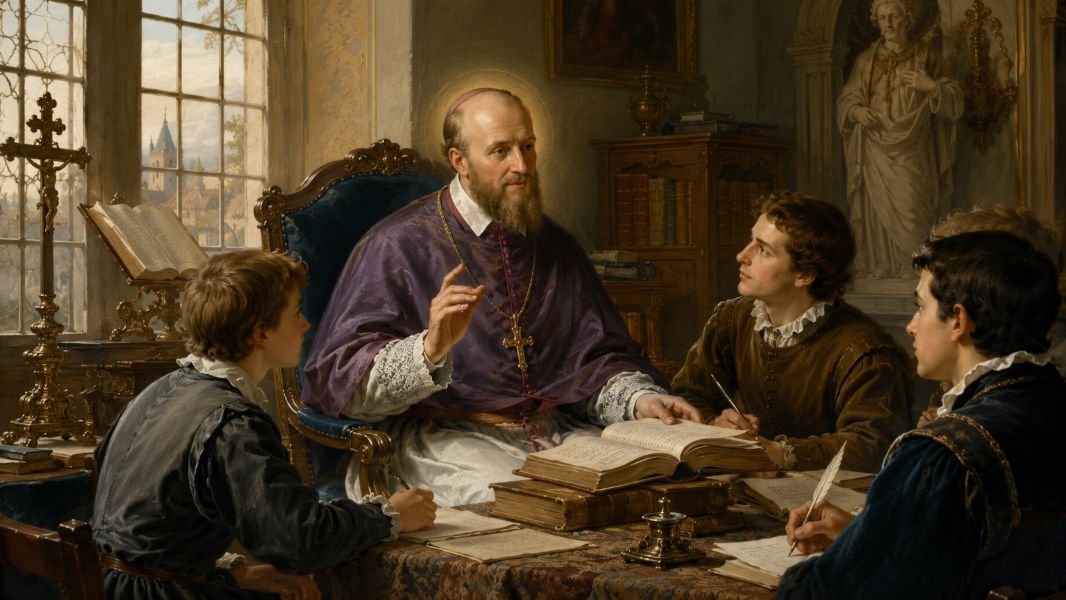
Reading time: 11 min.
When Francis de Sales was born in 1567, the world was changing its face. Gutenberg’s printing press was spreading books and a thirst for education even to the most remote countryside. Humanists were rediscovering the Greek and Latin classics. Copernicus and Galileo were revolutionising science. Navigators were opening up the routes to the New World. For the first time, childhood was recognised as a stage of life with its own needs, worthy of a pedagogy based on gentleness and patience. The future Bishop of Geneva fully breathed in this atmosphere. He read Erasmus and Montaigne, admired the geographical discoveries, and wrote elegant Latin and refined French. But his humanism had a Christian heart: it was the “devout humanism” that would also inspire Don Bosco.
A “divine” invention
At the dawn of modern times, as the Middle Ages drew to a close and a new period known as the Renaissance began, the invention of printing and typography in the mid-15th century must have seemed like something extraordinary. In Gargantua’s famous letter to his son Pantagruel, Rabelais marvelled at “those printings so elegant and correct in use, which were invented in my time by divine inspiration”. Francis de Sales was not far from sharing this enthusiasm when he compared the work of creation to Gutenberg’s art:
God, like the printer, gave existence to all the diversity of creatures that have been, are, and will be, with a single stroke of his omnipotent will.
Indeed, one cannot overstate the impact of this invention which, by disseminating the book, opened a new era in the communication of ideas and culture. Alongside the literary works of the humanists and specialist texts intended for jurists, clergymen, doctors, or even craftsmen, an immense production of works for all types of audiences began to emerge from the presses: books of hours, lives of the saints, the “Ars moriendi“, the “Imitation of Christ”, and chivalric romances of the Middle Ages.
The first printed schoolbooks were the classical Latin and Greek texts, the famous Latin dictionary by the Italian lexicographer Calepino, the Latin grammar of Donatus, a renowned 4th-century grammarian, as well as primers in which children learned to read directly in French using short religious and moralising texts. By now, printing was establishing itself in the cities, and pedlars were offering it even in the most remote countryside. Everywhere, it developed the taste and need for reading and education.
The humanism of modern times
The term Renaissance was introduced in the 19th century to designate the cultural movement born in Italy as early as the mid-15th century. A profound change in mindsets was taking place, the causes of which have been the subject of much debate. In any case, one cannot overlook the new economic conditions, particularly the development of trade, urban life, and monetary exchanges, which threw the old feudal and clerical culture of the Middle Ages into crisis.
In a negative sense, the Renaissance can be characterised by a series of rejections: the rejection of the barbarous Latin of medieval teaching, the rejection of the “dictatorship” of Aristotle, the philosopher par excellence of the Middle Ages which interpreted him in its own way, and the rejection of sterile scholastic logic. In a positive sense, it professed a genuine enthusiasm for human nature and a universal curiosity for all its manifestations. In this sense, the Renaissance paved the way for what would be called humanism, from which it is inseparable.
After the studia divinitatis of the Middle Ages, people became passionate about the studia humanitatis. Curiosity focused in particular on Greco-Latin antiquity, its authors, and its great figures, who were now the object of a veritable cult. In a sermon of 1621, Francis de Sales also evoked “the Philips and Alexanders of whom the humanists speak so much”. Even mythology and the pagan gods were coming back into fashion, if only to enrich literary and artistic expression, but perhaps also for something more.
The fashionable figure was Alexander the Great, hero of Greece and founder of an immense empire. The Bishop of Geneva often speaks of him, but taking care to show the superiority of the Apostle Paul:
The former destroys cities, tears down castles, subjugates the world by force of arms, and in the end allows himself to be defeated by himself. On the contrary, our great Apostle seems to want to subjugate and traverse the whole earth to tear down not walls, but the hearts of men, and submit them to his Master through his preaching.
The cult of literary perfection drove humanists not only to seek their models among the Greeks and Latins, but also to write in Latin following such models. Scholastic Latin gave way to a classical and elegant Latin, whose unsurpassed model was, for most humanists, that of Cicero. The French language was also gaining prestige; in 1539, Francis I had prescribed its use instead of Latin for court ordinances and rulings. In Savoy, Duke Emmanuel Philibert did the same in 1560, and Francis de Sales, who was not even a subject of the King of France, affectionately called it “our French language”.
An extraordinary thirst for knowledge had infected the humanists of the Renaissance. Not only was the true Aristotle being rediscovered by resorting to the original texts, but Plato was discovered almost entirely, which would inspire a new natural philosophy. In Florence, the master of the Platonic school, Marsilio Ficino, a theorist of love and beauty, saw the universe as an animated organism, subject to celestial influences, formed by the union between heaven and earth.
Mathematics was experiencing a new flourishing since Pierre de La Ramée – better known by his Latin name Ramus – had dared to oppose Aristotle, becoming the first professor of this discipline at the Collège Royal in Paris. Francis de Sales mentions one of his successors, “the famous Bressius”, who held his chair from 1576 onwards.
The Polish astronomer Copernicus overturned Ptolemy’s geocentric system, asserting that the planets rotate on their axes and around the Sun along circular orbits not situated on the same plane. His theory was at the origin of the scientific revolution of the 17th century. His most famous disciple was Galileo, a pioneer of the experimental method, who observed the sky using the astronomical spyglass, the ancestor of the telescope.
Medicine, too, was freeing itself from its philosophical prejudices to dedicate itself to experimentation, as happened in particular at the University of Padua, attended by the young Francis de Sales. In the same year, 1543, that Copernicus published his De revolutionibus orbium coelestium, the Flemish physician Vesalius had printed his De humani corporis fabrica, a treatise based entirely on the anatomical study of the human body.
An era – that of the Middle Ages – in which everything was considered in relation to God, was replaced by an era of discovery of man in all his aesthetic, literary, scientific, and moral dimensions. The various branches of knowledge were freeing themselves from the tutelage of theology. Politics freed itself from ethical and religious dogmas with Machiavelli, whose masterpiece, The Prince featured in Francis de Sales’s library of forbidden books.
The discovery of the New World
The discovery of unknown lands in America (the West “Indies”), in Asia (the East Indies), and in Africa fuelled a thirst for knowledge that from now on could be satisfied “in every corner of the earth, in the Old and the New World”. Francis de Sales took an interest in these great currents of information and exchange. He read the History of the East Indies by the Jesuit G.P. Maffei, the “Letters from Japan and China” by the Jesuit P. Almeida, the “General History of the West Indies“ by F. López de Gómara, and the “Dies caniculares” by S. Majoli, a collection of natural phenomena and curious things “in Europe, Asia, and Africa”.
He knew of the great Portuguese navigators: Bartolomeu Dias, who gave his name to the Cape of Good Hope; the “valiant and Catholic captain Albuquerque”, who had “Goa, the principal city of the East Indies, fortified”; the discoverer of Brazil, Pedro Álvares Cabral, who “erected a very high cross there, for which reason that whole country was called the region of the Holy Cross for many years, until the people, abandoning that sacred name, called it Brazil, from the name of the brazilwood that is extracted from it for dyeing”.
In his “Defence of the Standard of the Holy Cross”, Francis de Sales recounts the surprising facts that accompanied the arrival of Christianity overseas: the apparition of a cross at the time of Albuquerque “in one of the regions of the Indies”, the story of the miraculous cross of Meliapor, the devotion to the cross among the inhabitants of Socotra, “an island in the Erythraean Sea”, the apparitions of the cross “near the kingdom of the Abyssinians”, and “towards Japan”, the apparition in the ancient kingdom of the Congo of men marked with the sign of the cross in the service of King Afonso, and the construction of the temple of the Holy Cross in the city of Ambasse.
But the discovery of new lands brought about the rebirth of slavery, which was all too reminiscent of that practised by the Romans in the days of paganism:
Mark Antony one day bought two young boys who were presented to him by a certain horse merchant; for at that time, as still happens in some regions, children were sold. There were men who stocked up on them and practised this trade as is done with horses in our lands.
On the other hand, he also describes the amazement of the indigenous people in the face of certain inventions:
It is said that the good Indians amuse themselves for whole days in front of a clock to hear it strike the hours at the right time, and being unable to guess how this happens, they do not say, however, that it is devoid of art and reason, but remain enchanted by love and honour towards those who govern the clocks, admiring them as more than human persons.
In the letters of the Jesuit missionaries, Francis de Sales gathers curiosities, such as that of this animal from the Indies, ‘which, despite being terrestrial by nature, little by little and piece by piece entirely loses its nature and becomes completely fish’. In the “Introduction to the Devout Life” he recounts that ‘those who come from Peru, in addition to the gold and silver they extract from it, also bring monkeys and parrots’. In another passage he mentions those ‘peoples of the New World [who] send their delegates to the king with the most modest retinue possible, to make their baseness and humility all the more evident compared to the glory and majesty of their king’. He compares himself to geographers – who at the time were called cosmographers – when he tries to outline the portrait of a great figure:
Imitating therefore the cosmographers, who in their maps mark only dots to indicate cities, lines for mountains, and leave to the imagination the task of picturing the rest.
At least once, from his pen emerges the name of the new continent that was being explored:
We partly know the configuration of America and what concerns this country thanks to the descriptions made by those who have visited it.
As is known, it was the invention of the compass, with its magnetic needle always pointing north, that made possible the extraordinary discoveries of which contemporaries were witnesses. A marvellous invention, indeed, which ensures that one is never lost without a point of reference:
Whether the ship takes whatever route it wishes, whether it sails west or east, south or north, and whatever the wind that drives it, its compass will never look at anything other than its pole star and the pole.
The ‘discovery’ of childhood
The dawn of modern times also corresponds to a discovery of another kind, which Philippe Ariès defined as the discovery of childhood, now considered an age of life distinct from that of adults.
While in medieval society the child counted for very little or was treated from the outset as a little man, this phase of life is increasingly considered as an age in its own right.
People take an interest in the child, give them special clothes, and they play games different from those of adults. The family itself begins to become aware of its own identity, cultivates its own intimacy, its own affective bonds and its own educational attention. The awareness of the specific character of early childhood manifests itself in particular in the creation of schools and colleges that no longer experience the mixing of young and old as in the Middle Ages.
To renew society and form a new type of man – civil, courteous, amiable, pious and cultured – the humanists spread a renewed pedagogy.
Born in 1567, Francis de Sales was able to benefit from the teachings of the first generations of humanists. He knew and appreciated Jean Gerson, sometimes considered a precursor of the humanists. When he writes that ‘that man was extremely learned, judicious and devout’, he was undoubtedly referring to the book The “Imitation of Christ”, of which he was believed to be the author, but perhaps also to the pedagogical works of the Chancellor of the University of Paris, who hoped that children would be treated with gentleness and patience. Among the humanist authors who could have influenced in some way, positively or negatively, the thought and action of Francis de Sales, Erasmus, More, Vives, Sadolet, Rabelais, and Montaigne should be noted in particular.
Francis de Sales recognised in Erasmus of Rotterdam first and foremost a ‘great man of letters’, the one who stated that ‘the best way to learn and become learned is to teach’. In his library of forbidden books, which he had obtained authorisation to read, there were two works by the great European humanist, including the first critical edition of the New Testament. Francis de Sales did not fail to cite his Latin translation of the New Testament when it went in that direction, particularly in defence of the Catholic conception of the Mass.
Moreover, his work presents many Erasmian traits: humanism drawn from classical antiquity, the search for images and examples, and verbal abundance. One of Erasmus’s last works was, in 1530, his “De civilitate morum puerilium“, which spread the concept of ‘civility’ in European society at the time. A friend of Erasmus, the Chancellor of England Thomas More is cited once by Francis de Sales, but in reference to the authority of the Church.
We do not have explicit evidence to state with certainty that the Bishop of Geneva read the works of Juan Luis Vives. However, a careful study of his conception of man has made it possible to identify one of his sources in the De anima et vita of the great Spanish humanist. During the period when he was tutor to Mary Tudor, he wrote a “De institutione feminae christianae” and a “De ratione studii puerilis“, two treatises on humanist pedagogy published in 1523.
Saint Francis de Sales must have felt very close to the opinions of Cardinal Sadolet, Bishop of Carpentras and a great humanist, whose name appears in the book of Controversies, as a member of a commission for the reform of the Church. In his “De liberis recte instituendis“, written in the form of a letter to his nephew Paolo, Sadolet had founded education on religious need combined with an explicitly humanistic culture, a synthesis of ancient wisdom and Christian faith. His educational system embraces all fields: religious, moral and social formation, letters, philosophy and theology, mathematics and astronomy, gymnastics and music.
Rabelais, author of Pantagruel and Gargantua, spread in his writings the enthusiasm of the humanists for the philosophy, morality and knowledge of antiquity. The giants whose incredible adventures he recounts were the symbol of man without limits, true king of the universe, who had become an ‘abyss of sciences’. Although religion is very present in his work, it tends towards a naturalistic, non-dogmatic theism. Youth, Francis thinks, has little to gain from this less than honourable master who despises the past.
As for Michel de Montaigne, he was certainly no stranger to Francis de Sales, who cites him several times in his Controversies, not on questions of pedagogy, but in support of his controversies with the Protestants. Regarding the difficulty of controlling translations of the Bible into the vernacular, Francis de Sales relies on the opinion expressed by the ‘learned layman’. On a literary level, Francis de Sales is very close to him, even in the use of images and comparisons. He could feel quite in tune with the statements of this wise man who prefers ‘a well-formed mind rather than a well-filled one’, who wants the lesson to be not only useful, but also pleasant, and who rejects the use of violence in education.
Francis de Sales, a man of multiple borders
In Savoy they spoke French, despite not being French, and the cult of the French language was even one of the characteristics of the time. Francis de Sales himself was very sensitive to it, to the point of having one of his texts reviewed by a Parisian friend before publishing it, because, he said, ‘I fear that some accents of our way of speaking around here might escape me’.
Humanism was flourishing in the cultured circles of Savoy. Claude de Seyssel, who died in 1520, had brought back the cult of belles-lettres, Latin, Greek and Hebrew. The poet Marc-Claude de Buttet had been a pupil in Paris of Jean Dorat, who also counted Ronsard, du Bellay and Baïf among his disciples; he was secretary to Marguerite de Valois and a friend of the poets of the Pléiade. Francis de Sales’s father met him when he himself frequented the French court. In Chambéry, the historical capital of Savoy, the Jesuits had been teaching classical disciplines in their college since 1565.
From a geographical point of view, the gaze of this Savoyard between the end of the 16th century and the beginning of the 17th naturally turned towards Turin, where the duke had resided since 1563, and towards Rome, where he maintained a correspondence with the Pope and with the Curia.
Having spent more than three years in Padua, in the Republic of Venice, he was relatively bilingual and his correspondence contains a not insignificant number of letters in Italian. Trained in European humanism, he also writes a Latin with a classical flavour.
From a literary point of view, he finds himself in a moment of transition, straddling the Renaissance and the classical age. The first great Italian humanists were by now distant. In France, they were moving towards the classical age. In many aspects of his sensibility and his art, there is in him something of the richness and luminosity of that Baroque art which blossomed after the Council of Trent, under the influence in particular of the Jesuits.
Francis de Sales is certainly a humanist, but his humanism is that of a Christian humanist or, to use the words of Henri Bremond, of a devout humanist. Sometimes there are distances to be bridged between humanism and devotion, between a certain purely humanistic education and a fervent Christian education.
 BSOL Editor
  Fr Pierluigi CAMERONI