


 By Fr Bruno FERRERO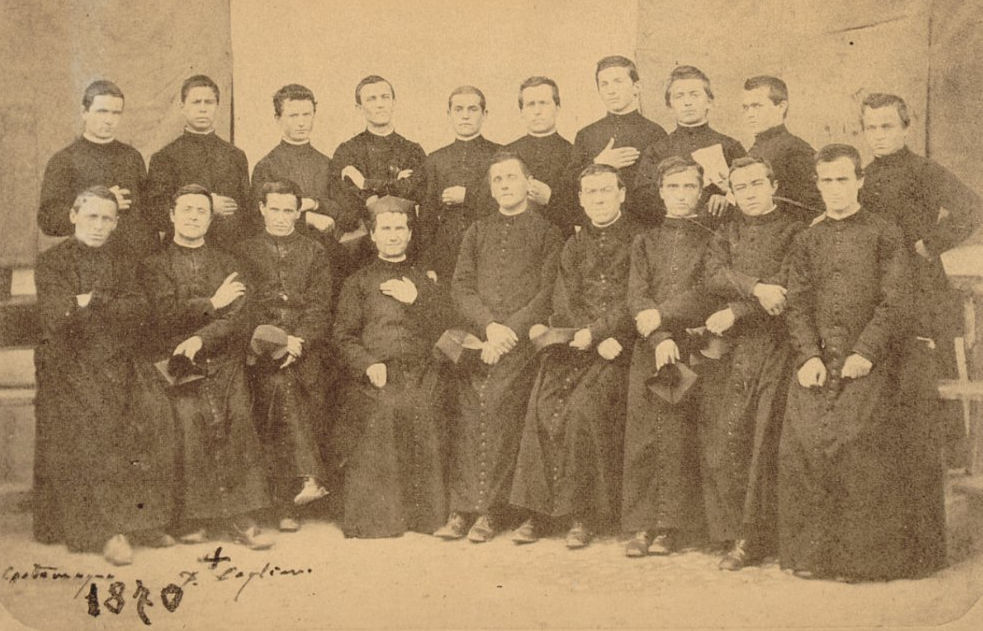
Reading time: 7 min.
Giovanni Battista Bertagna was born in Castelnuovo d’Asti on 26 October 1828. He graduated in theology from the University of Turin on 24 April 1850. He was ordained a priest in June 1851. From that year he was first a tutor, then head of conference of moral theology at the Ecclesiastical College of Turin, until in 1876, he was dismissed by Archbishop Gastaldi. He was then in Asti as a professor in the seminary, pro-vicar, and then vicar general of the diocese. Promoted to Titular Bishop of Capernaum on 24 March 1884, he was appointed Auxiliary Bishop to Cardinal Alimonda in Turin. In 1901, he was appointed archbishop. He gave testimony in the canonical process of Don Bosco.
Because he was magnificently human.
I am Giovanni Battista Bertagna, a native of Castelnuovo d’Asti (now Castelnuovo Don Bosco), 62 years of age, titular bishop of Capernaum, auxiliary to the most eminent Cardinal Alimonda, archbishop of Turin. I was not prompted by anyone concerning what I must say. What I will say is all from my own knowledge.
“He taught me Latin during the autumn holidays”
I have known Don Bosco since my infancy. He sometimes taught me, for some years, Latin during the autumn holidays (in the years 1839-40). I then had familiar acquaintance with him for many years, especially when we were both already priests (Monsignor Bertagna was born in 1828, Don Bosco in 1815; Monsignor Bertagna was ordained a priest in 1851, Don Bosco in 1841). During the many years I lived in the Ecclesiastical College, that is from 1864 to 1871, I had more frequent, more intimate familiarity with him. He came to the College every day to compose his Catholic Readings.
“I knew his mother”
I knew his mother, who was a very good woman, very simple and of very good spirit. She was a peasant, not of a rich condition, indeed, rather poor. She was highly esteemed throughout the town. Don Bosco spent the first years of his life in his hamlet (of Becchi), learning the first lessons of catechism from his own mother… When he was a bit older, he would come to the town, and always showed very great commitment and attention in all the things he did, especially if it concerned religion.
I heard from his own mouth, around the years when he began to occupy himself especially with the youth, that his first intention was to go and bring the Gospel to the infidels, and that he was held back from the execution of this firm plan for the reason that he could not bear a journey in a closed carriage (as long journeys were then made).
Educator
The facts are enough to demonstrate how much aptitude and vocation Don Bosco had in educating the youth in a Christian way. The outcome was extraordinary, marvellous. It would be a very difficult thing to explain the skilful and diligent industriousness that Don Bosco knew how to use to attract the youth to religion, the ways in which he kept them, the patience used. I believe he began to gather the youngsters in 1843 in the sacristy of the Church of St. Francis of Assisi, where I myself attended once as a disciple among others (Bertagna was 15 years old), invited by him on an occasion when I had come temporarily to Turin. In 1847, the festive Oratory in Valdocco was already in order, and I would go to do the festive catechism (Bertagna was by then a theology student).
To entice the young to go to the Oratory, he would attract them with pleasant ways wherever he met them; he would charge the young people themselves with attracting others; he would give them sweets; he would take them for walks; he himself would play games. With these means, he attracted a great number to himself, distancing them from vices and leading them to virtue and to the frequenting of the sacraments. He lent himself tirelessly to confession. He also had the habit of going now to one boss now to another (where the young people worked) to inquire about their conduct and to recommend them to their vigilance. With these methods, he not only aimed at the advantage of the children, but also at the good of the bosses.
I can attest that Don Bosco in all these works gave proof of great zeal and prudence. The young people, therefore, esteemed him as an extraordinary and holy person, and his mere presence was for them an invitation to good.
He obeyed only Fr. Cafasso without objections
He was on very good terms with the theologian Borel, a man of very great virtue. From some memories I keep, it seems to me that Don Bosco was not always compliant with the advice that was given to him, if it was not in conformity with his plans… However, he always obeyed Fr. Cafasso entirely and without objections.
I know that Don Bosco received some unfavourable observations on the running of his house from the Archbishop of Turin, Riccardi (di Netro). The archbishop (in Turin from 1867 to 1870) judged that Don Bosco gave responsibilities to his young people too soon, when they were not capable enough to sustain them. Sometimes Don Bosco gave the role of assistant in his schools to young men who were barely adolescents. Sometimes he gave the role of director of a school to someone who was barely a priest. It seems to me that Monsignor Riccardi did not proceed without foundation, although Don Bosco excused himself on the great need he had of these young people.
I have never heard anything from Don Bosco or about Don Bosco that was in the least contrary to the commandments of God and of the Church.
He spoke of the things of God
Don Bosco in every circumstance seemed to know how to speak only of spiritual things and of the glory of God. He was accustomed to say great things about the authority of the Pope; he taught veneration and obedience to him, and he instilled it in souls. It was familiar to him to give good advice for the conversion of sinners and to comfort the good. That spirit which drove him to preach so frequently, to attend to confessions with such assiduity, to write so continuously, also led him to seek the good of souls on any occasion.
His faith was very lively. His hope was kindled and flourished well beyond common attitudes. Those very frequent aspirations into which he used to burst, and those warm effusions of the soul with which he expressed the ardent desire for blessed eternity, bear witness to this.
He had a splendid vigilance in keeping a most rigorous account of time, always occupying it promptly in good works of the highest value.
A strong and calm man
Truly admirable was that continuous application of his now, to one labour now to another, and immediately after taking up another without allowing himself rest throughout the day. His night was very brief, and not always. It happened that he would spend entire nights working and, it seems, sometimes confessing… Admirable was the patience with which he often tolerated those who for almost trivial things came to interrupt his work, and this not once but many times. And after such labours, he did not show himself tired, but passed on to other occupations, always with a tranquillity that was prodigious.
A chaste and poor priest
I can attest that Don Bosco used great reserve in dealing with people and especially with women and with the children of the Oratory. On this point, he has always enjoyed an unblemished reputation both in Turin and in Castelnuovo, his native town, for the time of his youth. It is believed that he had a special gift for knowing how to instil this virtue in youthful souls.
Don Bosco was born to rather poor parents. He did not enrich the family in anything, and he never complained, that I know of, about his condition, indeed he was happy about it. If the occasion arose, he did not hide his family’s low condition, and he enjoyed recounting the humble services he had had to perform in the countryside as a boy. He liked to say that he had no title of honour, no degree in theology, no professor’s diploma, not even the diploma of a simple first-grade primary school teacher.
“Prophecies? Who knows… He certainly had the supernatural gift of healing”
I have heard many times that Don Bosco made prophecies, that he read people’s hearts, that he manifested hidden things. I have never had a firm argument to believe these things as true… I do believe it to be true, however, that Don Bosco had the supernatural gift of healing the sick. This I heard from him himself on an occasion when we were both on spiritual exercises at the sanctuary of St. Ignazio above Lanzo, and he told me this to get advice on whether he should continue to bless the sick with images of Mary Help of Christians and of the Saviour. He said this because a certain rumour was being raised about the healings that were happening and that had the air of being prodigious following such blessings imparted by him. And I hold that Don Bosco was telling the truth. For better or worse, I thought I should advise Don Bosco to continue his blessings.
The holiness and humanity of Don Bosco
It cannot in any way be denied that Don Bosco was venerated by many and serious people while he was alive, and especially for some years before his death. He was in great veneration among many bishops, and very many people looked upon him as a saint. I know that some, in the early days when his congregation was beginning, did not always in everything speak well of him, but later they showed they had reverence and esteem for him. In my judgment, seeing him in his last eight or ten years, already full of ailments, overloaded with occupations, always besieged by all sorts of people, and he was always calm, never giving in to even the slightest impatience, without showing haste, never rushing what was put in his hand, gives good reason to say that if he was not a saint, he nevertheless rendered the image of a saint. The outcome then of his principal work, and as of his whole life, that is, his congregation, is what has the most force for me in wanting to persuade myself that Don Bosco was a saint.
If then, I look at some traits of his life, that is, the tenacity with which he sometimes tried to succeed in his intent, it seems to me I see in it something of humanity. Thus, as it seems at first glance, he sometimes seemed somewhat inopportune in asking for alms, somewhat ardent, and more than was proper, to obtain them… Likewise, he sometimes seemed too reluctant to abandon his own opinion, although this cannot be criticised by me. If the offences touched his person, he paid them no mind and forgot them with admirable sacrifice. But if his plan to establish his congregation was opposed, he did not always show the same facility in forgetting.
I believe it true that Don Bosco had an easily irascible nature, very hard and not at all pliable. It is certain that he had to use much effort to conquer it, and he did conquer it.
I went to see him twice during his last illness; he spoke of spiritual things; he made himself admired for his patience. When I was about to end my visit, he asked me, and absolutely wanted me to bless him, uncovering his head.
Giovanni Battista BERTAGNA, bishop
manuscript of the ordinary process, public copy, folios 235-246.
 BSOL Editor