


 By St John Bosco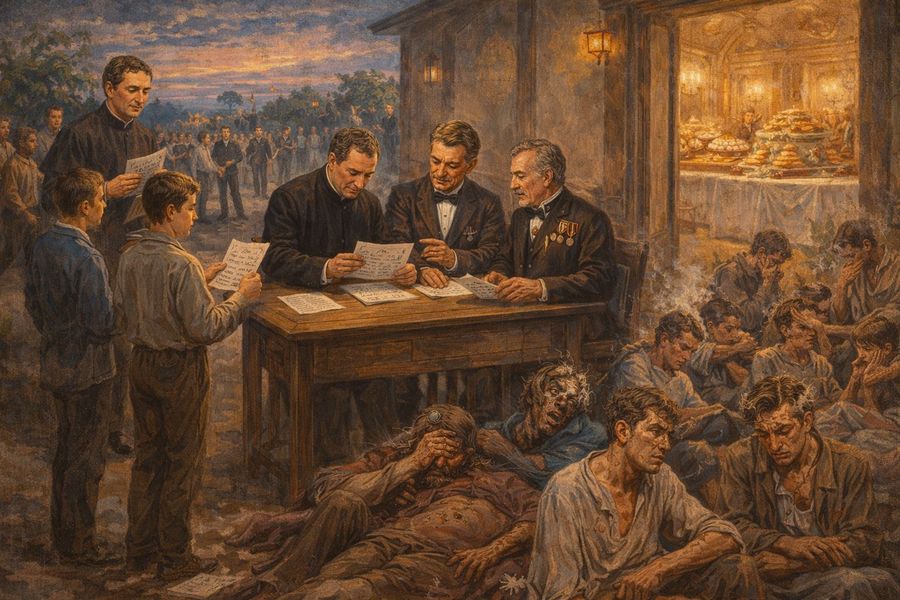
Reading time: 8 min.
It is to this divine goodness that Father Bonetti alludes [in the above-quoted excerpt] when he hints at the extraordinary incidents which Don Bosco’s biographer would one day narrate. Here is the first wondrous incident, taken from the chronicles of Father [Dominic] Rufino and Father [John] Bonetti: “On the nights of December 28, 29, and 30 [1860] Don Bosco had what he called three ‘dreams.’ From what we have seen, heard, and experienced, we can unhesitatingly call them ‘visions.’ It was the same dream repeating itself with new details. Our good father Don Bosco narrated it briefly, as follows, to all the boys gathered together at night prayers on the last day of the year 1860:
For three consecutive nights I found myself in the countryside of Rivalta with Father [Joseph] Cafasso, Silvio Pellico,2 and Count [Charles] Cays.3 The first night we discussed current religious topics; the second night we debated and solved moral cases relevant to the spiritual direction of young people. After having the same dream twice, I decided I would tell you about it, if it came to me again. Sure enough, on the night of December 30 I found myself once more with the same people in the same place. Putting other matters aside, I recalled that the following night, the last of the year, I would have to give you the customary strenna4 for the New Year. Therefore, I turned to Father Cafasso and said, “Father, since you are such a dear friend of mine, please give me the strenna for my boys.”
“On one condition,” he replied. “First you must tell them to put their accounts in order.”
We were standing in a large room with a table in the center. Father Cafasso, Silvio Pellico, and Count Cays sat themselves at the table. As I had been requested by Father Cafasso, I went out to get my boys. They were all busy adding up figures on a tablet. As I called them one by one, they presented their papers to the above-named gentlemen, who checked the sums and either approved or rejected them. Quite a few boys were turned back, sad and worried. Those whose totals had been found correct were quite happy and ran out to play. Since the line of boys was long, the examination took some time, but eventually it came to an end, or so it seemed to me until I noticed that some boys were still standing outside and were not coming in.
“Why don’t they come in?” I asked Father Cafasso.
“Their tablets are perfect blanks,” he replied. “They have no totals to show us. This is a question of summing up all that one has done.
Let them add up whatever they have done and we’ll verify the totals.”
After all the accounts had been checked, I went outside with the three gentlemen. All the boys whose totals had been found correct were running about having a joyful time, as happy as could be. You cannot imagine how that sight cheered me. Some boys, though, just stood apart, wistfully watching the games. Some were blindfolded; others had a mist about their eyes or a dark cloud around their heads. Smoke came from the heads of some; others had a head full of clay, or empty of the things of God. I recognized each boy. So clear is the picture in my mind now that I can name each one. I soon realized too that many boys were missing. “Where can those boys be who had blank tablets?” I wondered. I looked for them [but in vain]. Finally I spotted some boys in a distant corner of the playground. What a wretched sight they were! One lad was stretched out on the ground with the pallor of death; others were seated on a low, filthy bench; still others were resting on dirty straw mattresses or on the hard, bare ground. These were the boys whose totals had not been approved. They had various diseases: their tongues, ears, and eyes were swarming with worms that ate into them. One boy had a rotting tongue; another’s mouth was crammed with mud; a third’s breath was foul with pestilence. Other diseases afflicted the rest. One boy’s heart was moth-eaten; another’s was rotted away; others had all kinds of sores. One lad’s heart seemed to be all chewed up. The whole scene was a veritable hospital.
The sight shocked me, and I could not believe my eyes. “How can this be?” I kept asking myself. I went up to one boy and asked, “Are you really so and so?”
“Yes,” he replied, “that’s me.”
“What happened to you?”
“It’s my own doing, flour from my own grist. I reaped what I planted!”
I questioned another and got the same reply. I felt terribly hurt, but was soon to be comforted by what I am about to tell you.
Meanwhile, pitying these boys, I turned to Father Cafasso and begged for a remedy. “You know what must be done just as well as I,” he replied. “Figure it out for yourself.”
“At least give me a strenna for the healthy ones,” I insisted humbly but trustfully.
Beckoning me to follow, he went back to the mansion and opened a door leading into a spectacular hall which was richly draped, glittering with gold and silver. Dazzling chandeliers of a thousand lights flooded it with blinding radiance. As far as the eye could see, it stretched endlessly in length and width. In its center stood a giant table laden with all kinds of sweets, oversized bitter-sweet cookies, and biscuits. Any one delicacy alone would have satisfied a person. At the sight, I impulsively made as if to run and call my boys to enjoy this bonanza, but Father Cafasso stopped me. “Wait!” he said. “Not everyone may enjoy these sweets, but only those whose totals were approved.”
Even so, the hall was quickly filled with boys. I started breaking up and handing out the cookies and biscuits, but again Father Cafasso objected. “Not everyone here may have those,” he said. “Not all deserve them.” And he pointed some boys out to me: those whose totals had been approved but who had a mist over their eyes or clay in their hearts or whose hearts were empty of the things of God. These too were excluded, just as those with sores who had not been allowed into the hall.
I immediately begged Father Cafasso to let me give them some of the sweets too. “They also are my dear children,” I said, “and besides, there is plenty.”
“No,” he repeated firmly. “Only the healthy ones can savor these sweets. The others have no taste for these delicacies. They would only get sick.”
I said no more and began serving those who had been pointed out to me. When I was through, I gave out another generous helping to all of them. I must say that I really enjoyed seeing the boys eat with such relish. Joy shone on their faces and so transfigured them that they did not look like the same boys anymore.
The lads in the hall who had not been allowed to have any sweets stood in a corner, sad and mortified. I felt so sorry for them that again I begged Father Cafasso to let me give them some also.
“No,” he replied. “Not yet. Make them get well first.” I kept looking at them, as well as at the many others outside. I knew them all. I also noticed that, to make matters worse, some had moth-eaten hearts. Turning to Father Cafasso, I said, “Won’t you please tell me what medicine to give them?” Again he replied: “Figure it out for yourself. You know what to do!”
Again I asked him for a strenna to give to all the boys.
“Very well,” he answered. “I’ll give you one.” Turning about as if to leave, he exclaimed three times, each time in a louder voice: “Watch out! Watch out! Watch out!” With these words he and his companions vanished. I woke up and found myself sitting in bed. My shoulders were as cold as ice.
That’s my dream. Make of it what you like. It’s just a dream, but if anything in it is good for our souls, let’s take it. However, I wouldn’t want you to talk about it with outsiders. I told it to you because you are my children. I positively don’t want you to tell it to others.
Meanwhile, I assure you, I have you all present in my mind as I saw you in the dream, and I can tell who was diseased and who was not, who was eating [those sweets] and who was not. I am not going to disclose each boy’s condition here, but I will do so privately.
Now here is the strenna for the New Year: “Frequent and sincere confession, frequent and devout Communion.”
(MB IT VI, 817-822 / MB EN VI, 478-482)
[…]
II.
January 13 [1861]. At the “Good Night” Don Bosco said, “As things stand now, I feel I must speak clearly about the dream which, as I told you, lasted three consecutive nights — December 28, 29, and 30. The first night we discussed current theology, and the dream enlightened me on many matters. The second night we debated contemporary moral cases bearing especially on the spiritual condition of the Oratory boys. The third night we dealt with individual cases and I came to know the spiritual condition of each and every boy. At first, I refused to give the dream any importance, for God forbids such conduct in Holy Scripture. But these past few days, after checking privately with several boys on what I had learned of them in the dream and being assured of the truth of my knowledge, I could no longer doubt that God was giving the Oratory boys an extraordinary grace. I feel bound, then, to tell you that the Lord is speaking to you loudly and clearly. Woe to those who will not heed Him.
“Father Cafasso made all go into a long hall and gave each one a tablet. Some had all their accounts in order. Others had numbers, but no total. Did every boy get a tablet? No, because many were outside, lying on straw mattresses or seated on benches, on the bare ground or in the mud. Some boys were covered with hideous wounds and sores.
“Those who had received their tablet went out to play, but not all took part in the games because many had a mist over their eyes or were blindfolded, and still others had moth-eaten hearts. Those whose totals had been approved are those whose consciences are in order.
“Those whose numbers had not been totaled are those whose consciences are in order, but they have not yet summed matters up by going to confession.
“I can name all those who were lying down. I can tell you why they were lying on straw mattresses, benches, or on the bare ground. I saw the very inside of your hearts. Many hearts were lined with most fragrant roses, lilies, and violets, symbolizing charity, purity, and humility, but others…! Moth-eaten hearts meant hatred, spite, envy, aversion, and so on.
“Some boys had vipers in their hearts, signifying repeated mortal sins; others had clay, a symbol of attachment to earthly, sensual things. Empty hearts meant that those boys — though in the state of grace and detached from worldly things — do not strive through prayer to acquire the holy fear of God. They lead a careless life; even if they manage to avoid the devil’s first snare, they will still become bad gradually.
“Hence, my dear boys, if you have not yet put your conscience in order, do not delay any further. Come to me. Only promise that you will not hide anything. If you don’t know what to say, don’t worry; I’ll say it for you. I can tell each of you his past and present as well as a little of his future. I really shouldn’t be telling you these things. My dear boys, I shudder at the thought. I assure you I would never have believed that this very Oratory had so many boys in such a spiritual mess. No, I would never have believed it! I was amazed to see so many boys covered with sores, lying on the ground. I tell you, I spent frightful days and nights. I praise those who have already cleared their consciences, but there are many who are still not giving it a thought.”
As he spoke with deep emotion, tears were falling from his eyes. After a short pause he bade us all good night. Many boys also wept. His words obtained their desired effect.
Father Ruffino’s Chronicle
January 15 [1861]. The artisans are still flocking to Don Bosco for general confessions.
Today some boys asked Don Bosco, “Father, how is it that you had the first dream at Christmas time and you did not tell us right away?”
“I have already answered that question,” Don Bosco replied. “At first, I did not care to believe the dream; on the other hand, it seemed quite important and I took time to think about it. I called a boy whom I had seen covered with the most sores in the dream and said to him, ‘You have this and that on your conscience,’ according to the sores I had seen on him. He admitted that it was really so. I called another, with the same result. I saw my dream fully verified again when I spoke to a third boy. After this, I could no longer doubt. That dream showed me the present spiritual condition of all my boys and also much of their future.”
Later, Don Bosco told a few confidentially, “I learned more theology during those three nights than in all my time at the seminary.”
(MB IT VI, 829-832 / MB EN VI, 487-489)