


 By BSOL Editor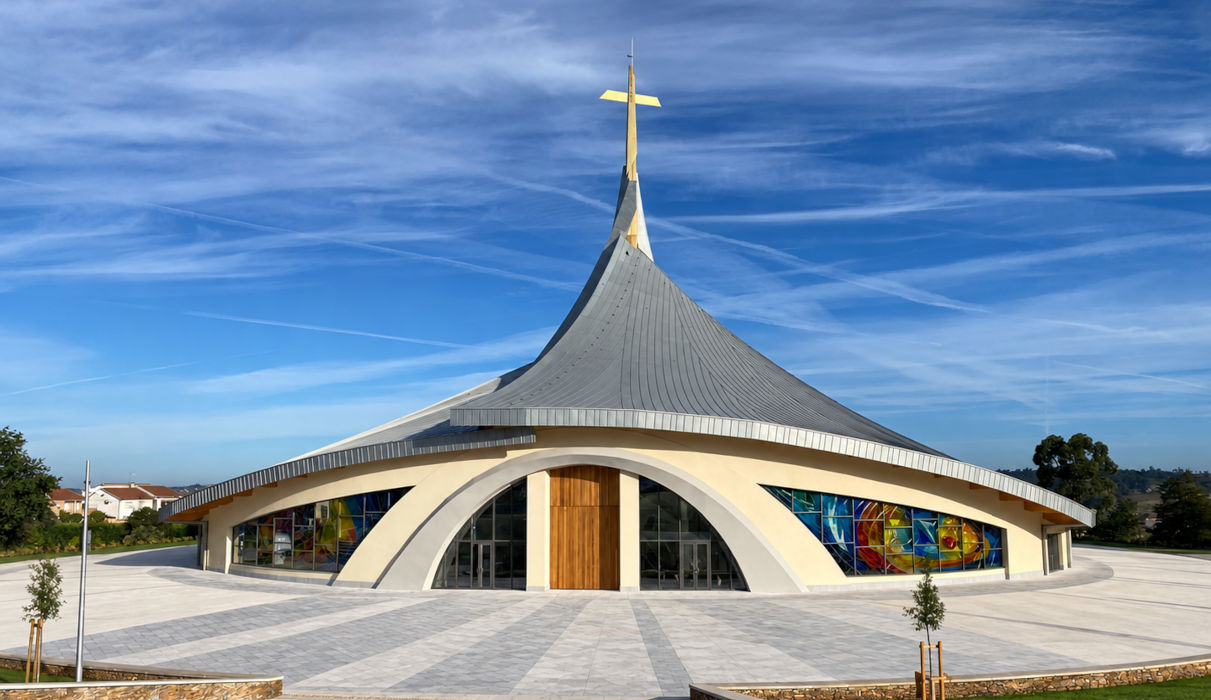
Reading time: 5 min.
On 10 and 11 October 2026, Balasar will experience two historic days. The mortal remains of Blessed Alexandrina Maria da Costa, a Salesian Cooperator, will leave the parish church of St. Eulalia for the new Eucharistic Shrine, which will be dedicated the following day by the Apostolic Nuncio to Portugal. It is a building designed through a reading of her writings: a tent that shelters the Tabernacle, a cross that supports its structure, a roof shaped like a mantle. For thirteen years and seven months, Alexandrina lived on the Eucharist alone, and now she will rest facing the Tabernacle, as she had wished. The Archdiocese of Braga, the Salesian Family, and thousands of devotees around the world will pray with her for peace and for her canonization.
There is a small town in northern Portugal, just a few kilometers from Braga, that has drawn pilgrims from every continent for decades. Each year, around 150,000 people stop to pray at the tomb of Blessed Alexandrina Maria da Costa (1904–1955), and 250,000 attend Eucharistic celebrations. From October, this silent crowd will have a new home: the Eucharistic Shrine of Balasar, which will be the permanent resting place of the Blessed’s body. For the Archdiocese of Braga, the community of Balasar, and the countless devotees scattered around the world, this is an event of great ecclesial and civic importance.
Two days of grace
On Saturday 10 October, at 10 am, the Archbishop of Braga, Archbishop José Cordeiro, will preside over the transfer of Alexandrina’s mortal remains from the parish church of St. Eulalia to the chapel dedicated to her in the new Shrine.
The following day, Sunday 11 October, at 4 pm, the Apostolic Nuncio to Portugal, Archbishop Andrés Carrascosa Coso, will preside over the dedication of the Shrine and its altar, in the presence of the highest religious and civic authorities. Among those invited will be the Provincial of the Salesians in Portugal, Fr. Tarcizio Morais. His presence is a sign of the deep bond between Alexandrina and the Family of Don Bosco, of which she was a part as a Salesian Cooperator and within which, in the final years of her life, she found spiritual guidance from the Salesian Fr. Umberto Pasquale.
Hundreds of devotees will arrive, particularly from Portugal, Italy, and Spain. Many more will follow the celebrations through the media.
An architecture born of prayer
The Shrine, with seating for 1,800, is not merely a large space for pilgrims. It was conceived to safeguard and convey the Eucharistic and Marian spirituality that Alexandrina lived out in her extraordinary mystical experience. The design arose from a careful study of her writings and life, and even today it communicates the message that God wishes to convey to us through her.
It was designed by the Centro Ave Arte di Loppiano, under the artistic direction of architect Elena di Taranto. The Centre describes its approach as follows: “By bringing together the expertise of architects, painters, and sculptors, the Centre understands liturgical art as a collective expression of beauty and communion, in which every element, from the architectural structure to the furnishings, from stained-glass windows to mosaics, is conceived to foster spiritual encounter and prayer through a contemporary artistic language.”
Four images guide the design of the entire building.
The Tent. Elena di Taranto gave the Shrine the form of a “Tent”, evoking the “tent in the desert”, the “tent where God met” His people as they crossed the desert towards the Promised Land.
The Tabernacle. At the heart of the tent is the Tabernacle, which safeguards the presence of Jesus in the Most Holy Eucharist. This is no decorative choice. Alexandrina was a living Eucharistic miracle. From 1942 until her death, for thirteen years and seven months, she took no food other than Holy Communion. The Lord had entrusted her with abandoned tabernacles, calling her to a life of union and reparation for the abandonment, indifference, and sacrilege directed against the Most Holy Eucharist.
The Cross. The Cross rises above the building, forming the backbone of the entire structure. The Shrine’s architecture developed from it, and directly beneath it, inside, is the Chapel of the Eucharist. “The Cross is the key to Heaven,” Jesus told Alexandrina. Bedridden and immobile from 1925 onwards, she was called to live united with Christ Crucified, offering her suffering for the salvation of souls, peace in the world, and the sanctification of the Church.
The Mantle. The roof is shaped like a “mantle”, a sign of her Marian spirituality. In her mystical experience, Alexandrina received Mary’s mantle from Jesus and the Virgin. United with the Mother’s love and sorrow, she was to shelter and protect the whole world with the mantle of love and sorrow of the Mother, in which she now shares in Heaven.
Stained glass that tells a story
The large stained-glass windows, liturgical furnishings and vestments are the work of Portuguese artist Dina Figueiredo. Her stained-glass works adorn churches, shrines, and chapels in many countries: from Italy, with the celebrated Shrine of Maria Theotokos in Loppiano, to Spain; from Portugal to Japan, and from Panama to Ireland.
A prominent place is given to the stained-glass window depicting the Passion, Death, and Resurrection. It portrays Alexandrina, wholly identified with Jesus on Calvary, at the moment when she meets the Mother. In her diary, she describes how their eyes met: “She looked at me and I looked at her. Our hearts were united in the same sorrow and did not part.” “Sorrow and martyrdom became blood that drenched all of Calvary, and on Calvary, all humanity.” And she prays: “May your Passion, O my Jesus, bring my soul back to life through that love and that grace which my heart so longs for. O Jesus, I want to be a saint!”
Another stained-glass window depicts a further Marian experience: the Virgin giving Alexandrina her royal mantle. “I see Mummy on my right. She kissed me, caressed me, took me in her arms, and covered me with her blue mantle edged in gold: it was the Queen’s mantle. At that moment, I felt as though the whole world were beneath the shadow of that heavenly mantle.” In December 1942, that gift became a mission: to wrap the world, together with the Mother, in the love and sorrow offered to save it.
A tomb at floor level
The Blessed’s chapel will house a tomb set flush with the floor, reflecting Alexandrina’s simplicity and humility. As she herself requested in her diary, her body will face the Tabernacle. On the floor will be a cross, a crown of thorns, and a statue of the Virgin Mary. The chapel will be decorated all around like a garden, with roses and passion flowers.
Towards the feast on 13 October
The celebrations will continue through to the Blessed’s liturgical memorial on 13 October. On the evening of the 12th, a candlelit procession will set out from Alexandrina’s home and make its way to the Shrine, where Eucharistic adoration will follow. On the 13th, Holy Mass will be celebrated, with a blessing for the sick, and will conclude with the consecration to the Immaculate Heart of Mary. The Shrine’s rector, Monsignor Manuel Casado Neiva, will preside.
Three intentions will accompany the days from 10 to 13 October:
peace in the world;
the canonization of Blessed Alexandrina;
thanksgiving for the new Shrine.
Specifically for the canonization, a Salesian has prepared a Novena, translated into seven languages (Italian, Portuguese, Spanish, English, French, German, and Polish). It is to be prayed during the nine days leading up to the transfer, from 1 to 9 October. The Holy Rosary is also suggested, either as an alternative or in addition.
For the gift of Blessed Alexandrina to the Church and to humanity, and for this beautiful new Eucharistic Shrine, all we can say is: “MAGNIFICAT, ANIMA MEA DOMINUM!”
Maria Rita Scrimieri