


 By BSOL Editor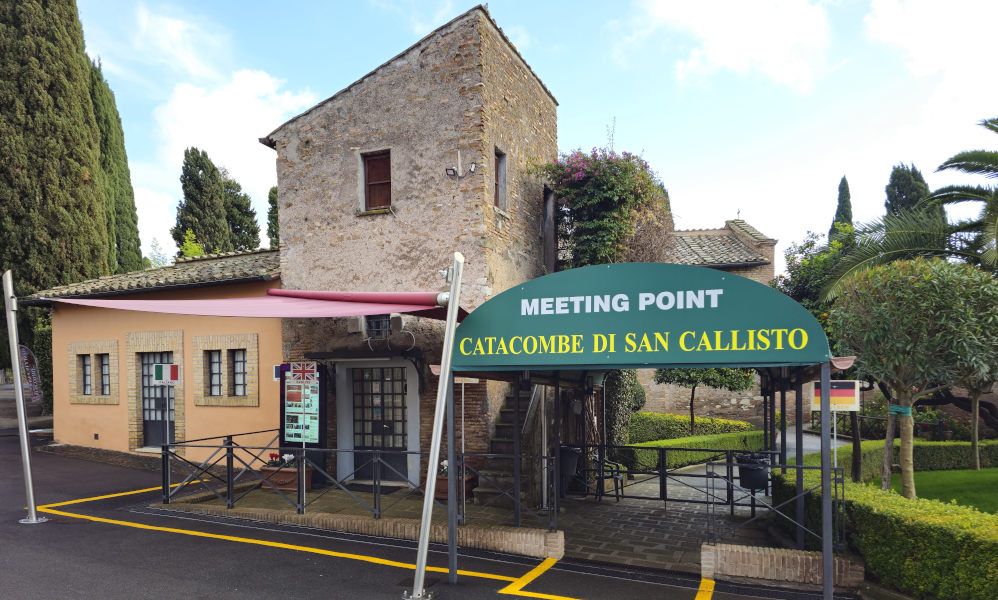
Reading time: 8 min.
Along the Via Appia Antica, in the heart of early Christian Rome, the Catacombs of San Callisto preserve a memory that spans centuries: that of the martyrs, the first popes, and a community that lived its faith to the point of giving their lives. But this place, among the most venerated in Christianity, does not belong only to the past. Since 1930, thanks to the presence of the Salesians of Don Bosco, it continues to be a living space of welcome, evangelisation, and prayer. Amidst underground galleries and ancient testimonies, a fruitful encounter between history and faith takes shape, where every visit becomes a spiritual journey capable of speaking to people today.
The first official cemetery of the Church of Rome
Along the Via Appia Antica, the Regina Viarum of Roman antiquity, between the second and third mile from the ancient Servian walls, opens one of the most solemn and meaningful places in all of Christianity: the Catacombs of San Callisto. Giovanni Battista de Rossi, the great founder of modern Christian archaeology, defined them without hesitation as “the Catacombs par excellence, the first official Cemetery of the Community of Rome, the glorious burial place of the Popes of the 3rd century”. Pope John XXIII called them “the most august and the most famous in Rome”. It is not difficult to understand why.
Arising around the middle of the 2nd century, the Catacombs of San Callisto are part of an immense cemetery complex – the so-called Callistian complex – which extends between the Via Appia Antica, the Via Ardeatina, and the Vicolo delle Sette Chiese, occupying about thirty hectares of land, of which about fifteen are strictly catacombs. The galleries develop on four underground levels for almost twenty kilometres, reaching a depth of over twenty metres. It is estimated that about half a million Christians were buried there, including dozens of martyrs and sixteen pontiffs.
The name and origins: Callistus, deacon and pope
Among all the catacombs of Rome, those of San Callisto constitute a singular exception in the naming tradition of these sacred places. While most Christian underground cemeteries took the name of the landowner, the most illustrious martyr buried there, or the geographical location, these catacombs bear the name of the man who was their administrator even before becoming pope: the deacon Callistus.
Callistus was born into a Christian family of servile condition and knew the hardships of slavery from childhood. After turbulent events – he was condemned to the mines of Sardinia and freed thanks to the intercession of Marcia, the favourite of the emperor Commodus – he was welcomed into the community of Rome and ordained a deacon by Pope Zephyrinus. The latter entrusted him with the administration of the so-called “Area prima”, the original nucleus of the future catacombs, which at the beginning of the 3rd century had already passed from private ownership to the direct control of the Church of Rome. As a deacon, Callistus had under his command the guild of the fossori, the diggers, and the task of ensuring a burial for all Christians, especially the poor and slaves. Upon the death of Zephyrinus, he was elected his successor and led the Church as pope from 217 to 222, the year in which he died a martyr during a popular uprising in Trastevere. A curious and significant irony of history. Callistus, who had guarded the great cemetery of the Appian Way for twenty years, could not be buried there due to the violence of those moments, and found rest in the Catacombs of Calepodius on the Aurelia Antica.
The Crypt of the Popes and the other underground treasures
The beating heart of the Catacombs of San Callisto is undoubtedly the Crypt of the Popes, which de Rossi defined as “the most distinguished glorious burial place of all Christian necropolises”. In this short stretch of gallery, aptly renamed “the little Vatican”, nine pontiffs of the 3rd century were buried – Pontian, Anterus, Fabian, Lucius, Sixtus II, Dionysius, Felix, Eutychian and, probably, others – as well as ecclesiastical dignitaries and the six deacons martyred together with Pope Sixtus II in August 258, when the emperor Valerian, during the confiscation of Church property, surprised them while they were celebrating the liturgy in these underground passages.
Pope Damasus (366–384), a great venerator of the martyrs, transformed the crypt into a real church, adorning it with a famous poem in Latin hexameters placed in front of the tomb of Sixtus II: “Know that here rests gathered together a host of saints / the venerable sepulchres preserve their bodies / while the Kingdom of Heaven welcomes their elect souls…”. Alongside the Crypt of the Popes is that of Saint Cecilia, a martyr from a noble Roman family, buried and venerated here for at least five centuries before her relics were transferred to Trastevere in 821. And again: the Cubicles of the Sacraments, with the oldest symbolic frescoes of Baptism and the Eucharist dating back to the early 3rd century; the region of Saint Soteris, with one of the oldest images of the Madonna; the above-ground area with the two small tri-apsidal basilicas called Tricore, where Pope Zephyrinus and the young martyr Tarcisius rested, the boy who preferred to give his life rather than hand over the Eucharist he was carrying to his attackers.
The rediscovery: de Rossi and the dream of Pius IX
After centuries of abandonment – the translations of the relics to the city in the 8th and 9th centuries had emptied the catacombs of their devotional heart, leaving them prey to landslides, vegetation, and looting. It was the young Giovanni Battista de Rossi who restored this immense heritage to the world. In 1849, at the age of twenty-seven, while exploring a vineyard between the Appia and the Ardeatina, he noticed a broken marble slab used as a step on a staircase, on which the fragment could be read: “…ELIVS – MARTYR”. He immediately intuited that he had before him part of the sepulchral inscription of Pope Cornelius, a martyr of 253. He went to Pius IX, explained the discovery to him and his conviction that he had identified the site of the Catacombs of San Callisto. The pope bought the land, excavations began, and de Rossi was not mistaken. Within a few years, he brought to light six crypts: that of Cornelius, of the martyrs Calocerus and Parthenius, the Crypt of the Popes, the Crypt of Saint Cecilia, and those of Pope Caius and Pope Eusebius. The visit of Pius IX to the underground galleries was memorable. De Rossi left a touching account of it. The pope, faced with the tombstones of his predecessors, turned pale, approached, took them in his hands, read those ancient names, turned red with emotion, his eyes filled with tears, then he knelt in silence. It was the first time, after almost a thousand years, that a Successor of Peter had set foot again in those places made holy by the blood of the martyrs.
1930: the catacombs entrusted to the Salesians
With the nineteenth-century rediscovery and the progressive scientific organisation conducted by the Pontifical Commission of Sacred Archaeology (founded by Pius IX in 1852), a practical but fundamental question arose with ever greater urgency: who would guard and spiritually animate these sacred places? Who would welcome the pilgrims who came there from all over the world? It was Pius XI who found the right answer. The pope had personally known Don Bosco and had been able to appreciate closely the spirit of the Salesian Congregation: an apostolic vocation oriented towards encountering young people and the people, towards the educational mission, towards presence in the frontier places between faith and culture. He intuited that this same vocation could also express itself in an extraordinary way in the custody of a place so crucial for the memory of the early Church. In 1930, Pius XI officially entrusted the Catacombs of San Callisto to the Salesians of Don Bosco, after the departure of the Trappists, custodians and workers of the field.
The choice was not obvious. Until then, the management of Christian archaeology sites had remained predominantly in the hands of academic or religious institutions of a contemplative and scientific nature. Entrusting the catacombs to an apostolic congregation like the Salesian one meant making a turning point: privileging not only conservation and study, but welcome, evangelisation, and the living encounter with visitors and pilgrims. It was ultimately consistent with the very history of the place: these galleries had never been just a museum, but a cemetery, a sanctuary, a place of prayer and community.
The Salesian mission: a spiritual journey, not just a tourist one
From that 1930 to today, generations of Salesians have cared for and animated the Catacombs of San Callisto, and some of them rest in a small cemetery at the entrance to the area, in a powerful symbolic continuity. Like the first Christian custodians of past centuries, the sons of Don Bosco have also chosen to remain, in life and in death, alongside the martyrs who preceded them. Today there are sixteen Salesians coming literally from all over the world – Europe, Africa, Asia, the Americas – to make the catacombs known to visitors, in every language, embodying that dimension of universality proper to both the Salesian charism and the Christian memory they guard. What they offer is not simply a tourist-archaeological visit. It is a true spiritual journey, experienced through the symbols, the sepulchres, the testimonies, and the history sedimented in that subsoil.
In a tour that lasts on average forty-five minutes, visitors are guided through the most significant places: the Crypt of the Popes with its sepulchral slabs, the Crypt of Saint Cecilia, the Cubicles of the Sacraments with their very ancient frescoes, the region of Saint Soteris with the image of the Madonna. Every group has the opportunity to stop in a crypt or in a surface chapel for a brief moment of prayer or for the celebration of the Eucharist. Even just reciting the litanies of the saints and martyrs of San Callisto – those ancient names, Sixtus, Cornelius, Fabian, Cecilia, Tarcisius – evokes a world of emotions and faith capable of crossing centuries and cultural differences.
There is an almost moving continuity between this Salesian way of inhabiting the catacombs and a story told by the very document accompanying the site. In the second half of the nineteenth century, at the time of de Rossi’s excavations, a group of young students of the archaeologist had taken the habit of gathering to pray together, as the early Christians did, right in four interconnected cubicles in the region of Saint Soteris. Those cubicles, due to their architectural conformation, lent themselves to the alternating singing of psalms, with the voices propagating from one chamber to another through the skylight. In the early days of 1878, they wanted to celebrate the feast of the Epiphany at the arcosolium of the Madonna, and from that experience was born, the following year, the Collegium Cultorum Martyrum, with the full approval of Pius IX. It was a seed of that same sensitivity that, half a century later, would guide Pius XI to hand over the catacombs to the Salesians.
A living place for the Church today
The Catacombs of San Callisto are not a relic of the past; they are a living place. After Pius IX, John XXIII descended there on 19 September 1961, in a gesture that was intended as an example for the faithful of Rome, and then Paul VI on 12 September 1965, on the eve of the final session of the Second Vatican Council. The Salesian presence has contributed decisively to keeping this character alive: not a simple museum of ancient Christianity, but a space for encounter, prayer, and rediscovery of one’s roots. To facilitate welcoming, the catacombs today have a large car park, a refreshment point, and large open spaces for playing, dining, and conviviality, in full Salesian style. Those who arrive as pilgrims or simple visitors find themselves welcomed not only by history, but by a community that continues to embody that history.
Ultimately, guarding the Catacombs of San Callisto means guarding something essential for the Christian faith: the memory of those who believed before us, of those who paid for that fidelity with their lives, of those who chose to bury their dead, not with pagan cremation but with inhumation, awaiting the resurrection. As the ancients wrote: the cemetery was not the “city of the dead” – the Greek necropolis – but the “place of sleep”, the coemeterium, where one awaits the awakening. And it is precisely this hope that the Salesians, every day, in every language of the world, continue to recount to those who descend into the stone galleries under the Via Appia.