


 By BSOL Editor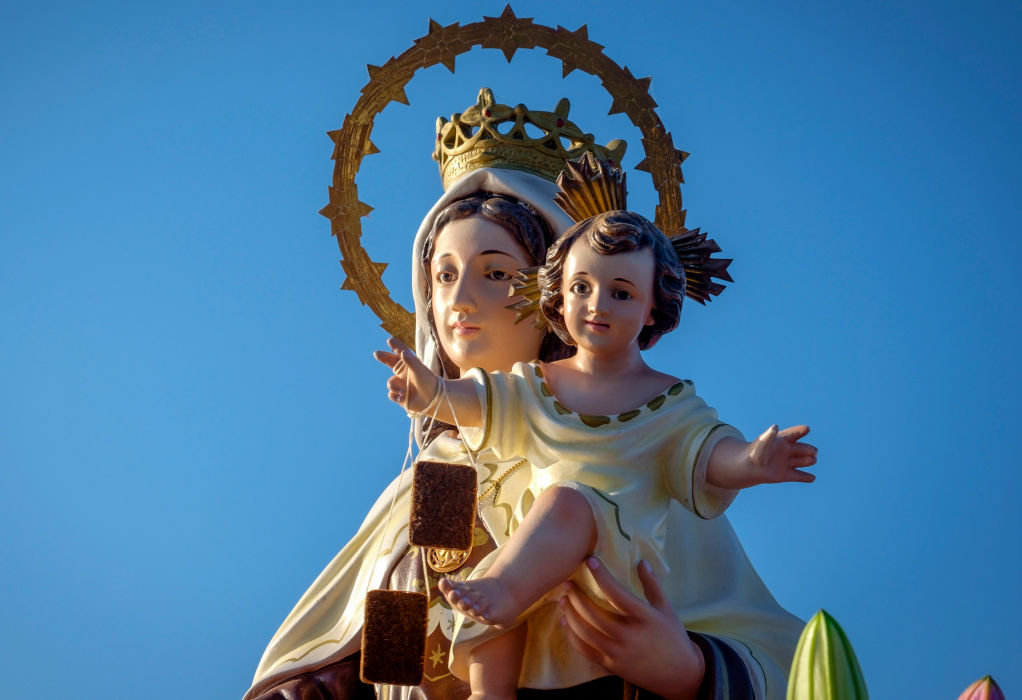
Reading time: 6 min.
On 16 July, the Church celebrates the memorial of the Blessed Virgin Mary of Mount Carmel. It is a feast that seems to belong entirely to the Carmelite family, with its scapular, its saints, its long contemplative tradition. Yet, leafing through the writings of Don Bosco, one discovers with surprise how much the saint of the young knew, loved, and gladly recounted the history of Carmel. This is not a marginal interest: Carmel enters his books of sacred history, his works of Marian popularisation, his spiritual choices for the Daughters of Mary Help of Christians, and even his travels. It is a little-known aspect of Don Bosco’s Marian devotion.
Carmel recounted to the young
Don Bosco was, among a thousand other things, a tireless writer and popular publisher. In his Catholic Readings he wanted to place the history of the Church, and in particular the lives of the popes, into the hands of the people and the young. In 1857, presenting the figure of Saint Telesphorus, the eighth pope in the series of pontiffs, Don Bosco gladly pauses to explain where that saint came from: he had been an anchorite of Mount Carmel.
With his plain and narrative style, Don Bosco explains to his readers that this “way of life” – monks, hermits, anchorites, solitaries – “is very ancient”, and that the prophets Elijah and Elisha “had withdrawn to a high mountain in Palestine called Carmel, where they were followed by many others”. The heads of those communities were called prophets, the disciples “sons of the prophets”, because the superior was “a true spiritual father who worked for their spiritual and temporal good, and especially to lead them to God”. It is interesting to note how Don Bosco, almost without realising it, describes in the spiritual father of ancient Carmel the portrait of what he himself wanted to be for his boys at Valdocco: a father who takes care of their spiritual and temporal good, to lead them to God.
Following the tradition commonly accepted at the time, Don Bosco recounts that after Pentecost many fervent faithful withdrew to Carmel and began to be called Carmelites; and that those monks, “enraptured by the marvels they heard recounted about the Blessed Virgin”, built a church to her on that mountain “at a time when the Great Mother of God was still living among mortals, around the year 38 of Jesus Christ”. And he adds, with evident satisfaction: “It is commonly believed that this is the oldest church in Christendom outside Jerusalem”. That sanctuary became a destination for pilgrims “from all parts”, and the Church – Don Bosco notes – “remembers this glorious event in the solemnity that is celebrated on the 16th day of July”.
Even in his Sacred History for primary schools (1876), Don Bosco does not forget Carmel. In the little dictionary of biblical names, he precisely distinguishes the city of Carmel, in the tribe of Judah, from the mountain “between Ptolemais and Dor on the Mediterranean, famous for the dwelling of Elijah and for the marvels worked there by him”. He notes that “the Carmelites take their name from this mountain on account of the prophets Elijah and Elisha who lived there, and whom they consider as their founders”. Even in a school textbook, therefore, Don Bosco found a way to make the prophetic roots of Carmel known to the young.
The little cloud of Carmel and Mary Help of Christians
But the most surprising text is from 1877, and bears a thoroughly Carmelite title: The little cloud of Carmel, or devotion to Mary Help of Christians rewarded with new graces. Don Bosco, the great apostle of Mary Help of Christians, chooses as the image of the devotion he is spreading throughout the world precisely the little cloud that the prophet Elijah saw rising from the sea on the high peak of Carmel (cf. 1 Kings 18:44): that little cloud which, after three years of drought, brought rain to the parched earth, and which tradition has always read as “a distinguished figure of Mary”. He writes it himself: “To the little cloud seen by the prophet Elijah is rightly compared in these latter times the devotion to Mary Help of Christians”.
The comparison is bold and beautiful. Just as the little cloud of Carmel, as small as a man’s hand, grew to cover the sky and pour beneficial rain upon the earth, so the devotion to the Help of Christians, starting from the humble sanctuary of Valdocco, was expanding, bringing a shower of graces everywhere. For Don Bosco, Carmel is therefore not ‘another’ devotion compared to Mary Help of Christians. It is the same Mother, contemplated at the source of her history among men.
In that short work Don Bosco shows how “by the same faithful of the early Church, constant recourse was made to Mary as a powerful help of Christians”. He movingly reports Saint John Damascene’s account of the glorious dormition of the Virgin. The apostles miraculously gathered in Jerusalem, the singing of the angels for three days at the tomb of Gethsemane, and finally, the tomb found empty, a sign that Mary’s immaculate body had been “honoured with translation to heaven before the common and universal resurrection”.
And here Don Bosco inserts, reporting it from the liturgical office of 16 July, the heart of the Carmelite tradition: from the days when Mary was still living, many pious men, seized “by special affection towards the Most Blessed Virgin”, built on Carmel – where Elijah had seen the little cloud rise – a small sanctuary in her honour, gathering every day to venerate her “as the singular protectress of the Order”; for this reason they were called “the brothers of the Blessed Virgin of Mount Carmel”. Don Bosco also recalls the gift of the scapular. Mary herself “established for them as a uniform a sacred scapular, which she gave to the English Blessed Simon Stock so that with this heavenly little habit that sacred order might be distinguished and whoever wore it might be protected from all evil”. The holy educator, who so highly recommended concrete signs of piety to his young people, looked with sympathy upon that “heavenly little habit” which placed Mary’s protection literally on the shoulders of her devotees.
The saints of Carmel in the life of Don Bosco
Don Bosco’s appreciation for Carmel did not stop at books. In 1865 he published the Life of the Blessed Mary of the Angels, Discalced Carmelite of Turin, making known to his readers a daughter of Saint Teresa who grew up right in Turin, as if to say that the holiness of Carmel flourished even in the shadow of his city. And when in 1883 he made his famous journey to Paris, he celebrated his first Mass in the French capital precisely at the Carmel of the Avenue de Messine. His correspondence preserves the memory of his relations with the superior of that monastery, who bore, by a striking coincidence, the same name as the Turinese blessed: Mary of the Angels.
But the Carmelite figure who most marked Don Bosco’s heart was undoubtedly Saint Teresa of Avila, the “daughter and mother of Mount Carmel”. In a page of his from 1871, he describes her with admiration: “locked in a cloister, oppressed by infirmities, persecuted by men and demons, in the midst of the most desolating aridities, she preserved all the cheerfulness of her good spirit”, to the point of praising one of her nuns who was “so facetious as to make the whole community laugh”. It is easy to understand why that portrait won him over: joyful holiness was the very heart of his educational system.
It is not surprising then that, in founding the Daughters of Mary Help of Christians, Don Bosco wanted Saint Teresa among the patronesses of the Institute. The Constitutions of 1885 established that the feasts of Saint Joseph, Saint Francis de Sales, and Saint Teresa of Jesus, “Particular Patrons of the Institute”, should be celebrated with special devotion and solemnity. And Don Bosco himself wrote there that “St Teresa wanted her Religious to be cheerful, sincere and open”, instructing the Mistress of Novices to form her pupils in this way, because Sisters of that character are the most suited to inspire in the young esteem and love for piety. Visiting the community of Alassio, he exhorted the Sisters with a quip that has remained famous: “I recommend to you holiness, health, knowledge… and cheerfulness! Make yourselves all Saint Teresas!”.
There was also a historical root. The first Daughters of Mary Help of Christians came from the group of the Daughters of the Immaculate Conception of Mornese, whose formation was largely “Teresian”. Thanks to Fr. Frassinetti, they knew pages of the Way of Perfection, and Mary Domenica Mazzarello loved to read and meditate on the petitions of the Pater of Saint Teresa. By choosing Teresa as patroness, Don Bosco was not imposing anything foreign. He was confirming a spirituality that in Mornese was already alive and breathed.
A profound affinity
What then did Don Bosco see in Carmel? He recognised in it traits profoundly akin to his own spirit: spiritual realism, an interior life unified by love, a simple and affective prayer made with the heart, cheerfulness as a sign of a healthy spirituality, harmony between contemplation and action, and above all, a filial and most tender love for Our Lady. Carmel showed him that one can belong entirely to Mary while living entirely for souls; and Mary Help of Christians, for him, was the same Virgin of Carmel who continues from heaven, “with the greatest success, the mission of mother of the Church and help of Christians which she had begun on earth”.
The 16th of July, then, is also somewhat of a feast for the Salesian Family. Looking at the little cloud rising from the sea on the peak of Carmel, we can repeat with Don Bosco that that little cloud is a figure of the Mother who never ceases to bring a shower of graces upon the thirsty earth: yesterday on Elijah’s mountain, today wherever a young person raises their eyes towards Mary, Help of Christians.
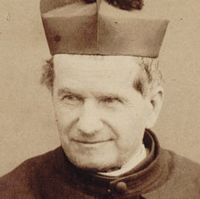 St John Bosco
  Fr Bruno FERRERO