

 By BSOL Editor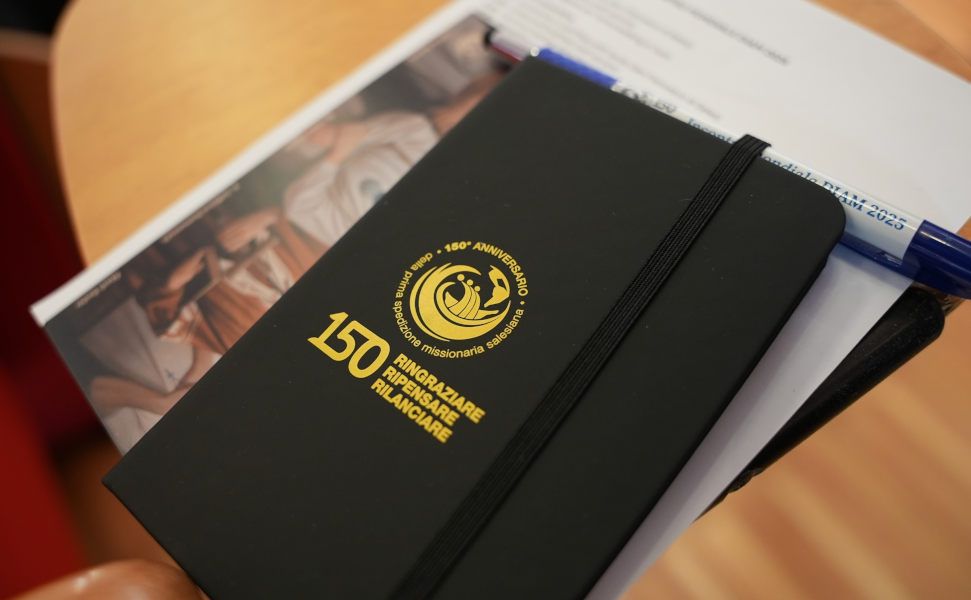
Reading time: 7 min.
A few months later, on the feast day of Mary Help of Christians, the proceedings of the historic world meeting of the delegates for missionary animation are published as part of the celebrations for the 150th anniversary of the first Salesian missionary expedition.
11 November 1875: the first group of Salesians is officially sent across the ocean to spread the Gospel according to Don Bosco’s method and style, the first Salesian missionary expedition, to which another 155 have been added over time.
The 150th anniversary has constituted a journey that started long ago and continues to bear fruit, in terms of reflection, renewed missionary zeal and belonging to the Salesian charism.
The starting point was to recognise three fundamental points:
to thank, to rethink, to relaunch.
We thank God for the gift of the missionary vocation, which today allows the sons of Don Bosco to reach poor and abandoned young people in 137 countries. It is an auspicious occasion to rethink and develop a renewed vision of the Salesian missions in light of new challenges and new perspectives, which have led to new missiological reflections. We do not only have a glorious history to remember and be grateful for, but also a great history yet to be made! We look to the future with missionary zeal and renewed enthusiasm to reach an even greater number of poor and abandoned young people.
With these premises, the world meeting of the DIAM (Provincial Delegates for Missionary Animation) began on 9 November, culminating in the Mass of sending for the 156th Salesian missionary expedition. The meeting was attended by about 90 people from all over the world, Salesians but also lay people, men and women, together with the new missionaries and the new FMA missionaries.
The atmosphere in Valdocco had already been warmed up by the Italian young people, who gathered for “Be A Mission”: an event born from the desire to meet up, share stories and relaunch the missionary journey together, starting from the experiences lived in recent years and engaging with Salesian missionaries from all over the world.
About 30 people for each of the Salesian territories (SDB and FMA Provinces of Italy) participated; most of them have lived a summer missionary experience in recent years and some are part of the missionary animation commissions of the Provinces. The programme was organised by “ENAM” (National Body for Missionary Animation), composed of Salesians, Daughters of Mary Help of Christians, and young people.
After the opening of the event, the participants were invited to an in-depth study of the missionary spirituality of Valdocco and then met Fr. Jorge Mario Crisafulli, General Councillor for the Missions elected a few months earlier, who reflected on the meaning of mission and Salesian mission today.
Following this, a moment of reflection in groups and then the official inauguration of the exhibition on Italian missionary animation by the Rector Major, Fr. Fabio Attard.
In the evening, a “missionary festival” with music and stands from all the countries hosting the missionary experiences, and the goodnight thought, in the Basilica, by Sister Chiara Cazzuola, Mother General of the FMA Sisters.
The highlights of the morning of Sunday 9 November, were the “living libraries” (testimonies of the young people’s missionary experiences) and the group dialogue with the new SDB and FMA missionaries, who, divided into small groups, answered some questions from the young people, encouraging them to take on a missionary commitment in their lives.
At 15:00, in the Basilica, Holy Mass presided over by the Rector Major, with the missionary mandate for the young people present.
Afterwards, in the church of St. Francis de Sales, the DIAM meeting began with an introduction by the Missions Sector team, the presentation of the participants and the prayer of Vespers.
On Monday 10th, after the greeting of the Rector Major, Fr. Jorge Crisafulli shared some challenges of the Salesian missions, addressing those who, in their own Country or region, carry forward this aspect with dedication and enthusiasm.
We reproduce here some excerpts from his speech.
Don Bosco had no intention of founding a “missionary order”, but through that first expedition he and his sons discovered that the Salesian charism is missionary by nature. In 1972, Fr. Ricceri stated that missionary activity is not something marginal or optional, but rather “an essential and distinctive element that touches the very essence and life of our Congregation”. For him, the missions became a “privileged place” where the Salesian charism could flourish and expand. The missions opened the doors to an extraordinary geographical and pastoral expansion: parishes, schools, shelters for orphans, migrants, hospitals, etc. In fact, we have become one of the most dynamic missionary movements in the Church. In 150 years, about 10,000 Salesians have left their Provinces to go on mission ad gentes, ad exteros, ad vitam, and today we are present in 137 countries, with 92 Provinces, 14,000 Salesians and 1,782 communities.
We must emphasise that the two Asian regions continue to be the most generous in sending missionaries. The two African regions are progressively becoming regions that send missionaries rather than receive them. The regions of America and Europe balance each other out, sending and receiving roughly the same number of missionaries. It is however worrying that many missionaries have returned to their Provinces of origin, have left the Congregation or have asked for a change of missionary destination. It is clear that we must review and improve the quality of the processes of discernment, selection, and formation of missionary candidates. At the same time, the receiving Provinces must strengthen their processes of accompaniment and inculturation of new missionaries.
I will now highlight some challenges that weaken the missionary dimension of our Congregation: the global vocational crisis, the mistaken idea that “the time of the missions is over”, and the belief that the Missions Sector is no longer necessary.
We can identify some particular contexts in which the Congregation exercises its missionary activity: indigenous peoples, our educational and pastoral communities where the Salesian charism is well rooted, and Countries that need a new evangelisation, in particular “those of ancient Christianity or even the younger Churches”.
150 years after that first missionary expedition, the mission continues. Don Bosco’s missionary dream continues to grow, thanks to the creative fidelity of his sons and daughters. We are all called to be missionaries. Young people are our mission land, our promised land. The passion for Jesus and for the salvation of the young drove Don Bosco to send his first missionaries to Patagonia. What does our love for Jesus and for the young drive us to do today? Each of us should ask ourselves: Where is my/our Patagonia today?
Let us return to the starting point: Don Bosco’s dream has not vanished. Don Bosco has not closed his eyes. He looks at us and calls us to continue. Yes, his dream is still alive, because we are the dream and we are the mission.
Then, the meeting continued with the presentation of good practices from each continent.
In Asia, the experiment of inserting a local delegate for missionary animation (LDMA) in each community in India and Sri Lanka to supervise missionary animation efforts and promote a lively missionary atmosphere within the local community was illustrated. Furthermore, the mission in a multicultural and multireligious context such as Cambodia, where the Church is a small minority, was recounted.
For Africa, the work being carried out in the face of the great challenge of refugees and internally displaced persons was presented, particularly in Kenya, Ethiopia, and Uganda.
Slovenia represented Europe, bringing to light the benefits and the journey that some missionaries from Asia and Africa have brought in recent years, within Project Europe, to the Slovenian Province.
Finally, the good practice of the process that led to the drafting of the regional missionary animation plan in Interamerica.
In the afternoon, the participants divided into mixed groups, based on some questions, taking up the theme of the anniversary, with the intention of sharing not only the work aspect but also the personal, and personalised, missionary call of each one.
Subsequently, after having donated two copies of the “Cagliero11” collection (from 2009 to 2024) to the Rector Major and to the Casa Don Bosco Museum, the groups presented their summary and questions. Afterwards, Fr. Jorge Crisafulli replied, offering a vision of the Salesian missions in line with the anniversary and GC29.
At the end of the afternoon, Fr. Luca Barone presented a video made by the Salesian Mission Office of Turin (Missioni Don Bosco) on the 150 years since the first Salesian missionary expedition.
During Vespers, in the historic chapel of St. Francis de Sales, in Valdocco, a profound moment of faith and dedication took place, when the Salesian Family gathered for the solemn handing over of the missionary destinations. Presiding over the event was Fr. Stefano Martoglio, Vicar of the Rector Major, who handed each missionary their letter of obedience, a symbol of trust, availability, and readiness to serve where the Congregation needs them most. The presence of the Rector Major of the Salesians, Fr. Fabio Attard, and of the Mother General of the Daughters of Mary Help of Christians, Mother Chiara Cazzuola, elevated the celebration, filling the church with warmth and encouragement, as both shared sincere words of blessing and support.
One after another, the missionaries approached the altar, as Fr. Martoglio called their names. Each received their assignment with visible joy and emotion, embodying the missionary spirit that has animated the Salesian tradition for generations. Also present, were representatives of Missionary Animation from different countries, who welcomed their future collaborators and strengthened the bonds that unite the Salesian world beyond languages and cultures.
The day concluded with a cultural evening and a party, during which Fr. Pavel Ženíšek presented the international Salesian recipe book, Bosco Food (for those who would like a copy, you can write to cagliero11@sdb.org).
On the 11th, the morning was dedicated to group work corresponding to the two regions of each continent, on the process of discernment, accompaniment, welcoming and follow-up of missionaries, a precious contribution that joins the reflection of these years.
After a fraternal meeting with the Rector Major and the official photos, the highlight of the celebrations began: the Mass with the sending of the 156th SDB and 148th FMA Salesian missionary expedition.
In his homily, Fr. Fabio Attard, Rector Major, expressed himself as follows: “We are unworthy servants; we have only done what was our duty.” (Lk 17:10) These are the concluding words of the Gospel we have just heard. Through these words we want to connect symbolically with that memorable event that was happening here in the Basilica of Mary Help of Christians, exactly 150 years ago, on 11 November 1875. It is not an exercise that takes us to the past, but rather an invitation that makes us enter in a participatory way into that extraordinary moment, which still speaks to us powerfully today.”
Continuing his homily, Fr. Fabio invited the missionaries to live these aspects: the centrality of Christ, fidelity to the charism, and service to the poor.
One by one, the missionaries were called by name and received the missionary cross, in a packed Basilica of Mary Help of Christians. It does not happen often that Salesians, Daughters of Mary Help of Christians, and lay people from all corners of the world can participate in the missionary sending, even less often does it happen on such an important anniversary.
The following day, the participants went to Genoa to experience another moving moment of the anniversary: first on the boat to retrace the route taken by the ten Salesian pioneers who departed from those same waters in mid-November 1875; then, the commemorative plaque at the Porto Antico, the international welcome at the “Don Bosco” Institute in Sampierdarena, founded by St. John Bosco himself in 1872, the solemn Eucharistic celebration and the inauguration of the Museum of Missionary Expeditions, a meticulously designed space, created to “help visitors to thank, rethink, and relaunch the missionary work”.
Dense days, days of celebration, days of family, which do not just constitute a memory but a pivotal point in Salesian history.
We thank Don Bosco, the first missionaries and all those who have been part, are still part and will be part of this wonderful adventure.
The complete booklet containing all the proceedings of the meeting can be downloaded from HERE.
Marco Fulgaro1