


 By BSOL Editor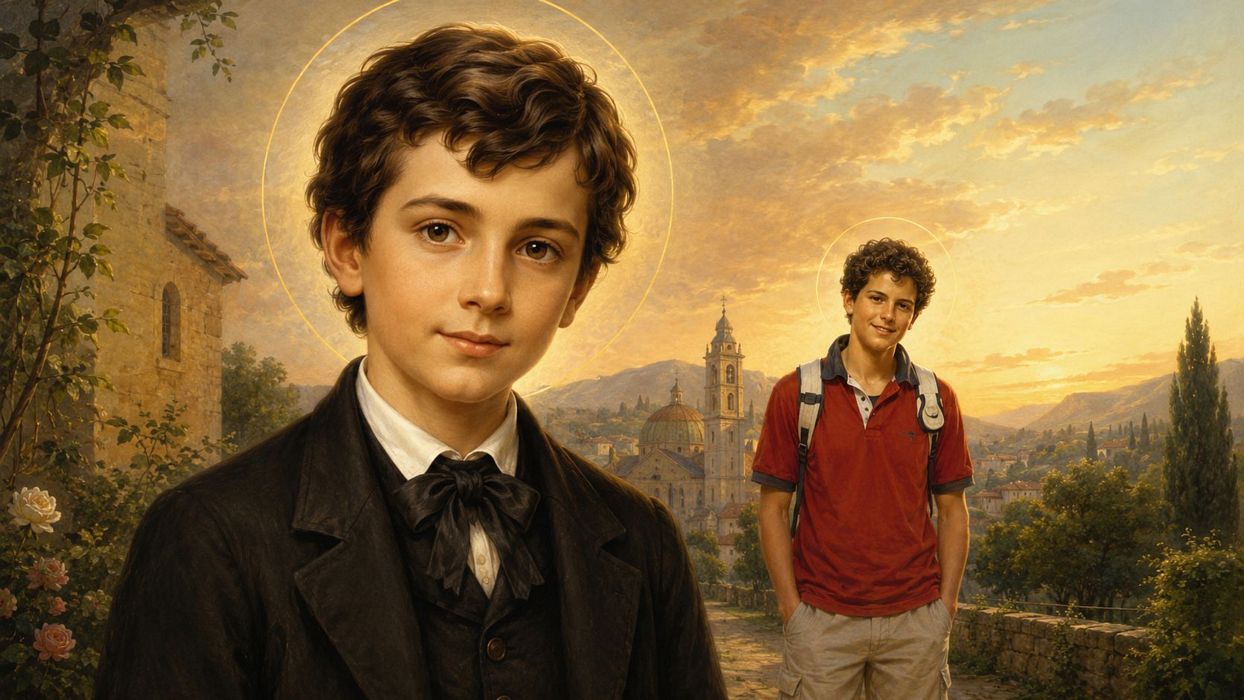
Reading time: 9 min.
Two young men, two distant eras, a single passion: to live their friendship with God to the full. The history of the Church is studded with young people who, despite the simplicity of their daily lives, managed to achieve extraordinary spiritual maturity. Among them, Domenico Savio and Carlo Acutis stand out; two teenagers separated by more than a century but surprisingly close in heart and in their choices. Both discovered very early on that holiness is not an unattainable ideal, but a possible path even for those who experience school, friendship, and family just like any other boy. To compare their lives is to discover how the Gospel can be lived with the same intensity in Don Bosco’s nineteenth century and in the digital age of the internet.
Holiness has no age: a comparison between two young witnesses
One hundred and fifty years apart, seemingly opposite worlds, yet a single flame in their hearts. Saint Domenico Savio, a pupil of Don Bosco at the Oratory of Valdocco in nineteenth-century Piedmont, and Saint Carlo Acutis, a Milanese millennial who grew up in the age of the internet, two young men whom the Church has raised to the altars as models of holiness for the new generations. The first was canonised in 1954 by Pius XII, the second proclaimed a saint in 2025 by Pope Leo XIV. Both died at fifteen, both without having accomplished anything extraordinary in the eyes of the world, yet both capable of burning with love for God with an intensity rare even in adults.
Juxtaposing these two figures is not a rhetorical exercise. It is a precious opportunity to understand how holiness is possible in every era, in every social condition, in every cultural context. Don Bosco, reading Domenico’s heart, wrote to the boys of the Oratory St. Augustine’s challenge: Si ille, cur non ego? – if he could do it, why can’t I? The same challenge comes to us through Carlo Acutis. The message has been the same for centuries; holiness is not for a select few, it is for everyone.
Two short lives, two extraordinary stories
Domenico Savio (1842–1857)
Born on 2 April 1842, in Riva di Chieri, the son of a blacksmith and a seamstress, Domenico grew up in a poor but deeply Christian family. He was a child like any other, yet from the age of four – as Don Bosco recounts in his Life of the Youth Domenico Savio (1859) – “it was no longer necessary to remind him to say his morning and evening prayers… indeed, it was he who would invite the others in the house to say them if they had forgotten.” When he found the church closed, he would kneel on the doorstep and pray in the rain or snow, without moving. The Chaplain of Murialdo, who observed him in amazement, noted, “Here is a young man of great promise. May God grant that a path opens for him to bring such precious fruits to maturity.”
At the age of seven – when one would normally wait until eleven or twelve – he managed to receive his First Communion due to his extraordinary spiritual maturity. That day, he wrote in his prayer book four resolutions that would become the programme for his entire life: “1. I will go to Confession very often and receive Communion as often as my confessor allows. 2. I wish to sanctify the holy days. 3. My friends shall be Jesus and Mary. 4. Death rather than sin.” Don Bosco comments, “These resolutions, which he often repeated, were like the guide for his actions until the end of his life.”
At the age of twelve, he entered the Oratory of Valdocco, where his first meeting with Don Bosco became legendary. The saintly educator looked at him and said, “Ah! It seems to me there is good cloth here.” Domenico promptly replied, “Then I am the cloth; you be the tailor; take me with you and you will make a beautiful suit for the Lord.” In just two and a half years of life at the oratory, Domenico demonstrated a daily, joyful, and contagious holiness. Don Bosco himself wrote that Mamma Margherita confided in him, “You have many good young men, but none surpasses the beautiful heart and beautiful soul of Savio Domenico. I always see him praying, staying in church even after the others; every day he takes time out from recreation to visit the Blessed Sacrament… He is in church like an angel dwelling in Paradise.” He died on 9 March 1857, at fourteen years and eleven months old.
Carlo Acutis (1991–2006)
Born in London on 3 May 1991, to an Italian family, Carlo grew up in Milan in a well-off environment, amidst computers, video games, and the opportunities of modernity. He too, like Domenico, received his First Communion early – at the age of seven – and from that moment the Eucharist became the absolute centre of his existence. He attended Mass every day, prayed the Rosary daily, and served as a catechist in his parish of Santa Maria Segreta.
He used his IT talents to create a multimedia exhibition on Eucharistic miracles, which would travel to more than ten thousand places around the world. He was generous with the poorest, defended weak classmates at school, and loved his pets. In October 2006, at the age of fifteen, he was struck by fulminant leukaemia. Before dying on 12 October 2006, he offered his sufferings for the Pope and for the Church with the same words that Domenico could have made his own, “I offer all the suffering I will have to suffer to the Lord, for the Pope, and for the Church, so as not to have to do Purgatory and to go straight to Heaven.”
Maxims: the wisdom of one who knows how to look up
One of the most direct ways to know the soul of a saint is to listen to their words. Those of Domenico and Carlo resonate today with a surprising, almost contemporary freshness.
Domenico’s heart was engraved with the motto “Death, but not sin”, a radical declaration, far from any sentimentality, which expresses the lucid understanding that sin is the true enemy of man. When Don Bosco asked him what he wanted for his name day, Domenico took a pen and paper and wrote, “Help me to become a saint.” He did not ask for toys or privileges. He asked for the most important thing. Another fiery phrase is the one he addressed before the altar of Mary on 8 December 1854, the evening of the dogmatic definition of the Immaculate Conception: “Mary, I give you my heart; grant that it may always be yours. Jesus and Mary, may you always be my friends; but for pity’s sake, let me die rather than have the misfortune of committing a single sin.”
No less astonishing is the answer that Domenico – still a child, questioned by a passer-by as he walked alone under the scorching sun to his school six kilometres away – gave to the person who asked if he was not tired. “Nothing is painful, nothing is tiring when you work for a master who pays very well.” – “Who is this master?” – “It is God the creator, who repays a glass of water given for love of Him.” A wholly Salesian theology of joy, lived in the daily life of a ten-year-old boy.
Equally unforgettable is his apostolic courage. Don Bosco recounts how Domenico, having discovered an imminent fight between two older and stronger classmates, led them to the place of the challenge, took out the Crucifix he wore around his neck, and said, “I want each of you to fix your gaze on this Crucifix, then, throwing a stone at me, pronounce in a clear voice these words: Jesus Christ, innocent, died forgiving His crucifiers; I, a sinner, want to offend him and take solemn revenge.” The quarrel dissolved into tears.
Carlo Acutis speaks the language of his time, but the depth is the same. His most famous phrase is a cry against conformity, “All are born as originals, but many die as photocopies.” It is an invitation not to lose the uniqueness of being children of God. His other great maxim, “The Eucharist is my highway to Heaven,” translates into modern language the same intuition Domenico had about the absolute centrality of the Sacrament. And shortly before he died, he would repeat, “Not me, but God” – the same radical humility of one who knows that holiness is not one’s own achievement, but a gift received. It was a maxim derived from the conclusion that “conversion is a process of subtraction: less of me to leave room for God.”
The last words of the two saints are mirror images. Domenico, dying in his parents’ arms in Mondonio, said to his mother, “Mamma, don’t cry. I am going to Heaven.” Then to his father, “Goodbye, dear papa.” And finally, his face illuminated by an inner light, he exclaimed, “Oh! what a beautiful thing I see!” Carlo, before his last breath, offered everything for the Church. Both departed smiling.
Similarities and differences
There are extraordinary similarities between Domenico and Carlo. Both received their First Communion early – at the age of seven – a sign of precocious spiritual maturity. Both made the Eucharist the beating heart of their day. Domenico frequented the sacraments with a constancy that astonished everyone; Carlo attended Mass every day. Both distinguished themselves by an active apostolate among their peers. Domenico founded the Company of the Immaculate Conception at the Oratory, to do good together; Carlo created the exhibition and the website to bring the Eucharistic message into the digital world. In both, Marian devotion is a mainstay: the daily Rosary, consecration to Mary, a deep bond with the Mother of God.
The differences are equally revealing. Domenico lived in real material poverty, walking six kilometres a day to school in the rain and snow, in a pre-unification Italy marked by the conflict between faith and secularism. Carlo lived in a wealthy family in Milan, with a smartphone and computer, in the heart of liquid modernity. Yet the substance is identical, to use everything one has in the service of God. Domenico used words, direct example, and physical presence alongside his companions. Carlo used technology as a tool for evangelisation, creating the exhibition on Eucharistic miracles that still travels the world today.
Another significant difference concerns spiritual guidance. Domenico had the inestimable good fortune to meet Don Bosco – the greatest educator of youth in modern times – who showed him the way with simplicity: cheerfulness, prayer, study, and doing good to others. Carlo found his way mainly in his family, in his parish, and in his own spiritual intelligence. Yet both arrived at the same place, a heart in love with God, a life offered without regret.
The recipe for holiness in youth
When Domenico asked him how to become a saint, Don Bosco pointed out three simple ingredients: cheerfulness, commitment to prayer and study, and doing good to others. Not heroic asceticism, not spectacular mortifications. A normal, joyful holiness, lived in real life. It was the sermon of the Oratory’s director that had ignited Domenico’s heart with the words, “It is God’s will that we all become saints; it is very easy to succeed; a great reward is prepared in heaven for those who become saints.” Carlo Acutis would have signed off on these words. He loved playing video games; he had a dog he was fond of; he went to school like everyone else – but none of this distracted him from the essential.
Reading Don Bosco’s pages on the Oratory of Valdocco, one recognises in Domenico a profile common to young saints of every era. First of all, the Eucharist as the centre of life: for Domenico it was the culmination of every day; for Carlo it was literally “the highway to Heaven.” Then, the apostolate among peers: not preaching to adults, but infecting one’s peers with the joy of faith. Domenico played with those who were alone, assisted those who were ill, and founded the Company of the Immaculate Conception. Carlo defended weaker classmates, taught catechism, and brought the friendship of Christ into the daily life of his Milanese school. Then again, faithfulness in small duties: Domenico’s teacher in Castelnuovo d’Asti testified that he was “Savio [wise] by name and always showed himself to be so in deed, that is, in study, in piety, in conversation with his companions and in all his actions.” Finally, Marian devotion as a daily breath; for both, the Rosary was an unmissable appointment.
There is, however, a further element, perhaps the most important, clarity about the meaning of life. Domenico asked Don Bosco to help him become a saint – he had understood that every day is precious. Carlo repeated, “All are born as originals, many die as photocopies.” He had understood that conformity is the greatest spiritual danger of any era. In a world that offers a thousand alternative models, knowing who you are before God is already half of holiness.
Holiness as a journey
Domenico Savio and Carlo Acutis are not models to be copied slavishly. They are lights to be followed, each in their own way, in their own uniqueness. This is the deepest message they leave us, holiness is not uniformity; it is fidelity. Fidelity to oneself, fidelity to God, fidelity to the mission that each person receives.
Both teach us that young people do not have to wait to grow up to become saints. Youth is not a waiting room in which to postpone serious spiritual commitment. It is itself a time of grace, in which holiness can blossom with a unique freshness. As Don Bosco wrote at the end of Domenico’s biography, addressing the young people of the Oratory: true religion “does not consist in words alone; one must come to deeds. Therefore, finding something worthy of admiration, do not be content to say, this is beautiful; I like this. Say rather, I want to strive to do those things which, when read about others, excite my wonder.”
For us, educators, parents, Salesian animators, the most beautiful task remains, to help today’s young people discover that they can be saints. Not by preaching perfection to them, but by showing them its joy. Not by asking them to be heroes, but to be authentic. Not by imposing a model on them, but by pointing them towards the goal.
“Cheerful, onwards!” Don Bosco used to say. Domenico Savio and Carlo Acutis repeat the same thing to us, from places that will never know sunset.
Information on the life of Saint Domenico Savio can be found in the publication “Vita del giovanetto Savio Domenico allievo dell’Oratorio di san Francesco di Sales” [Life of the Youth Domenico Savio, a pupil of the Oratory of St Francis de Sales], written by Don Bosco himself; it can be found online HERE
https://donboscosanto.eu/oe/vita_del_giovanetto_savio_domenico.php
Information on Saint Carlo Acutis can also be found HERE
Also of note are some exhibitions created, initiated or inspired by Carlo.
– “International Exhibition of Eucharistic Miracles” – can be viewed HERE
https://www.miracolieucaristici.org
– “The Appeals of Our Lady: Apparitions and Marian Shrines in the World” – can be viewed HERE
http://www.apparizionimadonna.org
– Exhibition “Angels and Demons” – can be viewed HERE
http://www.carloacutis.net/AngeliDemoni
– Exhibition “Hell, Purgatory and Paradise” – can be viewed HERE
 Fr Pierluigi CAMERONI
  P. Wirth MORAND