


 By BSOL Editor
Reading time: 16 min.
On 2 November, the Church offers a plenary indulgence for the dead. But it is not the only occasion. There are many throughout the year, some even available daily. Don Bosco knew this well and asked the Popes for these “precious gifts” for his boys and benefactors. A guide to understanding what indulgences are, where they come from and how to receive them today.
In the first days of November, cemeteries fill with flowers, votive candles, and people standing in silent reflection before a name carved in stone. It is an ancient, simple gesture that says more than many words: love does not end with death. The Church welcomes this desire to remain close to those who have gone before us and gives it a concrete form, rooted in faith in the communion of saints: the plenary indulgence for the dead.
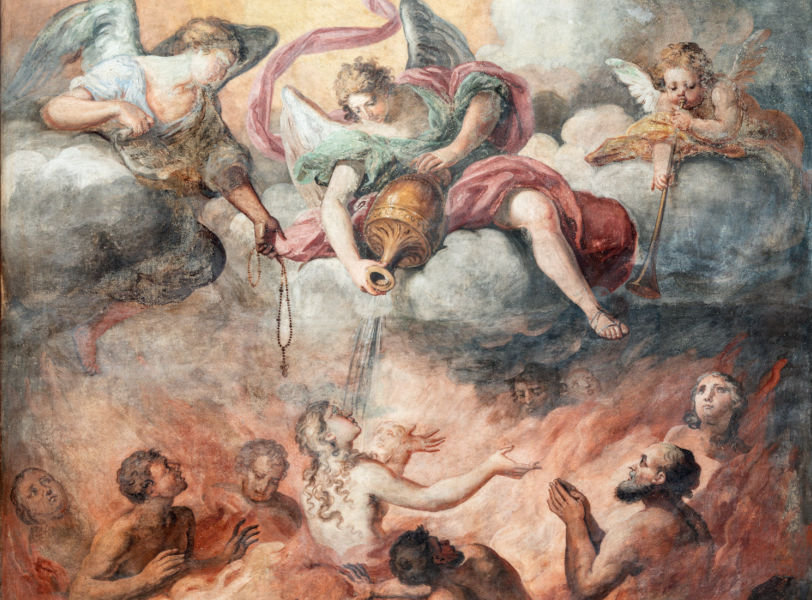
From 1 to 8 November, anyone who devoutly visits a cemetery and prays, even silently, for the dead may obtain a plenary indulgence each day, applicable only to the souls in Purgatory. On the Commemoration of All the Faithful Departed, it may also be obtained by visiting a church or an oratory and reciting the Our Father and the Creed there. The visit may be made from midday on 1 November until midnight on 2 November. As with every plenary indulgence, the usual conditions must be met—sacramental confession, Eucharistic Communion, prayer for the Pope’s intentions—and one’s heart must be detached from all sin. During the rest of the year, visiting a cemetery and praying for the dead, as well as reciting Lauds or Vespers from the Office of the Dead or the prayer “Eternal rest”, brings a partial indulgence, which may also be applied to the dead.
2 November, however, is no exception: it is simply one of the best-known occasions. Few people know that a plenary indulgence can be received on many other days of the year and, under certain conditions, even every day: by reading the Bible for half an hour, spending time in adoration before the Blessed Sacrament, praying the Rosary as a family, or making the Way of the Cross. A treasure within reach that many Christians have simply forgotten.
Don Bosco’s “treasure”
Don Bosco knew this treasure well and never tired of drawing on it. Whenever he had the opportunity to address the Pope, his requests always included indulgences for the young people in his Oratories and for the benefactors who supported his work. The petitions and rescripts, which he himself had collected and published in 1881, allow us to trace this persistence almost year by year.
On 28 September 1850, Pius IX granted a plenary indulgence to young people who, having confessed and received Communion, enrolled in the Company of St. Aloysius. A few months later, on 18 February 1851, he extended it “to all the young people who attend any of the aforesaid Oratories”, on the last Sunday of each month. In August 1856, Don Bosco asked for the apostolic blessing with a plenary indulgence for himself and the boys under his care, “numbering about nine hundred”. The Pope replied with a rescript written in his own hand. During his first trip to Rome, in the spring of 1858, he obtained indulgences for those who taught the boys to sing sacred hymns free of charge—also applicable to the dead—and a blessing for benefactors. On 12 January 1862, came the monthly plenary indulgence for young people who practiced the Exercise for a Good Death, and the indulgence at the point of death for the boys in the house and for benefactors. In 1869, it was the turn of the Association of the Devotees of Mary Help of Christians, enriched with indulgences and elevated to an archconfraternity the following year.
The same zeal accompanied the founding of the Cooperators. By a decree of 30 July 1875, Pius IX granted “the benefactors of this Congregation and all the Salesian Cooperators all the favors, spiritual graces and indulgences granted to the Salesian religious”, except those connected with communal life. On 9 May 1876, with the Brief approving the Pious Union of Salesian Cooperators, the Pope enriched them with new indulgences, including all those granted to the Third Order of St Francis of Assisi.
Don Bosco did not merely ask for indulgences; he explained them. In 1875, the Jubilee Year, he published a popular booklet, The Jubilee of 1875: Its Institution and Devout Practices for Visiting Churches, in which he defined indulgences as “the remission of the temporal punishment due for our sins”, described the Jubilee as “a great treasure for Christians”, and reminded readers that its indulgence could be applied to the souls in Purgatory. He urged the reader: “Read, Christian, and read attentively; who knows whether this may not be the last Jubilee for you and me?” In 1881, presenting the collection Favors and Spiritual Graces Granted by the Holy See to the Pious Society of St. Francis de Sales, he described them as “precious gifts bestowed by the Holy See on religious institutes”, to be understood and put into practice.
For Don Bosco, indulgences were not a matter of spiritual bookkeeping, but an educational tool. The conditions required—confession, Communion, and prayer for the Pope coincided with the pillars of his method: “Frequent confession, frequent Communion and daily Mass are the pillars that must support an educational edifice,” he wrote in 1877, when presenting the Preventive System. The indulgence on the last Sunday of the month or for the Exercise for a Good Death thus became a regular occasion that brought the young people back to the sacrament of forgiveness, taught them fidelity, and to think of eternity, taught them to pray for the dead and helped them feel that the Church was a family gathered around the successor of Peter.
This concern was passed on to his sons. For decades, the Salesian Bulletin, founded in 1877, regularly reminded the Cooperators of the indulgences they could obtain during the year. In 1922, Fr. Philip Rinaldi obtained from Pius XI what was known as the indulgence for “sanctified work”, which Cooperators could receive by joining a pious invocation to their work. To bring indulgences back into focus today is to remain faithful to a pastoral insight of Don Bosco.
A word to reclaim
And yet the word “indulgence” still arouses suspicion. It calls to mind the “sale of forgiveness”, the shady dealings that were one of the sparks of the Protestant Reformation in the sixteenth century. There were abuses, and the Church has repeatedly and firmly condemned them: as early as the Fourth Lateran Council (1215), then the Council of Trent (1562–1563), St Pius V (1567), and finally St Paul VI (1967). But the abuse of a gift does not erase its value. The trouble is that over time we have moved from “abuse” to “non-use”, and then to ignorance—if not contempt—of a gift that the Church has never stopped offering. Since an indulgence is a matter of faith, after all, it cannot be understood outside faith. Seen from the outside, it may seem like a mechanism; seen from within, it is an act of mercy.
Its roots are biblical. Jesus entrusts Peter with a singular authority: “I will give you the keys of the kingdom of heaven: whatever you bind on earth will be bound in heaven, and whatever you loose on earth will be loosed in heaven” (Mt 16:19; cf. Mt 18:18). From these words, the Church has understood that it can administer, for the benefit of the faithful, the spiritual goods entrusted to it. St. Paul himself, faced with the repentance of a member of the community in Corinth who had been punished, urges his brothers and sisters to “show him kindness and comfort him” (2 Cor 2:7), mitigating discipline in response to conversion.
In the first centuries, the Church imposed long and severe penances on public sinners, which could last for years. Before long, however, people began to shorten or commute them: through the intercession of martyrs and confessors of the faith, in exchange for works of charity, prayers, and pilgrimages. The Council of Nicaea (325) recognized the bishop’s authority to show greater leniency to those who demonstrated sincere conversion (can. 12), and the Church Fathers attest over a long period to this practice of “reducing penance”. This is the origin of indulgences as we know them today.
While abolishing all trade connected with indulgences, the Council of Trent solemnly reaffirmed their legitimacy:
“The power of granting indulgences was given by Christ to the Church, which, from the earliest times, has made use of this divinely granted power [cf. Mt 16:19; 18:18]. For this reason, the holy synod teaches and commands that this practice, most beneficial to the Christian people and approved by the authority of the sacred councils, be maintained in the Church, and it condemns with anathema those who declare that indulgences are useless or deny the Church the power to grant them. Nevertheless, it desires that moderation be observed in granting them […] so that excessive ease in granting them may not weaken ecclesiastical discipline. Desiring, moreover, to reform and correct the abuses that have crept into the practice, and because of which the fine word indulgence is blasphemed by heretics, it hereby decrees, in general, the complete abolition of all unworthy dealings in money to obtain them […]”. (Council of Trent, Session XXV, Decree on Indulgences, 4 December 1563; DH 1835)
In 1967, St Paul VI renewed the rules governing indulgences with the apostolic constitution Indulgentiarum doctrina: he simplified the language, abolished the reckoning in days and years, clearly distinguished between partial and plenary indulgences, and paved the way for a much more streamlined collection of grants. The rules in force today are set out in the Enchiridion Indulgentiarum (Handbook of Indulgences), whose fourth and most recent edition was published in 1999 by the Apostolic Penitentiary.
What is an indulgence?
The official definition is precise: “An indulgence is the remission before God of the temporal punishment due for sins whose guilt has already been forgiven, which the faithful, properly disposed and under certain conditions, obtain through the intervention of the Church, which, as the minister of redemption, authoritatively dispenses and applies the treasury of the satisfactions of Christ and the saints” (Indulgentiarum doctrina, norm 1; cf. Catechism of the Catholic Church [CCC] 1471; Code of Canon Law, can. 992).
To understand it, we need to distinguish between the guilt of sin and its consequences. Sin—in thought, word, deed, and omission—is a rejection of God’s will and love, and of our neighbor: an offence that no creature could make amends for by its own strength. Reparation was accomplished once and for all in Christ’s sacrifice on the cross. It is only through His merits that we are forgiven and justified. In confession, God freely forgives our guilt and, if the sin is mortal, remits the eternal punishment as well.
Sin, however, leaves traces. It leaves them outside us, in the harm done to others and to the world; and it leaves them within us, as disordered inclinations, habits, and attachments added to the wound of original sin. Scripture offers an eloquent example. When David repents, the prophet Nathan tells him, “The Lord has put away your sin”, yet the consequences of that sin are not erased (cf. 2 Sam 12:13–14). Likewise, although original sin has been forgiven, its consequences remain throughout human nature. This is what the Church calls “temporal punishment”: not vengeance inflicted by God from outside, but something that stems from the very nature of sin (cf. CCC 1472).
To heal these wounds, after absolution the confessor imposes a penance—a prayer, an act of charity or a renunciation—not as punishment, but as medicine for the soul (cf. CCC 1459–1460). God forgives freely; healing, however, calls for our co-operation. And since our dispositions are often imperfect—our sorrow for sin is incomplete, our resolve is fragile, and we do not always avoid the occasions of sin—wounds remain. They are healed through trials patiently accepted in this life, works of charity, prayer, and penance, or through the purification of Purgatory after death (cf. CCC 1030–1032; 1472–1473). Or, indeed, through an indulgence: an extraordinary gift of God’s mercy that makes up for our weakness and that every member of the faithful should desire.
Where does the Church draw this gift from? From the “treasury” made up of Christ’s infinite merits, joined to the prayers and good works of, first and foremost, the Blessed Virgin Mary, and then of all the Saints. Those prayers and works are not necessary for redemption, which Christ accomplished in its fullness, but through the communion of saints they become a shared good: the good of one, benefits all (cf. CCC 1474–1477).
An analogy: from the courtroom to the confessional
Every analogy has its limits, because the confessional is a tribunal of mercy rather than condemnation. Still, comparing it with a civil trial may help distinguish the different stages.
| Stage | In judicial proceedings | In the sacrament of Reconciliation |
| Investigation | The competent authority gathers evidence and testimony to establish the facts. | Through an examination of conscience, the penitent reviews their life and acknowledges the sins they have committed. |
| Judgement | The judge weighs the evidence and determines guilt, taking any mitigating or aggravating circumstances into account. | The confessor, in God’s name, listens and discerns the gravity of the sins and the circumstances. |
| Punishment | A penalty proportionate to the offence is imposed: imprisonment, a fine or community service. | Christ has already served the sentence: it is only through His merits that the priest freely absolves the repentant sinner. The penance he imposes is not a punishment, but medicine for the soul. |
| Reparation | The harm is repaired: returning stolen property, paying compensation, or issuing a correction in the case of defamation. | Spiritual and material harm is repaired: returning what was taken, apologizing (also publicly, if the sin was public), and restoring another person’s good name. |
| Afterwards | Once the sentence has been served, the person must rebuild relationships and habits. | Interior wounds and inclinations towards evil remain: they are healed through prayer, charity, penance and the gift of an indulgence. |
Types of indulgence: plenary or partial
A plenary indulgence remits all the temporal punishment due for sins committed up to that point and already forgiven as regards their guilt – which, in the case of grave sins, requires sacramental confession. According to common teaching, anyone who died immediately after validly receiving one would enter Heaven without passing through Purgatory. It can be obtained only once a day, except at the point of death.
A partial indulgence, on the other hand, remits part of the temporal punishment and can be obtained several times on the same day. In the past, it was quantified in days or years – ‘300 days of indulgence’ – and many thought this meant a corresponding ‘reduction’ in time spent in Purgatory. It did not. The expression referred to a remission equivalent to what would have been obtained through three hundred days of penance under the Church’s ancient discipline. To avoid misunderstandings, Paul VI abolished these figures: today, we simply speak of a partial indulgence.
A partial indulgence accompanies everyday life. The Enchiridion grants one to those who, while carrying out their duties and enduring difficulties, lift their hearts to God with a brief invocation; to those who, moved by faith, place themselves or their possessions at the service of brothers and sisters in need; to those who, in a spirit of penance, voluntarily give up something lawful; and to those who, in everyday circumstances, bear explicit witness to their faith. These are the four ‘general grants’: a way of life in which a Salesian will immediately recognize the pairing so dear to Don Bosco, work and temperance, alongside charity and witness.
Every indulgence, whether partial or plenary, can be received for oneself or offered for the dead by way of suffrage (can. 994), but cannot be applied to other living people. It is an act of spiritual solidarity that expresses the communion between the Church on pilgrimage on earth and the Church being purified as it awaits glory.
Why the Church still offers them
A spiritual approach to formation. An indulgence is not a shortcut. It encourages the concrete practice of prayer, penance, and works of mercy, and leads us back to the sacraments.
The communion of saints. It reminds us that believers are bound together. The merits of Christ, the Virgin Mary, and the Saints form a treasury from which we can all draw for our own good, and which we can also offer for our dear departed.
Consolation and hope. It supports the journey of personal purification and gives shape to prayer for the dead, transforming the pain of separation into an effective act of love.
Trust in the Church. The Church has been entrusted with the power to ‘bind and loose’ (Mt 16:19): it administers this treasury with authority for the good of the faithful. No one can be a Christian without living within the Church.
Who can receive them and under what conditions
Indulgences can be received by anyone who is baptized, is not excommunicated, and is in a state of grace, at least by the time they complete the prescribed works (Enchiridion, norm 17). The debt of temporal punishment can be remitted only after guilt has been erased and eternal punishment remitted through the sacrament of Reconciliation or, when confession is not possible, through an act of perfect contrition accompanied by the intention to receive the sacrament as soon as possible. One must also have at least a general intention to receive the indulgence: the gift is granted only to those who desire it.
For a plenary indulgence, in addition to performing the specified work (a visit, a prayer or an act of devotion), the following are required:
- Sacramental confession, individual and complete, with sincere repentance. It may take place on the same day or a few days before or after: the Apostolic Penitentiary indicates a period of around twenty days. A single confession is sufficient for several plenary indulgences;
- Eucharistic Communion, one for each plenary indulgence, preferably on the same day as the prescribed work;
- Prayer for the Pope’s intentions: an Our Father and a Hail Mary, although everyone is free to choose another prayer; this, too, must be repeated for each plenary indulgence;
- Freedom from all attachment to sin, even venial sin.
If the person is not fully disposed, or any of the conditions is missing, the indulgence is only partial (norm 20). For anyone legitimately prevented from fulfilling them – someone who is ill, for example, or an elderly person unable to leave home – the confessor may substitute another prescribed work or modify the conditions.
Not just 2 November
There are far more opportunities to receive a plenary indulgence than one might imagine: not only Jubilees, the Pardon of Assisi on 2 August or the Commemoration of the Faithful Departed. The Enchiridion indulgentiarum lists them precisely. Here are the main ones, bearing in mind throughout that the date alone is not enough: one must perform the specified work and be properly disposed. The numbers in brackets refer to the grants in the Enchiridion (4th edition, 1999).
When plenary indulgences can be received
Plenary indulgence obtainable every day (once a day only, for oneself or the dead)
– Reading Sacred Scripture for at least half an hour, with the reverence due to the Word of God; those unable to read may listen (30).
– Adoration of the Blessed Sacrament for at least half an hour (7).
– Reciting the Rosary in a church or oratory, with one’s family, in a religious community, an association of the faithful or a group gathered for a worthy purpose: five decades without interruption are sufficient, while meditating on the mysteries. Joining the Rosary led by the Pope and broadcast live also qualifies (17).
– The ‘Akathist’ Hymn or the Office of the ‘Paraclisis’ in honor of the Mother of God, in the same circumstances; it is not necessary to recite the entire hymn (23).
– The Stations of the Cross before duly erected stations, moving from one station to the next (during a communal celebration, it is sufficient for the person leading it to move), or joining the Stations led by the Pope and broadcast live (13).
Plenary indulgence obtainable during the year
– 1 January: solemn singing or recitation of the Veni Creator (26).
– 18–25 January, the Week of Prayer for Christian Unity: taking part in some of the celebrations and in the concluding celebration (11).
– Fridays in Lent: after Communion, reciting the prayer ‘Behold me, O my beloved and good Jesus’ before the Crucifix (8).
– Holy Thursday: reciting the Tantum ergo during the solemn reposition of the Blessed Sacrament after the Mass of the Lord’s Supper (7).
– Good Friday: taking part in the adoration of the Cross during the liturgy (13).
– Easter Vigil: renewing one’s baptismal promises (28).
– Divine Mercy Sunday (the Second Sunday of Easter): taking part in the specified devotional practices (Apostolic Penitentiary, decree of 29 June 2002).
– Pentecost: solemn singing or recitation of the Veni Creator (26).
– Corpus Christi: taking part in the solemn Eucharistic procession (7).
– Sacred Heart of Jesus: public recitation of the Act of Reparation (3).
– 29 June, Saints Peter and Paul: devout use of an object of devotion blessed by the Pope or a bishop, together with a profession of faith (14).
– 1–2 August, Pardon of Assisi: visiting a parish church, cathedral or minor basilica, and reciting the Our Father and the Creed (33).
– 28–29 August, Celestinian Pardon: visiting the Basilica of Santa Maria di Collemaggio in L’Aquila (Bull of Pardon of Celestine V, 29 September 1294).
– 1–8 November: visiting a cemetery and praying for the dead; for the dead only (29).
– 2 November: visiting a church or oratory and reciting the Our Father and the Creed; for the dead only (29).
– Christ the King: public recitation of the Act of Consecration of the Human Race to Jesus Christ the King (2).
– 31 December: solemn singing or recitation of the Te Deum in thanksgiving for the year that has passed (26).
At holy places (with the Our Father and the Creed)
– One of Rome’s four papal basilicas, on pilgrimage or at least with feelings of filial attachment to the Pope (33).
– A minor basilica or cathedral on the appointed days, including the solemnity of its titular, the feast of Saints Peter and Paul, and 2 August; a minor basilica may also be visited once a year on a freely chosen day (33).
– A recognized shrine (international, national or diocesan) on the solemnity of its titular, once a year on a day of one’s choice, and when arriving there as part of a group pilgrimage (33).
– The parish church on the solemnity of its titular and on 2 August (33).
– A church or altar on the anniversary of its dedication (33).
– The church or oratory of a religious institute on the day of the liturgical celebration of its founder (33).
– In Rome, the station churches on the appointed days, by taking part in the celebrations (33).
– Any church or oratory to which the Holy See has attached a plenary indulgence, subject to the conditions of the grant.
In certain circumstances in life
– First Communion, for the person receiving it and those taking part (8).
– A priest’s first Mass, for the priest and the faithful present; and jubilee anniversaries of priestly and episcopal ordination (27).
– The anniversary of one’s Baptism, by renewing one’s baptismal promises (28).
– The day a family consecrates itself for the first time to the Sacred Heart of Jesus or the Holy Family (1).
– Spiritual exercises lasting at least three full days (10).
– Popular missions: listening to some of the preaching and taking part in the solemn conclusion (16).
– The papal blessing Urbi et Orbi, including when followed live by radio or television, and the papal blessing imparted by a bishop (4).
– The concluding Eucharistic celebration of a Eucharistic congress (7).
– A visit to the church where a diocesan synod is being held (31), and taking part in a celebration presided over by the bishop during a pastoral visit (32).
– Once, within a year of a canonization or beatification, visiting the church where the solemn feast is celebrated (21).
– Days devoted universally to a religious purpose, by taking part in the celebrations (5).
– At the point of death: the apostolic blessing imparted by a priest. If no priest is available, the Church nevertheless grants a plenary indulgence to anyone who is properly disposed, provided they had a habit of praying during their lifetime (12).
These are joined by indulgences granted for extraordinary occasions: Holy Years, such as the Jubilee of 2025, or jubilee years dedicated to a saint. In this year, 2026, for the eighth centenary of the death of Saint Francis of Assisi, the Apostolic Penitentiary has granted a plenary indulgence, until 10 January 2027, to anyone who makes a pilgrimage to a Franciscan conventual church or a place of worship associated with the saint; the elderly and sick may receive it by spiritually joining in the celebrations and offering their prayers and sufferings to God.
For the Salesian Family
– 31 January, Saint John Bosco. On the day of the liturgical celebration of the founder, anyone who devoutly visits a Salesian church or oratory and recites the Our Father and the Creed may receive a plenary indulgence under the usual conditions (33). The same applies to other institutes of the Salesian Family on the feast of their own founder.
– 24 May, Mary Help of Christians. The Basilica of Valdocco is a minor basilica: those who visit it may receive a plenary indulgence on the solemnity of its titular, on 29 June, on 2 August and once a year on a day of their choice. The same applies to other minor basilicas and Salesian shrines around the world on their titular feast.
– The Exercise for a Happy Death. The monthly retreat so dear to Don Bosco – confession, Communion, and a review of one’s life – is the ideal opportunity to combine the required conditions with one of the daily works: adoration, the Rosary or reading the Word.
Things to remember
– The date alone does not grant an indulgence: one must perform the prescribed work, be properly disposed, and fulfil the conditions (norm 20).
– Ordinarily, only one plenary indulgence may be received each day; the indulgence at the point of death is an exception (norm 18).
– The indulgences from 1–8 November and on 2 November may be applied only to the dead.
– When an indulgence is linked to visiting a church on a specified day, the visit may take place from midday on the preceding day until midnight on the appointed day (norm 14): for the Pardon of Assisi, from midday on 1 August; for the Commemoration of the Faithful Departed, from midday on 1 November.
– Unless otherwise specified, the prescribed visit consists of devoutly reciting the Our Father, and the Creed (norm 19).
– Indulgences linked to visits apply only to the places specified: not every church or pilgrimage grants one automatically.
A gift not to be forgotten
Indulgences are neither a bureaucratic shortcut nor a folkloric relic of the Middle Ages. They are an expression of the Church’s maternal care, which, drawing on the merits of Christ and the saints, helps each person grow in holiness and practice charity towards those who have gone before us. Properly understood and lived, they become a path to deeper conversion and more active charity.
At Valdocco, once a month, the boys would line up at Don Bosco’s confessional for the Exercise for a Happy Death: a day which, thanks to his supplications, also brought with it the gift of a plenary indulgence. This November, as we lay a flower on the graves of our loved ones, we can do the same: be reconciled with God, receive the Eucharist, pray for the Pope, and offer them the greatest gift the Church places in our hands.