


 By BSOL Editor
Reading time: 5 min.
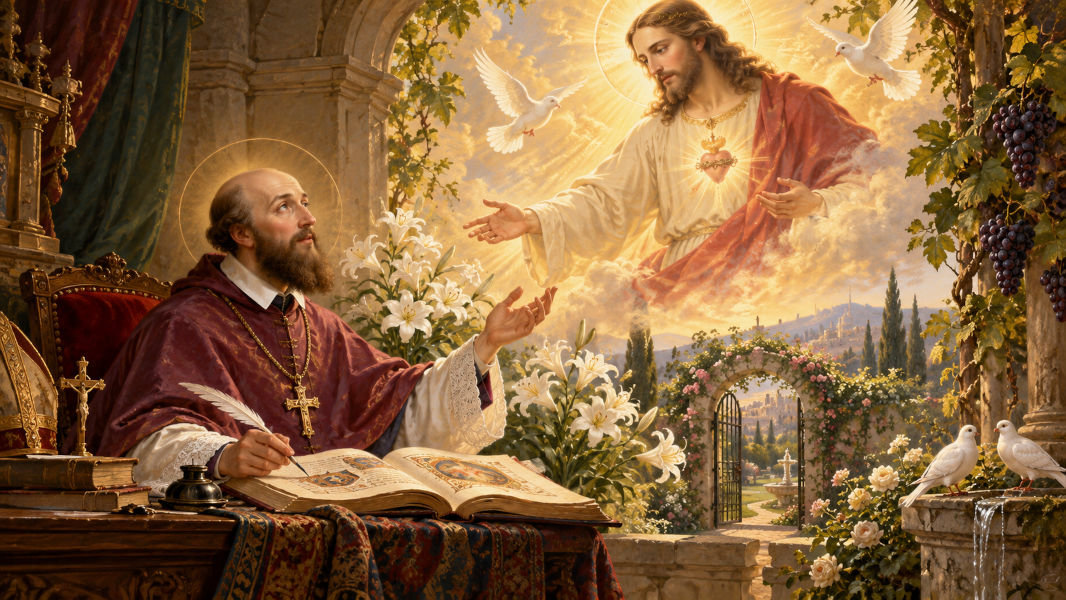
In his reading of the Song of Songs, Saint Francis de Sales evokes the figure of Christ the Bridegroom, above all as the one who brings salvation and whom he commonly calls ‘the Savior’, through quotations from the Song or simple allusions to it.
It is clear that many of his interpretations draw on a long tradition that preceded him. Yet, when speaking of the mysteries of God made man, the Doctor of Love was captivated, as few others were, by his taste for images, symbols, and ‘similitudes’.
The Joyful Mysteries
The Incarnation is the first of all the mysteries, hidden in God’s eternal providence and awaited throughout the ages.
In the poems of the Song, where vineyards and grapes are often mentioned, the author of the Treatise on the Love of God extends the image of the vineyard, a traditional symbol of God’s people, to the whole created universe, awaiting the delightful Fruit. For Jesus is the grape awaited by generations; it was for Him that the Father planted His vineyard from the beginning:
The great Savior was first in the divine intention and in that eternal plan which divine Providence made for the creation of creatures; and in contemplation of this desirable fruit, the vineyard of the universe was planted and the succession of generations established. Like leaves and flowers, they were to precede Him as forerunners and fitting preparations for the production of that grape so highly praised by the sacred bride in the Song.
After the long wait for the Incarnation, the moment of the Annunciation of the Savior’s coming finally arrives: the moment of the kiss.
The Virgin’s longing, as the voice of humanity in waiting, had found expression in her cry, ‘Let him kiss me with the kiss of his mouth’. Now it was mysteriously fulfilled.
Setting aside for once the mystical language he loves in favor of speculative theology, Saint Francis de Sales says that the kiss signifies ‘the hypostatic union of human nature with the divine’.
Our Lord came into His garden, he explains, when He came ‘into the most pure, most humble and most sweet womb of his Mother, full of all the flowering plants of the holy virtues’. Jesus is the flower of the fields, the flower par excellence, sprung from the most holy Virgin.
After Jesus’ birth, the Virgin’s longing is fulfilled in a very concrete way; she receives the kisses of her Child, whom she feeds with her milk.
Eight days after his birth, He is given the name Jesus, and one may say to Him: ‘Your name is oil poured out. O saving name, name of hope!’ This Name above every name inspired in Francis de Sales a cry of love and victory that he never tired of repeating: ‘Long live Jesus!’
At the beginning of His public ministry, the Beloved’s ‘Voice’ begins to be heard. The prophets of the Old Testament had said: behold, he will come and will not delay. But John the Baptist says: ‘Behold, He comes, leaping over the mountains, bounding over the hills’, as if to say that nothing can prevent His coming, not even the high mountains. Jesus preaches, and His preaching is like oil spreading its fragrance all around.
The Sorrowful Mysteries
But as he read the poems of the Song, our author dwelt chiefly on the images and symbols that spoke to him of Christ’s Passion and death on the cross.
The myrrh, often mentioned, represents the bitterness of His painful Passion.
He himself is the lily among the thorns.
He is the ‘fire of love burning in a thorny bush of sorrow’.
The dew and the drops of night covering the Beloved’s head represent His afflictions and sufferings.
The flowering bed, lectulus noster floridus, is the bed of the cross, for it was there that Our Lord became ‘the rose of martyrdom, the violet of mortification, the lily of purity’.
And what is this crown placed upon Him by his mother, the Synagogue, if not the crown of thorns for His wedding day?
Contemplation of Christ’s wounds suggested several more images from the Song to our author. The image of the honeycomb, with all its cells, reminds him of Christ’s body, pierced with holes like so many wounds. The windows and the lattice represent ‘the wounds of His body and the opening in His side’, through which He looks at us.
Another striking image, taken from Saint Bernard, is that of the holes in the rock where the dove nests—symbols of Christ’s wounds, in which it is good to hide. We must dwell, he writes, ‘in the cave of the turtledove and in the pierced side of our dear Savior’.
The Glorious Mysteries
There was no shortage of images with which to celebrate the mystery of the Resurrection, either. The reunion of Christ’s soul with His body is compared to honey filling a honeycomb:
He lived a new life, reuniting His soul, sweeter than honey, with His body, pierced and wounded by more holes than a honeycomb.
Wine represents the joy of His resurrection, and milk ‘the sweetness of His conversation’ with the apostles and disciples during the forty days that followed.
The Song of Songs also provided him with material to illustrate the mystery of the Ascension, which he describes as the last and the completion of the mysteries of Redemption.
The framing is perfect. If the kiss in the Song’s first verse evoked the mystery of the Incarnation, Francis de Sales read the mystery of the Ascension in the book’s final verse: ‘Flee, my Beloved, and be like the stag or the young stag of the does, upon the mountains of spices.’
In His Ascension, Christ is like the stag, which reaches the mountain peaks ‘to contemplate the sun more closely’, but also ‘to see more clearly all things beneath its feet’. Ascending to heaven in body and soul, Jesus mingled ‘the joyful wine of the essential glory of His soul with the delicious milk of the perfect happiness of His body’.
Exalted in glory beside the Father, the Son desires nothing but the Father’s one eternal kiss: ‘Let him kiss me with a kiss of His mouth.’ Thus, in heaven, the Son feeds and is satisfied ‘at the noon of His glory’, where there is no shadow.
Having ascended to heaven beside the Father, Jesus sends the Holy Spirit. In this He resembles the leaping young stag, which nevertheless keeps looking down into the valley where it left its mother, that is, human nature, to which He will send the Holy Spirit.
The gift of the Spirit marks the beginning of the Church. Upon it He pours not only His oil, that is, ‘the saving anointing of justification’, but also ‘the gentle wind of consolations’, that is, His love. Such love, our Doctor explains, cannot be the product of natural powers. It is a gift of the Holy Spirit, who ‘bestows it and pours it into our hearts’.
Conclusion
As we can see, Saint Francis de Sales interpreted many images and symbols in the Song with great freedom, reading in them the principal mysteries of the salvation brought by Christ. Above all, however, he was keen to show that the whole work of salvation is motivated by love.