


 By BSOL Editor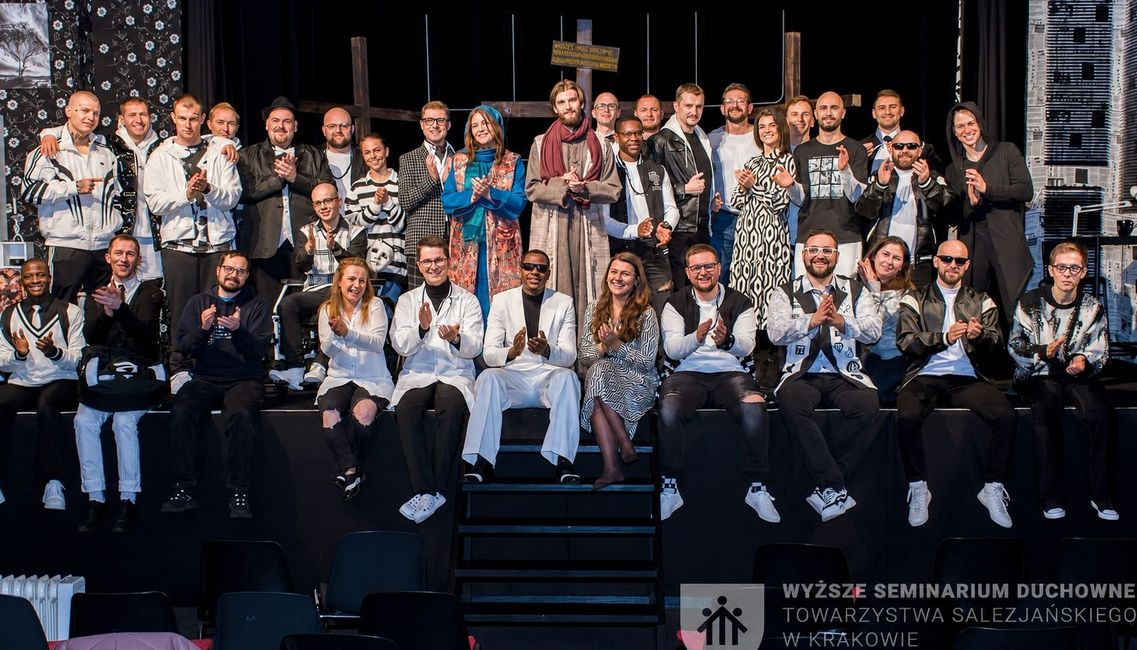
Reading time: 7 min.
In the Dębniki district, along the banks of the Vistula, stands one of the first Salesian houses in Poland. Over a century of history, nine new blesseds, and thousands of young people who continue to fill it with life.
A few minutes from the historic centre of Krakow, where the Vistula draws a wide bend under the gaze of Wawel Castle, lies the Dębniki district. It is here, at 39 Tyniecka Street, in the area everyone familiarly calls “Łosiówka”, that the Salesian formation house stands: one of the first opened in Poland, one of the most significant places in the Salesian geography of the Country and, since a few days ago, a house that the whole Church looks upon with gratitude and emotion.
A hill on the Vistula
Before the Salesians settled permanently in Krakow, the young Poles who knocked on Don Bosco’s door had to cross Europe: their studies were completed in Italy, especially in Turin. Everything changed at the end of the First World War, as Poland regained its independence. In July 1918, the Salesians purchased an estate of over five hectares from Count Zdzisław Łoś of Dzików, on which stood, among other things, an 18th-century hunting lodge. From the surname of the former owner, the entire place took the name of Łosiówka, and a religious house dedicated to the Immaculate Conception of the Blessed Virgin Mary was erected there.
The early years were an educational building site in constant motion. In 1919, the Salesian Philosophical Institute was housed there; in 1931, with a reorganisation that transferred the philosophy students to Marszałki, near Ostrzeszów, the Salesian Theological Institute was born in Krakow. From that moment, and for almost a century, the theological studentate has been the beating heart of the Dębniki house. In 1936, construction began on a modern church dedicated to Mary Help of Christians, designed for the community in formation and, at the same time, for the inhabitants of the district.
The darkest chapter, the greatest light
The Nazi occupation is the most dramatic page – and, today we know, the brightest – of this history. In extreme conditions, philosophical and theological studies were never interrupted, and Łosiówka also opened its doors to clerics taking refuge from other houses. Then came the darkest day: on 23 May 1941, the eve of the feast of Mary Help of Christians, the Gestapo surrounded the house and arrested twelve Salesians, including priests and clerics. They passed through the Montelupich Street prison and from there were deported to Auschwitz; most did not return. Taken away in that raid against the Salesians of Dębniki were, Fr. Józef Kowalski – whom John Paul II would beatify in 1999 – and six of the nine martyrs whom the Church has just enrolled in the register of the blesseds.
On Saturday 6 June 2026, in fact, in the Sanctuary of St. John Paul II in Krakow, Cardinal Marcello Semeraro, Prefect of the Dicastery for the Causes of Saints, presided over the beatification of Fr. Jan Świerc and his eight companions: Fr. Ignacy Antonowicz, director of Łosiówka, Fr. Franciszek Harazim, an esteemed professor of the studentate, and with them Fr. Ignacy Dobiasz, Fr. Karol Golda, Fr. Franciszek Miśka, Fr. Ludwik Mroczek, Fr. Włodzimierz Szembek, and Fr. Kazimierz Wojciechowski. Educators, teachers, school directors, pastors, and confessors: killed in hatred of the faith in the Auschwitz and Dachau concentration camps between 1941 and 1942, they were recognised as martyrs by the decree signed by Pope Leo XIV in October 2025.
During the celebration, the Metropolitan of Krakow, Cardinal Grzegorz Ryś, visibly moved, invited the young people to “make friends” in particular with Blessed Karol Golda, killed at the age of 28 for having confessed German soldiers: a love – he recalled – capable of seeing brothers even in enemies. And Cardinal Semeraro gave the young people a word that we know well at Łosiówka: young people are not only the future of society; they are the living present of the Church. The following day, a Mass of thanksgiving was celebrated in the Salesian sanctuary of Oświęcim, a few steps from the place of martyrdom.
A boy named Karol
There is a providential thread that links that bloody page to the story of a saint. A few hundred metres from Łosiówka, at number 10 of the same Tyniecka Street, lived a young student and worker in those years: Karol Wojtyła. He attended the Salesian parish of St. Stanislaus Kostka, the religious heart of Dębniki, and right in front of the image of Mary Help of Christians his vocation was maturing. When the arrest of 23 May 1941, deprived the community of its priests, the Salesians entrusted the spiritual care of the young people to a layman, the tailor Jan Tyranowski, now venerable. It was he, with the “Living Rosary”, who became the spiritual guide of the future pope. From that small cenacle blossomed eleven priestly vocations, and even today the people of Krakow gladly speak of their “holy Dębniki”. History then drew a perfect circle: John Paul II raised Fr. Kowalski to the altars, and in the sanctuary dedicated to John Paul II the Salesians of his youth were beatified.
Rebirth and growth
After the war, the church was completed and consecrated in 1947, by Cardinal Adam Stefan Sapieha. During the years of communism, despite the repressions of the state authorities, the Salesians not only resisted, but developed their own academic centre: the clerics studied on site, obtaining academic degrees thanks to the collaboration with Catholic universities. In the 1970s and 1980s, vocations in Poland grew with such momentum that space at Łosiówka was no longer enough: at its peak, in the 1980s, over 140 clerics studied there. In 1983, work began on the construction of a new, large building with educational and residential functions.
A house open to the world
The fall of communism in 1989, threw the doors wide open. From 1991, the formation house took on an international character: young people from Eastern Europe – Ukraine, Belarus, Russia – but also from Asia and Africa prepared for the priesthood there, concluding their journey with a master’s degree in theology at the Pontifical University of John Paul II in Krakow.
Today, demographic changes, the decline in the number of clerics and the reorganisation of religious structures in Poland demand an even greater openness – and we experience it as an opportunity. At the end of the 2025/2026 academic year, the Salesian Theological Institute is transferring its activities to the Philosophical-Theological College of the Dominican Fathers of Krakow, heir to the Dominican Studium Generale erected in 1304: over seven centuries of theological tradition. The young Salesians will study side by side with the sons of St. Dominic de Guzmán, and with Carmelites, Salvatorians, and Benedictines. We deeply believe that stepping outside one’s own walls, engaging and exchanging ideas with other religious families, and savouring the authentic commitments of student life will enrich the young confreres – and not only intellectually.
The Gospel goes on stage
Łosiówka, meanwhile, remains what it has always been: a lively pastoral, missionary, and youth centre. The formation house, besides being a place of residence and study, is above all a place of evangelisation. The Salesians are among the few congregations in Poland that every year, on the weekends of Lent, stage the Mystery of the Lord’s Passion. The preparation for this massive undertaking begins as early as October, under the guidance of Marcin Kobielski, an actor from the Bagatela Theatre in Krakow and a professional director, but above all a man of deep faith and a member of the Ziemia Boga community. Mr. Marcin does not only teach the young Salesians to act: he shapes their sensitivity to beauty, to art, and to their neighbour. This year, the Mystery filled the theatre hall to the last seat – over three hundred armchairs, under the rectoral church – and was seen by a total of about nine thousand spectators. And not only from Krakow!
The Ziemia Boga (“Land of God”) community, born more than twenty years ago as a university pastoral care group, has grown to become a true community of evangelisation through theatre: some twenty shows to its credit, each capable of gathering over five thousand spectators. Its members meet every Wednesday for the Eucharist, prayer, and adoration, and during the week they meet in small groups in homes.
A house full of young people
For over thirty years, on the second weekend of May, the house has hosted the SAVIONALIA: the gathering of the young people of the province, which brings together several hundred youngsters for a time of prayer, formation, and celebration. For years, Łosiówka has been a space where young people grow in the spirit of St John Bosco, just like the Salesians.
The Salesian Missionary Voluntary Service “Młodzi Światu” (“Youth for the World”) also has its home here. Every week, about forty young people train and serve in the “Villages of the World” Global Education Park, a miniature of Salesian missionary work across the five continents. And every year about fifteen of them actually leave, sent as missionaries in the spirit of Don Bosco to proclaim the Gospel all over the world.
Recently, a new university pastoral group, Kontakt, was born, gathering about seventy students: formation, outdoor activities, fun, and time well spent enliven the whole of Łosiówka with their presence. The house also runs a boarding house for students linked to the works of the province and the Salesian charism. In addition to renting a room, they get involved in our life and our events. And on the field of the SALOS Salesian Sports Organisation, sports are played every day: children and teenagers in the afternoon, adults late in the evening – including Salesians, together with other religious of Krakow.
Family Sunday
Pastoral care at the rectoral church, meanwhile, never stops. Masses and services are celebrated every day. On Sundays, there are four Eucharists, and the most attended is the 12 o’clock one: the Mass for families with children. After the Liturgy of the Word, the clerics accompany the little ones to the sacristy for a catechesis tailored to them, while the parents are addressed with a preaching designed specifically for them. These meetings arouse great interest, well beyond the boundaries of our pastoral care and the district.
ART.43: the charism communicates
In implementation of Article 43 of our Constitutions, dedicated to evangelisation through social communication, the media group ART.43 Don Bosco Media was born in Łosiówka. It has its own recording studio and documents the activities of the community, the province, and the life of the Church. The group has spread not only in Poland, but now has branches in other parts of the Salesian world.
The beating heart
Science, music, sport, and theatre are the heart of Łosiówka, and the number of young people and people who live the Salesian charism around our house continues to grow. The recent beatification of our nine martyrs powerfully reminded us of this: the Salesian charism has gone through very harsh trials, but it continues, always, to be reborn. Don Bosco’s heart beats here too, on the hill of Łosiówka. And it beats strongly.
Fr. Mateusz Koziołek, SDB
Director of the Salesian house in Krakow