

 By BSOL Editor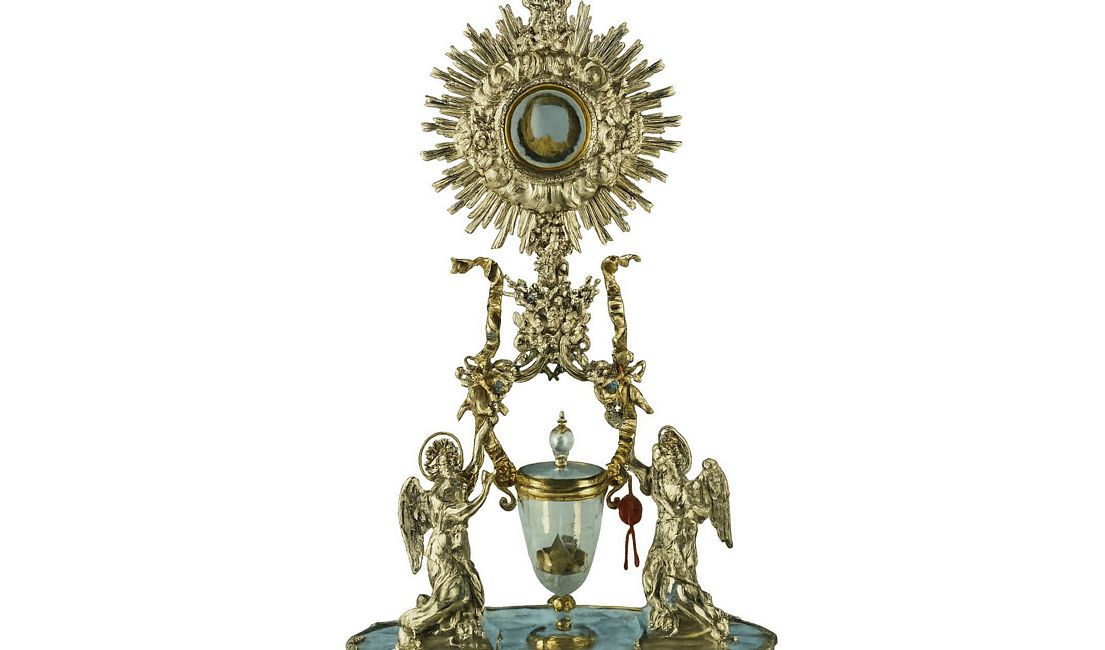
Reading time: 5 min.
The Eucharistic Miracle of Lanciano, Italy – Silver monstrance of the Holy Relics (1713)
There is a Bolognese doctor who has chosen to apply to the mystery of faith the same tools with which he listens to his patients’ heartbeats every day. His name is Franco Serafini; he is a cardiologist at the AUSL in Bologna, born in 1967, and his book – “Un cardiologo visita Gesù. I miracoli eucaristici alla prova della scienza” [A cardiologist visits Jesus. Eucharistic miracles put to the test of science] – has opened an extraordinary dialogue between the laboratory and the altar, between the scalpel and the tabernacle. He is not a theologian. He is not a professional apologist. He is simply a doctor who, with the same intellectual honesty with which he reads an electrocardiogram, has decided to read the traces left by five Eucharistic miracles recognised by the Church and subjected, in recent decades, to the most refined scientific analyses available.
The result is something that, as he himself admits, has “shocked him in its precision”.
A crime scene on the altar
The method chosen by Serafini is borrowed directly from forensic and legal medicine – the same technologies we see in American TV shows when analysing a crime scene. Only here the “scene” is a consecrated host. In very different places and centuries, some hosts have transformed into bleeding tissue, and modern science has been called upon to answer a simple and uncomfortable question: what is it?
The five miracles examined by Serafini are: Lanciano (Italy, 8th century), Buenos Aires (Argentina, 1992-1994-1996), Tixtla (Mexico, 2006), Sokółka, and Legnica (Poland, 2008 and 2013 respectively). Five events separated by centuries and thousands of kilometres, occurring in completely different cultures and contexts, yet united by the same initial dynamic: a host dropped on the ground is placed in water to dissolve, and instead transforms into something unexpected.
The histological, genetic, and immunohistochemical analyses conducted by teams of independent pathologists and forensic doctors have produced data that the Bolognese cardiologist defines as “explosive from a statistical point of view”.
Five times the same heart
The first piece of data that emerges with disconcerting regularity is anatomical in nature. In all five Eucharistic miracles examined, the tissue detected is myocardial muscle tissue, i.e., heart tissue. Not skeletal muscle, not another organ: heart. And not just any heart.
“Five times out of five,” explains Serafini, “we find myocardial tissue. This heart is always torn; it is always suffering, from a medico-legal point of view.” The cells unequivocally show the biological signs of severe trauma, of intense stress, compatible with what is observed in victims of violent assaults, road accidents, or executions. A heart that has suffered. A heart that was dying.
For a cardiologist, this language is precise and unequivocal. It is not an interpretation; it is a diagnosis. And the diagnosis, in five cases out of five, separated by centuries and continents, says the same thing.
The blood that does not lie: group AB
The second extraordinary piece of data concerns the blood. In all the Eucharistic miracles analysed, the blood present belongs to group AB, the rarest of human blood groups. It is also called the “universal recipient” because people with this blood group can receive transfusions from people who have all the other groups. A detail that alone would already have considerable statistical weight, but which becomes even more significant when read in relation to another element. It is the same blood group detected on the three main cloths of the Passion of Christ – the Shroud of Turin, the Sudarium of Oviedo in Spain, and the Tunic of Argenteuil in France.
The convergence between the relics of the Passion and the Eucharistic miracles, on this specific point, is neither coincidental nor interpretative; it is laboratory data, reproducible and verifiable. “It is explosive data from a statistical point of view,” comments Serafini with the sobriety of someone who knows the language of numbers well. The probability of such coincidences repeating by chance five times out of five, in very different eras and places, is mathematically negligible.
Inexplicable vitality
But there is a third element that surpasses even the previous ones in terms of scientific bewilderment; the cellular vitality of the samples taken. The tissues of the Eucharistic miracles – often preserved in conditions that are anything but optimal, without any refrigeration or adequate chemical protection – show under the microscope characteristics of a vitality that is completely inexplicable given their age and the methods of preservation.
In the case of Buenos Aires in 1996, in particular, the sample taken from the tissue showed cells on the slide still in a condition of relative integrity, despite the time that had passed since the transformation and despite no preservation technique having been applied. It is the type of finding that, in an ordinary hospital setting, would require immediate and extraordinary explanations.
The pattern: a message, not a spectacle
Serafini does not limit himself to listing data. As a doctor accustomed to reading symptoms not as ends in themselves but as messages from the body, he interprets these convergences as a coherent and intentional language.
“The miracle does not mock us, but wants to comfort and strengthen us in faith,” he says. “These miracles do not want to amaze us by showing ever-different and unpredictable human tissues, but rather they speak to us, and they do so using the unprecedented language of science and technology to which modern man is so sensitive, to transmit a simple, coherent content that is instinctively understandable even for the faith of the simplest: in the Eucharist there is the heart of a torn and agonising Man.”
This is the theological synthesis that emerges from the scientific analysis. Not a subjective spiritual elaboration, but the medical reading of an objective report. The Sacred Heart of Jesus – for centuries an object of veneration in the Catholic and Salesian tradition – finds in the Eucharist not only a symbol, but, according to these data, a real, scientifically measurable physical presence.
A gift for our time
It is no coincidence, Serafini points out, that the vast majority of these miracles have occurred in recent decades. The miracle of Lanciano dates back to the 8th century, but all the others occurred between 1992 and 2013 – right in the scientific era, in a world that demands proof and documentation. “If Heaven gives us these signs, it is evidently because they are for us,” observes the cardiologist, “and it is our duty to talk about them.”
In this sense, Serafini’s work fits into a renewed apologetic tradition, which does not ask science to replace faith, but to dialogue with it. As he himself writes, “the study of Eucharistic miracles is a wonderful opportunity to demonstrate how faith and science have a meeting point, and that a rigorous and profound study of life cannot fail to recognise a complexity such as to make one think of a creating and organising entity”.
It is not science that creates faith. But it can lower the defences of doubt, open a door, and lay down the weapons of indifference.
A heart for Salesian education
For those who, like us Salesians, accompany children and young people on the journey of faith, Serafini’s discoveries offer a precious tool. In an era in which rationalism is often perceived as an antagonist to belief, being able to show that science itself – the serious kind, the rigorous kind, the kind from university laboratories – finds itself faced with something inexplicable and coherent, is a pedagogical gift of great value.
Don Bosco always wanted faith to be reasonable, capable of answering young people’s questions without sentimental shortcuts. Today, in the 21st century, a cardiologist reminds us that the Eucharist is not just a rite to be celebrated, but a mystery to be encountered – and that the heart of Jesus, broken for us, continues to beat in the silence of every tabernacle.
Franco Serafini, “Un cardiologo visita Gesù. I miracoli eucaristici alla prova della scienza”, ESD – Edizioni Studio Domenicano, third expanded edition.