


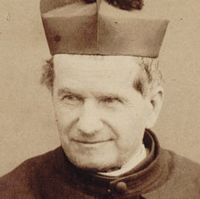
 By St John Bosco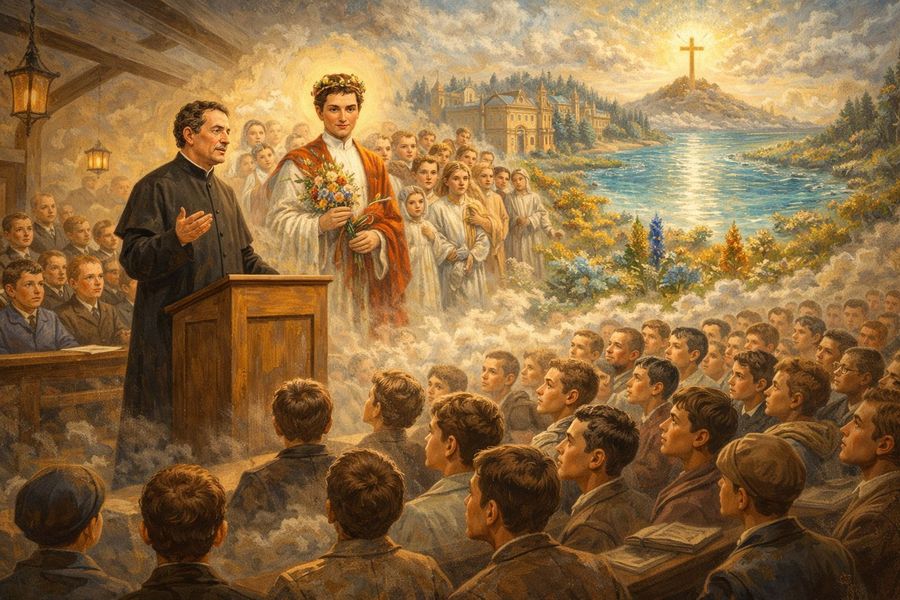
Reading time: 18 min.
The following text recounts the “Vision of Saint Dominic Savio”, as told by Don Giovanni Bosco on the evening of 22 December 1876 to the students and artisans of the Valdocco Oratory. In the form of a dream, Don Bosco describes the appearance of his young pupil Dominic Savio, who died with a reputation for holiness, and who guides him through a paradisiacal landscape, rich in spiritual and musical symbols. The narrative, full of luminous images, messages of hope, and calls to purity, charity, and obedience, concludes with prophecies about the future of the Salesian Congregation and the fate of some of its members. It is a precious document of Don Bosco’s preventive pedagogy and his mystical-symbolic universe, capable of speaking to the hearts of readers even today.
Finally came the evening of December 22, a date that made history at the Oratory. Night prayers were said earlier than usual, and then the artisans and the rest of the community joined the students. Don Bosco had promised to speak the night before, but he had been unable to keep his word, so one can imagine the overall feeling of expectation. He stepped up to the platform and, as usual when he came to give the “Good Night” to the entire community, was greeted by enthusiastic applause. As soon as he began to speak a profound silence fell.
When I feel asleep the first night I was at Lanzo, I had a dream which is totally different from all the previous ones. I did narrate a dream somewhat like this during the spiritual retreat, but since you were not all present and this is quite different, I have decided to recount it to you. It is quite strange. However, as you know, I bare my very heart to my sons and keep no secrets from them. So give this dream whatever consideration you wish, but because St. Paul says: “Test everything; retain what is good [1 Thess. 5, 21], if you should happen to find something in this dream that is beneficial to your soul, make good use of it. Those who do not want to believe it don’t have to, but let no one ever hold up to ridicule what I am about to say. Furthermore, I ask you not to tell any outsider and not to write home about it. Dreams are to be given the importance they deserve. Those who do not know how close we are to each other might well misjudge the whole thing. They do not realize that you are my children and that I tell you everything I know, and even, sometimes, things I don’t know. (General laughter) Whatever a father tells his beloved sons for their own good should stay between them and go no further. There is another reason, too. If the dream were to be told to outsiders, more often than not the facts could be twisted or presented out of context. This could be harmful and lead people to regard as worthless what, instead, is important.
As you know, dreams come in one’s sleep. So during the night hours of December 6, while I was in my room — whether reading or pacing back and forth or resting in bed, 1 am not sure — I began dreaming.
It suddenly seemed to me that I was standing on a small mound or hillock, on the rim of a broad plain so far-reaching that the eye could not compass its boundaries lost in vastness. All was blue, blue as the calmest sea, though what I saw was not water. It resembled a highly polished, sparkling sea of glass. Stretching out beneath, behind and on either side of me was an expanse of what looked like a seashore.
Broad imposing avenues divided the plain into grand gardens of indescribable beauty, each broken up by thickets, lawns, and flower beds of varied shapes and colors. None of the plants we know could ever give you an idea of those flowers, although there was a resemblance of sorts. The very grass, the flowers, the trees, the fruit — all were of singular and magnificent beauty. Leaves were of gold, trunks and boughs were of diamonds, and every tiny detail was in keeping with this wealth. The various kinds of plants were beyond counting. Each species and each single plant sparkled with a brilliance of its own. Scattered throughout those gardens and spread over the entire plain I could see countless buildings whose architecture, magnificence, harmony, grandeur and size were so unique that one could say all the treasures of earth could not suffice to build a single one. If only my boys had one such house, I said to myself, how they would love it, how happy they would be, and how much they would enjoy being there! Thus ran my thoughts as I gazed upon the exterior of those buildings, but how much greater must their inner splendor have been!
As I stood there basking in the splendor of those gardens, I suddenly heard music most sweet — so delightful and enchanting a melody that I could never adequately describe it. Compared with it, the compositions of Father Cagliero and Brother Dogliani are hardly music at all. A hundred thousand instruments played, each with its own sound, uniquely different from all others, and every possible sound set the air alive with its resonant waves. Blended with them were the songs of choristers.
In those gardens I looked upon a multitude of people enjoying themselves happily, some singing, others playing, but every voice, every note, had the effect of a thousand different instruments playing together. At one and the same time, if you can imagine such a thing, one could hear all the notes of the chromatic scale, from the deepest to the highest, yet all in perfect harmony. Ah yes, we have nothing on earth to compare with that symphony.
One could tell from the expressions of those happy faces that the singers not only took the deepest pleasure in singing, but also received vast joy in listening to the others. The more they sang, the more pressing became their desire to sing. The more they listened, the more vibrant became their yearning to hear more. And this was their song: Salus, honor, gloria Deo Patri Omnipotenti. . . Auctor saeculi, qui erat, qui venturus est iudicare vivos et mortuos in saecula saeculorum [Salvation, honor and glory to Almighty God the Father… the Creator who was, who is and who will come to judge the living and the dead forever and ever].
As I listened enthralled to that heavenly choir I saw an endless multitude of boys approaching me. Many I recognized as having been at the Oratory and in our other schools, but by far the majority of them were total strangers to me. Their endless ranks drew closer, headed by Dominic Savio, who was followed immediately by Father Alasonatti, Father Chiala, Father Giulitto and many, many other clerics and priests, each leading a squad of boys.
I kept asking myself: Am I sleeping or am I awake? I clapped my hands and felt myself to make sure that I was seeing reality. Once that host of boys got some eight or ten paces from me, they halted. There was a flash of light far brighter than before, the music stopped, and a hushed silence fell over all. A most radiant joy encompassed all those boys and sparkled in their eyes, their countenances aglow with happiness. They looked and smiled at me very pleasantly, as though anxious to speak, but no one said a word.
Dominic Savio stepped forward a pace or two, standing so close to me that, had I stretched out my hand, I would surely have touched him. He too was silent and gazed upon me with a smile. How wonderful he looked! His garments were altogether unique. The snow-white tunic which he wore down to his feet was studded with diamonds, and there were threads of gold running through it. About his waist was fastened a broad red sash, so thickly embroidered with precious gems that they almost overlapped each other, and sewn into such a charming design with such brilliance of colors that, just looking at them, I could feel myself quite lost in admiration. From his neck hung a necklace woven of exotic but not natural flowers whose petals seemed to be clusters of diamonds set into stems of gold. And so it was with everything else. Those flowers flashed with a preternatural sparkle brighter than the very sun, which was then brilliantly burning in all the glory of a spring morning. Their blinding sparkles reflected from Dominic’s candid, ruddy countenance in an indescribable manner, so brilliant indeed that their individual species were undetectable. A crown of roses encircled his head. His hair fell down in waves to his shoulders, giving him such a handsome and lovely charm that he seemed … he seemed … an angel!
While enunciating these last few words, Don Bosco seemed to be at a loss for suitable expressions, punctuating them with a gesture which defies description and a tone of voice which moved his listeners. It was as if he had exhausted himself in an effort to find words that would fully convey his idea. He paused momentarily and then went on.
The other persons too were aglow with light, dressed as they all were in different but always glittering garments, some more colorful than others, each garment symbolizing something that exceeded human understanding. However, all wore the same red sash about the waist.
I kept staring and wondering: What can it all mean? How did I ever manage to get here? With no idea where I was, beside myself and shaking with awe, I dared not take a step forward. The others all remained silent. At last Dominic Savio spoke. “Why do you stand there silent, as though you were almost devitalized?” he asked. “Aren’t you the one who once feared nothing, holding your ground against slander, persecution, hostility, hardships and dangers of all sorts? Where is your courage? Say something!”
I forced myself to reply in a stammer, “I do not know what to say. Are you Dominic Savio?”
“Yes, I am. Don’t you know me anymore?”
“How come you are here?” I asked, still bewildered.
Savio spoke affectionately. “I came to talk with you. We spoke together so often on earth! Do you not recall how much you loved me, or how many tokens of friendship you gave me and how kind you were to me? And did I not return the warmth of your love? How much trust I placed in you! So why are you tongue-tied? Why are you shaking? Come, ask me a question or two!”
Summoning my courage, I replied, “I am shaking because I don’t know where I am.”
“You are in the abode of happiness,” Savio answered, “where one experiences every joy, every delight.”
“Is this the reward of the just?”
“Not at all! Here we do not enjoy supernatural happiness but only a natural one, though greatly magnified.”
“Everything here then is natural?”
“Yes, only enhanced by God’s power!”
“Oh,” I exclaimed. “I thought this was paradise.”
“Oh, no, no!” Savio answered. “No human eye can look upon the beauty of paradise.”
“And this music,” I asked, “is it the music which you enjoy in heaven?”
“No, no, absolutely not!”
“Are these then natural sounds?”
“Yes, of course, but brought to perfection by God’s infinite power.”
“And this light which outshines the very sun’s brilliance — is it a supernatural light? Is it heavenly light?”
“It is only natural light, fortified and perfected by God’s omnipotence.”
“Might I be allowed to see a little supernatural light?”
“No one can see it until he has come to see God as He is. The faintest ray of that light would instantly strike one dead, because the human senses are not sturdy enough to endure it.”
“Could there possibly be a natural light lovelier than this?”
“Yes, but if you could only see a single ray of natural light increased by just one degree, you would go into an ecstasy.”
“Might I not see at least one tiny ray of this brighter light?”
“Yes, of course you may. I’ll give you a proof of what I say. Open your eyes.”
“They are open,” I answered.
“Pay close attention, then, and look out toward the farthest end of that crystal sea.”
I looked. Instantly from the remotest heavens a sudden streak of light flashed through space, fine as a thread, but so brilliant, so piercing that my gaze faltered in pain. 1 shut my eyes and screamed loud enough to wake Father Lemoyne (he is here now) who was sleeping in the next room. In the morning he asked me in fright what had happened to me during the night to have so upset me. That filament of light was a hundred million times brighter than the sun; its brilliance could have lit up our entire universe.
After some moments I opened my eyes again. “What was that?” I asked Dominic. “Was not that a heavenly beam?”
“It was not a supernatural light,” Dominic replied, “though ever so much superior in brilliance than the light of the world. It was nothing more than earthly light rendered ever so dazzling by God’s power. Even if a vast array of light as strong as the ray you saw at the end of that crystal sea were to cover the whole world, it would still not give you an idea of the splendors of paradise.”
“Then what do you enjoy in paradise?”
“Ah, that defies all telling. The happiness of heaven no mortal beings can ever know until they die and are reunited to their Maker. We enjoy God — nothing else!”
By now I had fully recovered from my initial bewilderment and was taken up with admiring Dominic Savio’s beauty. “Why are you wearing that white, sparkling robe?” I asked him frankly.
Giving no sign of wanting to respond, Savio remained silent, but the choir, accompanied by all the instruments, sang: Ipsi habuerunt lumbos praecinctos et dealbaverunt stolas suas in sanguine Agni [They have girded themselves and have washed their robes white in the blood of the Lamb — cf. Apoc. 7, 14].
“And why,” I asked as the music ended, “are you wearing that red sash about your waist?”
Again Savio did not reply and motioned that he did not wish to answer.
It was Father Alasonatti who then began to sing by himself: Virgines enim sunt et sequuntur Agnum quocumque ierit [They are virgins and follow the Lamb wherever He goes — cf. Apoc. 14, 4].
I then understood that Dominic’s blood-red sash was a symbol of the great sacrifices, the strenuous efforts, and the near-martyrdom he had endured to preserve the virtue of purity, and that, to remain chaste in God’s eyes, he would have given up his life if the circumstances had warranted it. It was also a symbol of penance which cleanses the soul of guilt. In addition, the shining whiteness of his robe signified the baptismal innocence which he had preserved.
Entranced by the singing and gazing upon those endless ranks of heavenly youths massed behind Dominic Savio, I asked him, “Who are they?” Then, turning, I asked: “Why are all of you so resplendent with light?” Savio continued to remain silent and all his companions broke into song: Hi sunt sicut Angeli Dei in caelo [They are like God’s angels in heaven]. I had noticed meanwhile that Savio seemed to enjoy a certain preeminence over that assembly, which kept at a respectful distance some ten paces behind him. “Tell me, Savio,” I said, “you are the youngest of this entire following and of those who have died in our houses. Why then are you at their head as their leader? Why are you their spokesman, while they are silent?”
“I am the oldest of them all.”
“Oh, no,” I countered. “Many of them are a good deal older than you.”
“I am the oldest of the Oratory,” Dominic Savio repeated, “because 1 was the first to leave the world and enter into this life. Besides, legatione Dei fungor” [I am God’s ambassador]. This answer made the reason for the apparition clear to me. He was God’s envoy.
“Well, then,” I said, “let us speak of the things which most concern us at this moment.”
“Yes, and be quick. Ask me whatever you wish to know. Hours go by and the time I have been given to speak with you may run out and you might not see me again.”
“I am convinced you have something of supreme importance to tell me.
“What could I ever tell you — I, a poor creature?” Savio said with the deepest humility. “From on high I was given the mission to speak with you. That is why I am here.”
“Then,” I exclaimed, “tell me of the past, of the present, and of the future of our Oratory. Tell me something about my dear sons. Talk to me of my Congregation.”
“There are so many things I could tell you about that.”
“Reveal to me the things you know. Tell me about the past.”
“All the past is your responsibility,” Savio replied.
“Have I made any blunders?”
“As to the past,” he answered, “I will say that your Congregation has already accomplished a great deal of good. Do you see that countless multitude of boys there?”
“Yes. They are so many,” I answered. “How happy they look!”
“Observe,” he went on. “Do you see what is written at the gateway of that garden?”
“I do. It says ‘Salesian Garden.’”
“Well then,” Savio went on, “those who are there were all Salesians or Salesian pupils. They were saved by you or your priests and clerics. Or they are those whom you directed on the path of their vocation. Count them if you can! Still, there would be a hundred million times more if you only had greater faith and trust in the Lord.”
I sighed in dismay. I had no excuse for his reproach but resolved within my heart: I shall endeavor to have this faith and trust in the future.
Then I inquired, “What of the present?”
Savio held out a gorgeous bouquet of roses, violets, sunflowers, gentians, lilies, evergreens, perennials, and sprigs of wheat and he handed it to me. “Look at these flowers,” he said.
“I am looking,” I replied, “but I don’t know what you mean.”
“Give this bouquet to your sons so that, when the time comes, they may offer it to the Lord. See to it that everyone has it, that no one is without it, and that no one steals it from them. Do this and you can rest assured that they will have enough to make them happy.”
“What do these flowers symbolize?”
“Get your theology book,” he replied, “and you will know.”
“I’ve studied theology,” I objected, “and I still can’t fathom any meaning from what you have given me.”
“And yet you absolutely should know these things.”
“Well then,” I pleaded, “ease my anxiety. Tell me what this is all about.”
“Do you see these flowers?” Savio obliged. “They symbolize the virtues which most delight the Lord.”
“Which are they?”
“The rose is the symbol of charity, the violet of humility, the sunflower of obedience, the gentian of penance and self-denial, and the wheat stalks of frequent Communion. Then, the lily stands for the beautiful virtue of chastity of which it is written: Erunt sicut angeli Dei in caelo [They shall be like God’s angels in heaven]. Finally, the evergreens and perennials tell you that these virtues must endure forever. They denote perseverance.”
“Very well, my dear Savio,” I answered. “Now tell me, you who practiced all these virtues in your lifetime, what comforted you the most at the moment of your death?”
“What do you think it was?” Savio prompted.
“Perhaps having preserved the beautiful virtue of purity?”
“Not that alone.”
“Having your conscience at peace?”
“That too is a good thing, but it is still not the best.”
“Perhaps the hope of paradise?”
“No, not even that.”
“Well, was it the treasury of good deeds you had stored up?”
“No, no.”
“Well, what was it then?” I pleaded with him, nonplussed at having failed to fathom his thought.
“The one thing that consoled me most at the hour of my death,” Savio answered, “was the assistance of the mighty and lovely Mother of the Savior. Tell your sons never to forget to pray to Her as long as they live. But now hurry if you want me to answer more questions.”
“What can you tell me about the future?”
“In the coming year of 1877, you will have a painful sorrow to endure. Six and then two more of those dearest to you will be summoned into eternity. But be comforted, for they will be transplanted from this world to the gardens of heaven. They will receive their crown. And do not be worried, for the Lord will be your help and will give you other good sons.”
“God’s will be done! And what will happen to the Congregation?”
“The Lord is preparing great things for you. In the coming year your Congregation will see a dawn of glory so resplendent that it will light up the four corners of the earth. A great splendor lies in the offing. But see to it that the Lord’s chariot is not led by your Salesians off its course, out of its set path. If your priests will guide it in a manner worthy of their lofty calling, the future of your Congregation will be most glorious and will bring salvation to endless multitudes of people. There is but one condition: that your sons be devoted to the Blessed Virgin Mary and that all of them learn to preserve the virtue of chastity which so delights God.”
“Now I would like you to tell me about the Church in general,” I continued.
“The Church’s destiny is in the hands of God, our Maker. I cannot tell you what He has determined in His infinite decrees. To Himself alone He keeps such mysteries, and no heavenly creature can ever share that knowledge.”
“What will happen to Pius IX?”
“All I can tell you is that the Church’s shepherd will not have much longer to do battle here on earth. Few are the combats he must still win. Soon he will be taken from his see and the Lord will grant him his well- earned reward. The rest you know. The Church will not die. Is there anything else you want to know?”
“What will happen to me?” I asked.
“If you only knew how many tribulations still await you! But hurry now, for the time allotted me to speak to you is drawing to a close.”
Impulsively I stretched out my hands to clutch those of that blessed youth, but his hands were no firmer than thin air, and I grasped nothingness.
“How foolish!” Dominic said with a smile. “What are you trying to do?”
“I am afraid to lose you,” I exclaimed. “Are you not really here in the flesh?”
“Not in my flesh. One day I will take that up again.”
“But what is that I see? You have Dominic Savio’s features; you are Dominic Savio.”
“Look,” he said, “when a soul, separated from the body, is allowed by God to reveal itself to a human, it retains its features just as it had them in the flesh, though considerably enhanced in beauty, until it is reunited to the body on the day of the universal judgment. From then on soul and body will again be together. That is why I seem to have hands, feet and head, but you cannot grasp me because I am a pure spirit. You only recognize me because of the features that I am allowed to retain in order to be seen.”
“I understand,” I answered. “I have one more question: Are all my boys on the path of salvation? Tell me how to guide them.”
“The boys whom Divine Providence has entrusted to your care can be divided into three groups. Take a look at these three sheets of paper.” (He held one out to me.)
I looked at the first. It bore one word: Invulnerati, unscathed, that is, those whom the devil had not been able to harm, those who had never lost their baptismal innocence. There was a great number of them and I saw them all. Many I personally knew; many others I was seeing for the first time — perhaps boys who will come to the Oratory in future years. They were all moving forward unswervingly along a narrow path, regardless of the arrows and swords and spears that were continually being hurled at them from everywhere. These weapons bristled like hedges on both sides of their path, threatening and harassing but never wounding them.
Savio then handed me a second sheet. It bore the word: Vulnerati, wounded, that is, those who had fallen into sin but had risen to their feet again, healed of their wounds after repentance and confession. Their number was considerably greater than the first. They had been wounded on their passage through life by the enemies who lined their way. I scanned the list of their names and saw them all. Many dragged themselves along, bent over and disheartened.
Savio still held a third sheet in his hand, labeled: Lassati in via iniquitatis, exhausted on the path of iniquity. [Wis. 5, 7] It bore the names of all those boys who at that moment were in the state of sin. Impatient to know the contents of that list, I put out my hand, but Savio quickly held the note back. “Wait a moment,” he said, “and listen. Once you open this note, such a stench will come out that it will overcome us both and make the angels withdraw in disgust and horror. The Holy Spirit himself cannot stand the offensive odor of sin!”
“How can this be,” I objected, “since God and his angels are impassible? How can they smell a material stench?”
“They can,” he answered. “The purer and holier a creature is, the more it resembles a heavenly spirit, but the filthier and more sinful one is, the further he moves from God and His angels, who in turn withdraw from him, an object of disgust and loathing.”
He then gave me the note. “Take it,” he said, “and use it for the good of your boys, but don’t forget the bouquet of flowers which I have given you. Make sure that everyone has it and does not lose it.” Giving me the list, he hastily withdrew and joined his companions. I opened it. I saw no names, but in an instant there flashed before my eyes all the lads therein mentioned, just as real as if they were standing there in front of me. With great grief I saw all of them. Most I knew personally as belonging to this Oratory and to our other schools. I also noticed quite a few who rate as good boys and even some who rank among the very best but are not so at all. Then, as I opened that note, an unbearable stench emanated from it. An atrocious headache immediately seized me, and I felt so sick to my stomach that I thought I would die. The whole sky darkened, the vision vanished, and nothing was left of that wonderful sight. Suddenly a bolt of lightning flashed with a crash of thunder so deafening and frightening that I awoke in a cold sweat.
That stench penetrated the very walls and got into all my clothing, so much so that for days afterward I could still detect its foulness. Even the name of the sinner is truly foul in God’s eyes. Even now, no sooner do I recall that stench than I begin to shudder and choke, and my stomach turns over with retching.
There at Lanzo, where I had this dream, I began to call in some boys and soon realized that my dream was no dream but, rather, a very special favor of God that enabled me to know each one’s state of soul. Of this, however, I shall say nothing in public. There are also several points which need clearing up, but I will put this off to some other evening. Now, let me just wish you a good night.
Because the dream showed that some Oratory boys who seemed to be among the best were actually morally bad, it gave Don Bosco cause for misgivings that it might be a mere hallucination. That is why [before narrating the dream] he had summoned several boys to his room in order to ascertain its truth. Hence, too, he delayed two weeks before narrating it, and only when he felt quite sure that it had come from above did he speak. As its predictions would be fulfilled, time would corroborate its message.
The first prediction — very important to him — concerned his beloved sons who were to die in 1877: six within a short span and two later on. The Oratory records of that year bear the symbolic cross beside the names of six boys and two clerics (1). The second prediction, likewise to be fulfilled in 1877, heralded for the Salesian Society a radiant dawn whose splendor would reach to the farthest ends of the earth. That same year, the Association of Salesian Cooperators began to shine on the Church’s horizon, and the Salesian Bulletin came into existence — two events which were instrumental in spreading the knowledge and practice of Don Bosco’s spirit to the ends of the earth. The third prediction concerned the forthcoming death of Pope Pius IX, who did in fact die fourteen months later. The last prediction had an ominous ring for Don Bosco: “If you only knew how many tribulations still await you!” And sure enough, Don Bosco’s last eleven years and two months were packed with ceaseless struggles, travails and sacrifices to his very dying breath.
At this time the police precinct of Borgo Dora [quite near the Oratory] was headed by a captain who knew several people at the Oratory. Having heard about the dream, he was struck by the prediction regarding the eight deaths, and so he kept careful count throughout 1877 to test its truthfulness. At the news of the eighth death, which occurred on the last day of the year, he abandoned the world, became a Salesian and exercised his apostolate in Italy and South America. He was Father Angelo Piccone, whom many still remember.
(1) Boys: John Briatore, Victor Strolengo, Stephen Mazzoglio, Natale Garola, Anthony Bognati and Louis Boggiatto. Clerics: Michael Giovannetti, a Salesian seminarian, and Charles Becchio, a seminarian who died at home in Murialdo on December 31, 1877, but who attended the Oratory throughout the school year 1876-77. [Author]
(MB IT XII, 585-596 / MB EN XII, 431-442)