


 By BSOL Editor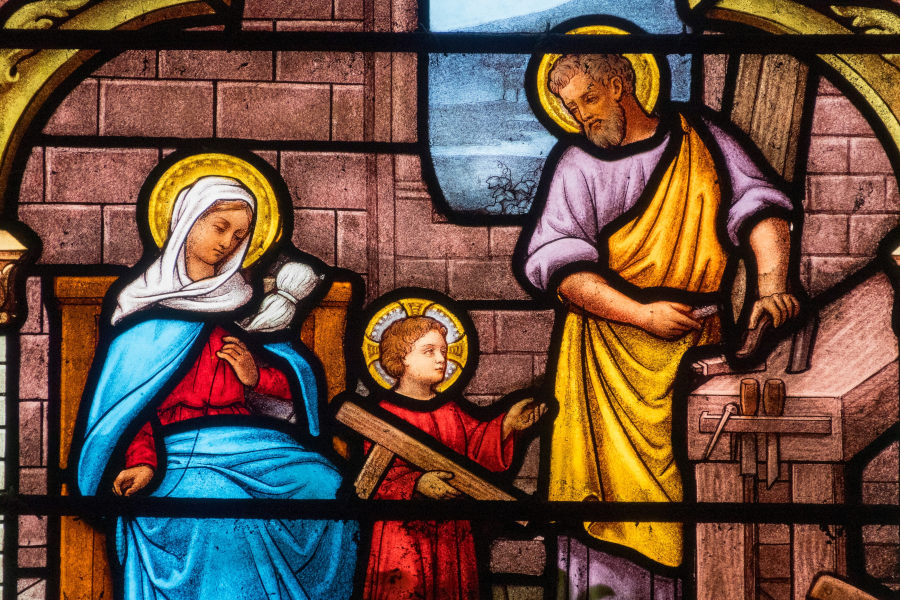
Reading time: 4 min.
In the panorama of Christian spirituality, Saint Joseph occupies a unique place: a silent, just, and hard-working man. The Gospel does not record a single word from his mouth, yet his figure speaks powerfully through the concreteness of his life. Among the most significant aspects, work emerges not as a simple economic necessity, but as a theological locus, a space for sanctification and an educational mission. From a Salesian perspective, that is, in the light of Don Bosco’s spiritual and pastoral experience, Saint Joseph becomes a particularly eloquent model: father, educator, and worker. Pius XII declared him “Patron of Workers” in 1955, but long before that, Don Bosco had already intuited the educational and spiritual power of this figure for his work.
Work in the life of Saint Joseph
Saint Joseph is presented in the Gospels as a “tekton”, a Greek term indicating an artisan, probably a carpenter or builder. This is not a marginal detail: the Son of God grows up in a family where manual labour is daily, arduous, and dignified. Joseph not only provides for the family’s sustenance but introduces Jesus himself to the human dimension of work. Joseph’s work is characterised by certain fundamental qualities; it is silent, faithful, and concrete. It is not spectacular, it does not attract attention, but it is essential. In this sense, he represents all those who live an ordinary life, made up of daily commitment and responsibility. Work thus becomes participation in God’s plan, through his hands, Joseph contributes to the human growth of the Saviour.
One of the most profound aspects of the figure of Saint Joseph is his educational role. He is not only a worker but a teacher. His workshop is also a school.
This educational dimension of work is central to Salesian spirituality. Don Bosco, in fact, always considered work as a privileged instrument for the formation of young people. In his oratories and vocational schools, work was never an end in itself, but integrated into a broader project of human and Christian growth.
Saint Joseph therefore becomes a model of an educator who forms through example. He does not teach with speeches, but with his life. His authority stems from consistency, dedication, and the ability to be present.
Don Bosco and the spirituality of work
Don Bosco developed a vision of work deeply rooted in the Gospel and incarnated in the social reality of his time. In the nineteenth century, many young people were exploited or abandoned. He understood that offering them dignified work meant restoring their hope and future.
In this context, the figure of Saint Joseph assumes a paradigmatic role. He is the patron of workers, but also of young people in training. Don Bosco proposed him as a model to his boys: a just, hard-working, and reliable man. The famous Salesian motto “work and temperance” reflects this vision. Work is not only productivity, but inner discipline, the capacity for sacrifice, and openness to others. It is a means to grow, to serve, to love.
From a Christian perspective, work is not merely a duty, but a vocation. Saint Joseph embodies this dimension in an exemplary way. He does not choose an extraordinary life, but accepts with faith the mission entrusted to him: to guard Jesus and Mary through daily work. In Salesian spirituality too, work is lived as a response to a calling. Every young person is invited to discover their place in the world, to develop their talents, and to contribute to the common good. Work thus becomes an expression of one’s identity and an instrument of personal fulfilment. In this sense, educating for work means helping young people discover the meaning of their lives. It is not just about teaching technical skills, but about forming people capable of responsibility, creativity, and solidarity.
Work and the dignity of the person
Another fundamental element is the dignity of work. Saint Joseph, despite carrying out a humble trade, lives his work with great dignity. This aspect is particularly relevant today, in a context where work is often precarious, dehumanising, or reduced to a mere means of earning.
The Salesian tradition insists heavily on this point: every job has value, because it is an expression of the person. Don Bosco always sought to guarantee his boys fair working conditions, opposing exploitation and promoting equitable contracts. Saint Joseph thus becomes a sign of hope for all workers: dignity does not depend on the type of work, but on the love with which it is carried out.
One of the most profound teachings that emerges from the figure of Saint Joseph is that holiness is built in daily life. Extraordinary gestures are not necessary: it is in faithfulness to small things that the will of God is fulfilled. This is also a central point in Salesian spirituality. Daily work, lived with love and responsibility, becomes a place of encounter with God.
A proposal for today
In a world marked by rapid transformations and uncertainties in the field of work, the figure of Saint Joseph appears more relevant than ever. He invites us to rediscover the value of work as service, as education, as a vocation.
Saint Joseph, on this journey, is a discreet yet reliable companion. His life teaches that even in the simplest situations it is possible to build something great. To a young person preparing to enter the world of work, or who has just lost a job, or who dreams of starting their own business, the figure of Saint Joseph says:
Never despise manual labour. Even if you go to university, even if you aspire to high positions, keep your feet on the ground. Whoever knows how to work with their hands will never be a slave.
Work with competence. Don Bosco used to say: “Be good Christians and honest citizens”. Honesty also passes through knowing how to do one’s job well. A job badly done is a lack of charity towards the one who receives it.
Work for others, not just for yourself. Joseph worked for Mary and Jesus. Salesian work is always teamwork, work for the community, work that builds the common good.
Pray while you work. There is no need to interrupt work to pray: work itself can be transformed into prayer, offering every gesture to God, as the holy Patriarch did.
For Salesians, for educators, for parents, for young people: start again from Joseph. Start again from work that is dignified, honest, competent, and above all, loved. Because where there is a man or a woman who works with love, there is still Nazareth. And there, in the silence of a workshop, God continues to grow among us.
 P. Wirth MORAND
  Fr Pierluigi CAMERONI