


 By BSOL Editor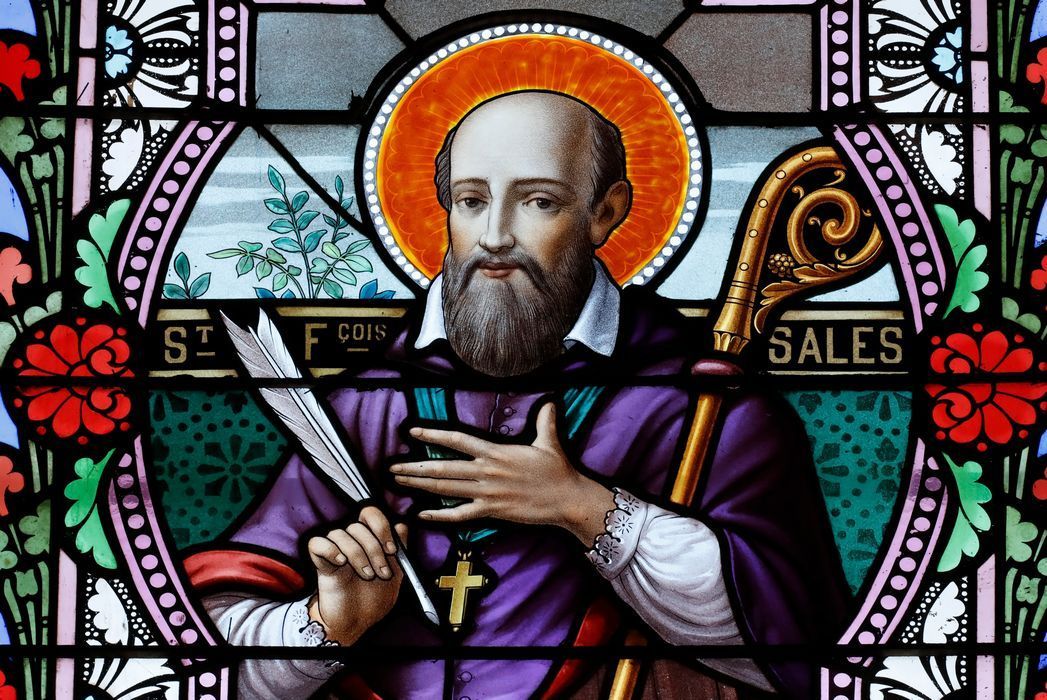
Reading time: 6 min.
Stained glass window of Saint Francis de Sales, Church of Saint Nicholas (Église Saint-Nicolas), Combloux, Haute-Savoie, France. Late 19th – early 20th century (shutterstock.com)
In 1859, when John Bosco founded the Society of St. Francis de Sales – which the world would come to know as the Salesian Congregation – the choice of patron was neither accidental nor purely devotional. It was a declaration of a profound spiritual affinity, developed through reading, meditating on, and engaging with the writings of the Bishop of Geneva. It was an affinity that Don Bosco had transformed into a way of life, a pedagogy, and a pastoral method.
We do not know for certain the exact moment John Bosco first encountered the writings of St. Francis de Sales. We do know, however, that he read them attentively and with his unique ability to commit to memory that which answered the truest needs of his vocation.
The most immediate point of convergence between the two saints is the centrality of charity, understood not as a vague sentiment but as an operative principle. St. Francis de Sales had built his entire spiritual theology around the love of God, which becomes love for souls, with a gentleness that does not exclude rigour but transforms it from within. His famous assertion – that one catches more flies with a spoonful of honey than with a barrel of vinegar – was for Don Bosco much more than an aphorism. It was the synthesis of an entire vision of humanity.
In the Preventive System, developed by Don Bosco as a concrete response to the needs of the poor and abandoned youth of Turin, this insight translates into an educational approach that anticipates wrongdoing rather than punishing it, that accompanies rather than monitors, that persuades rather than compels. The Salesian educator is not a guardian of rules, but a witness to a loving presence. Don Bosco wrote that the young person must not only be loved, but must know that he is loved. Here vibrates the same chord that had made St. Francis de Sales the pre-eminent spiritual director of his time; the certainty that the soul opens to grace when it feels welcomed, not when it is judged.
A second fundamental element of the Salesian heritage that Don Bosco made his own is the so-called dévotion – devotion as a quality of daily life accessible to all, not reserved for monks and contemplatives. St. Francis de Sales had revolutionised the spirituality of his time by affirming that every state of life – the merchant, the soldier, the father, the wife – is a place of holiness if lived with love and right intention. Holiness is not an escape from the world, but a transfiguration of the world.
Don Bosco absorbed this principle and applied it with pastoral genius to the youth environment. His boys were not to become saints in spite of their games, their running about, the noisy playgrounds of the oratory. They were to become saints through all of this. The model of Dominic Savio – an ordinary adolescent yet capable of a heroic interior life – is the most beautiful transposition of this Salesian insight: holiness as joy, as fullness of life, as a grateful response to God’s love in the concreteness of the everyday.
When Don Bosco chose to dedicate his congregation to St. Francis de Sales, he was not simply paying homage to a great saint. He was declaring that this spirit – made of humanity, of supernatural optimism, of trust in the original goodness of man and in the grace that restores him – was the spirit he wanted to pass on to his spiritual sons. The congregation that bore the name of St. Francis de Sales would, in time, also bear his face.
In 1885, Don Bosco published “The Companion of Youth” (a kind of manual of spiritual formation for young people), in which he included some forty maxims drawn from the writings of St Francis de Sales. This was not a scholarly tribute, but a revealing gesture. Don Bosco had found in this saint words that could educate the hearts of boys, words that were already his own even before he quoted them. We publish them below.
1. It is a great fortune for youth to have someone watching over them, because at that age self-love blinds reason.
2. Accustom yourselves to having a humble and pliable heart, ready to yield in lawful matters. Thus, is true charity acquired.
3. When anger has carried you away against someone, repair this fault as soon as possible with some outward act of gentleness towards that same person.
4. Love everyone with charity; but let your friendships be only with people who can help you acquire virtue.
5. Be careful not to mock, jest with, or offend your neighbour. It takes little to despise and mortally hate him.
6. Make it a rule never to censure the devotion and conduct of others. This way of offending charity is very prejudicial.
7. Before judging your neighbour, imagine you are him and he is you, and I assure you that you will judge rightly and well.
8. Speak as little as possible of yourselves, whether in a good or bad light; for self-love is seeks to blind even when one speaks ill of oneself.
9. Do not speak of God and of what pertains to divine service for recreation or in jest; but always with humble reverence and submission.
10. Let your speech be brief and gentle, brief and good, brief and sincere, brief and amiable.
11. It is an act of charity to cry wolf when it approaches the sheep; thus, one must not be silent when the enemies of God and His Church can do harm.
12. Let the world cry out as it will, criticise, murmur; if one is acting well, listen to it all, suffer it, do not be frightened by it; but continue with firmness.
13. Those works which are most contrary to our own nature and inclination are most pleasing to God; and therefore, more profitable to us.
14. When you are accused of some fault of which you are not guilty, justify yourself with gentleness. If that is not enough, seek no more; and be content to resort to humility and silence.
15. Beware of anxiety, melancholy, and scruples; for one who for nothing in the world would wish to offend God, that should be enough to live cheerfully.
16. In this life, patience must be our daily bread, and particularly with ourselves.
17. The way to do all our actions well is to do them in the presence of God. We shall certainly not have the heart to botch them, knowing that He sees and observes us.
18. I have said many times that he who is not humble is not chaste; and I have said it because God is wont to permit a fall into more shameful sins, to repress and correct the pride of the spirit.
19. Let us always conduct ourselves with modesty, even when we are alone, for we are always in the presence of God and His Holy Angels.
20. Temptation never has as much power against us as when it finds us idle.
21. A great remedy against temptations is to inform one’s Confessor of them with holy frankness; since the first pact the Devil seeks to make with the soul is that of silence.
22. One ought rather to die than to sin deliberately; but after having sinned, rather lose everything than courage, hope, and resolution.
23. To the Confessor, one should open one’s soul with all confidence, in the same way a son does to his father, and the sick person reveals his ills to the doctor.
24. Many make no progress because they do not sincerely disclose to their spiritual Father that passion which is the true root of all their failings.
25. Always have a true sorrow for the sins you confess, however small they may be, with a firm resolution to amend them for the future.
26. A continual moderation in eating and drinking is worth much more than certain rigorous abstinences.
27. The Devil does not fear austerities, but obedience.
28. God loves obedience so much that He prospers and approves even the mere counsels received from others, and particularly from spiritual Fathers.
29. Nothing serves so well to enlighten the intellect and enkindle the will as prayer, especially mental prayer, made from the heart.
30. Learn to make frequent ejaculatory prayers and aspirations of the heart to God.
31. Be faithful in little, and God will set you over much.
32. It is not always in your power to do great things; let the small things that present themselves to you at all hours suffice; but do them with fervour and love.
33. A single “Our Father” said with attention and from the heart is worth much more than many recited in haste and by habit.
34. A single Communion well-made is capable of and sufficient for making you holy and perfect.
35. Do not neglect the present opportunity to do good. Sometimes, by leaving a good to seek a better one, one leaves the one and does not find the other.
36. You are not preachers; but take comfort, for there is a most effective way of preaching; and this is the good example one gives to one’s neighbour.
37. Act in such a way that your devotion becomes amiable, so that everyone may grow to love it and be encouraged to practise it.
38. Do as the bees do, which suck honey from every flower; striving to imitate what we observe of good in our neighbour.
39. Do not be so curious as to want to know everything; but yet do not be neglectful of knowing what concerns our eternal salvation.
40. Endeavour to read every day in some good book something that will instruct you and invite you to devotion.
(Giovanni Bosco, Il giovane provveduto, Turin, Tipografia e libreria salesiana 1885, pp. 139-141)
 P. Wirth MORAND
  Fr Pierluigi CAMERONI