

 By BSOL Editor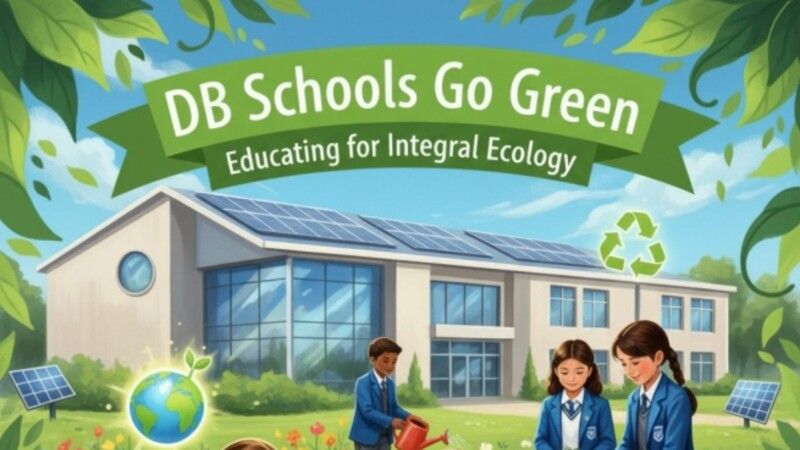
Reading time: 6 min.
The Sector for Youth Ministry launches #DBSchoolsGoGreen
The #DBSchoolsGoGreen campaign, launched in 2026 by the Sector for Youth Ministry, was created in response to the worsening global environmental crisis and follows the direction set by recent General Chapters. The Salesians thus reaffirm integral ecology as a sphere of educational and pastoral action. The initiative aims to guide Salesian schools on a journey of transformation into “Green Schools”, inspired by the UNESCO Quality Standard, which is based on four operational areas: school governance, facilities and management, teaching and learning, and community engagement. Coordinated by the Don Bosco Green Alliance, the campaign aims to promote a concrete and lasting ecological conversion, forming young people capable of caring for creation and contributing responsibly to a sustainable future.
The year that has just ended — 2025 — was a “year of hope”, and we had fervently hoped that global environmental conditions would improve during that special year. Unfortunately, the environmental challenges have intensified on multiple fronts. Climate change remained the dominant global emergency, causing extreme weather events, including severe wildfires in various regions of the world, fuelled by record heat and prolonged drought. These events significantly degraded air quality and threatened human health and ecosystems. The year also marked the peak of the largest global coral bleaching event ever recorded, affecting approximately eighty-four per cent of the world’s coral reefs due to rising ocean temperatures. Plastic pollution continued to pose a serious threat, with microplastics increasingly contaminating ecosystems and food chains. Biodiversity loss accelerated due to habitat destruction, changes in land use, and pollution, undermining food security and essential ecosystem services. Meanwhile, air pollution and worsening water scarcity and contamination emerged as critical public health and environmental challenges worldwide, making 2025 a year of profound concern for everyone, particularly for the poorest communities.
As Salesians, we have certainly not remained indifferent to the environmental crisis that has grown in recent years. Over the last decade, a strong focus on environmental issues has been clearly visible in our Salesian Youth Ministry. Addressing these environmental concerns is an obvious priority for us Salesians, as it is an issue that today’s young people feel strongly about. As Pope Francis clearly pointed out in Laudato Sì, in the face of the global environmental crisis, “Young people demand change. They wonder how anyone can claim to be building a better future without thinking of the environmental crisis and the sufferings of the excluded” (Laudato Sì, 13).
Our recent General Chapters (GC) have all stressed the need for us Salesians to commit ourselves, together with young people, to caring for our “common home”. GC27 stated: “We recognise that responsibility for the care of the environment is an emerging sensitivity also in our communities. However, we are not yet sufficiently convinced of this priority in our choice of a modest and essential lifestyle and in the education of the young” (GC27, 30). Therefore, GC27 went on to say: “we commit ourselves to making communities and the young aware of respect for creation, educating them in ecological responsibility through concrete activities that safeguard the environment and sustainable development” (GC27, 73).
The subsequent General Chapter (GC28) paid even greater attention to this issue. In the post-GC28 Reflection, one of the “eight priorities” presented by the Rector Major to the congregation was: “Accompanying the Young towards a Sustainable Future”. Elaborating on this priority, the Rector Major wrote: “Listening to the worldwide cry of so many young people today, we Salesians commit ourselves to being credible witnesses, personally and as a community, of conversion in the care for creation and of ecological spirituality” (ACG 433). Continuing with a very concrete proposal, the Rector Major stated: “Every province in the world will respond, through the Provincial Delegate for Youth Ministry, to the request to make our schools, training centres, university campuses, oratories, parishes, educational models of care for the environment and for nature. As a Salesian option in education, we must include action in favour of creation: care for nature, the climate and sustainable development” (ACG 433).
Continuing in the direction of the previous General Chapters, GC29 rightly pointed out that “Integral ecology emerges as a privileged field of educational and pastoral work” (GC29, 64). Developing this theme further, GC29 went on to say that: “Pope Francis has made this issue a constant part of his magisterium: his voice challenges us to be more ready in listening to the cry of the earth and of the poor, and in promoting an authentic ecological spirituality that recognises creation as a gift from God and teaches us to have a contemplative gaze and a simple lifestyle” (GC29, 64). Therefore, GC29 made a clear recommendation: “Every province should promote formation in integral ecology and the ecological education of the young” (GC29, 69).
To carry forward the impetus and proposals of GC29, our Rector Major, Fr Fabio Attard, presented the “Six-Year Project 2025-2031” to the congregation. Highlighting the theme of integral ecology in this Six-Year Project, the Rector Major states: “The Church’s commitment to integral ecology has been taken up by the Congregation and must be strengthened with a charismatically inspired vision. May the commitment of the young to the common good and to our common home be ever more rooted at the local level, with the young playing a leading role, sharing in the choices and participating actively and concretely” (ACG 446).
Given the ever-deepening environmental crisis and the strong determination of the congregation to address this global challenge, at the beginning of the new year 2026, the Sector for Youth Ministry has launched a new campaign called #DBSchoolsGoGreen. Presenting this campaign, Fr Rafael Bejarano, General Councillor for Youth Ministry, stated: “Our General Chapter 29 asked every province to promote formation in integral ecology and the ecological education of the young. A good starting point for implementing this recommendation is in all our Salesian schools. Therefore, for this year 2026, the Sector for Youth Ministry is pleased to announce the #DBSchoolsGoGreen campaign.”
To enable Salesian Schools to embark on the journey to becoming Green Schools, Fr Bejarano proposed the use of the UNESCO Quality Standard for Green Schools. This tool offers a comprehensive and practical roadmap for becoming a green school. It outlines four main areas for implementing sustainability principles and ecological action: school governance, facilities and management, teaching and learning, and community engagement. For each of these four main areas, the UNESCO Quality Standard for Green Schools suggests various concrete actions that the school community can take.
The first main area — school governance — is the foundation of the UNESCO Quality Standard for Green Schools, ensuring that sustainability is not an add-on, but a guiding principle of leadership and decision-making. School governing bodies that are strongly committed to sustainability are the driving force behind all efforts to develop a Green School. By prioritising sustainability and integrating green practices into policies, school governing bodies can establish a solid framework for a long-term commitment to being a Green School. As a first step, schools are asked to establish a Green Committee composed of representatives from the school community (i.e., students, staff, parents, and community members) and to entrust it with the responsibility of developing a Green School vision and policy with clear goals, strategies, and targets that outline the entire school’s commitment to addressing environmental issues. Thus, through strategic planning, goal setting, and transparent monitoring, green practices become rooted in the school culture.
The second main area of the UNESCO Quality Standard for Green Schools provides guidelines for transforming the school’s infrastructure, facilities, and daily operations into a credible model of environmental care. By improving energy and water efficiency, reducing waste, and adopting eco-responsible procurement, schools can significantly reduce their ecological footprint. Green spaces, renewable energy solutions, and routine environmental audits transform the campus into a living example of responsible resource management. These daily operational practices not only create healthier and safer learning environments but also allow students to see sustainability in practice. An important action in this second main area is the establishment of a Monitoring Team (composed of staff and students) that regularly checks the green practices implemented in the school.
Teaching and learning — the third main area — are at the heart of the UNESCO Green School approach.
Teachers are invited to develop lesson plans that incorporate concepts and activities related to sustainable development and climate change education, and to adopt transformative pedagogies and assessment methods that promote inquiry-based learning, critical thinking, problem-solving, and collaborative learning. Classrooms extend beyond the four walls, as students engage in projects, outdoor learning, and real-world problem-solving. In this way, students are equipped with the values, attitudes, and skills that enable them to become active agents of change who contribute meaningfully to environmental protection and sustainable development throughout their lives.
The fourth and final main area of the UNESCO Quality Standard for Green Schools is community engagement. This aligns well with our Salesian approach of the “educative-pastoral community”. Schools are encouraged to work closely with families, local authorities, and community organisations to promote shared environmental goals. Through joint projects, awareness campaigns, and student-led initiatives, learning extends to the wider community. Schools serve as hubs for collaboration and dialogue, fostering intergenerational learning and collective action. This reciprocal relationship strengthens educational outcomes while amplifying the school’s positive impact, positioning it as a catalyst for green practices and a culture of sustainability in the local community.
The #DBSchoolsGoGreen campaign is led by the Don Bosco Green Alliance, which is the coordinating body for integral ecology in the Sector for Youth Ministry. Through the methodology offered by the UNESCO Quality Standard for Green Schools, the #DBSchoolsGoGreen campaign hopes to effectively transform our schools into “educational models of care for the environment and for nature” (GC28), and to “promote formation in integral ecology and the ecological education of the young” (GC29). Although this campaign may not offer an immediate solution to the many environmental challenges our world is facing, it certainly serves as a good long-term strategy, forming people who possess the knowledge, values, attitudes, and skills necessary to protect God’s creation and preserve our common home.
Fr Savio Silveira, SDB
Coordinator for Integral Ecology
Sector for Youth Ministry