


 By BSOL Editor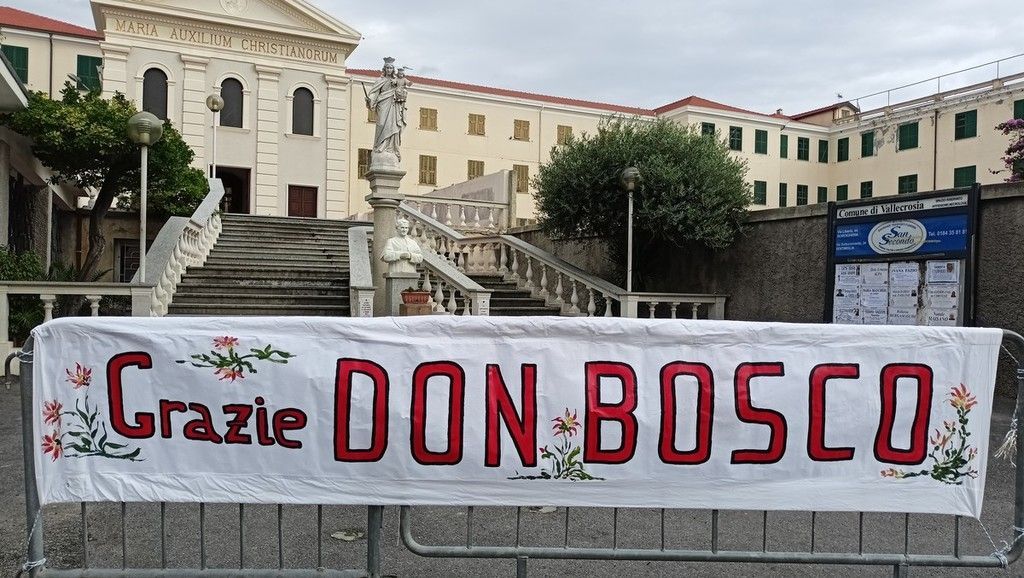
Reading time: 5 min.
In 2026, the Salesian community of Vallecrosia will celebrate a significant milestone: 150 years of educational and pastoral presence in the heart of Western Liguria. This anniversary is not only an occasion for remembrance but also for reflection on the value of a history that has spanned generations, social changes, and cultural transformations without losing its identity. From its origins, directly linked to Don Bosco’s educational vision, to the challenges of the present day, the Salesian work has been a stable point of reference for many young people and families. Retracing this journey means discovering how an educational community, rooted in the local area and animated by the Salesian spirit, has continued over time to put young people at its centre, looking to the future with confidence.
In 2026, the Salesian work in Vallecrosia celebrates 150 years of educational and pastoral presence in Western Liguria. From 1876 to the present day, this institution has lived through very different eras, adapting to societal changes and the new needs of younger generations.
In a century and a half, the work has changed its faces and activities, renewed its facilities and educational projects, but has never lost the heart of its mission: to put young people at the centre, accompanying them in their human and spiritual growth and defending their dignity. Generations of children, families, and educators have found in this Salesian house a stable point of reference, capable of evolving without losing its identity.
This continuity represents one of the most significant aspects of the Salesian presence in Vallecrosia: a story that has never been interrupted and continues today with the same spirit that animated Giovanni Bosco, the founder of the Salesians.
The origins: Don Bosco and the Shrine of Mary Help of Christians
The Salesian presence in the far west of Liguria began in the final years of Don Bosco’s life. In 1876, the work in Vallecrosia took shape, destined to become an educational and spiritual centre of great importance for the area between Ventimiglia and Sanremo.
From the very beginning, the Salesians’ mission was intertwined with that of the Daughters of Mary Help of Christians, who were already present in the area. The collaboration between the two congregations gave rise to a complementary educational presence: that of the Salesians for boys and that of the nuns for girls.
This dual presence, male and female, helped to create a broad educational network, capable of accompanying entire generations on their path of growth.
At the heart of this institution is the Shrine of Mary Help of Christians. From its origins, the shrine became the spiritual heart of the community: a place where faith was intertwined with educational and social commitment. Even today, it represents a meeting place between the religious dimension and the daily life of the area.
A work that grows with the local area
Over the decades, the Salesian work has developed by expanding its educational and pastoral activities.
Around the Salesian presence, various initiatives have emerged that have marked the life of the local community: the parish, the oratory, school activities, and sports and cultural initiatives. In more recent times, the experience of vocational training has also been consolidated through CNOS-FAP, which offers young people concrete opportunities to prepare for the world of work.
These initiatives have allowed the work to respond to the transformations of society without losing its educational identity.
The oratory’s courtyard, in particular, has remained over time one of the most vivid symbols of the Salesian spirit: a place for meeting, friendship, and growth, where games and sport become opportunities for education in responsibility and solidarity.
Many former pupils remember those years as a defining experience in their lives. They often recount that it was within the walls of the oratory that they learned values such as respect for others, a sense of duty, and commitment to the community.
A book to tell one hundred and fifty years of history
On the occasion of the 150th anniversary, a volume entitled “Don Bosco in Vallecrosia: yesterday, today and tomorrow” has been published.
The book, created by the management of the Salesian Institute together with the organising committee for the celebrations, is a true historical reconstruction of the Salesian presence in the area. Through documents, letters, vintage photographs, and personal testimonies, the volume retraces the life of the parish, the school, the oratory, the sporting activities, and the socio-cultural initiatives that have characterised these one hundred and fifty years.
The editor, Roberto Capaccio, a Salesian alumnus, explained the spirit of the initiative: to gather the voices and experiences of those who have lived this history to show how profoundly the Salesian work has impacted life in the far west of Liguria.
According to Capaccio, the book’s objective is to bear witness to how the Salesians and the Daughters of Mary Help of Christians have spread Don Bosco’s educational spirit in the area, helping to form generations of young people capable of taking on responsibilities in society and working for the common good.
The creation of the volume required a year of work, involving an editorial team made up of Salesians, alumni, and local history scholars. The result is a mosaic of memories and documents that reveals the face of an educational community rooted in its local area.
The afterword of the book is written by Fabio Attard, the eleventh successor of Don Bosco at the head of the Salesians of Don Bosco.
Present at the celebrations, Don Attard emphasised in his speech the profound meaning of historical memory. Remembering the past, he observed, does not mean taking refuge in nostalgia. On the contrary, memory must become a driving force towards the future and a call to responsibility.
The history of the work in Vallecrosia shows how, over time, the Salesian community has been able to interpret the challenges of different historical periods without losing sight of the main objective: placing young people at the centre of its educational action.
This, stated Don Attard, is the common thread that runs through one hundred and fifty years of Salesian presence in the area.
A gift for the Church and for society
The bishop of the diocese of Ventimiglia-Sanremo, Mons. Antonio Suetta, also wished to underline the value of this anniversary.
According to the prelate, these one hundred and fifty years represent a heritage of incalculable gifts for the Church and for society. Only time, he explained, can fully reveal how much good the seed planted by Don Bosco has produced in people’s hearts and in the life of the communities.
His words are confirmed by the many personal stories linked to the Salesian work. Every time a former pupil recounts what the oratory meant to them, or when a young person in difficulty finds a new opportunity at the vocational training centre, the depth of this educational heritage emerges.
A story that continues
One hundred and fifty years of history do not represent a final goal, but rather a new stage in the journey.
In his concluding speech during the celebrations, Don Fabio Attard invited the Salesian community and civil society to look to the future with confidence.
The task of educational works, he recalled, is to listen to the questions and anxieties of today’s young people, accompanying them in building a more just and humane tomorrow. Every young person must be able to find an environment where hope can flourish, where the person is always respected, and where the most fragile are not considered a problem, but protagonists with talents to be discovered and developed.
This is the spirit that continues to animate the Salesian work of Vallecrosia.
After 150 years of activity, the Salesian house in Vallecrosia remains a living presence in the area. Its history does not only belong to the past but continues to be written every day through the work of educators, the commitment of volunteers, and the enthusiasm of young people.
The memory of what has been thus becomes a resource for facing the future.
As in Don Bosco’s time, even today the oratory courtyard, the vocational training classrooms, and the community spaces continue to be places where young people can grow, discover their abilities, and build their own life project.
And this is precisely the true legacy of one hundred and fifty years of Salesian presence in Vallecrosia: a community that – founded on Christian values – continues to educate fruitfully.