


 By BSOL Editor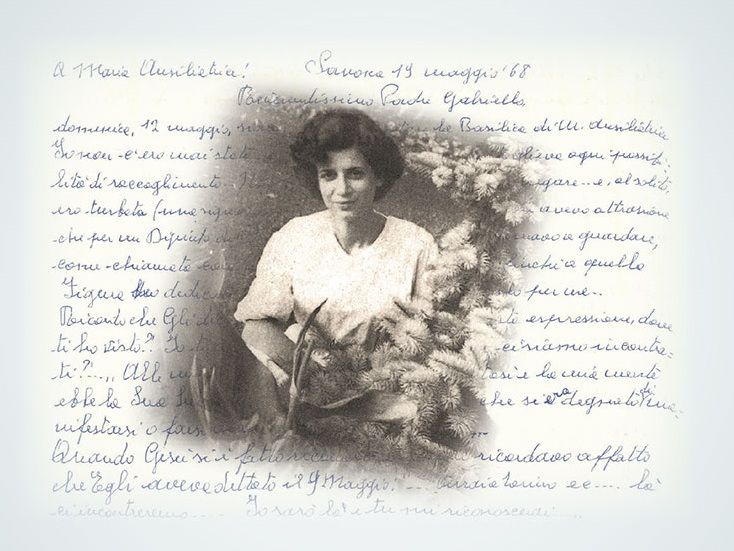
Reading time: 13 min.
The figure of Vera Grita, a humble Ligurian teacher and Salesian Cooperator, shines as a testament to peace in the heart of the twentieth century, wounded by crisis, war, and social unrest. Marked in her body by serious illnesses and the consequences of a bombing, Vera learned to live every suffering as an offering of love united with Jesus in the Eucharist and with the Virgin Mary. Thus, in her family, at school, in hospital, and in the mystical experience that led her to the Work of the Living Tabernacles, she became a silent but active presence of reconciliation, mercy, and hope. Let us retrace the journey of this “woman of peace”, allowing ourselves to be guided by her simple yet powerful words and by the Gospel lived in everyday life.
A Tested Life
Vera Grita’s life unfolded within the short span of 46 years, marked by dramatic social events such as the great economic crisis of 1929-1930 and the Second World War. She was born in Rome on 28 January 1923, the second of four sisters. The great economic crisis of ’29-30 caused financial distress in many families, including Vera’s, who at that juncture moved from Rome to Savona. Vera’s life then ended on the eve of another important historical event; the protests of 1968, which had profound repercussions at a social, political, and religious level, both in Italy and in many other nations.
But it was the Second World War, with the bombing of Savona in 1944, which inflicted irreparable damage that affected Vera’s health for the rest of her life. Vera was in fact, overwhelmed and trampled by the crowd who, fleeing, sought shelter in a tunnel-shelter located near the military district where Vera worked as an auxiliary. Medicine calls crushing syndrome the physical consequences that occur after bombings, earthquakes, structural collapses, due to which a limb or the entire body is crushed. Due to the crushing, Vera suffered lumbar and dorsal injuries that created irreparable damage to her health, with fevers, headaches, pleurisy, and favouring the onset of tuberculosis that affected various internal organs with no prospect of recovery. Vera was 21 years old when her “Via Crucis” began, which lasted until her death, alternating work as a primary school teacher with long hospital stays. At 32, she was diagnosed with Addison’s disease, which would consume her, further debilitating her body, to the point of weighing only 40 kilos. She died in Pietra Ligure on 22 December 1969, in a ward of Santa Corona Hospital, after 6 months of hospitalisation and undergoing several surgical operations.
Vera and the Work of the Living Tabernacles
Vera’s life was therefore not an easy one. She bore in her body, in her flesh, the marks of war, but her heart was turned towards and entrusted to the God of Peace, Jesus Christ, Prince of Peace. Her story, in fact, shows how she went through the difficult events of her life, facing them with the strength of faith in the Virgin Mary and in Jesus Christ, truly present in the Most Holy Eucharist. In fact, a few months after the beginning of her mystical experience (September 1967) which led her to write the Work of the Living Tabernacles, Jesus told her, “To you, my daughter, to you who suffer and groan under the crushing weight of your fragility, to you my strength more and more each day” (1 January 1968). Indeed, human qualities alone, however uncommon, are not enough to remain unharmed by the negative consequences that a life marked by continuous physical suffering can leave at a psychological, moral, and spiritual level, but personal maturation in the Mystery of the Cross, in the Mystery of the Eucharist, which introduces the believer into the dynamic of self-giving to the Father in union with the crucified and risen Jesus, is needed to be in turn transformed into a gift for the needs of one’s neighbour and the Church, animated and moved by the presence of the living God within us.
Woman of Peace in School
Precisely because Vera was a profoundly Eucharistic and Marian soul, she was a woman of peace in all circumstances of her life: in her family, at school, in hospital during her long hospitalisations, thus bearing witness to a heroic fidelity to Jesus Christ and to His love for all creatures. A fidelity that, at the end of her life, the Lord repaid by giving her a new name, Vera of Jesus. “I have given you my holy Name, and from now on you will be called and will be ‘Vera of Jesus'” (3 December 1968). Not that Vera lacked interior struggles, difficulties due to her physical fragility, fears of succumbing and being shipwrecked under the weight of her suffering and the limitations it imposed on her, but she had made all of this a gift to Jesus through the Holy Mass, which she tried to attend daily, when possible. The letters Vera wrote to the Salesian priest Fr. Bocchi from 1965 to 1969 bear witness to this. In their simplicity and immediacy of language, the letters shed light on her interior struggles, especially when she felt a human and instinctive rebellion against the injustices suffered at school or in her family. But a word from the priest, a simple postcard with the face of Don Bosco sent to Vera, was enough to bring her back to the centre of her life given, out of love, to Jesus. Once the inner storm had passed, Vera returned to being a woman of peace, because she was at peace in her heart. Let’s look at an example. In the school year 1966-67, she had been assigned to the school in Carbuta, a hamlet of Calice Ligure, located in a hilly area, without public transport services. Vera, hospitalised during October and half of November, had requested a change of location, given the real difficulty of reaching the school on foot, a difficulty aggravated by her health conditions, but this request had been refused. Vera experienced this refusal as a serious injustice and felt an inner rebellion. She wrote to Fr. Bocchi, “… after renouncing Your illuminating guidance, [due to the priest’s transfer from Savona to Sampierdarena] I once again found myself in spiritual solitude, made perhaps more painful by moral and physical tribulations… Everything weighed on me: hospitalisation in S. Corona, rather painful treatments, a difficult school profile (I will go to Carbuta, a hamlet of Calice L.). My nature, so fragile, rebelled several times especially in the face of injustice while I was forgetting my place in Jesus’ thought (a small victim). But, one evening, through your postcard, S. J. Bosco returned to remind me… (Savona 24 November 1966). In the letter of 20 December 1966 from Corbuta, she wrote: “the struggles I sustained to obtain the seat of Calice, readmitted on 1 January, were just for me. But the Superiors decided differently… Now that I have come to my senses, the light of God has returned. One who offers oneself with Jesus must know how to renounce. I had forgotten this once again. Now there is great peace in me; now I am happy because I feel that He holds me to Himself. After Holy Communion, through the Gospel, He spoke to me thus “…if I, Master, wash your feet, you must do so even more…”. And I meditated, “if I, Jesus, always forgive you, always forgive those whom you consider to be the cause of renunciation or injustice for you.”
The headmistress of Carbuta, in the annual informative report of that year, expressed herself thus about Vera, “Upon resuming service (after a month’s hospitalisation) she faced with tenacious will the discomfort of a school located in a hilly area without public transport services. Good and sensitive, she participates with solicitude in the life of the school, of the pupils and their families, whom she approaches with cordiality. With singular fervour, she has taken care of the formation and development of the individual personalities of the pupils. Supported by a very lively religious faith, she is capable of sacrifice, serene work, and introspection.” The inner rebellion against the injustice suffered, offered to Jesus, sustained by confidential and trusting prayer, was transformed by Grace into “tenacious will”, into new strength to face the sacrifice.
Woman of Peace in the Family
Another significant episode is found in a letter to Fr. Bocchi from July 1967. Vera experiences a strong emotional conflict with her family, because, due to the change of the new house where the family has moved, mainly at her mother’s will, Vera can no longer dispose of her teacher’s salary as it is used to pay for the redemption of the new house. Vera writes a long letter-confession to Fr. Bocchi, exposing the state of her soul, the inner struggles she is facing, the darkness in which she finds herself, the difficulty in accepting this new sacrifice that has been imposed on her. But at the end of the letter, love for Jesus will triumph in her and, by reflection, love for those around her, her family, and Vera returns to being a woman of peace. We report only an excerpt from this long letter: “… But now it is I who cannot submit to this new state of affairs and difficult situations created in the family. The thorns are enormous and I rebel, sometimes I am dismayed because everything hurts me, starting with my mother. Before me I feel two paths open: one drives me crazy, the other… would lead to holiness… I ask for the “Light of Jesus” because I cannot walk alone, in the dark, in my miseries. I cannot, I cannot do it, I feel that I am losing myself, that I am losing my soul… Oh, Father, if you only knew how I hear it crying, how it agonises before Jesus… [referring to her soul]. I want nothing, but do not leave me; that is, do not allow me to trample Him in my neighbour so close, which is my family. Oh, Father, I can no longer love them after having made the greatest sacrifice I could make for them (I have committed myself, as long as I live, to give £35,000 monthly, in addition to maintenance, that is, another £30,000 for the redemption of this new house). I say no more because the most burning wounds I received from my mother and these have reopened other distant ones… And in all this my mother has never realised and never realises anything by her nature. Of this she is not to blame, while I am… The Lord has made me understand what the way is, “to forget oneself and to give; to offer oneself without asking; to let oneself be dominated because I as I must not be…!”. This happens with Love, through Love, in the Love of Jesus… I can no longer live without Him, I cannot. Yet, He is there in the Most Holy Eucharist, He is here in my miserable heart, He is in the squalor of my soul. That is why I suffer if I disfigure Him (in His divine love reflected in my family), if I suffocate Him, if I silence Him!” Vera then concludes the long letter with these words, “I feel the peace of Jesus, I feel that He has guided me in this long writing. It is always Jesus who entrusts me to you! Glory to You, O Lord! The image of Mary Help of Christians smiles! Having been able to write, having overcome the opposing and horrendous forces within me, are the smile of Mary!” (our italics). These two reported episodes refer to the period immediately preceding the beginning of Vera’s mystical experience (1966-’67).
Messenger of Peace for Humanity
From September 1967, during the last two years of her earthly life, Vera experienced a mystical experience in which Jesus in the Eucharist communicated to her the Work of the Living Tabernacles. Vera wrote down her spiritual experience in 13 Notebooks which are kept in the Archive of the Diocese of Savona. In the same period, she had chosen to be part of the Association of Salesian Cooperators present in Savona at the Church of Mary Help of Christians. The Message of love, mercy, and salvation for all humanity of which Vera is a spokesperson can be summarised as follows. Jesus, the Good Shepherd, seeks out souls who have strayed from Him to give them forgiveness and salvation, through His new Living Tabernacles. Through Vera, Jesus seeks poor, simple souls, willing to place Jesus in the Eucharist at the centre of their lives to allow themselves to be transformed into Living Tabernacles, Eucharistic souls capable of a deep life of communion and self-giving to God and to their brothers and sisters. The 13 Notebooks written by Vera were published in the book “Portami con te!“ (Elledici 2017). By the explicit will of the Lord, the Work of the Living Tabernacles was entrusted to the Salesian Congregation for its realisation and dissemination in the Church.
A woman of peace, Vera was a spokesperson for a Message of mercy and peace for humanity, through the Work of the Living Tabernacles that Jesus in the Eucharist gradually communicated to her. Here is the Message in which we see how Jesus expands the horizons of peace experienced by Vera up to that moment, in the family, in school, towards horizons that include all humanity, especially humanity wounded by war. Let us listen to what Jesus communicated to her on 28 February 1968, “Jesus. I call you to your task. There is a distant horizon that I want to reach to immerse My Wounds in it, to pour out My Blood: Blood of the Immaculate Lamb. My Blood must be shed where there is hatred, rivalry, ambitions. Men shed their blood, sacrifice their lives, and hatred does not die out. I, Jesus, will go to visit those places in ruin, those afflicted men. I want to give them too the Blood of the Immaculate Lamb. We will go before God the Father and offer ourselves to Him for Peace among peoples. If men have woven their leagues to nourish hatreds and unleash wars, if they fight and destroy each other, I have pity; I have pity on the poor, on the unhappy who suffer the tyrannies of the leagues. To this I want to oppose My League of Love. Yes, I will gather you, My blessed souls, around Me, and you in Me will offer yourselves to My Father for Peace among peoples, among Nations, among Races. You will always be My army of Love that I want to oppose to the army of men: you the army that advances in Me before My Father, and I, as the Immaculate Lamb, want to implore with you, with My League of Souls, Peace, as a message of Love to the humble, to the poor, to the disinherited of goods, to those who love and hope in Me. The confines of the Earth are vast, and I comprehend and contain them all in My Mercy. I, Jesus, as God and Father, address My Voice to the World, to Peoples, to Brothers. I will soon pass to visit you from one end of the Earth to the other, so that My message of Love may be addressed to all, so that souls may turn to Me who am the Author of Life. My Life will still pass among you, as a thrill of love and Forgiveness… I give Myself completely to you, and you to Me, and together we will offer ourselves in the Love of the Father, of the Son, of the Holy Spirit. Yes, I give My Grace in these Words: the Grace of Jesus in the Eucharist who wants to become the food of all souls contained in the world, the nourishment of the soul, the comfort and peace of the world.”
Tested by various illnesses, Vera maintained inner stability and balance through her union with the immolated Lamb, Jesus in the Eucharist, received daily when possible. Therefore, Holy Mass was the centre of her spiritual life, where, like a “small drop of water”, she united herself with the wine to be inseparably united with infinite Love, Jesus Christ, who continually gives Himself, saves and sustains the world. A few months before dying, on 6 September 1969, she wrote to her spiritual father, Fr. Gabriello Zucconi, “The illnesses I have carried within me for more than twenty years have degenerated, devoured by fever and pains in all my bones, I am alive in Holy Mass.” Again, “The flame of Holy Mass remains, the divine spark that animates me, gives me life, then work, the children, the family, the impossibility of finding (in my house) a quiet little place to isolate myself to pray, or physical tiredness after school.” (Letter from Vera to Fr. Borra of 13 May 1969).
Woman of peace and reconciliation
I would like to conclude with a look at Vera, during her last hospitalisation at the Santa Corona Hospital in Pietra Ligure through the testimony of a patient, Agnese, her bed neighbour whom Vera, a woman of peace, helped to reconcile with the Lord to find peace and serenity of heart. “I met Vera during her last hospitalisation at S. Corona in ’69, having also been a patient in the same ward for a short period. In that ward, serious patients and elderly people were hospitalised. I still remember our first meeting. I found myself in front of a still young girl, dark-haired and very thin, of medium height, with large expressive and deep dark brown eyes, hair combed in a “ponytail”, who immediately made me feel at ease by smiling at me confidentially and simply. We became very good friends. I remember that, at the beginning of our relationship, I noticed in her, in her behaviour, and in all her attitudes some peculiarities that I considered, very hastily, as contradictions of her character. For example, she seemed to attach too much importance to others, while she did not seem worried about the outcome of her illness. She took great care of her outward appearance not out of ambition, but out of true respect for herself and, despite the severe suffering that her illness caused her, I never heard her complain about her condition. She gave comfort and hope to all those she approached and when she spoke of her future, she did so with enthusiasm and courage. She loved her job as a teacher very much, which she hoped to resume in a small village above Varazze, and she loved young people very much. Nevertheless, she also confided to me, very humanly, some of her misfortunes and disappointments but she did so with such measure and humility, that I remember, they impressed me. From then on, I saw Vera with different eyes and began to understand… Her great and unique love that, in my opinion, every girl hides in her heart, was not an earthly one. Having made this discovery, Vera no longer had secrets and our friendship became much deeper and when she asked me to recite the Holy Rosary with her, I did so very spontaneously. It was just as simple and natural for me to confide in her that for four years I had not received the Eucharist, because I did not feel in the material and spiritual conditions suitable to approach Jesus. She told me, “Receive Jesus, do not lose Him. I take all responsibility for you, before Him.” And I found, with the help of the Hospital Chaplain who confessed me, the joy of forgiveness that gives so much peace. Vera had only one purpose in life, I finally understood, and that was to always do God’s will with love and joy. Often from her loved ones she received many good things, which she regularly shared with us in her ward. I remember, it was the end of October, when Vera received a beautiful bunch of out-of-season grapes from her family; she divided it into many small parts that she had us find for breakfast on our bedside tables. What struck me about the episode was the detachment she showed in receiving the gift in stark contrast to the evident pleasure she felt in sharing it with others. My husband, who often came to visit me, had also become a great friend of Vera and still remembers with emotion, an episode that, although it might seem insignificant, is instead, for us, an important secret to keep in our hearts and if I tell it, it is because, in perfect good faith, I believe I am bearing witness to Vera as a person whom Jesus wanted in the world, but not of this world. Vera, now operated on, lay in her bed, when Guido noticed that it was important to remove the bedspread and sheets from her legs to give her some relief. In doing so, her lower limbs were involuntarily exposed. Then Vera, suffering greatly, almost at the limit of endurance, still had the courage and spirit to make us smile, “Don’t look at my legs, Guido!” In fact, she exclaimed, with a certain humour and so she immediately relieved our discomfort. Meanwhile, as I passed a hand under the pillow to rearrange it, I felt the presence of a wooden crucifix… And this is how Vera was, for my husband and me, a person of great humanity and, at the same time, a person very… very… but very close to the Crucified Christ. We continue to feel Vera alive and close… We feel that she is here, that she exists, and that now, more than before, she is present among us. One night, during a very bad period of my life, while I was sleeping, she appeared to me and spoke to me at length and in the morning, when I woke up, I faced the new day with a serenity that I had not possessed for a long time. My husband also often turns to her in prayer and speaks to her as if she were alive.”
Two months later, on 22 December, Vera left her earthly life to unite definitively with her Spouse and Prince of Peace, Jesus Christ our Lord.
Maria Rita Scrimieri
President of the Vera Grita Foundation and Fr. G. Zucconi, SDB
 Fr Pierluigi CAMERONI