

 By Fr Pierluigi CAMERONI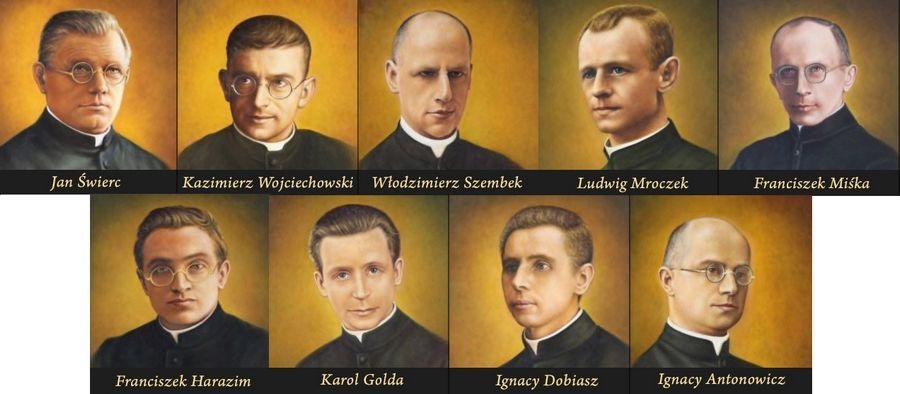
Reading time: 8 min.
Among the most painful and luminous pages in the history of the Church during the Second World War is the story of nine Polish Salesian priests, led by Fr. Jan Świerc, who paid for their fidelity to the Gospel with their lives. Arrested by the Gestapo between 1941 and 1942, these pastors and educators were deported to the extermination camps of Auschwitz and Dachau, where they met their deaths amidst atrocious suffering. Their only “crime” was to be Catholic priests who, refusing to abandon the flock entrusted to their care, continued to form young people in the faith and in Polish culture, representing an insurmountable obstacle to Nazi indoctrination. Their story is not only a memory of a horrific persecution but a living testimony to how faith can triumph over evil through forgiveness and the ultimate sacrifice of self.
A Faith Under Siege
The invasion of Poland by Nazi Germany, which began on 1 September 1939, marked the start of one of the darkest chapters in European history. In this context of brutal occupation, it is of fundamental strategic importance to understand the vehement persecution unleashed against the Catholic Church, which became a primary target for the ideology of the Third Reich. The Church, with its moral influence, its rich culture, and its loyalty to a spiritual authority that transcended the State, represented an intolerable obstacle to the Nazi totalitarian project. Its systematic destruction was therefore not a secondary, but a central, objective in the strategy to subjugate the Polish people.
In this tragic scenario, the story of the nine Salesian Servants of God, led by the eldest, Fr. Jan Świerc, emerges as an emblematic example of this persecution. These men, religious engaged exclusively in pastoral and educational activities, entirely removed from the political tensions of the time, were arrested, tortured, and ultimately killed. Their only “crime” was to be Catholic priests faithful to their vocation. Their story is not a footnote to history, but a window into the very essence of the anti-Christian hatred that animated Nazism.
It is a matter of remembering their sacrifice, their extraordinary witness of unshakeable faith in the face of absolute evil, and reflecting on the perennial meaning of their martyrdom. Their story compels us to look beyond the horror of violence to glimpse the light of a hope that does not fail, even in the deepest darkness. Understanding the specific context in which these pastor-educators worked and were arrested is the first step to grasping the fullness of their testimony.
Pastors, Not Politicians
The Gestapo’s decision to specifically target this group of Salesian priests reveals a profound contradiction at the heart of the Nazi persecution. These men were educators and pastors, dedicated to the care of souls and the formation of the young according to the charism of Saint John Bosco. Their world was that of the oratory, the parish, and the classroom, not that of political conspiracies. Yet, the charges brought against them were constructed to paint them as enemies of the State.
The official charges, recorded after summary interrogations, spoke of “participation in clandestine organisations” and, an even more serious accusation, of “promoting national culture among the youth to the detriment of Nazi Germany, by exploiting the influence derived from their priesthood.” These accusations, though factually unfounded, were strategically astute. They reveal the regime’s true fear; not so much an armed opposition, but the moral and cultural influence of the Church. The Nazis understood perfectly that teaching young people their own history, their own language, and their own faith was tantamount to erecting an impassable bulwark against totalitarian indoctrination. Their fidelity to the Gospel and to Polish culture was, in the eyes of the Gestapo, an act of subversion.
Faced with the looming danger, family and friends had prudently advised them to leave the country. Their conscious choice to remain alongside the faithful and the young represents the first, silent act of their martyrdom. This decision was not a gesture of recklessness, but of supreme fidelity to their ministry and to the Salesian charism, which requires one to stay with the young, especially in their time of need. By remaining, they affirmed that their place was that of the shepherd who does not abandon the flock when the wolf comes. To understand the scope of this collective sacrifice, it is essential to know the individual lives that composed it.
Profiles of the Nine Servants of God
To grasp the full theological and historical dimension of their sacrifice, it is essential to dwell on the individual stories that converged into a single, tragic destiny. In the study of martyrology, the analysis of collective martyrdom is fully understood only through the unique paths of virtue and service that defined each individual before the final trial. While sharing the same vocation and the same fate, each life represents an unrepeatable testimony of dedication to God, which the Nazi persecution sought to systematically annihilate. These brief profiles restore the human face of men who, behind the anonymity of the extermination camp numbers, retained their identity as pastor-educators of the young and of the people of God.
– Jan Świerc Born in Królewska on 29 April 1877, he completed his Salesian formation in Italy, being ordained a priest in Turin in 1903. Returning to Poland, he directed several Salesian Houses and was a respected preacher. From 1938, he was director and parish priest in Kraków. Arrested by the Gestapo on 23 May 1941, he was tortured in Montelupich prison before being transferred to Auschwitz on 26 June 1941, where he was killed the following day.
– Ignacy Antonowicz Born in Więsławice on 14 July 1890, he was ordained a priest in Rome in 1916. He was a teacher of theology, a military chaplain during the First World War and, at the time of his arrest, director of the theological studentate in Kraków. Arrested on 23 May 1941, and taken to Auschwitz, he died on 21 July 1941, as a result of the severe mistreatment he suffered.
– Ignacy Dobiasz Born in Ciochowice on 14 January 1880, he trained in Italy and was ordained in 1908. He carried out his ministry in various places in Poland before becoming a parish collaborator in Kraków in 1931. Arrested on 23 May 1941, and deported to Auschwitz, he died on 27 June 1941 from exhaustion and beatings.
– Karol Golda Born in Tychy on 23 December 1914, he was ordained a priest in Rome in 1938. Having returned to his country to teach theology in the studentate of Auschwitz, he was arrested by the Gestapo on 31 December 1941. Deported to Auschwitz in February 1942, he was shot on 14 May of the same year.
– Franciszek Harazim Born in Osiny on 22 August 1885, he was ordained a priest in Ivrea in 1915. He taught in various Salesian schools and in the major seminary of Kraków. Arrested on 23 May 1941, he was imprisoned in Montelupich and then deported to Auschwitz, where he died from beatings and mistreatment on 27 June 1941.
– Ludwik Mroczek Born in Kęty on 11 August 1905, he was ordained a priest in Poland in 1933. He carried out his pastoral work in various locations. Arrested on 22 May 1941, he went from Montelupich prison to Auschwitz, where he died on 5 January 1942.
– Włodzimierz Szembek Born into a noble family in Poręba Żegoty on 22 April 1883, he graduated in engineering before joining the Salesians. Ordained a priest in Kraków in 1934, he became secretary of the province. Arrested on 9 July 1942, he was imprisoned in Nowy Targ and then taken to Auschwitz, where he died on 7 September 1942.
– Kazimierz Wojciechowski Born in Jasło on 16 August 1904, he was ordained a priest in Kraków in 1935. He carried out pastoral activities in Daszawa and Kraków, where he was arrested on 23 May 1941. Deported to Auschwitz, he was killed on 27 June 1941.
– Franciszek Miśka Born in Swierczyniek on 5 December 1898, he was ordained a priest in Turin in 1927. Belonging to the Salesian Province of ‘Saint Adalbert’ of Poland-Piła, he worked in various institutes and parishes, until he was put in charge of the management of the institute of Ląd. Arrested and transferred to several camps, he was deported to Dachau on 30 October 1941, where he died on 30 May 1942.
Their lives, different in origin and age, converged in the collective and inhuman experience of the concentration camps, an ordeal that tested their faith to the ultimate sacrifice.
The Calvary of Auschwitz and Dachau
To grasp the exceptional spiritual strength of these priests, it is necessary to immerse oneself, as much as possible, in the brutal and dehumanising reality of the concentration camps of Auschwitz and Dachau. These were not simply places of imprisonment, but a scientifically organised system to annihilate human identity even before the body. Upon their arrival, prisoners were stripped of their names, reduced to a number. Our priests were forced to wear the “blood-stained rags” of the victims who had preceded them, a macabre welcome to a hell where death was the norm. The very air was steeped in horror, with the “nauseating fumes of burning corpses rising from the crematorium chimney.” Every day was a struggle for survival against inhuman labour, hunger, beatings, and the arbitrary violence of the SS.
In this apocalyptic scenario, their end was a foretold death. 27 June 1941, became a day of particular ferocity in Auschwitz. In the morning, Fr. Jan Świerc and Fr. Ignacy Dobiasz were killed. In the afternoon, the same fate befell Fr. Franciszek Harazim and Fr. Kazimierz Wojciechowski, who suffered martyrdom “side by side”, in a final gesture of fraternal communion. Fr. Ignacy Antonowicz died a few weeks later, on 21 July, due to the mistreatment suffered on that tragic 27th of June. The deaths followed one another in the subsequent months: Fr. Ludwik Mroczek perished on 5 January 1942, due to the torture he endured and numerous surgical operations; Fr. Karol Golda was shot on 14 May 1942, accused of having administered the sacrament of confession to two German soldiers; Fr. Włodzimierz Szembek died from mistreatment on 7 September 1942. Far from them, in the Dachau camp, Fr. Franciszek Miśka succumbed to torture and mistreatment on 30 May 1942.
This account of atrocious suffering, however, does not represent the end of their story. It is, on the contrary, the prelude to understanding the deeper meaning of their sacrifice, a meaning that transcends violence and death.
“A Seed of Victory”
To interpret martyrdom solely as a defeat or a tragic fate would be to betray its deepest meaning. In the Christian perspective, martyrdom is not the end, but the pinnacle of a virtuous life; it is not the victory of evil, but a powerful testimony of faith that participates in an extraordinary way in the Cross of Christ. Jan Świerc and his companions bear witness that, precisely when death seems to have triumphed, the true victors are those who, suffering for the sake of the Gospel, fully adhere to God’s saving plan.
Their spiritual greatness shines through in the way they faced the abyss of evil. Despite all manner of abuse, they kept the faith, abandoned themselves to the Lord and, miraculously, showed no resentment towards their tormentors. Indeed, sources attest that in some cases, words of forgiveness were spoken. This attitude is not the fruit of heroic human strength, but of a divine grace that sustains its witnesses in the moment of trial. As Pope Francis has recalled, this is the dynamic of faith, “the Lord always gives strength; He never fails us. The Lord does not test us beyond what we can bear. He is always with us.” It is for this reason that the nine Servants of God were able to welcome martyrdom, sustained by the same certainty with which the apostle Paul wrote, “I can do all things through him who gives me strength” (Cf. Phil 4:13).
This perspective radically transforms the reading of their sacrifice. As the then Cardinal Karol Wojtyła prophetically observed in a homily in 1972, their blood was not shed in vain, but became a source of life for the Church and for the people to whom they had dedicated their existence. “This sacrifice was a seed of life, a seed of victory […]. Those pastors […] for the Christian life of every parishioner and especially for the young parishioners […] paid not only with a good word, not only with the good example of their generous lives, but also with the sacrifice and blood of martyrdom.”
Their death ceases to be a simple act of violence suffered and becomes a supreme act of love, a total offering of self, and a supreme testimony of fidelity to the Gospel. This is the seed of victory that continues to sprout, leaving a legacy that still questions our conscience today.
A Legacy of Faith that Questions the Present
The story of Jan Świerc and his eight Salesian companions is much more than a tragic episode of the Second World War. It is a luminous and perennial example of moral courage and Christian coherence in the face of the incarnation of absolute evil. In an era when human dignity was systematically trampled upon, they affirmed with their lives, and finally with their deaths, the unshakeable primacy of faith, charity, and forgiveness. Their fidelity to their vocation as pastors and educators, even at the cost of their lives, represents the highest expression of the Salesian charism.
The enduring legacy of their martyrdom lies precisely in this radical witness. In a world still marked by violence, hatred, and indifference, their ability to offer forgiveness and to keep hope alive in the darkness of Auschwitz and Dachau remains a powerful message. They teach us that true strength lies not in the violence that oppresses, but in the faith that resists and the love that forgives. Their sacrifice questions us about the quality of our own faith and our willingness to bear witness to the Gospel without compromise. We are called not only to an act of historical remembrance, but to a renewed spiritual commitment. The sacrifice of these nine Servants of God continues to be a “seed of victory”, a warning against every totalitarian ideology and an inspiration for all who believe in the redemptive power of love and in the final victory of Christ over death and evil.
 BSOL Editor
  P. Wirth MORAND