


 By BSOL Editor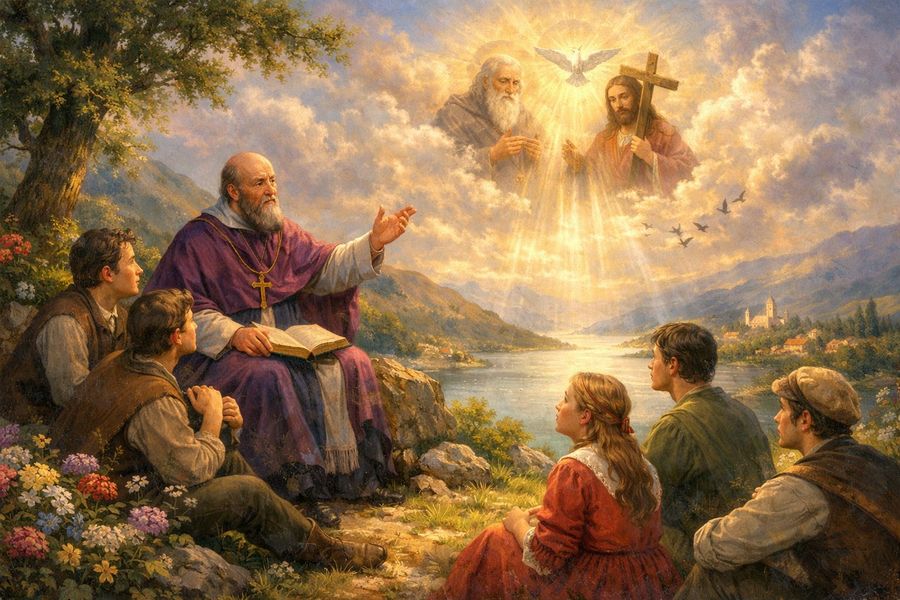
Reading time: 13 min.
Saint Francis de Sales proposes a pedagogy of faith that begins with human experience to lead to an encounter with the divine. At the heart of his reflection lies happiness as a natural human aspiration, a desire that finds its fulfilment only in God. The holy bishop of Geneva develops an optimistic view of human nature, showing how the soul is created in the image of God and possesses a natural inclination towards Him. This “congruence” between the human and the divine is not a burden imposed from above, but a mutual attraction that responds to the deepest aspirations of the heart. Francis de Sales thus outlines a spiritual journey that starts from the contemplation of created beauty and inner aspirations to lead to the discovery of the supreme Good, inviting everyone, especially the young, to give themselves to God without delay.
A Question of Happiness
“Man is created for happiness and happiness for man,” states Francis de Sales. This is a natural desire common to all. “All of man aspires to the good and desires that it be shown to him; I am not one of those who do not desire it, for I have discovered in myself a certain natural instinct that leads me and makes me tend towards happiness.” But humans are often mistaken about the means: some seek it in riches, others in pleasures, still others in honours.
In reality, only the “supreme good” can fully satisfy the human heart. Francis de Sales had no difficulty in identifying the supreme good with God. This leads him to say that “the human heart naturally tends towards God, who is its blessedness.” He had learned from his philosophy masters that “practical happiness,” identified in particular with the possession of wisdom, honesty, goodness, and pleasure, was not yet man’s true happiness. To achieve it, one must go beyond the dimension of doing and having and strive for that of being and essence, because the object of the “essential happiness” of the human subject can be none other than “God, and Him alone.”
Saint Francis de Sales has full confidence in the intellect and the will, “universal faculties that embrace all that is true and good. Now, God is the most universal object there can be, as He is the fullness of goodness and truth. God, therefore, is the object of these faculties, and He alone is able to satisfy them completely.”
At this point, the famous phrase of Saint Augustine comes to his mind, “My God! my heart is created for you and will have no rest or tranquillity until it rejoices in you.” Happiness is union with God “towards which we tend quite naturally.” “By a kind of paradox,” comments Louis Lavelle, “we do not perceive the heart of ourselves, except through a movement that carries us beyond ourselves.”
We naturally tend towards this union, yet we are incapable of achieving it by ourselves; it is the object of a pure gift from God, who takes the initiative. Destined for man without any merit on his part, this union “does not seem to be true happiness unless the human subject possesses it, because God created it precisely for man’s happiness, and promised it to him in such a way as to be obliged to give it to him.” Between the innate aspiration of the human person and God’s plan to unite with us, a relationship is established that Francis de Sales calls “congruity.”
Congruity between Man and God
The relationship between the human and the divine is explained by the fact that between man and God there exists what Francis de Sales calls a “congruity,” a sort of complicity, one might say. There is nothing strange in this; “We are created in the image and likeness of God. What does this mean if not that we have a great congruity with his divine majesty?”
The author of the *Treatise on the Love of God* distinguishes several forms of “congruity,” beginning with that of resemblance. The human soul resembles God because it is “spiritual, indivisible, immortal; [it] understands, wills freely; it is capable of judging, of reasoning, of comprehending, and of having virtues.” Moreover, the soul “resides wholly in its whole body and in each of its parts, just as the divinity is wholly in all and in every part of the world.”
But the most wonderful resemblance is that made “in the image and likeness” of the divine unity and trinity. Indeed, just as God made his thought known through the Son, who proceeds from him, and expresses his love which proceeds from him and his Son, through the work of the Holy Spirit, so man knows with his intellect and loves with his loving will. The three divine Persons are distinct but inseparable. In the same way, the acts of the human person that proceed from his intellect and his will are truly distinct, although they “remain inseparably united in the soul and in the faculties from which they proceed.” In this way, all is perfectly one: with his intellect and his will, man forms an image of the Trinity.
Besides this “congruity” by resemblance, the author is especially interested in the “unparalleled correspondence between God and man for the sake of mutual perfection.” By this he means that God is powerfully moved to exercise his goodness towards humanity and that humanity has an extreme need and a radical capacity to receive the good that God wishes to give it. “It is therefore a sweet and desirable encounter, between abundance and indigence.” One finds a reciprocity of this type not only in the loving relationship of the bridegroom and the bride, as described in the Song of Songs, but also in the figure of the mother who enjoys offering her milk to the newborn, who takes pleasure in receiving it.
Mothers sometimes have breasts so swollen and abundant that they cannot resist offering them to a child; and even if the child sucks the breast with great eagerness, the nurse’s eagerness to offer it is even greater. The child sucks driven by its own need, the mother by nursing it, from her abundance.
Natural Inclination towards God
This “congruity” between God and man is continually nourished by what Francis de Sales calls a “natural inclination,” which pushes man towards God. Certainly, as a good theologian, he appropriately articulates the desire for the supernatural and its gratuitousness. On the one hand, the human heart tends towards God, moved by natural inclination; on the other hand, the happiness to which it aspires goes far beyond a simple natural joy. However, he spends a great deal of time showing the path that leads from natural desire to its supernatural fulfilment. He dwells on the natural capacities of man that lead him towards the All, explaining that “his intellect has a limitless inclination to know ever more, and his will an insatiable appetite to love and find the good.” He teaches that the intellect is not content with partial and fragmentary truths, and he stresses that its spontaneous motion leads it to the search for Truth; that the will with its capacity for love is attracted by the supreme Good capable of satisfying its desire. Where does this extraordinary inclination come from? The conclusion is self-evident. There is “some infinite operator” who impresses in me “this infinite desire to know, and this appetite that cannot be sated” in this world and by this world.
This inclination directed towards seeking the good and, let us say it, to loving God, has remained in man even after original sin. It is true that it often does not appear at all, as it remains “secret, hidden, and almost asleep in the depths of nature,” “drowsy and imperceptible”; but when it encounters its object, it suddenly reawakens and “appears like a spark from under the ashes,” like the partridge chick, huddled under the wings of a “thieving” partridge, which runs towards its true mother at her first call.
From a chronological point of view and following the natural development of the child, this inclination towards God appears last. In fact, the child’s love first manifests itself towards himself, then towards his mother, then towards others, before turning to God, when he becomes capable of it. “Divine love is the last born among the affections of the human heart,” but it is no less important or optional for that, because it is destined by nature to take precedence over all other loves. “Everything is subject to this heavenly love which demands to be either king or nothing, it being impossible for it to live except as king, nor to reign except as sovereign.” An excellent humanist, Francis de Sales cannot fail to consider the completeness that Christianity confers upon man: “We see clearly that we cannot be true men if we do not have the inclination to love God more than ourselves, nor true Christians, if we do not put this inclination into practice.”
Mutual Attraction
The God of Saint Francis de Sales attracts the one who goes towards him:
Whether, therefore, the union of our soul with God is effected imperceptibly, or whether it occurs in a perceptible way, the author is always God, and no one can unite with him unless He himself moves first, and no one can go to Him unless he is drawn by Him, as the divine Bridegroom testifies, saying, ‘No one can come to me unless my Father draws him; which the heavenly Bride also proclaims when she says, Draw me, let us run to the fragrance of your perfumes.’
Between God and man there exists a mutual attraction, so much so that the voluntary rejection of God appeared to Francis de Sales as something unthinkable, incredible. Once one has tasted the love of God, how is it possible to renounce its sweetness? “Children, though they are children, if they are fed with milk, butter, and honey, shrink from the bitterness of wormwood and gall, and cry until they are breathless if they are forced to taste them. And so, good God, how can the soul, once joined with the goodness of the Creator, abandon Him to follow the vanity of creatures?”
The encounter between God and man open to transcendence is not a burden that God has imposed on human beings, but rather a pleasure to be shared:
If man thinks with a little attention about the divinity, he immediately feels a certain sweet emotion in his heart, which proves that God is the God of the human heart. In no other circumstance does our intellect experience so much pleasure as in this thinking about the divinity, the slightest knowledge of which, as the prince of philosophers says, is worth more than the greatest of all other things […]. This pleasure and this trust that the human heart naturally finds in God can only derive from the congruity that exists between the divine goodness and our soul.
A Pedagogy of Faith
Based on Francis de Sales’s conceptions of the relationship between the human and the divine, it is possible to imagine a pedagogy of faith. Several paths present themselves. The first starts from the spectacle of creation to ascend towards the Creator; indeed, “God has impressed his footprint, his sign, his mark on all created things.” The Bishop of Geneva was particularly attracted and sensitive to this.
To go to God, we are invited to follow the via pulchritudinis, the way of beauty. A piece of advice given to Philothea reads thus: “Aspire therefore often to God, Philothea, with brief but ardent impulses of your heart; admire His beauty.” The beginning of the Treatise on the Love of God is a hymn to the “beauty of human nature.” In daily life, particularly at the time of “recreation,” Francis de Sales’s thought easily rises from the contemplation of the beautiful to the contemplation of uncreated Beauty. His friend, Camus, was the astonished witness of this:
When people spoke to him of palaces, of paintings, of music, of hunting, of birds, of plants, of gardens, of flowers, he did not blame those who occupied themselves with them, but he wished that all these occupations had served them as so many means and mystical ladders to elevate themselves to God […]. If he was shown a beautiful orchard, full of well-aligned plants, “We are the agriculture and the workshop of God,” he would exclaim. If it was a matter of palaces built with right symmetry, “We are the building of God,” was his reflection. […] When he was shown rare and splendid paintings, “There is nothing so beautiful,” he would say, “as the soul made in the likeness of God.”
Another, more interior path consists in showing that the human subject harbours within itself desires and aspirations that guide it almost spontaneously above itself. It is a matter of plumbing the depths of the human heart to discover the divine seeds that God has deposited there. It is undoubtedly on this track that Francis de Sales engages the reader of the Treatise on the Love of God, following a “pedagogy of summits” that starts from man, from his nature and his aspirations. In this, he respects the transcendence of God and His initiative, because it is He who has placed this nature and these dispositions in the human being, and it is He who fills them with his grace.
It is enough to compare the first book of the Treatise with the second to discover its author’s proposal. In the first, which contains “a preparation for the whole Treatise,” we are on earth, where man lives as a being made to love. In the second book, the author transports us to heaven, to tell us the “story of the conception and heavenly birth of divine love.”
It is therefore the ascending and inductive path that Francis de Sales prefers. He wants to show the human subject that to be faithful to himself, he must recognise the internal dynamism that inhabits him and orients him towards God. In this sense, one can say that the first book of the Treatise is nothing other than a philosophical preparation to welcome the transcendent gift of charity. He does not borrow the path of pure transcendence, which consists in showing a God who can intervene powerfully from on high in the lives of human beings, revealing Himself and establishing a covenant with the full authority of creator and master of the universe. “God is the God of the human heart,” writes the author of the Treatise.
Only God is capable of filling the heart of man, because it is made for the absolute. “Taking into account, therefore, that nothing perfectly satisfies our soul and that its aspiration cannot be exhausted by anything in this world, […] it has good reason to exclaim: I am not, then, made for this world!”
Francis de Sales seems incapable of speaking of man without speaking of God, nor of speaking of God without speaking of man.
Youth and God
Opening myself to transcendence and knowing God as my supreme Good, all this pushes me to give myself to Him. This does not depend on age. The nephew and biographer of Francis de Sales, Charles-Auguste, recounts that when he was very young, his uncle often repeated to his playmates, “Let us learn early to serve God and to pray to him, while he gives us the opportunity.”
Should one wait to grow older to give oneself to God? Such a prospect is undoubtedly outside the views of the Savoyard bishop, who never ceases to repeat to those who have chosen his direction, “Do not wish not to be what you are, but wish to be in the best possible way what you are.” If you are young, be truly so, according to your vocation and occupation. “Let us learn to serve God with a true heart and early on,” urged Francis de Sales, who did not forget in this regard the biblical saying, “It is good for a man to have borne the yoke from his youth.” This is what the Duke of Mercœur did, whose Christian education received in his youth was to bear copious fruits in his mature age:
In this prince, the praise for having so well nurtured his first inclinations with virtue, even amidst so many encounters and occasions, must be highlighted, given that […] neither the court, nor war, sworn enemies of devotion, although aided by the secret allurements of youth, beauty, and the good graces of this excellent prince, could ever conquer his soul, which always remained pure and unscathed amidst so many attractions.
The “devotion” taught by Francis de Sales is valid for everyone, and not only for all conditions of life and for all vocations, but also for all ages, and, in particular for the young; it “makes youth wiser and more amiable and old age less unbearable and tedious.” It is the best commitment one can make from the “dawn of one’s age,” all the more so as one does not know how many years one will have. “There are those who pay homage to God with what they do not have,” states the Bishop of Geneva, imagining this little dialogue. “My son, why are you not devout? – I will be in my old age. – Good God! Who knows if you will grow old?” On several occasions, Francis de Sales had to combat this feature of the common mentality:
It is quite certain that the old are close to death and that the young can die soon; nevertheless, try to speak to a thoughtless young man and ask him about his health. What! he will say, is it not enough that I dedicate the days of my old age to God? One must therefore give oneself early, while one is young.
Youth possesses sometimes unsuspected resources. Certainly, the old Abraham is admirable when he wants to obey God by agreeing to sacrifice his son, but “to see Isaac, in the spring of his years, still a novice and apprentice in the art of loving his God, offering himself, on the sole word of his father, to the sword and the fire to be a holocaust of obedience to the divine goodness, is something beyond all admiration.”
As for people of the “weaker sex,” countless are those who chose martyrdom in the flower of their age, when they were “whiter than lilies for purity, redder than the rose for charity, these at twelve, those at thirteen, fifteen, twenty, and twenty-five years old.” By his own account, he knew a little girl who, “from the age of nine to ten,” “wished to die for the faith and for the holy Church.”
Giving oneself to God when one is young is a particularly frequent theme in the conferences given by the founder of the Visitation to the Sisters, especially on the occasion of the clothing and professions of the nuns. Since some candidates were often very young, one being only “fifteen years old and the other sixteen,” the occasion was ripe to address the theme of adolescence in its relationship with God and to teach that youth that gives itself to God arouses a mutual happiness:
It is very true that the beauty of those who dedicate themselves to the divine majesty from their adolescence is very great, all the more so as God desires it and takes great pleasure in it, while he deplores, on the contrary, when he declares through the mouth of the Prophet that from their adolescence, they have abandoned His way and have taken the road to perdition.
Consequently, “the divine Goodness desires the time of our youth, it being the most suitable for putting ourselves at his service.” He would also state that “God particularly loves the first fruits of the years and desires that they be consecrated to him.” And if one had to choose between two types of flowers, roses or lilies, his preference fell on the former, “because roses are more fragrant in the morning.”
One can be young all one’s life, but for the young who are so “by age,” it is an “extraordinary happiness to be able to dedicate these their best years to the divine majesty.” When Our Lord is the first love of one’s life, the result can be wonderful, because these “young souls who have not yet placed their love anywhere else, are wonderfully disposed to love the heavenly Lover of our hearts.” Speaking of those who have dedicated themselves to God from their youth and who have subsequently persevered, it can be said that “in them everything has been good, the leaves, the flowers, and the fruits, their childhood, their youth, and the rest of their life.”
 P. Wirth MORAND
  Fr Pierluigi CAMERONI