


 By St John Bosco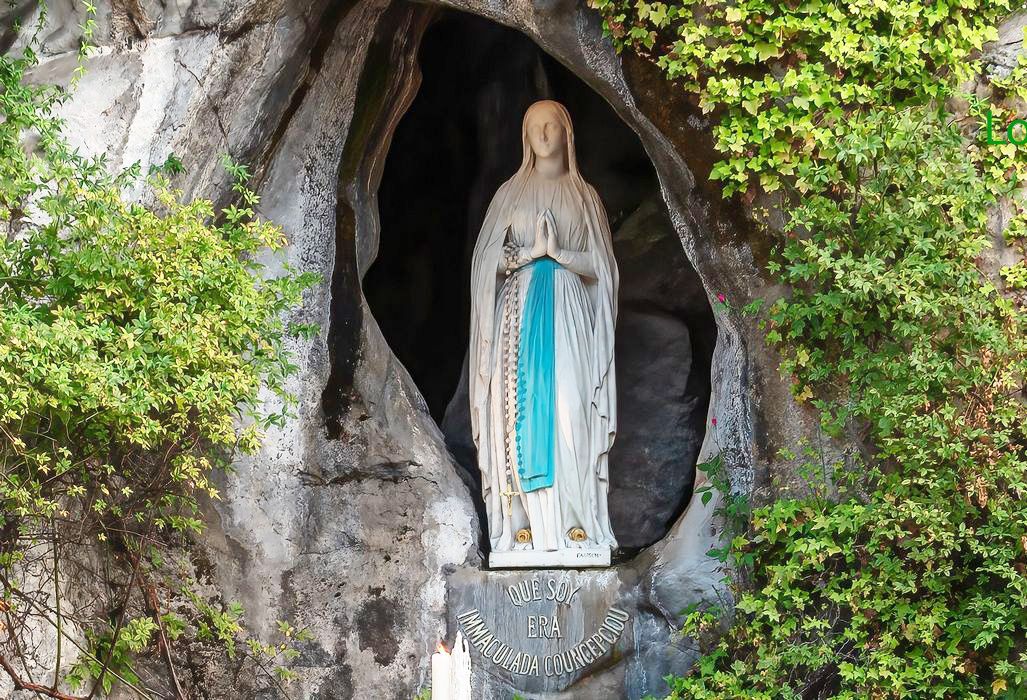
Reading time: 54 min.
In the heart of the French Pyrenees, in Lourdes, on 11 February 1858, one of the most luminous pages of contemporary Marian piety opened. A poor and simple girl, Bernadette Soubirous, was the protagonist of an event that transcended all human prediction: the apparition of the Virgin Mary, who revealed herself with the words, “I am the Immaculate Conception”. The following narrative, based on the story of Mr. Henri Lasserre, retraces the apparitions, miracles, and events that followed, amidst popular enthusiasm, governmental opposition, and ecclesiastical prudence. Lourdes thus became a living sign of God’s mercy, a testament to the truth of faith, and an urgent call to penance, in a time marked by scepticism and hostility towards the supernatural.
I. The Apparitions
II. Bernadette
III. The Government
IV. The People
V. The Church
VI. The Miracles
VII. The Defeated Adversaries
Conclusion. Pastoral Letter of the Bishop of Tarbes, on the apparitions that occurred at the grotto of Lourdes.
The Apparition of Lourdes
Appendix. Graces obtained through Mary Help of Christians
I am the Immaculate Conception.
The glories of the most holy Virgin Mary, always most dear to the hearts of her devotees, who in their sorrows and prosperities recognise from her precious gifts of comfort and protection, come to shine with new triumphs when it pleases the Lord to manifest with new wonders the most powerful Patronage that He has entrusted to His Immaculate Mother over the Holy Church.
Then the mercy of God, while strengthening the piety of Mary’s devotees and filling their hearts with the sweetest consolations, conquers many souls and multiplies faith.
Sometimes it could be said that to a world led astray by impious doctrines and to peoples deceived by perverse teachings, dragged into unbelief by doctors often powerful through the support of governments, the Lord wishes to bring new safeguards and reveal His Providence even more through sensible means for the triumph of faith.
This thought comes to us when meditating on the manifestations and prodigies that occurred in recent years in Lourdes. We discern a character of particular evidence and clarity, inasmuch as the marvellous facts occurred in the midst of and under the eyes of an entire people. They met with powerful opposition, which then, against the aims of the opponents, succeeded in dispelling all doubt or uncertainty, and to the triumph of truth.
They cried out: banish the supernatural; dispel the hallucinations; thwart the deceptions. But the supernatural triumphed, the supposed hallucinations became splendid truths, and the deceptions appeared on the part of those who stubbornly denied and opposed the evidence.
Therefore, to Lourdes!
Let us go to admire the new triumph of the most holy Virgin and a most splendid triumph of the Catholic Faith.
This is the purpose of the narrative, which we undertake in brief, of the apparitions and prodigies of Our Lady of Lourdes, guided by the extensive history published by Mr. Henri Lasserre and translated into Italian.
We wish to entice our readers to read that book, which will fully satisfy them. In the meantime, we will endeavour to provide precise information on the main facts and to sufficiently make known Our Lady of Lourdes.
I. The Apparitions
The small town of Lourdes in the department of the Hautes-Pyrenees has four or five thousand inhabitants. It is located at the mouth of the seven valleys of Lavedan and at the junction of the roads leading to the renowned thermal stations of Barèges, Saint-Sauveur, Cauterets, Bagnères-de-Bigorre, Luchon, Luz, Eaux-Bonnes.
François Soubirous lived there with his wife and four children. The eldest, Bernadette, 14 years old, was chosen by the most holy Virgin as her messenger, and obtained the signal favour of contemplating her many times.
On the eleventh of February of the year 1858, Bernadette, called Bernardette in the village, while with her younger sister, named Marie, and another girl, named Jeanne Abadie, were gathering dry wood for the poor domestic hearth, suddenly saw a beautiful matron appear before a grotto, surrounded by the extraordinary splendour of living light, and she was able to contemplate her for a quarter of an hour. She then had the same favour seventeen more times.
The appearance of the sublime person had nothing uncertain or ethereal, or in any way fantastic, but rather showed a living reality, a human body, which the eye judged as palpable as a human being, and which had only this particularity, that it showed a dear amiability and was surrounded by living light.
That light did not obscure or dazzle the eyes like that of the sun. Indeed, that luminous aura, shining like a bundle of rays, attracted the gazes, which one seemed to be immersed in it and delight sweetly.
Of medium stature, she seemed young, with the grace of a twenty-year-old. She exuded candour of innocence and virginal purity, maternal tenderness and gravity, wisdom and majesty.
Her beauty defied all description. A graceful oval was the shape of her face, her eyes cerulean, so gentle that they softened the heart of anyone who looked at her. Her lips and mouth expressed a divine goodness.
Her garments of an unknown fabric were white as snow, and of great magnificence. The trailing gown revealed her feet, and on each of them a rose the colour of gold.
A cerulean sash like the sky encircled her waist with a half-knot, and hung with two long ends down to her feet. A wide white veil wrapped around her head covered her shoulders and the tops of her arms, descending to the bottom of her dress. There was no ornament similar to jewels, nor any diadem. From her hands joined in fervent prayer hung a Rosary of white beads like milk, held by a golden thread. The beads slid one after another between her fingers. The lips of that Queen remained motionless.
This marvellous apparition looked at Bernadette; and she, in her first astonishment, instinctively took her rosary in her hand, and holding it between her fingers, tried to raise her hand to her forehead to make the sign of the cross. But she trembled so much that she lacked the strength to raise her arm, which immediately fell back impotently onto her knees.
In the apparitions, some particularities manifested themselves, which are worth narrating.
In the third, which occurred on Thursday, 18 February, the mysterious Lady invited Bernadette to come to the same place for fifteen days. She promised to make her happy, not in this world, but in the next. She said that she desired to see other people with Bernadette.
Another time, the gaze of the celestial Woman seemed to turn all around, then stopped with an expression of sorrow upon the kneeling Bernadette.
“What is wrong?” she said; “What is to be done?”
“Pray for sinners,” was the reply. The sorrowful expression was reflected on Bernadette, spreading an inexpressible sadness over her face. From her always open eyes fixed on the apparition, came two tears that stopped on her cheeks. Then she brightened, and her face lit up as if by a ray of joy.
The marvellous Virgin confided three secrets to Bernadette three times, which concerned her personally, and forbade her to reveal them to anyone. She instructed her to tell the priests that it was her will that a chapel be erected there for her, and that processions be held. She also pronounced the word: Penance! Penance!
It is worthy of special mention that on 25 March, sacred to the Annunciation of the Most Holy Mary, when Bernadette’s fifteen visits to the grotto had ended, she went there again, moved by a very strong inner impulse. It was then that the crowd, noticing this, followed her in great numbers.
Bernadette had already asked the celestial Matron her name several times; then she repeated the question four times, and insisted again while the apparition already seemed to vanish and assume an even more sublime aspect. Her hands were joined; her face was radiant with infinite beatitude. Humility breathed in glory. In the same way that Bernadette contemplated the Matron, the latter was undoubtedly immersed in the contemplation of Divinity.
At Bernadette’s last request, she opened her hands, letting the Rosary of white beads and golden thread slide down her right arm. She opened her arms, bowed them towards the earth, as if to show her virginal hands full of blessings. Then, raising them towards heaven, she joined them fervently; and looking at heaven with a countenance of inexpressible gratitude, she uttered these words:
I am the Immaculate Conception!
Having said this, she disappeared.
The shepherdess heard these words for the first time: Immaculate Conception. And not understanding them, she made every effort to remember them well on her way back to Lourdes. She then narrated that on her way to the parish priest, she continuously repeated: Immaculate Conception, Immaculate Conception, because she wanted to convey the words of the vision, so that the chapel might be erected.
The most notable fact, because it had a permanent effect, occurred on 25 February when the Virgin instructed Bernadette to drink and wash herself at the fountain, but at a sign given to her. She shook the earth with her hand, making a hollow the size of a glass, which immediately filled with water. At first it was earthy and turbid, then became clearer and clearer, then grew into a spring as thick as a child’s arm, and finally came to gush out a hundred thousand litres per day.
This fountain was a source of remarkable graces and prodigious miracles. We will narrate some of them. But first, to complete the account, it is necessary to show how the apparitions were judged by the people, by the government, by the Church, and how the truth emerged luminous, triumphant, despite, indeed thanks to, the contrasts opposed by unbelief and the rigorous reserve of wise prudence.
II. Bernadette
Candid, naive, modest as she was before the apparitions, so Bernadette remained even when she became the object of public admiration. Free from childish pride, she did not boast of heavenly favours. She only spoke of them when asked. She did indeed report to her parents what happened to her, and to the parish priest what she had to tell him when she had a message from the celestial Lady.
But nevertheless, she was not dismayed when she was brought, even with manners not always free from severity and harshness, now before the police officer, now before the imperial prosecutor. She answered unperturbed, calmly, with the accent of truth, which alone governed her. She did not get lost when, pretending to have misunderstood her, her sayings were reproduced less accurately; she always rectified consistently and precisely.
When the first apparition occurred, Bernadette had only returned to the village fifteen days earlier, having spent her childhood in the mountains tending sheep. Only then had she begun to attend catechism.
The priest who presided over it had never paid attention to her; he questioned her without knowing her name. Once called, he saw a humble, poorly dressed girl rise; and he observed nothing in her but her simplicity, and also her ignorance in matters of religion. The poor girl did not cease, even when she had such celebrity, from considering herself the last in the school. She struggled greatly to learn to read and write. During recreation, she mingled with her companions, and played joyfully with great pleasure. If someone asked about the visionary, about the Lord’s favourite, about the Madonna’s favourite, the Sister who ran the school pointed her out and one only saw a simple girl, in poor clothes, intent on childish games.
Despite all this, Bernadette could not escape, as is easy to imagine, the attention of the multitude, especially when the rumour spread that she would return to the grotto for several days. There was a rush from all sides, a crowding by hundreds and thousands, so that sometimes up to twenty thousand people were counted gathered.
Once, when Bernadette went unexpectedly to the grotto, as soon as she was seen heading that way, at least ten thousand people gathered in a short time. The mayor, in a report to the prefect, stated that, having stationed agents on the roads and paths, he recognised the presence of 4822 inhabitants of Lourdes, 4838 foreigners, in total 9660 people. This was precisely on the day when Bernadette’s arrival was not expected.
But, to what end such a large gathering, if no one saw what was manifested only to Bernadette? It must be said that the mere sight of the girl in ecstasy was an irresistible proof of the truth of the apparition. There was one who explained this with a very apt comparison. When the sun rises, its light illuminates the mountain peaks, while darkness still reigns in the valley. Those who live in the elevated regions see the sun, but those who are in the lowlands do not see it, but nevertheless, seeing the high peaks struck by the sun’s rays, they are quite certain of its presence. Thus, precisely those who looked at Bernadette transformed, and as if illuminated by the apparition, had the same certainty, acquired the same evidence of the prodigious fact. Therefore, the reflection must have been truly visible; or the breath of God that stirs hearts must have passed over the multitude. It seemed that an irresistible power raised the population at the voice of that ignorant shepherdess.
III. The Government
To increase the evidence and strengthen the truth, the government contributed not a little by opposing the popular movement. It displayed rigours sometimes excessive, never motivated by the slightest disorder. The police commissioner, the prefect, the minister himself, always for the good of religion, as they said, multiplied decrees, fines, and punishments. They even prosecuted and fined those who, to approach the grotto, entered municipal land that had been forbidden. Then the flowers, candles, gifts, and ornaments brought to the grotto by the devotees were removed. The grotto itself was barricaded with a fence, gendarmes, and soldiers were stationed. But nevertheless, people faced convictions and fines, threw flowers over the fence, and the crowd gathered from afar as before.
It is truly admirable how the conduct and behaviour of public officials, intent on thwarting with all their power the unfolding of the prodigious events of Lourdes, and above all on suppressing the fervour of the populations and stifling the fame that arose and spread grandiosely, succeeded precisely in accumulating evidence that brought into full light the loyalty, sincerity of Bernadette and her disinterestedness. All these contrasts served only to increase the explosion of manifestations of religion and faith, and to provide greater fuel for the clamour that redoubled and propagated the renown of the portentous events.
As soon as the apparitions had aroused such great commotion among the populations and these began to move either by instinct of devotion or by impulse of curiosity, official liberalism felt somewhat compromised if it did not oppose that explosion of religious sentiment now so strongly pronounced in acclaiming evidently supernatural facts.
Therefore, the imperial prosecutor Mr. Dufour, the justice of the peace Mr. Duprat, the mayor, the substitute, the police commissioner agreed to work together to curb the disorder that seemed so dangerous to them in stirring up the populations, and therefore to arrange rigorous measures against Bernadette.
One Sunday, then, as the people left Vespers, a police agent approached Bernadette and, touching her on the shoulder, said to her: in the name of the law, follow me to the police commissioner. This act in such circumstances annoyed the bystanders, who began to murmur and be resentful. However, a priest who was then leaving the church brought them to a wiser counsel and exhorted them to leave the authority’s action free. Bernadette was taken to the police commissioner Mr. Jacomet. He was a man of great intelligence, very shrewd and very experienced in his office. Bernadette soon found herself alone before him. But as soon as the first interrogations were made, Mr. Estrade, receiver of indirect contributions, a tenant of the same house, entered. He was drawn by curiosity and was well persuaded that Bernadette would very easily be caught in error, so that he diligently listened to the conversation and then reported it to Mr. Lasserre who reproduced it in his story.
Mr. Jacomet began with great benevolence and with expressions of good nature. Bernadette told her story with her native simplicity and with the accent of the purest innocence and utmost candour. The commissioner, ever more affable and somewhat saccharine, appeared pitifully moved, and showed the greatest interest in the divine wonders. He multiplied the interrogations, pressing the girl in such a way as to give her no room to reflect. And Bernadette answered without hesitation, without disturbance. Then, all artifice proving vain, to tire the young girl and to confuse her mind, he transitioned without warning to the menacing and terrible, changing his tone. “You are lying,” he said as if seized by vivid anger; “you are a deceiver, and if you do not confess the truth, I will hand you over to the gendarmes.”
Poor Bernardina was so astonished by that sudden change that she was seized with disgust, but contrary to Jacomet’s expectation, she was not disturbed; she remained calm as if sustained by an inner force. “Sir,” she said with placid firmness, “you can hand me over to the gendarmes, but I can only say that what I have said is the truth.” “We shall see,” replied the commissioner, sitting down, well aware that threats would be useless with that extraordinary young girl.
He resumed the interrogation, drew up a report, and read it to Bernardina, who, regarding the inaccuracies artfully introduced, observed, rectifying that she had not said so, but in another way. “Yet I wrote, while you were speaking, what you were saying.” “No,” Bernardina replied, “I did not speak like that, it is not possible because that is not the truth.” The commissioner always had to yield to the girl’s objections.
Finally, the commissioner, becoming gruff and threatening again, said to her: “If you continue to go to the grotto, I will have you imprisoned, and you will not leave here unless you promise not to return.” “I promised the apparition,” said Bernardina, “to go there. And then, when the moment comes, I am driven by an inner impulse that calls me. Good God! What am I doing! I go alone to pray; I don’t call anyone. If many people precede and follow me, it is not my fault. They say it is the Madonna; but I don’t know who she is.”
The conversation lasted a full hour. The crowd awaited the outcome outside and began to grow agitated. Then there was a violent knock at the door and Soubirous, Bernardina’s father, entered. Upon seeing him, the astute commissioner easily discerned in him a certain boldness, but with a mixture of fear, and therefore took advantage of it to severely reproach him for his audacity. Then he admonished him about his daughter’s behaviour, and threatened him with punishment if he did not put an end to it. Here it ended with this advantage for the commissioner of having intimidated Soubirous and having determined him to restrain his daughter.
Mr. Estrade, a silent witness to the scene, could not contain himself and showed his admiration for Bernardina’s unwavering frankness in her replies — “Obstinacy in falsehood!” said the commissioner — “Accent of truth!” replied Estrade — “You mean quick-wittedness. She is skilled in her trickery; she is very shrewd!” exclaimed the commissioner — “No! She is most sincere!” repeated Estrade.
After this conversation, the apparitions did not cease; indeed, the multiplication of prodigies further confirmed the faithful in their admiration, and dispelled any doubt in the minds of those who hesitated, delaying to surrender. Many respectable figures were drawn by the evidence to testify to the truth of the supernatural events. This was the case for Mr. Dufor, a distinguished lawyer, Dr. Dozoux, as well as Mr. Estrade, and also the commander of the garrison, Mr. Laffitte, a retired military intendant.
Another time Bernardina was summoned to the tribunal where she found herself grappling with the stringent dialectic of the imperial prosecutor, his substitute, and the judges, all intent, but all powerless to catch her in error and to detect variations or contradictions in her statements. The imperial prosecutor spoke eloquently against the invasion of fanaticism and his resolve in fulfilling his duties. His zeal came to nothing; indeed, it helped to accumulate evidence and documents contrary to his aims and intentions.
Having failed in attempts to initiate legal action, and the government increasingly striving to thwart the progress of events that were now attracting the attention of all France to Lourdes, and with Mr. Rouland, Minister of Public Instruction and Worship, also taking an interest, the prefect wanted an inquiry into Bernardina’s mental state. He entrusted it to two distinguished doctors, chosen from those who agreed with his way of thinking. But they found nothing disconcerting or irregular in her and could only say that she might be hallucinating. With such a flimsy argument, the prefect did not hesitate to decree Bernardina’s arrest and to have her confined in an asylum for the mentally ill. He issued the order to the mayor, Mr. Lacade, who, with the imperial prosecutor, Mr. Dufour, went to the parish priest and informed him of the mission he had to carry out.
But Bernardina was saved this time by the resolute firmness of the parish priest, who, while protesting his respect for authority, did not hesitate to declare with reasoned discourse that such a course of action constituted an evident abuse, and that he would rise in defence of the oppressed weak, concluding by saying: “Go and tell Mr. Masses (the prefect) that his gendarmes will find me on the threshold of that poor family’s house, and that they will have to overthrow me and trample my body before they can harm a hair on the girl’s head.” Nothing more was done.
IV. The People
Prefect Masses did not give up, not because of the failed attempt at legal action, nor because of the reckless violence against Bernardina, and he turned his attention to stopping the great movement of the people and dispersing the crowd that was now incessant and very frequently at the grotto. He decreed that all ornaments, gifts, and offerings accumulated there by the piety of the faithful should be removed, and that the grotto itself should be closed and access forbidden to anyone. The executor of this order was the police commissioner, Jacomet, who applied himself with all his zeal and the greatest activity. He had no small amount of work, as the inhabitants of Lourdes refused him all help and cooperation, to the point that no one, even for a large reward, would provide him with a cart and the necessary tools. Therefore, he himself, with his own hands and with the help of the gendarmes, had to remove the objects one by one and place them on a cart that he managed to find with great difficulty. And whenever gifts and devotional objects were brought again, the commissioner would return to remove them and often threw them into the nearby stream. It was then that, by order of the prefect, the mayor came to decree the prohibition of drawing water from the fountain and of entering the adjacent land, and to place a fence for this purpose to close the grotto. The justice of the peace prosecuted and fined offenders.
It is impossible to describe how much that brutal intervention by the government aroused discontent and irritation. Protests and appeals arose from all sides, but nevertheless, in the immense concourse, which before and after was continuous at the grotto, there was never the slightest disorder. The harshness caused serious annoyance, yet, thanks also to the incessant exhortations of the clergy, no blameworthy act occurred: never seditious shouts, no resistance, but rather, hymns, litanies, cheers to the Blessed Virgin. The very soldiers brought in to enforce the orders and prohibitions were witnesses to acts of devotion and very often took part in them.
It was certainly astonishing that in the six months during which the apparitions lasted, not a single crime was committed in the department and there was not a single conviction. The Assizes of March had nothing to judge but a single case from an earlier period, which was concluded with an acquittal.
This admirable case, this clear indication of the invisible influence spreading throughout the region, this external argument, this moral prodigy, was bound to move the hardest hearts, the most reluctant intellects.
Such a state of affairs could not last long. Indeed, one fine day, Monsignor Salmis, Archbishop of Auch, and Mr. Rességnier, a former deputy, went to Biarritz to see Emperor Napoleon III, and having informed him of everything, they obtained an order by telegraph to Mr. Masses, Prefect of Tarbes, to revoke his bans and prohibitions. The prefect kept the telegram secret, wrote to the emperor, and interposed the minister. But, as God willed, the emperor stood firm, so the prefect had to bend and yield, and had to instruct the mayor to publish a decree revoking the previous one.
The obstacles, the impediments, every opposition, resulted in as many victories of the supernatural over the stubborn adversaries.
V. The Church
To confirm the evidence and finally document the truth, the conduct of the ecclesiastical authority was helpful. At first, the parish priest strictly forbade all priests and nuns from going to the grotto and mingling with the people, so that their presence would not in any way sanction the events, and would not, however unintentionally, excite and encourage the populations.
The Bishop of Tarbes approved and confirmed what the parish priest had arranged. With Bernardina, moreover, the parish priest, Mr. Peyramale, maintained not only great reserve, showing that he did not care at all. But the first time she went to him, he received her with a coldness that to some seemed not free from harshness, almost rejecting her. Indeed, when Bernardina received the command from the apparition to go and manifest to the priests her desire for a chapel to be built, she explained her mission to the parish priest with all simplicity, and he, interrupting her, said, “What is this fuss you are making with the visions you claim to have and of which nothing proves the truth?” Bernardina, surprised and confused by the unusual severity and sustained tone of the parish priest, who was usually so paternal and affable with his parishioners, especially the poor, was at first disconcerted.
But she soon recovered, and candidly recounted to the parish priest what had happened to her. He was deeply moved by this, but he restrained himself and concealed the feelings that agitated him internally. “Do you not know,” he said, “the name of that Lady?” “I do not know,” replied Bernardina, “she did not tell me who she is.” “Those who believe you,” added the parish priest, “say that she is the Madonna. But be careful,” he continued with great gravity, “if you tell a falsehood, you expose them to the danger of never seeing her in heaven when all good people will see her.” “I do not know if she is the Blessed Virgin,” continued Bernardina, “but I see the apparition as I see you at this moment. She speaks to me as you speak to me. I come to tell you on her behalf that she wants a chapel to be built for her near the grotto where she appears to me.”
The parish priest made the girl repeat the exact words she had heard from the apparition and dismissed her.
The conduct of the parish priest was approved by the Bishop of Tarbes, Monsignor Laurence, who confirmed what he had arranged.
Meanwhile, the clergy refrained from going to the grotto and remained aloof from the great movement; the bishop’s orders were strictly observed throughout the diocese.
The populations, troubled by the government’s harshness, anxiously turned to the ecclesiastical authorities, and longed for the bishop to rise in defence of their religious freedom.
Where the bishop, inspired by the dictates of prudence, did not deem it appropriate to intervene to second the wishes of the population, and although he could not approve the conduct and decrees of the authorities, he considered it more opportune to delay. He therefore wanted the clergy to strive to inculcate greater tranquillity in the faithful and to induce them to submit to the government’s orders and patiently await the natural development of events.
In this way, Divine Providence arranged that the great event of the apparitions of Our Lady of Lourdes should undergo, like Christianity in its beginnings, the trials of contradictions, tests, and persecution.
However, it was not only the population of Lourdes and the surrounding villages who were surprised by the prolonged silence of the ecclesiastical authority, but also the many foreigners who flocked from nearby thermal resorts. They highly condemned the action displayed by the civil power and disapproved of the conduct of the bishop and the clergy, while many other bishops already did not conceal their opinion on the truth of the events of Lourdes.
Thus, July arrived, completing five months since the first apparition of the Blessed Virgin to Bernardina Soubirous. It was on the 18th of that month that the Bishop of Tarbes published a decree by which he appointed a commission to examine the truth of the events that occurred in Lourdes. This commission, after a long and thorough examination that lasted three and a half years, and the interrogation of many witnesses, made its report. Following this, the bishop pronounced on January 18, 1862, the truth of the apparitions of the Blessed Virgin to Bernardina Soubirous, authorising the cult of Our Lady under the title of Our Lady of Lourdes, and to conform to her repeatedly expressed will, decreed the erection of a chapel on the land of the grotto, which had been acquired by the Bishop of Tarbes.
VI. The Miracles
The fame of the prodigious events, which moved the inhabitants of Lourdes and its surroundings, spread ever more widely, so that many began to flock even from distant countries, and people of high standing also came, mostly out of curiosity, often out of an instinct for devotion, from the thermal resorts. Thus, the news of the apparitions of Lourdes quickly spread throughout France and Europe.
But what increased the great movement were the miracles that manifested themselves with great frequency from the very beginning. Suffice it to say that when a regular process was instituted by the ecclesiastical authority, and among the many, about thirty miraculous healings were examined, as those that most clearly showed the characteristics of supernatural facts, such was the rigour used in excluding everything that admitted any other explanation, however ill-founded, that it must be said that the miraculous nature was only recognised when it could not be otherwise. Thus, the miracles for which a solemn affirmative judgment was pronounced were reduced to fifteen.
Having to limit this information to brief terms, we leave it to those who desire a complete account to read, as we urge them, the history of Our Lady of Lourdes by Mr. Lasserre (“Notre Dame de Lourdes, par Henri Lasserre”, Paris, Victor Palmé. “Nostra Signora di Lourdes”, Italian version, Modena, tipogr. dell’Immacolata Concezione); and we will content ourselves with reporting three of the miracles narrated therein. This will suffice for our purpose, which is to give precise information about the sanctuary of Lourdes.
As soon as the fountain indicated to Bernardina by the heavenly Lady appeared in the grotto, it was understood that that water would be salutary, and on the same morning, word spread of several prodigious healings. It reached the ear of a poor worker named Luigi Bouriette, who for several years had been living a miserable existence due to an injury suffered in the explosion of a mine.
His face had been lacerated and his right eye almost crushed. His sight had become so weakened and indeed was progressively worsening, that he was no longer able to do work that required any diligence. Known by all the inhabitants, he was employed by most of them for rough work. Having heard of the prodigious fountain, “Go,” he said to his daughter, “and bring me some water from the grotto; only the Madonna can heal me.” The water came, he washed his eye, and cried out, he was healed!
The next day or the day after, he met the doctor who had been treating him since the day of the accident, and said to him, “I am healed.” “You are healed!” replied the doctor. “But what? Your illness is incurable; I try to calm your pains, but I do not claim to restore your sight.” “But you did not heal me, but the Virgin of the Grotto.” “That Bernardina has inexplicable ecstasies is certain, and I have verified it with careful study; but that the water from the fountain instantly heals incurable diseases is not possible.”
As Bouriette persisted in claiming to be healed, the doctor took out his notebook, tore off a sheet, and having written a few words, covered Bouriette’s left eye with his hand, and said to him, “If you read, I will believe.” Bouriette read quickly. Meanwhile, people had gathered, and were watching the singular dispute, so they soon admired the wonder and the doctor’s confession.
Another of the miracles recognised by the ecclesiastical authority, which, as will be seen, can be said to have occurred under the eyes of an entire city, was the prodigious healing of the widow Maddalena Rizan, a very elderly woman from the city of Nay.
She had suffered from cholera in 1832, and thereafter had remained almost entirely paralysed on the left side of her body. She walked with great difficulty, only leaving her house two or three times a year in the height of summer, more carried than supported by others to go to the nearby church. Moreover, she was subject to continuous vomiting of blood, and could only tolerate scanty food.
For sixteen or eighteen months, that unhappy state had worsened, and had confined the invalid to bed. Then, in a short time, she deteriorated so much that, having lost all strength, she could not change position without help. The pains of the poor woman were so strong, and her courage so exhausted, that she implored the Lord for either healing or death, but an end to her suffering. Finally, at her last gasp, she had received the Last Rites and was in painful agony. At this point, she redoubled her invocations to the Madonna, and asked a neighbour to get her some Lourdes water.
While Mrs. Rizan was gasping for breath, and had already taken leave of the curate and another priest at nightfall, her daughter, who was lovingly assisting her, had begun to pray to the Blessed Virgin. Her mother called her, and told her to give her the Lourdes water. But as night was advanced, it was necessary to postpone the search at the neighbour’s house, who had been to Lourdes.
In the morning, the water was obtained. The invalid eagerly drank a few sips, and immediately exclaimed, “This is water of health! Wash my face, daughter, my arm, my whole body.” The anxious, trembling daughter complied with her mother’s wish. Then, with a voice that had become clear and resonant, “I am healed, oh blessed be Mary Most Holy! Give me my clothes, I want to get up, give me some food, I feel hungry.” The daughter wanted to give her coffee, wine, or milk; but the mother, “Give me meat and bread, which I haven’t tasted for twenty-four years;” and she ate with complete ease. Then the daughter went for the clothes, which had been put away for a long time and were believed to never be worn again. When she returned bringing her mother something to wear, what was her surprise to find her out of bed and kneeling before the image of Mary, where she herself had just been praying for her mother!
It was seven in the morning, on a Sunday, and the faithful were leaving the nearby church after mass. Some entered the widow Rizan’s house to see if she had passed away during the night, but instead, they saw her healed, almost resurrected. The news quickly spread; infinite numbers of people flocked to the house, and for two days the crowd did not cease. Everyone wanted to judge with their own eyes the prodigy that was said to have occurred. Doctor Subervielle, who attended the widow Rizan, and who had recognised the impotence of medicine, and declared all hope now vain, also came and unhesitatingly recognised the supernatural and divine character of the healing.
The widow Rizan remained in good health from then on, and in 1869, when Mr. Lasserre published her story, she was still full of vigour, as he says, and with her recovered health and the disappearance of her infirmity, she bore witness to the most powerful mercy of the Apparition of the Grotto of Lourdes.
On the last day of the fortnight prescribed for Bernadette, twenty thousand people were gathered at the grotto. The emotion was immense, and it continued after the apparition had ceased. The discussions and arguments lasted. Throughout the day there was a continuous coming and going. Around five o’clock there were still five or six hundred people at the grotto, when a weeping woman arrived in a hurry, her face inflamed, completely dishevelled, invoking the Holy Virgin. She prostrated herself at the entrance of the grotto, then dragged herself on her knees to the fountain. Then she untied her apron, in which she held a child more dead than alive. She signed herself and the child with the cross, then plunged him up to his neck in the icy water of the fountain. At that sight, a cry of terror and indignation arose. The crowd pressed around the woman, “You are mad,” they said to her; “you are killing your child.” “Leave me alone! I am doing what I can. God and the Madonna will do the rest.” Others, observing the child’s immobility, the pallor that covered him, the squalor of his tiny body, said, “He is dead, let us leave the poor woman in peace; she is out of her mind.” Meanwhile, the child, held immersed in the water for a long time, looked more like a corpse than anything else. The poor woman gathered him in her apron and went home. Her husband, seeing her, “Wretch!” he said to her, “you have killed the child!” “He is not dead,” replied the woman, “the Madonna will heal him;” and she put him back in the cradle.
At the grotto, the whispering and reasoning did not cease. There was exclaiming, questioning. It was learned that this woman was Croisine Ducouts, wife of Giovanni Bouhohorts. The child had been born sickly, was about two years old, had always been ill, and had never walked. He was exhausted by a continuous low fever resistant to all treatments, and was now at the point of death; death already covered his face with a livid tint, and his body was extremely thin and utterly wasted.
While at the grotto, people were discussing the woman’s actions in various ways, and were in a state of great emotion, silence reigned in the poor dwelling. And it was not the silence of death, nor even the silence of sorrow, but it was the silence of hope; for, as soon as he was laid in the cradle, the child fell asleep. He began to breathe gently, then more freely and strongly, and so he passed the whole night peacefully. The poor parents took turns listening to their little son’s breathing, anxiously awaiting his awakening, which occurred at daybreak. The child was still emaciated, but a beautiful rosy colour appeared on his cheeks, his appearance was calm. He turned his eyes to his mother and asked for her breast, and took abundant refreshment from it. He wanted to get up and walk; but his mother did not trust him, and kept him in bed all day and the following night, repeatedly offering him her breast when requested. In the morning, after the parents had gone out, leaving the child alone, when the mother returned home, she saw the cradle empty, and little Justin running and playing around the room. Let mothers say what Croisine’s joy was; let them say with what accent she cried out to her husband, “See, he was not dead! Long live Mary!”
The neighbours and the doctor who attended the child rushed over. He frankly recognised the radical impotence of medicine to explain the fact. Two other doctors came, examined what had happened separately, and also did not doubt to see in it the most powerful action of the Lord. The doctors established, as very serious circumstances, the duration of the immersion, the immediate effect, the ability to walk that occurred as soon as the child got out of bed.
These three facts, which, like other similar ones, were perfectly clarified and proven in the process instituted by the Bishop of Tarbes, did not admit the slightest doubt, having had so many witnesses, and excluding any explanation, except for the power of the Lord.
Yet the impious and unbelievers may persist in their stubbornness, and croak against the ignorance of the multitude. They will never succeed with their laborious science in explaining how the voice of a poor shepherdess, or the spreading of falsehoods, can awaken and move peoples, and induce them to erect a temple such as the one that now towers over the grotto, built with millions spontaneously brought from all parts of France and Europe.
To us, ignorant common folk, who believe in God Creator of heaven and earth, it is not difficult to believe in miracles when they are duly proven. We believe them as any other historical fact. We raise our hearts to praise our Father, who is in heaven.
Oh, great mercy of God, which strengthens our faith and solidifies with new arguments our trust in the protection of His Most Holy Mother, dispensing His graces with a generous hand in such sad times as ours, and so adverse to the Holy Catholic, Apostolic, and Roman Church!
VII. The Defeated Adversaries
The grandiose manifestation of Divine Mercy accomplished with the apparitions of the Blessed Virgin in Lourdes and with the numerous and solemn prodigies that followed them, was not enough to conquer the impiety and audacity of the wicked. They did not surrender to the most luminous proofs, but nevertheless persisted as if nothing had happened in their impudent denials. In vain did truth triumph over all contrasts, scoffing and derision persisted in print and in speeches.
Even to such boldness, it pleased the Lord to provide opportune remedy, and we dare say adequate punishment, if indeed there is a limit that bad faith can respect.
By disposition of Divine Providence, another prodigious healing, occurring with all the characteristics of full evidence, gave occasion to a challenge courageously issued to free thinkers, opponents of miracles, putting them to the test of bringing proof against facts now victoriously clarified, and luminously known to the whole world. All the adversaries were dismayed, and by retreating they demonstrated their impotence, whereby it was proven that they do not speak according to conviction, but only out of blind hatred and improper passion.
One would not care about the hardened wickedness of such a sad breed, were it not for the harm to the simple and the ignorant. Of these, there are far too many who are victims of easy deception. Little concerned with diligently seeking the truth, they remain neutral rather than endure the slight discomfort of examining the pros and cons, all the more so if they have to encounter the mockery of those wicked ones who make it their business to always lie according to the motto: lie boldly, something will always be gained.
Therefore, there is still a duty after having exposed, yes, but with studied precision, the arguments that demonstrate the truth of the prodigies that occurred in Lourdes. It is not enough to have highlighted the agreement of the populations, the overcome opposition of the government, the overcome prudent reserve of the Church. It is necessary to make known this other argument of the defeated boldness of the wicked. It does not matter that they do not want to admit defeat; they are indeed defeated in the judgment of every honest and loyal person.
In Bordeaux in 1870, lived Mr. Fournier, a retired naval captain, with his wife and three children; the first, Ernesto, a naval ensign, the second, Giulietta, who was then 14 years old, and Alberto, who was 11.
Giulietta was afflicted with a serious slow illness. She suffered from complete atony of the stomach with a dislike for all food. She had extreme weakness, unable to stand without help and only for a short time, having to sit down every three or four steps. Her pulmonary muscles were affected; her breathing increasingly laboured did not allow a horizontal position; sleep was not possible except sitting on the bed. Finally, her right side was paralysed.
The most famous doctors of Bordeaux had been called one after another without success. Mr. Cogniet was consulted, then Mr. Denucè. Unanimously with his colleagues, this illustrious doctor declared the illness deeply rooted; the healing, in any case, of such diseases, rebellious to medicine, would require a very long cure and no sensible improvement could be hoped for before the full development of the physical body, which was also delayed in the girl by weakness and infirmity.
As summer was then approaching, the Fourniers settled in a villa in a place called Bouscat, near the gates of Bordeaux. Giulietta was undergoing hydropathic treatment, and a certain number of bath tickets were taken for the cure. And since the invalid could not bear the motion of the carriage, an old and steady donkey was found, which for a long time had not known, if it had ever known, what trotting and galloping were. The placid donkey carried Giulietta every day at a slow and gentle pace to the hydropathic establishment. The father, mother, and brothers accompanied her on foot. On the road from Bouscat to Bordeaux, this melancholic group, which was seen passing every day at the same time, was well known. Everyone showed interest in the afflicted family. The appearance of the invalid struck so much that signs of dismay were very often observed among the curious who looked out of windows and doors and who revealed their inner sinister premonitions.
At this time, Mrs. Fournier’s brother got hold of Mr. Henri Lasserre’s story of Our Lady of Lourdes, read it eagerly, and felt filled with vivid sentiments of admiration and trust. So much so that he wrote without delay to the parish priest of Lourdes to immediately send a bottle of Lourdes water to Mrs. Fournier.
Mr. Fournier was a free thinker and his son Ernesto shared his opinions; however, they raised no objections, respecting the faith and trust of their loved ones. It is superfluous to observe that while wives, daughter, and younger son were free to say their prayers, the father and elder son took no part in those practices and signs of devotion.
But young Ernesto could not refrain from writing to his uncle, philosophically jesting about such naivety. In the first letter he wrote to him, he insinuated these words, “With all the respect I profess for you, I must confess, dearest uncle, that your clear water inspires in me a very mediocre trust. Our poor Giulietta is too seriously ill for me to feel like joking. I limit myself to simply telling you that if Giulietta recovers by drinking that water, I promise to exclaim ‘miracle!’ to shout it from the rooftops, and even more, to go and shout it in the confessional. You will find me easy to please. You seem to believe before having seen; I want to see before believing. I am like Saint Thomas.”
Mrs. Fournier, her daughter, and young Alberto had read Mr. Lasserre’s book together; their faith had become ardent. They redoubled their prayers and prepared to implore the great grace, while saying they did not believe themselves worthy, and they sought to become so. Finally, June 14th was set to ask the Blessed Virgin for the longed-for healing.
The parish priest celebrated Holy Mass with this intention; Giulietta was brought to the church and received Holy Communion. Then she began to drink the Lourdes water, but felt no effect. Great was the sorrow for the vanished hope; it even seemed that the invalid worsened, while her mother and brother suffered not a little from the emotion they endured. The day was very sad and disheartening. When night came, Giulietta was laid down, not lying flat, but sitting on the bed, her mother and brother knelt beside her praying. The father entered the room; although he did not suffer from the emotions due to the alternatives of hope and despair that tore at his family, and which he had never shared, just as he did not share their feelings. Nevertheless, the sufferings of his loved ones affected and tormented him, so he refrained from disturbing them in their faith. He stayed for a few moments then retired to bed.
After finishing her prayer, Giulietta wanted to add a decade of the holy rosary; doing so, she gradually resigned herself. Then she asked her mother for the Lourdes water. Her mother, fearful of disappointment, said to her daughter, “My dear, if the Madonna had wanted to heal you, she would have done so this morning.”
“I,” said Giulietta, “am sure to be healed this evening; give me the water.”
Young Alberto, kneeling again, “Mother,” he said, “give her the water; she will certainly be healed.”
Mrs. Fournier offered the water to her daughter, who, devoutly crossing herself, drank slowly, and putting down the glass, eagerly took a long breath, her chest rose, her lungs expanded. At this long and vigorous breath, following the strident distress that had sadly afflicted her for so many months, the good mother felt a tremor. Giulietta bathed and washed her chest with the Lourdes water. “Mother,” she cried, “this water frees me from all my pains; it seems to me to remove them as with a sponge.”
Alberto rushed to the bedroom door exclaiming, “Giulietta is healed, Giulietta is healed.”
The father rushed over, “Healed!” he exclaimed, and remained astonished. He had faced great dangers in his life, but he had never felt such a powerful blow as that which the clear and resonant voice of his daughter made him feel when she said, “Dad, you see that the Madonna has healed me!”
The whole house was awakened; everyone came to admire the prodigy. After everyone had left, Giulietta lay down on the bed and enjoyed a very peaceful night, and in the morning, she woke up in full health. The healing was perfect.
In the morning, as soon as she got out of bed, Giulietta hurried to Bordeaux to buy flowers to adorn the chapel of the Madonna, and brought back a large quantity, walking there and back to the great wonder and manifest astonishment of all those who were used to seeing her sad and suffering on the donkey.
Doctor Denucé recognised with admiration the healing, of which he heard all the details.
A curious thing happened when the idea arose of making use of the remaining bath tickets to further strengthen Giulietta’s strength. The donkey was brought; Giulietta, as can be understood, did not need help, but with a graceful leap she was on it, everyone praising her agility. But the donkey, until then so placid and quiet, was seized by a singular frenzy and unusual ardour, reared up, raged, bucked, and refusing service to the girl, threw her to the ground, then began to run, dragging her dangling with her foot caught in the stirrup, the poor girl all bloody, almost fainted from fright. But it was not a serious injury and had no consequences. All hydropathic aid was renounced. The lesson was understood, rightly or wrongly, it seemed no less clear than if Balaam’s ass had given it.
Mr Fournier immediately wrote to his brother-in-law to arrange an appointment in Lourdes. The loyal heart of the old sailor could not overlook the conclusion due to such a prodigious healing. Surrounded by his whole family, he performed acts of a good Christian. Ernest, who had been absent from such a beautiful celebration, kept his commitments and also went to confession.
Mr Artus, this is the name of Mrs Fournier’s brother, as he had the first thought of invoking Our Lady of Lourdes, so he then worked with great zeal to spread the miraculous event through the press. He warned, as he said and published, that anyone who is presented with facts that clearly reveal the truth to misguided intellects, and the remedy and health to infirm wills, has the duty to proclaim those facts and to bear public witness to them, so that the light that has enlightened and healed him may bring the same benefit to others. Indeed, he did more; he set out to confound the arrogance of the impious and their denials. It pained and dismayed him to observe how often the contemptible strategy of free thinkers succeeds in stifling the truth. And rightly so; for that action is very powerful over the multitude of newspaper readers who take seriously all the follies that are fed to them, and those theses a thousand times refuted yet always reproduced as if they were supported by the greatest evidence, shamelessly maintaining the denial of the most incontestable facts and the best clarified with very solid proofs. The common people, incapable for lack of time and means to conduct an investigation, entrust themselves to their newspaper, believe in their naivety that the writer has conscientiously ascertained the truth. The petulant certainty of the writer, his scornful denial, is supposed to be well-founded, believed to be accurately studied; therefore, his respect for the truth, good faith, and honour are not doubted. But all this is nothing but deception.
Mr Artus therefore issued a solemn challenge to all free thinkers, provoking them to demonstrate the falsity of two or three of the main facts narrated by Mr Lasserre in his history of Our Lady of Lourdes. He deposited with Mr Turquet, notary in Paris, via di Hanovre, N° 6: 1st ten thousand lire for the wager; 2nd five thousand lire as guarantee for the expenses of the inquiry; the total sum of fifteen thousand lire to remain in the hands of the notary for two months.
Having established the most minute and rigorous conditions of judgment, he proposed that this be entrusted to persons of great celebrity, designating by name a large number of members of the most illustrious academies of Paris, doctors, scientists, magistrates, even a renowned theologian, and even went so far as to invite a Protestant whom he designated and who was known for a writing on the war and the siege of Paris.
He declared that anyone who wished to accept the challenge would only have to notify the notary, depositing a sum equal to that which he had deposited on his part.
Mr. Artus thought, and rightly so, that if the miracles narrated by Mr. Lasserre were false, in the cities and towns where they were asserted to have occurred, dozens of bettors would have arisen, lured by a sure win. “Surely there will be,” he said to himself, “free thinkers tenacious enough in their assumption, certain enough of the impossibility of miracles to trust that no fact can belie their doctrine. They will unfailingly rise as champions and risk their money as I risk mine, as everyone would expose it against anyone who undertook to advocate some absurdity, for example perpetual motion or the squaring of the circle.
If, however, by chance among so many witnesses who saw those facts with their own eyes, if among so many philosophers who feign contempt when divine intervention is mentioned, if among so many adversaries no one, absolutely no one, rises to face the challenge, if free thought en masse turns a deaf ear, or refuses to put its money on the table before the inquiry, then it remains well demonstrated to every man of good faith that the supernatural events that occurred in our days and narrated by Mr. Lasserre are beyond any dispute: — that truly the Most Holy Virgin appeared in Lourdes: — that at her voice and her sign a fountain gushed forth under Bernardina’s fingers: — and that from then on miraculous healings occurred, perfectly ascertained even in the eyes of the adversaries who shy away from disputing them. It will also be demonstrated, to those who wish to see, the superhuman reality of Christianity, and the eternal omnipotence of God, made man, adored on the altars. It will be demonstrated furthermore that the gentlemen of free thought, when they boast in their books, in their newspapers, in their speeches, and rise against miracles, against Catholicism, against Jesus Christ, boast of a security that they do not have in their soul, nor in their mind, nor in their intellect, nor in their conscience, nor in their heart.”
Mr. Artus’s challenge was published in the press and widely disseminated. But a year passed and no one had the courage to face it, thus further proving the truth of the glorious events of Lourdes and shamefully defeating the audacity of the adversaries.
Having therefore narrated in detail in an elegant booklet the healing of his niece, and the efforts made to bring the loyalty of the adversaries to an examination, Mr. Artus sent copies to all members of the French Academy, to all free-thinking newspapers, to all magazines, and to the most well-known champions of modern incredulity.
Having thus conveniently provided for maximum publicity, Mr. Artus removed every pretext of ignorance, fully exposing the ill will and bad faith of those who opposed the apparitions of the Blessed Virgin in Lourdes and those who challenged the prodigies that validated them. At the same time, he brought a most powerful argument to strengthen further the faith and confidence of good Christians.
Conclusion. Pastoral Letter of the Bishop of Tarbes, on the apparitions that occurred at the grotto of Lourdes.
Bernardina Soubirous, chosen by Divine Providence as an instrument of the prodigious manifestations of Lourdes, is new proof that the Lord delights in the humble and simple, and chooses them for the highest missions, so that His works may shine even more brightly through the weakness of the means by which they are accomplished.
When the Sanctuary of Lourdes was victoriously erected with the offerings of the faithful, and the Holy Church thus obtained a new bulwark, a signal comfort in the calamities which, in His inscrutable designs, He presently allows it to suffer, Bernardina’s mission appeared complete.
Perhaps she understood it more clearly when, during the most solemn celebrations for the inauguration of the new sanctuary, she was prevented from participating due to a serious illness that confined her to a hospital bed. And it is indeed worthy of note that the same happened to the parish priest of Lourdes. Therefore, the ministers of the will of the Blessed Virgin for the erection of the sanctuary, who were the young messenger and the principal executing priest, remained excluded, and thus completely unobserved in the public joy and exultation. Indeed, to withdraw forever absolutely from all eyes, Bernardina consecrated herself to God by entering a pious association of Sisters of Charity.
Her family did not change its status, nor did it benefit in any way from its condition, although it was not spared the accusation of sordid trade. The truth is that no gift, however small, was ever accepted there. Bernardina once condescended to accept an offering. It was from a pious lady favoured with a signal grace. When this lady laid aside the votive habit she had worn for many months, she accepted it, pleased to wear the colours of the Blessed Virgin until she changed them for the austere religious garments.
Now, in the seclusion of a humble cell and in the exercise of charity, she remembers, and certainly with spiritual sweet delight, the secret communications and favours of the Most Holy Virgin.
In confirmation of what we have narrated so far, we deem it right to publish here the pastoral letter of the Bishop of Tarbes, in which the wonders wrought at the grotto of Lourdes are set forth and confirmed.
Bertrand Severus Laurence
by the mercy of God, and by the grace of the Holy Apostolic See, Bishop of Tarbes, assistant to the Pontifical throne, etc., etc.
To the Clergy and faithful of our Diocese, health and blessing in our Lord Jesus Christ
At all times, most beloved co-workers and dearest brethren, wonderful communications have been established between heaven and earth. From the beginning of the world, the Lord appeared to our first parents to reproach them for the disobedience committed. In the following centuries, we see Him converse with the Patriarchs and Prophets, and the Old Testament recounts the history of the heavenly apparitions with which the children of Israel were favoured. These divine favours were not to cease with the Mosaic law; on the contrary, in the law of grace they were even more stupendous and more numerous.
From the beginnings of the Church, in those times of cruel persecution, Christians had visits from Jesus Christ, or from Angels, who appeared now to reveal to them the secrets of the future, now to free them from chains, now to strengthen them in battles. In this way, according to the opinion of a judicious writer, God encouraged those illustrious confessors of the faith, while the powerful of the earth made every effort to extinguish in its germ the saving doctrine of the world. These supernatural manifestations did not occur only in the first centuries of Christianity; history attests that they have been renewed from time to time for the glory of religion and the edification of the faithful.
Among the heavenly apparitions, those of the Most Holy Virgin are noteworthy and have been a copious source of blessings for the world. Traversing the Catholic universe, the traveller occasionally comes across temples consecrated to the Mother of God; and many of these monuments originate from apparitions of the Queen of Heaven. We already possess one of these blessed sanctuaries, founded four centuries ago, after a revelation made to a tender shepherdess, to which thousands of pilgrims go every year to prostrate themselves before the throne of the glorious Virgin and implore her favours.
Thanks be to the Almighty, who in the infinite treasures of His goodness bestows a new favour upon us. He wills that in the Diocese of Tarbes a new sanctuary be built to the glory of Mary. And what is the instrument chosen by her to manifest her merciful designs to us? As always happens, one of the humblest according to the world; a fourteen-year-old girl, Bernardina Soubirous, born in Lourdes of a poor family.
It was the eleventh day of February in the year 1858. Bernardina was gathering dry wood on the bank of the Gave, in the company of one of her sisters, aged eleven, and another young girl, aged thirteen. She had reached the grotto called Massabielle, when in the midst of the silence of nature she heard a noise similar to a gust of wind. She looked towards the right bank of the river, flanked by poplars, but saw them motionless. A new noise having struck her ears, she turned towards the grotto, and saw on the extremity of the rock, in a kind of niche, near a bush that was moving, a lady who motioned for her to approach. Her face was of a captivating beauty; she was dressed in white, with a sky-blue sash around her waist, she had a white veil on her head and a yellow rose on each of her feet. At that sight, Bernardina was frightened, thinking she was the victim of an illusion. She rubbed her eyes, but the object she saw became more and more tangible. Then she instinctively fell to her knees, took her rosary, recited it, and when she had finished it, the apparition vanished.
Whether by a secret inspiration, or at the instigation of her companions, to whom she had revealed what she had seen, Bernardina returned to the grotto on the following Sunday and Thursday, and each time the same phenomenon was renewed. On Sunday, to ascertain whether that mysterious being came from the Lord, the young girl sprinkled holy water on it three times, and she received a look full of sweetness and tenderness. On Thursday, the apparition spoke to Bernardina, and told her to return for fifteen consecutive days; to drink, to wash in the fountain, and to eat a herb she would find there. The young girl, not seeing water in the grotto, walked towards the river La Gave, when the apparition called her back and told her to go to the bottom of the grotto, to the place she indicated with her finger. The girl obeyed, but found nothing but damp earth. She immediately dug a small hole with her hands, which filled with muddy water; she drank from it, washed herself, and ate a kind of watercress that was in that place.
Having completed that act of obedience, the apparition spoke again to Bernardina and instructed her to go and tell the priests that it was her will that a chapel be erected for her on the spot where she had appeared; and the girl hastened to carry out the mission received from the parish priest.
The young girl had been invited to return to the grotto for fifteen days. She faithfully obeyed and every day, with the exception of two, she contemplated the same spectacle in the presence of an innumerable crowd of people, who flocked before the grotto without seeing or hearing anything. During these fifteen days the apparition repeatedly invited Bernardina to go and drink and wash in the place already indicated. She recommended her to pray for sinners and renewed the invitation for a chapel to be erected for her. For her part, Bernardina asked her who she was, but received no answer other than a graceful smile.
After the fifteenth visit, two more apparitions took place, one on the twenty-fifth of March, the day of the Annunciation of the Most Holy Virgin, and the other on the fifth of April. On the day of the Annunciation, Bernardina asked the mysterious being three times who she was. Then the apparition raised her hands, joined them at chest height, lifted her eyes to Heaven, and with a smiling air exclaimed: I am the Immaculate Conception. “Je suis l’Immaculée Conception.”
Such, in essence, continued the Prelate, is the genuine narration that we ourselves received from Bernardina’s mouth, in the presence of the Commission gathered to question her a second time.
Consequently, the girl will have seen and heard a being called the Immaculate Conception, who, although clothed in human form, was neither seen nor heard by any of the numerous spectators present at the apparition. This, then, will be a supernatural being. What should we think of such a fact?
Dearest brethren, you know with what slowness the Church proceeds in judging these supernatural facts. Before admitting and declaring them divine, it requires most certain proofs. Man, after his original fall, is subject to many errors, especially in such matters. If he is not deceived by reason, which has become so weak, he can be misled by the devil. And who does not know that sometimes the evil one, to make us easily fall into his snares, transforms himself into an angel of light? (2 Cor. c. XI, 14) For this reason, the beloved Disciple urges us not to believe every spirit, but to test whether the spirits proceed from God (1 Ep. Ioan. c. IV, 1). We have made this test, dearest brethren. Regarding the fact of which we speak, we have spent four years on our concerns; we have observed it in its various phases; and we have been inspired according to the Commission composed of virtuous, learned, and experienced ecclesiastics, who have questioned the girl, studied the facts with utmost diligence, and examined and weighed everything. We have also invoked the authority of science, and we have remained convinced that the apparition is supernatural and divine, and that consequently what Bernardina saw is the Most Holy Virgin. Our conviction has been formed upon Bernardina’s testimony, but principally upon the events that occurred, and which cannot be explained without admitting a divine operation. The girl’s testimony carries every assurance. And firstly, her sincerity cannot be doubted. And who, dealing with her, can fail to admire her simplicity, her candour, her modesty? While the wonders revealed to her are spoken of everywhere, she alone remains silent, and when questioned, she answers, recounts everything without affectation, and with an indescribable ingenuousness; and to the many questions put to her, she gives without hesitation clear, precise, appropriate answers full of the greatest persuasion. Subjected to harsh trials, she has not yielded to threats, and has refused large offerings. Always consistent with herself, questioned many times, she has constantly maintained what she had said once without adding anything, and without taking anything away. Bernardina’s sincerity is therefore incontestable, indeed we add that it is undisputed, because her contradictors, of whom she has had some, have been forced to confess it.
But if Bernardina did not intend to deceive, could it not be that she was deceived? Could it not be that she believed she saw and heard when she saw and heard nothing? Could it not be that she was taken by hallucinations? — This cannot be supposed. The wisdom of her answers demonstrates that she is upright in spirit, that she has a calm imagination and wisdom far superior to her age. She is not exalted by religious sentiment; no intellectual disorder, no alteration of senses, no eccentricity of character, nor any illness predisposing her to form imaginary inventions has been found in her. She saw the apparition not just once but eighteen times; at first suddenly, there being nothing that could make her even suspect the event that was happening; and in the fifteen days, hoping to see her always, twice she saw nothing, although she was in the same place and under the same circumstances. And then what happened when she saw her? Bernardina was transformed; she took on other feelings, her gaze ignited, she saw things she had never seen, she heard a language she had never heard, whose meaning she sometimes ignored but did not forget. The totality of these circumstances does not allow us to suppose that she was taken by hallucination. The young girl therefore saw and heard a being who called herself the Immaculate Conception, and since this fact cannot be naturally explained, we have reason to believe that the apparition is supernatural.
Bernardina’s testimony, which is important even by itself, gains new strength or rather its fulfilment from the marvellous facts that followed. If the tree is to be judged by its fruits, we can affirm that the apparition recounted by the girl is supernatural and divine, because it has produced supernatural and divine effects. And indeed, what has happened since then, dearest brethren? As soon as the apparition became known, the news spread everywhere in a short time. It was known that Bernardina was to go to the grotto for fifteen days; and behold, the whole region is moved. A multitude of people flock to the place of the apparition; with great desire they await the solemn hour, and while the girl, rapt out of herself, is absorbed in the Being she contemplates. The witnesses of this prodigy are moved and softened in a shared feeling of admiration and prayer.
The apparitions have ceased, but the concourse continues; pilgrims from distant lands no less than from neighbouring countries go to the grotto: and there are people of all ages, classes and conditions. And what cause moves these innumerable visitors? They go to the grotto to pray and ask for some favour from the Immaculate Mary, and with their recollection they show that they feel a divine breath, which animates that rock now become so famous. Many souls already good have been strengthened in virtue, others cold and indifferent have resumed the ancient practices of Religion; obstinate sinners, having invoked the Madonna of Lourdes in their favour, have been reconciled with God. These wonders of grace, which have a character of universality and duration, can have no other author than God. And all this evidently confirms the truth of the apparition.
If from the effects produced for the good of souls we pass to those concerning the health of bodies, what and how many prodigies do we not have to recount?
Bernardina had been seen drinking and washing herself in the place designated by the apparition. This circumstance had been noted and had aroused public attention. Everyone wondered if this should not be taken as a sign of a supernatural virtue of the water from that spring.
The infirm have resorted to the water of the grotto, and not in vain: many whose infirmities had resisted the most energetic cures, have suddenly recovered their health there. These extraordinary healings aroused much wonder and their fame soon spread everywhere. Hence from all sides sick people who could not be transported to the grotto, asked for water from Massabielle. How many sick people healed! How many families consoled!… If we wanted to invoke their testimony, innumerable voices would rise to proclaim with the language of gratitude the sovereign efficacy of the water of the grotto. We cannot here enumerate all the favours obtained; but we can affirm that the water of Massabielle has healed desperate invalids, and those already declared incurable. These healings occurred with the use of water devoid of any curative quality by nature (according to the rigorous analysis made by good and experienced chemists) some instantaneously, others after having used it two or three times either as a drink or as a lotion. Furthermore, these healings are permanent. Now what force produced them? Perhaps the force of organisation? Science says no. They are therefore the work of God. But all refer to the Apparition; she is its principle; she inspired confidence in the sick; there is consequently a strict link between the Apparition and the healings; and therefore, the Apparition is divine because the healings bear a divine imprint. But what proceeds from God is truth! Consequently, the Apparition who called herself the Immaculate Conception, whom Bernardina saw and heard, is the Most Holy Virgin! Let us therefore exclaim: “here is the finger of God — Digitus Dei est hic.”
Let us admire, dearest brethren, the economy of divine Providence. The immortal Pius IX at the end of the year 1854, defined the dogma of the Immaculate Conception. The word of the Pontiff was immediately proclaimed throughout the world; the hearts of Catholics rejoiced with gladness, and everywhere the glorious privilege of Mary was celebrated with feasts that we shall never forget. And behold, three years later, the Most Holy Virgin appearing to a girl says to her, I am the Immaculate Conception…. I want a chapel to be built in this place in my honour. Does it not seem that she thus wished to consecrate with a monument the infallible oracle of the Successor of Peter? And where does she want this monument to be erected? At the foot of our Pyrenees; a place to which many foreigners from all parts of the world flock to regain bodily health. Does it not seem that in this way the Virgin summons the faithful of all nations to honour her in the new temple that will be erected for her?
Inhabitants of the city of Lourdes, rejoice! The August Mary deigns to turn her merciful gaze upon you. She wants a sanctuary to be built near your city where she will bestow her favours. Thank her for this sign of predilection she gives you: and since she shows herself liberal with a Mother’s tenderness, show yourselves her devoted children by imitating her virtues and by affection for Religion. Moreover, we are pleased to say, the Apparition has already brought forth abundant fruits of salvation among you. Eyewitnesses of the facts of the grotto, and of the happy successes that occurred there, your confidence has been great, and your conviction strong. We have admired your prudence, your docility in following our advice of submission to civil authority, when for some weeks you had to refrain from going to the grotto, and repress in your hearts the sentiments inspired by the spectacle that had so moved you during the fifteen days of the Apparitions.
And all of you, our dearest diocesans, open your hearts to hope: a new era of graces begins for you, and heavenly blessings are prepared for all.
In your supplications and canticles, you will henceforth add the title of Our Lady of Lourdes to those of Our Lady of Garaison, of Poeylaün, of Héas, and of Piétat. From these venerable sanctuaries, the Immaculate Virgin will watch over you, and will cover you with her most efficacious protection. Yes, our dearest collaborators and beloved brethren, if with a heart full of confidence, we keep our eyes fixed on this star of the sea, we shall cross without fear of shipwreck the stormy sea of this life and arrive safe and sound at the harbour of eternal happiness.
For these reasons, after having consulted with our venerable brothers Dignitaries, Canons and Chapter of our cathedral church;
HAVING INVOKED THE HOLY NAME OF GOD
Basing ourselves on the rules wisely laid down by Benedict XIV in his work on the Beatification and Canonisation of Saints for the discernment of true or false apparitions;
Having seen the favourable report presented to us by the Commission appointed to inform on the Apparition that occurred in the grotto of Lourdes, and on the facts pertaining to it;
Having seen the written testimonies of the doctors requested by us on the numerous healings obtained with the use of the water of the grotto;
Considering firstly that the fact of the Apparition, both on the part of the girl who reported it, and principally for the extraordinary effects that resulted from it, could not be explained otherwise than by the operation of a supernatural cause;
Considering secondly that this cause can only be divine, inasmuch as the effects produced, some being sensible signs of grace, such as the conversion of sinners; others derogations from the laws of nature, such as miraculous healings, can only be attributed to the Author of grace, and to the Master of nature;
Considering finally that our conviction is corroborated by the very great and spontaneous concourse of the faithful to the grotto, a concourse that has not ceased since the first apparitions, and which aims to ask for favours, or to give thanks for those received;
To satisfy the just desire of our venerable Chapter, of the Clergy, of the laity of our diocese and of so many pious souls who have long desired from the ecclesiastical authority a sentence that prudential reasons have made us defer;
Wishing also to satisfy the wishes of many of our colleagues in the Episcopate, and of a large number of distinguished persons who are not of our diocese;
After having invoked the lights of the Holy Spirit, and the assistance of the Most Holy Virgin
We have declared and declare the following:
Art. 1. We judge that the Immaculate Mary Mother of God truly appeared to Bernardina Soubirous on 11 February 1858 and on the subsequent days for eighteen times at the grotto of Massabielle near the city of Lourdes, and that this apparition has all the characteristics of truth, and therefore the faithful can hold it for certain. We humbly submit our judgment to the judgment of the Sovereign Pontiff, to whom belongs the government of the entire Church.
Art. 2. We permit the cult of Our Lady of Lourdes in our diocese; but we prohibit at the same time any publication of a particular formula of prayer, of any canticle or book of devotion relating to this event without our written approval.
Art. 3. To conform to the will of the Most Holy Virgin manifested again and again in her various apparitions, we propose to erect a sanctuary on the ground of the grotto, which has become the private property of the Bishops of Tarbes.
This construction, due to the steep and difficult site, will require long works and great expenses. Therefore, to carry out our pious intention, we need the help of the priests and faithful of our Diocese, of the priests and faithful of France and of other countries. We invite their generous hearts, and particularly all devout persons of every nation who profess a special cult to the Immaculate Conception of the Most Holy Mary.
Art. 4. With confidence we turn to the Institutes of both sexes consecrated to the education of youth, to the Congregations of the Daughters of Mary, to the Confraternities of the Most Holy Virgin, and to the various pious Associations both of our Diocese and of all France.
Art. 5. Every parish, corporation, establishment, religious community, confraternity or person who offers for themselves or through gifts they have collected, a sum of 500 francs or more, will have the title of founder of the sanctuary of the grotto of Lourdes.
If the gifts offered are 20 francs or more, the title will be principal benefactor.
The names of the founders and principal benefactors will be sent to us with the offerings; they will be diligently preserved in a register designated for this purpose; moreover, they will be deposited in a gilded silver heart, which will be placed on the high altar of the sanctuary.
Every week and in perpetuity, two masses will be celebrated in this sanctuary on Wednesdays for the founders and principal benefactors; on Fridays, one will be celebrated for all those who, with their offerings, however minimal, have contributed to this construction.
It is not without a particular purpose of love and mercy that the Holy Virgin has asked for the erection of a sanctuary in this place in her honour. There is no doubt, therefore, that the persons who contribute with their largesse to the construction of this monument will receive in return some signal favour, both in the spiritual and in the temporal order.
Art. 6. A very large number of people, both from our diocese, and from various parts of France, and also foreigners, have obtained signal graces at the grotto of Lourdes; many have promised us to send us their offering as soon as it would be a question of erecting a sanctuary in this place. We make it known that the moment has come. We also ask them to recommend the work of the Grotto to people they know, and to take charge, if necessary, of their voluntary gifts to have them sent to us.
Art. 7. A commission composed of priests and lay people will be appointed to supervise, under our presidency, the use of the funds.
This our Pastoral Letter will be read and published in all churches, chapels and oratories of seminaries, colleges, hospices of our Diocese, on the Sunday following its reception.
Given at Tarbes, in our Episcopal palace, with subscription made by our own hand, with our seal, and counter-seal of our secretary, on 18 January 1862.
† BERTRAND SÉVÈRE
Bishop of Tarbes.
FOURCADE
canon secretary.
The Apparition of Lourdes
(11 February 1858)
Rejoice, O France! Barely ten years have passed
Since the Eternal accomplished great things in you:
The Blessed One, full of every grace,
First appeared to the shepherd children of La Salette,
Then, on a path leading to the Pyrenees,
Eighteen times She appeared
To a humble fourteen-year-old maiden
Named Bernadette Soubirous.
One rigid February morning,
She was gathering wood on the banks of the Gave,
When she felt a sudden breeze
Stirring the leaves behind her:
She turned, and saw a divine vision
That filled her heart with joy and fear,
So much so that she began to recite the Rosary,
Fearing a diabolical illusion.
Who she was, the fortunate ignorant girl
Did not truly know:
She only knew when She told her:
“I am the Immaculate Conception.”
And meanwhile, she received the command
To return for fifteen days
To that dark grotto of Massabielle
Where the illustrious figure shone.
There, amidst a reverent crowd,
Humble in such glory, she returned:
Clothed in white, beautiful and smiling,
The Madonna appeared to her again;
And at Her sign, miraculously,
A spring of living water gushed forth,
Which gave health to the sick,
Even those already given up by doctors.
Mad with rage, disbelief dared
To discredit the great wonders.
It threatened Bernadette and her relatives,
Resorted to deceit, to violence:
But God restrained the raging peoples
Against atheistic foolishness and arrogance:
The arduous trial ceased; the virtue of the wonders
And of the handmaiden shone more brightly.
Rome affixed the seal of its sanction:
Hence, an influx of countless people
To the place of the holy apparition;
To avert the ever-imminent woes,
All the flower of the Gallic nation
Convened there, offered fervent vows;
And to obey the Divine Mother,
A temple arose where she appeared to Bernadette.
If to La Salette, O Mary, you announced
The misfortunes of the Church and of France,
May the smile of Lourdes also foretell
Their much-desired triumph,
With those wicked schisms removed
That have alienated the Temple and the Throne:
And our heart to your heart, O Mary,
Shall be eternally grateful.
But we must remember that if at La Salette
Repentance was insinuated to us,
Mary gave us a similar reminder
In the heavenly apparition of Lourdes.
Penance! for God is watching;
Penance! she exclaimed with a strong accent.
Oh, let us obey the Mother of God,
And embrace the paths of penance!
D. G. Zambaldi
Appendix. Graces obtained through Mary Help of Christians
Not only in France, but throughout Christendom, God is pleased in these times to grant very remarkable graces through the intercession of the Most Holy Mary.
We have clear proof of this in Turin, in the Church of Mary Help of Christians, annexed to the Oratory of Saint Francis de Sales in Valdocco. Not a day passes without someone presenting themselves in the sacristy or to the Director of the Oratory to recount favours, healings, and graces of all kinds obtained following triduums or novenas, or prayers practised in honour of the Blessed Virgin invoked under the title of Help of Christians. Among the many facts we could recount, we choose some of the most recent, which we present here to further excite the faithful to confidence in the great Mother of God.
On a Sunday in May 1873, Mrs. Vaschetti Maria, unable to go to Church for services due to her ailments, remained alone at home praying by the fire. As she sat there, a spark flew onto her clothes, and she did not notice it until the flame had already developed. Frightened by the sight, she began to run through the rooms, thus causing the flame to flare up even more. It already surrounded her completely, and she felt herself fainting, when, raising her bewildered eyes to the window, she saw the statue of Mary Help of Christians, which towers over the Church of Valdocco, near which her home was located. The poor lady, in that moment of crisis, raised her hands imploringly towards that statue and exclaimed: “But will you allow, O Mary Help of Christians, that your devoted servant die in this miserable way?” (She had been one of the pious benefactors who had contributed to the building of that Church). No sooner had she uttered those words than she, as if fresh water had been poured over her, as she later said, suddenly found herself free from the flames and all danger. Shortly after, her brother arrived, and seeing her so dejected and asking her the reason, the pious lady recounted how, by an evident miracle of Mary Help of Christians, she had escaped a terrible death. She then came to the Church to give thanks to the Blessed Virgin, insisting that the event be publicly printed for ever greater thanksgiving and for the exaltation of Mary honoured under the title of Help of Christians.
A doctor, highly esteemed in his art, but incredulous and indifferent in matters of religion, one day presented himself to the Director of the Oratory of St. F. de Sales and said to him:
“I hear that you cure all kinds of illnesses.”
“Me? No.”
“Yet they assured me, even citing the names of the people and the type of illness.”
“They have deceived you. It often happens that people come to me to obtain similar graces for themselves or for their acquaintances through the intercession of Mary Help of Christians, by performing triduums or novenas or prayers, or with some promise to be fulfilled once the grace is obtained, but in such cases, the healings occur by the grace of the Most Holy Mary, certainly not by me.”
“Well, cure me too, and I will believe in these miracles.”
“And what illness is Your Excellency afflicted with?”
The doctor then began to recount how he was afflicted with epilepsy and that, especially for the past year, the seizures were so frequent that he no longer dared to go out unless accompanied. All treatments had been useless, and seeing himself wasting away more each day, he had come to him in the hope of obtaining healing, like so many others.
“Well,” the director told him, “you do as the others, kneel here, recite some prayers with me, prepare to cleanse your soul with the sacraments of confession and communion, and you will see that the Madonna will console you.”
“Ask me anything else, but what you are telling me I cannot do.”
“And why?”
“Because it would be hypocrisy on my part. I do not believe in God, nor in the Madonna, nor in prayers, nor in miracles.”
The director was dismayed, yet he said so much that, with the help of God’s grace, the doctor knelt and recited some prayers in union with the said priest. Then, having made the sign of the Holy Cross, he rose and said: “I am amazed to still know how to make this sign; it has been forty years since I stopped doing it!”
He further promised that he would prepare to go to confession.
Indeed, he kept his word. As soon as he confessed, he felt as if internally healed — and never again had any epileptic attack, whereas, according to his family, those attacks were previously so frequent and terrible as to always cause fear of some accident.
Sometime later, he came to the church of Mary Help of Christians, approached the Holy Sacraments, and afterwards went to the sacristy and said to the relatives gathered there:
“Give glory to God. The heavenly Virgin has obtained for me the health of soul and body; and from incredulity, she led me to the Christian faith, in which I had almost shipwrecked.”
On May 24, 1873, on the very day of the solemnity of Mary Help of Christians, a young officer presented himself to the director of the Oratory, and with a face distorted by pain and words broken by tears, he explained how his wife at home was at the point of death from a cruel and long illness. He implored him as much as he could and knew how to obtain from God the grace that his wife would recover. The director addressed him with words of compassion and comfort and, taking advantage of the good dispositions in which the officer’s heart was at that moment, persuaded him to kneel with him to recite some prayers to Mary Help of Christians for the health of the dying woman, after which he dismissed him.
Barely an hour had passed, and the officer returned with hurried steps, but his face was radiant. He was told that at that moment the director was among the pious benefactors of the house, and it was not possible to speak to him…
“Tell him my name,” replied the officer, “that I absolutely need to tell him just one word.”
The director, learning that he was being asked for with such insistence, went to the officer. As soon as the latter saw him, moved by joy and radiant with jubilation, he said:
“As soon as I left here, I ran home: oh! a miracle, my wife, whom I had left dying in bed, suddenly felt her pains cease, and her strength return; she had asked for her clothes, and when I entered, she came to meet me, weak indeed, but completely healed.”
And continuing to recount the emotion he had felt, he pulled out a rich gold bracelet, “This,” he said, “is the wedding gift I had given to my wife; we both now offer it wholeheartedly to Mary Help of Christians, to whom we attribute this unexpected healing.”
The director returned a few minutes later to the room where the benefactors were gathered and, showing them the bracelet, told them, “Here is a sign of gratitude for a grace obtained this very day through the intercession of Mary Help of Christians, whose solemnity we are celebrating!”
While these last pages were being printed, the following event occurred in a village in Piedmont. One of a farmer’s oxen fell ill, and in a few days, it worsened so much that the veterinarian gave up hope for its recovery. With the fabulous prices that such animals cost nowadays, the farmer immediately measured the magnitude of the misfortune that was about to strike him, and having no more hope or human means, he turned to Mary Help of Christians, promising her an offering if the ox recovered. To confirm this promise, he sent a letter to the Director of this Oratory, asking for his blessing. The letter arrived just in time, and the ox began to improve, and yesterday (8 Dec. 1873), the promised offering arrived from that honest farmer, with confirmation that the animal was perfectly healed, to the surprise of everyone, especially the veterinarian.
With ecclesiastical authority’s permission.
Turin, Typography and Bookstore of the Oratory of St. Francis de Sales 1873.
Property of the publisher, available for sale, also at the Bookstore of the Hospice of St. Vincent de Paul in Sampierdarena.
 P. Wirth MORAND
  P. Natale CERRATO
  BSOL Editor