

 By BSOL Editor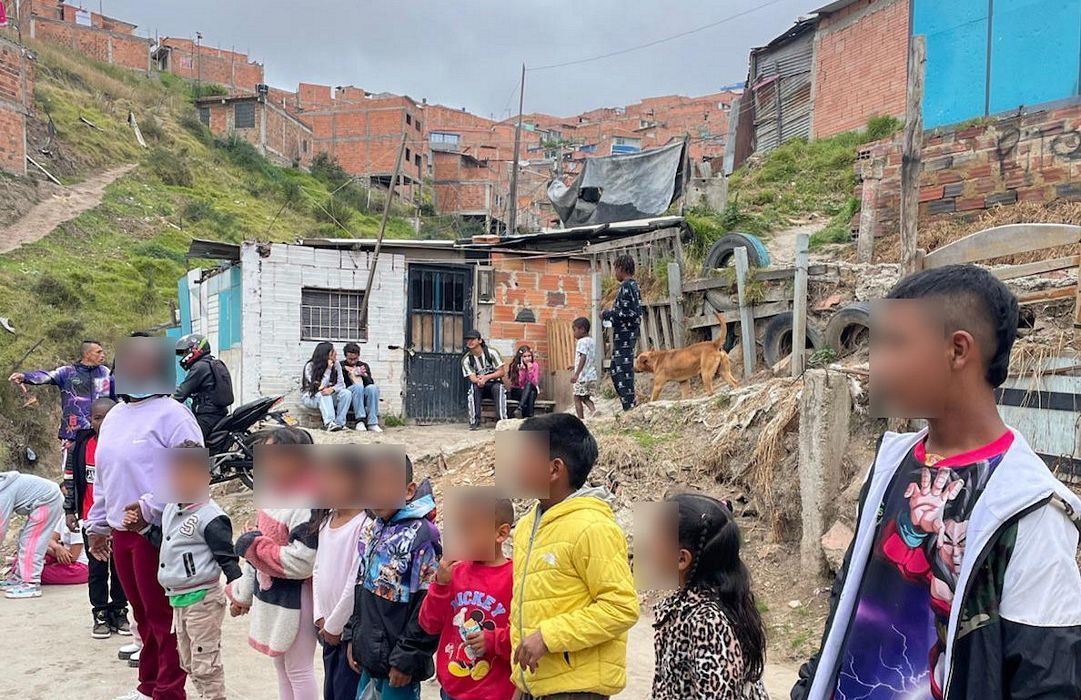
Reading time: 5 min.
A journey can change the way you see things, especially when it passes through wounded but still vibrant realities. Milena’s experience, a young woman from the missionary animation of central Italy, in the Salesian works of Bogotá, Cúcuta, and Medellín, is concrete proof of this. Hope is born precisely in the most vulnerable peripheries. In neighbourhoods marked by violence, forced migration, and extreme poverty, Don Bosco’s charisma continues to generate spaces of welcome, education, and rebirth. Through encounters, stories, and small daily gestures, Milena discovers a light capable of transforming pain and loneliness into a shared future. A story that invites us to believe in the good that grows silently.
In Colombia, amidst neighbourhoods marked by violence, drug dealing, forced migration, and social precariousness, Salesian works are points of light that change the lives of hundreds of children and families. Don Bosco’s charism here becomes welcome, education, and future.
The first stop on the journey was Bogotá, the capital. Here the Salesian presence is rooted mainly in the most fragile areas, including the popular neighbourhood of Ciudad Bolívar, where the Don Bosco Obrero centre is located. A living home, which works every day with children and, at weekends, also reaches the most peripheral realities; one of these is the “Rinconcito de Arabia”, a settlement made up of illegal dwellings, built of sheet metal and often immersed in mud, without roads, light, water or sanitation.
It was here that I experienced one of the most beautiful days of my trip. On Saturdays, in fact, Don Bosco Obrero “visits the territory“. A group of animators sets off to meet the children of the poorest neighbourhoods, bringing games, songs, and moments of recreation. A free and safe space is sought nearby and there a small open-air oratory is born. These simple visits thus become a time of friendship, distraction, fraternity, and spirituality; a way to make these children feel seen and loved, as if to say, “No matter how far away you are or the area you live in, we still come to play with you!”
Before the games, they invited me into a small house made of sheet metal. Some ladies (the mamas del Rinconcito) had prepared coffee and small chairs for a chat. They were keen to tell me how much the Salesians had changed their lives. “We have learned fraternity, mutual support, the strength to walk together.” One of them spoke proudly of the “olla comunitaria“, the pot cooked in the street every Saturday. Everyone brings what little they have at home and everything is cooked together, so that it becomes a sufficient meal for everyone. A simple but powerful gesture, a sign of a true community.
That day they also prepared the “olla” for me; we all ate together. After the games and prayer, I stayed to talk with some of the younger ones who live in the Rinconcito. Many of them struck me with their desire to study. One young woman told me that thanks to the work of Don Bosco Obrero she was finally able to dedicate herself to studying and now feels that she can pursue her dreams.
The Don Bosco Obrero house is much more than an educational centre; it is a refuge and a laboratory for the future. During the day, literacy courses and homework help alternate, then from 5:00 p.m. the courtyards come alive with basketball, football, circus activities, and dance workshops. The courses, designed for different age groups, allow children to cultivate talents and passions, even coming from situations of extreme poverty.
The structure also houses a boarding school. Some children live there during the week because their families cannot guarantee a safe environment or because they face situations of violence or addiction. The simple but tidy bedrooms, with bunk beds and small lockers, are a space of protection and serenity. Educators take turns at night, ensuring a constant and affectionate presence. Many children are only seven or eight years old; some return home at the weekend, others are no longer even sought by their parents. Here, however, their childhood is protected and saved, and for them school, sport, and art become tools to dream and build a different future.
Subsequently, I spent a few days in Cúcuta, a city on the border with Venezuela. Here the daily challenge is to welcome families and young people who arrive after long and painful journeys, often with nothing but the desire to start over. Most of the young people welcomed by the Salesians are young Venezuelans living on the streets, constantly exposed to violence, drugs, and prostitution.
In the Salesian oratory they find a concrete alternative: a place to play, learn, and grow in a protected environment. Many of these children and adolescents have never been schooled; some are illiterate, others dropped out of school early to escape their country. The work deals with managing literacy courses, but it does much more. It is not just about education; many children have never received a real behavioural education. Violence is often their first response because it is the only one they have known. In the oratory, they learn that there are rules, respect, and healthy relationships. It is a slow and constant but fundamental work for their lives.
Here I saw the evangelical message of welcome come to life; no one is ever turned away. Even those who carry stories of drugs, prostitution or extreme violence find a place, a smile, a possibility. Maximum acceptance, without judgment, is the basis on which the Salesians of Cúcuta are rebuilding hope for these young people on the border.
Another very significant stop on this journey was Medellín, where one of the best-known Salesian works is located: Ciudad Don Bosco. It is a large house that welcomes young people from very complex backgrounds: former guerrilla members, children removed from their families and entrusted to the State due to drug problems, violence or prostitution. The Salesians believe that no story is lost.
Before leaving, I had the opportunity to gather the words of Esmeralda, a young volunteer who lived for a few months in Ciudad Don Bosco. I remember our long sharing and her beautiful reflections. “When I arrived, I immediately felt that that place had a different glow. It didn’t come from the buildings or the people who work there, but from the young people themselves. In each of them I saw a small light that, put together with the others, illuminates the whole house.”
In her service, Esmeralda learned that behind every gesture there is a story of pain and hope. “I heard very harsh stories — she said — but I also saw smiles that are born despite everything. I understood that where pain abounds, a deeper gratitude can be born, one that teaches you to appreciate details that others do not notice.”
Then she used an image that I still carry with me. “I recognised each of those children in their most authentic form, like diamonds or, as we say in Colombia, ‘un diamante en bruto’ (a diamond in the rough). For me it was a gift to recognise this hidden purity in them.”
Esmeralda concluded her story with words that encapsulate the essence of the Salesian spirit, “In three months at Ciudad Don Bosco, I learned that a true bond does not depend on the time spent together, but on the willingness to open one’s heart. The children taught me the strength of love that does not judge, that welcomes, and that educates. And I understood that one can truly ‘overcome evil with love’.”
Finally, one day during a simple community lunch, there was a moment that encapsulated the meaning of the journey. A Salesian named two churches in an area I don’t remember, but he said “Paz y Esperanza” (Peace and Hope); he was talking about the fact that a Salesian work is located between these two points. It seemed like a geographical detail, but for me it became a perfect synthesis; the Salesians work with hope to build peace.
It was exciting to discover that, on the other side of the world, after more than two hundred years, Don Bosco’s charism is lived one hundred percent, exactly as he had imagined it, simple, joyful, and concrete.
Milena D’Acunzo