

 By Fr Bruno FERRERO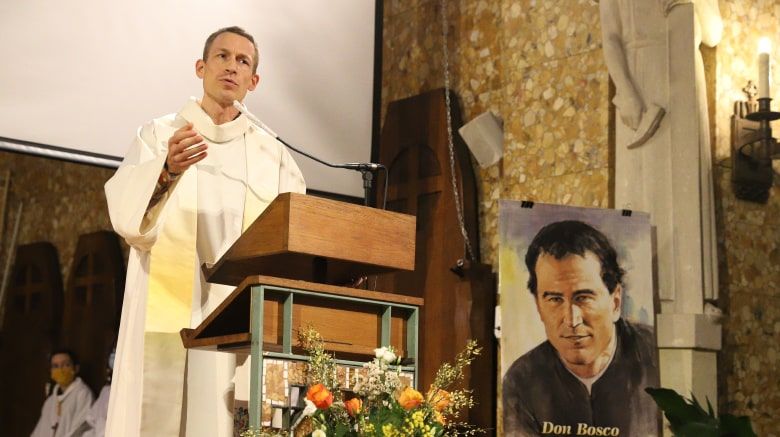
Reading time: 5 min.
Fr. Xavier Ernst, born in Belgium in 1981, is the new superior of the France-Southern Belgium Province. Growing up in a family with an adopted sister who has Down’s syndrome, he discovered his vocation during a retreat, struck by Don Bosco’s closeness to young people. After his formation in Spain, Belgium, and Rome, he was ordained a priest in 2013 in Liège. Using the symbolic language of cycling, so dear to his personal experience, Fr Xavier describes the Provincial’s service as a ministry of accompaniment entirely oriented towards the young. His province faces significant challenges: vocations, accompanying the elderly, and reconfiguring its presences. In a secularised France and Belgium, he notes a spiritual reawakening among young people who are seeking authenticity and depth. His goal remains faithful to Don Bosco: the preferential option for the poorest, focusing on experiences of personal encounter with Christ.
Could you introduce yourself to us?
I was born on 30 October 1981, in Verviers, Belgium, twenty minutes after my twin brother, Samuel. I studied to be a social worker and worked for two years as an educator, first at a therapeutic centre for adolescents in Brussels, then at a residential facility for at-risk youth. I did my novitiate in Spain and took my first vows on 16 August 2005, in Granada. After studying philosophy in Burgos, I returned to Belgium, to Brussels, for two years of practical training. For theology, I went abroad again, to Rome, in Italy. I was ordained a deacon at the Sacro Cuore, with my companions from Gerini. I carried out my diaconal service at the Salesian parish in Liège, where I was ordained a priest on 20 May 2013. After four years in the school and parish ministry of Liège, I was called to be the provincial delegate for Youth Ministry in France and Southern Belgium. For the last three years, I have also been serving as the parish priest of the national shrine of Saint John Bosco in Paris.
Dear Father Xavier, this time you are at the head of the peloton of the Salesians of France and Belgium. For a champion like you, it is a fitting recognition and an honour. The yellow jersey is yours. Will we win this special Tour?
No, the yellow jersey is not mine; it will always belong to the young people! Otherwise, this jersey would not be Salesian! In a Grand Tour, there is a lot of talk about who wins, but there are also all those who, silently, make the victory possible. I am thinking in particular of the “water carriers” who, during the high mountain passes, make endless trips back and forth between the team cars and the champions to bring them water and quench their thirst. I like to think of the Provincial’s service as that of a water carrier who goes to meet those who are thirsty. The effort will always be bearable if it allows the young people entrusted to us to claim the victory of Heaven.
Can you tell us something about your life (including cycling)?
I owe so much to life: my parents, their choice to adopt a sister who has Down’s syndrome (so she has something more than me: the chromosome of joy). Magali will never win any cycling race, but she has already won the most beautiful victory, that of Love. I was lucky enough to grow up in a loving family with three brothers and a sister. Today, I have a lot of fun with my nieces and nephews.
I also owe a lot to my grandparents, who had a faith deeply rooted in their hearts and bodies. My grandfather, who was also my godfather, always rode his bike until he was 80. I remember when I was little, he would support me with his hand on my back to help me get up the hill in his village. When the Rector Major often asks, “who is your Cafasso?” to remind us of the importance of a spiritual director, I think of this image of my grandfather’s hand supporting, accompanying, giving strength… without taking the handlebars for me.
This family peloton perfectly embodies the family spirit so dear to Don Bosco.
How did you end up on the Salesian team?
I encountered Don Bosco and the Salesian spirit during a retreat at a Salesian house of spirituality in Farnières, Belgium. I was struck by a cartoon strip with the image of young John saying to his mentor, Fr. Calosso, “Later I will be a priest, but not like all those priests who are distant from young people, whom we dare not approach, who command respect out of fear and awe.” In Don Bosco, I found my deepest aspirations that were growing within me, the vocation of a priest-educator, living in community, among young people, with the motto, “to educate by evangelising and to evangelise by educating.”
For your French-Belgian province, are there many climbs and difficult cobbled sections?
Oh yes! The biggest challenge is both vocations ministry and accompanying the older confrères. We also have to reconfigure our Salesian community presences, making the difficult decision to close some houses and, perhaps, to open others.
France loved Don Bosco very much, perhaps also for his honest face of a Savoyard mountaineer, and Don Bosco returned this love with all his heart. How are the Salesians seen today?
There is an intrinsic link between Don Bosco and France: firstly, because he adopted the name “Salesian” from a French Savoyard saint. Secondly, he travelled extensively throughout France, preaching and raising huge funds for his charitable works, including the construction of the Basilica of the Sacred Heart. Don Bosco is very well known in the Church in France and Belgium. Many places and youth centres bear his name, even if they are not Salesian. The Salesians, supported by many committed lay people, are appreciated for their presence among young people, particularly in the school system and the social action network.
What are the flagship works of your Province?
Between Nice in France, where Don Bosco sent the first four Salesians in 1875, (two days before sending missionaries to Patagonia), and Liège in Belgium, which was the last house Don Bosco wanted during his lifetime, there are numerous flagship Salesian works in France and Belgium. They are all those that remain faithful to our Founder by welcoming the poorest young people! General Chapter 29 has strongly reaffirmed this; the preferential option for the poorest must remain our priority criterion. I would like to highlight our latest presence opened in Guadeloupe, in the poorest department of France.
What do you think of the young people of Belgium and France?
In a highly secularised society, we are witnessing a kind of “spiritual awakening”. In a world where everything is considered equal, young people yearn for guidance, depth, and authenticity. They are also showing great generosity in their commitment to various causes. In a context of fear of the other, young people have a taste for encounter and for overcoming prejudice.
What are the plans for a decisive “breakaway”? What should youth ministry focus on?
To win a cycling race there are well-studied strategies, but they don’t always work. There are also winning moves dictated by a good intuition, like a gust of the Holy Spirit that no one expected. In my opinion, our youth ministry must focus on experiences of personal encounter with Christ, synodal experiences involving young people and adults of different vocations, and experiences that allow for socio-cultural diversity among young people.
What is the finish line?
The finish line is Heaven. As Don Bosco said to his young men who had fallen in battle, “I await you all in Heaven.” But this Heaven, this eternal life, this Kingdom of God is already lived here and now.
 BSOL Editor