

 By BSOL Editor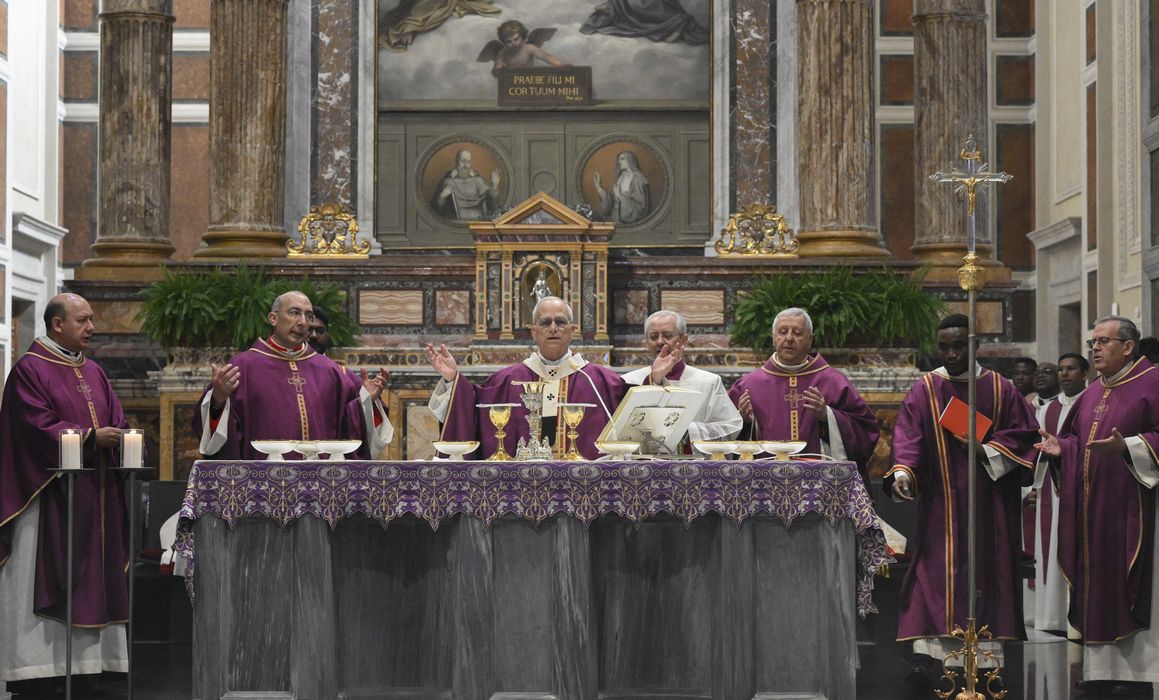
Reading time: 7 min.
For the first Sunday of Lent in 2026, Pope Leo XIV chose not the solemnity of St Peter’s for his celebration, but the Basilica of the Sacred Heart of Jesus at Castro Pretorio. The basilica, entrusted to the Salesians for almost one hundred and fifty years, is located just a stone’s throw from Termini Station. It is a choice rich in meaning, part of a centuries-old history intertwined with the names of Pius IX and Leo XIII. A pastoral gesture that tells, once again, of a Church that walks towards those on the margins.
At 8:15 on a Sunday morning, still wrapped in the winter chill, Pope Leo XIV stepped out of his car in the courtyard at Via Marsala 42, welcomed by the emotional ovation of over a thousand people. It was the first Sunday of Lent, and the Pontiff had chosen to spend it, not among the solemn marbles of St Peter’s Basilica, but in what his predecessor Francis had with happy intuition called, “the centre of the periphery”. It is the parish Basilica of the Sacred Heart of Jesus in Castro Pretorio, entrusted to the Salesians of Don Bosco for almost one hundred and fifty years.
This is Leo XIV’s second pastoral visit to a Roman parish since the beginning of his pontificate. The first took him to Ostia, to the parish of Santa Maria Regina Pacis, and it carries a precise message, the Church walks towards its peripheries, even when they are, paradoxically, in the very heart of the capital.
A history of popes: from the first stone of Pius IX to the arrival of Leo XIV
To understand the significance of that morning, one must go back almost a century and a half, to the final years of the pontificate of Pius IX. It was 30 September 1870, when the Pontiff laid the first stone of a new church along the Via di Porta San Lorenzo – today’s Via Marsala – in an area of the city undergoing rapid urban development, dedicating it to St Joseph. The choice had a precise spiritual coherence. A few months later, on 8 December of that same year, Pius IX recognised St. Joseph as “Patron of the Universal Church” through the decree Quemadmodum Deus, and he wished to honour that proclamation in advance with a tangible sign in stone.
But something soon changed in the Pontiff’s intentions. Insistent requests were coming from the Catholic world to dedicate a great international shrine in Rome to the Sacred Heart of Jesus, as a collective act of reparation and entrustment for the entire Church. Pius IX heeded those voices and changed the dedication of the church still under construction. History, however, did not give him time to see his project realised. With the annexation of Rome to the Kingdom of Italy in October 1870, the work slowed down and, a few months later, stopped. The breach of Porta Pia had changed the world, and the new church remained unfinished for years.
Leo XIII and Don Bosco: an alliance that builds a basilica
It was the successor of Pius IX, Leo XIII, who took up that interrupted dream. On 16 August 1879, work resumed on the Esquiline Hill, and this time the Pope entrusted the construction to an extraordinary man, John Bosco, the priest from Turin who had made poor and marginalised young people his life’s purpose. It was a prophetic choice. The new church would be built on the exact spot where trains brought migrants from the Italian countryside to Rome, pilgrims from every corner of the world, the homeless and the nameless, exactly the people for whom Don Bosco had always worked.
There is a singular historical resonance in the fact that the name of the currently reigning Pontiff – Leo XIV – directly evokes the great Leo XIII, the one who not only restarted the construction of the basilica but was also its main spiritual and political inspiration. In an era of great social upheaval, the cult of the Sacred Heart represented for Leo XIII the response of faith to the wounds of a world that was secularising at a rapid pace.
Don Bosco personally oversaw the work, despite his declining strength. He returned to Rome for the last time in 1887, when the church was about to be completed. He stayed in the small rooms on the upper floor – the “camerette” that pilgrims still visit with devotion today – and from there he blessed his life’s work. The church was inaugurated on 14 May 1887, by the Vicar of Rome, Cardinal Lucido Maria Parocchi, with Don Bosco present. Leo XIII could not take part personally. From the capture of Rome in 1870 until the Concordat of 1929, the Pontiffs considered themselves “prisoners in the Vatican”. Don Bosco died on 31 January of the year following the inauguration. He never saw, with his own eyes, the gilded statue of the Sacred Heart raised on the bell tower, 62.5 metres high: the highest point in Rome, located on the Esquiline Hill, but his sons see it.
From Leo XIII to Paul VI: the basilica grows in the history of the Church
From that consecration onwards, the basilica of Castro Pretorio has entered the heart of every pontificate. Leo XIII himself, who had been its visionary promoter, wanted it as a symbol of the relationship between the Holy See and popular devotion to the Heart of Christ. The choice of name for the new pope – Leo XIV – has inevitably reawakened this historical bond in the collective memory of the Roman faithful.
On 11 February 1921, Pope Benedict XV elevated the church to a Minor Basilica (AAS 1921, p.192), conferring upon it a liturgical and spiritual rank of particular importance. The date chosen was not random; 11 February was already charged with meaning for the history of the Church, and Benedict XV’s act definitively consecrated Castro Pretorio as one of the key places of Catholic devotion in Rome.
Pius X, the “pope of the poor”, blessed the Salesian community that officiated there several times, seeing in that strategic position near the railway station an irreplaceable apostolic outpost for the masses of workers and pilgrims who passed through Rome every day.
Pius XII, in the midst of a twentieth century troubled by war, encouraged the parish to intensify its charitable works for the displaced and refugees who crowded the area around Termini.
Four decades later, on 5 February 1965, it was Paul VI who took another institutional step. He established the cardinalatial diaconate for this basilica (AAS 1965, p.498), integrating the community of the Sacred Heart even more deeply into the fabric of the College of Cardinals and the governance of the universal Church. From that moment on, a titular cardinal would carry in his name the link to this extraordinary place just a stone’s throw from Termini station.
John Paul II: the first pastoral visit
On 29 November 1987, for the first time in history, a Pope physically crossed the threshold of the basilica of Castro Pretorio for a pastoral visit. It was Saint John Paul II, the great Polish pilgrim who had already changed the way the pontificate was conceived by taking the Bishop of Rome to the peripheries of the world and of Rome itself. His visit to the Sacred Heart was part of the systematic cycle of visits to the parishes of the diocese that John Paul II had initiated from the beginning of his pontificate. But it had a special meaning, to honour a place that had been willed by one of his holy predecessors – Don Bosco, canonised in 1934 – and that bore in its name the very heart of the Christian mystery. The Salesian community welcomed him with the characteristic joy of those who recognise, in the arriving shepherd, the continuity of a history much longer than any pontificate.
Francis: “the centre of the periphery”
On 19 January 2014, Pope Francis added a new chapter to this story. His pastoral visit to the basilica of Castro Pretorio was not just a stop on the programme of Sunday parish visits. It was a declaration of intent. Francis looked at the position of that church – squeezed between the tracks of Termini and the streets travelled every day by immigrants, the homeless, people in transit, workers looking for an early morning Mass – and defined it with a phrase destined to remain, “the centre of the periphery”. An oxymoron that was, in reality, the most precise description possible; geographically in the heart of Rome, spiritually projected towards its human frontiers.
Francis celebrated Mass there with his characteristic simplicity, met the poor assisted by the parish, and the faithful of the foreign communities that filled the neighbourhood. He left that community with the renewed certainty of being not a rearguard garrison, but an outpost of the Gospel.
Pope Leo XIV: the second visit of the pontificate
At 9:00 on 22 February 2026, Leo XIV celebrated the solemn Mass in the basilica. Concelebrating with him were Cardinal Baldo Reina, the Pope’s Vicar for the Diocese of Rome; Cardinal Giuseppe Versaldi, titular of the cardinalatial diaconate established by Paul VI in 1965 and former Prefect Emeritus of the Congregation for Catholic Education, with Fr. Fabio Attard, Rector Major of the Salesians, and many other Salesians. Also present, were the three female religious communities that animate parish life: the Daughters of Mary Help of Christians, the Franciscan Clarist Missionaries of the Most Blessed Sacrament, and the Missionaries of the Risen Christ.
Before the celebration, Leo XIV had walked slowly through the courtyard of Via Marsala, stopping to greet the representatives of the parish groups who were waiting for him. There were the volunteers from the Listening Centre, those from the Talent Bank, the young people from the oratory, the catechism children with their coloured sashes. There were the poor assisted by the parish – immigrants from India, Bangladesh, Peru, Cuba, the communities that populate this cosmopolitan neighbourhood with just 2,500 permanent residents, mostly elderly. And there were five catechumens, adults of various nationalities who will receive the sacraments for the first time at the next Easter Vigil, a detail that Leo XIV wanted to warmly emphasise in his initial greeting, as a concrete sign that faith continues to attract and transform lives.
In his homily, the Pontiff reflected on the gift of Baptism, starting from the First Reading (Genesis) and the Gospel (the temptations of Jesus). The Genesis account shows how sin arises from the temptation to nullify the difference between creatures and the Creator, while Jesus, by resisting the devil, reveals the new and free man who is realised in the “yes” to God.
Baptism is like a dynamic and relational grace. It is not exhausted in the rite, but accompanies one’s entire life, urging the Christian to conform to Christ and to live out love for God and neighbour, breaking down every division (Gal 3:28).
In the final part, addressing the Salesian parish near Rome’s Termini Station, the Pope stressed how this area – a crossroads of students, workers, immigrants, refugees, and homeless people – calls the community to be concretely “leaven of the Gospel”, a sign of closeness, welcome, and hope amidst the many contradictions of the neighbourhood.
A pilgrimage that continues
The visit to Castro Pretorio is the second stage of a journey that Leo XIV has undertaken with the Roman communities during this Lenten season. After Ostia, after the Sacred Heart, the journey will continue: on 1 March to the church of the Ascension of Our Lord Jesus Christ in Quarticciolo, on 8 March to Santa Maria della Presentazione in Primavalle, on 15 March to the Sacred Heart of Jesus in Ponte Mammolo. Each time a different reality, each time the same gesture; the Bishop of Rome crossing the thresholds of his smallest churches, furthest from the spotlight, to remind us that the centre of the Church is not a square with a fountain, but the heart of those in need.
As the gilded statue of the Sacred Heart shone in the February light on the highest bell tower in Rome, Leo XIV got back into his car to the applause of the square. He left behind a moved and strengthened community, and took with him the certainty that in this crossroads of humanity, a stone’s throw from the tracks of Termini, the Church had always found one of its most authentic places.
We remind you that it is possible to visit the Basilica of the Sacred Heart of Jesus in Rome virtually, including in 3D, at this link.