


Examination of conscience according to the theological and cardinal virtues
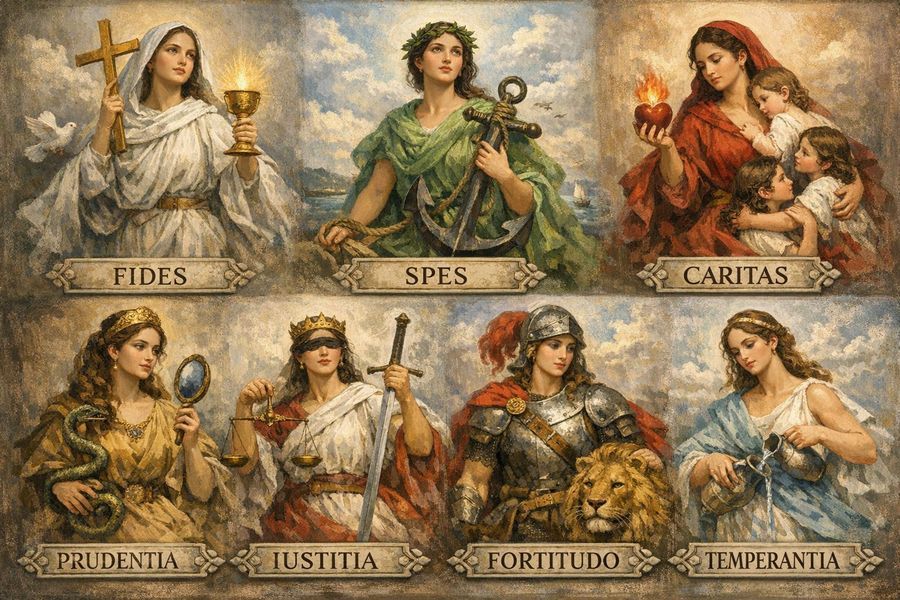
Take a moment of silence and recollection. Read each question slowly, letting it touch your conscience. This is not a list of faults to be recited, but a mirror to encounter the truth of yourself before God. Conclude with a sincere act of contrition and the resolution to improve.
Opening Prayer
Come, Holy Spirit, enlighten my mind and my heart. Help me to see clearly where I have strayed from God and from what is good. Grant me the grace of truth and sincere repentance. Amen.
The theological and cardinal virtues
The theological virtues – Faith, Hope, and Charity – unite us directly to God. They are gifts that we must cherish and cultivate.
The cardinal virtues – Prudence, Justice, Fortitude, and Temperance – order our moral life and govern the other human virtues.
I. FAITH
It is the theological virtue by which we believe in God and in all that He has revealed – because He is Truth itself – and that the Church proposes for our belief. It is the adherence of the intellect and will to the truth revealed by God and proposed by the Church as credible.
“Now faith is the assurance of things hoped for, the conviction of things not seen.” (Heb 11:1)
“Your faith has made you well” (Mk 10:52)
“The one who is righteous will live by faith.” (Rom 1:17)
“And without faith it is impossible to please God, for whoever would approach him must believe that he exists and that he rewards those who seek him.” (Heb 11:6)
Grave sins against faith
1. Have I obstinately rejected one or more truths of the Catholic faith after my baptism? (Heresy – e.g., denying the Resurrection, the real presence in the Eucharist, etc.)
2. Have I completely repudiated the Christian faith I received at baptism? (Apostasy – total abandonment of the faith.)
3. Have I refused to recognise the Pope as the head of the Church or separated myself from communion with it? (Schism – breaking with the Church.)
4. Have I reduced my faith only to what I can understand or see with my own eyes, rejecting what is beyond my reason? (Incredulity – refusal to believe in Revelation.)
Weaknesses and abandonments of faith
5. Have I wilfully cultivated doubts about what God has revealed or what the Church teaches, without trying to resolve them? (E.g., have I deliberately doubted God, Christ, or a dogma of the faith.)
6. Have I questioned the faith to respect the opinions of others or for fear of their judgement? (Human respect – shame in professing the faith.)
7. Have I kept silent or hidden my faith in situations where I could have witnessed to it with courage?
8. Have I engaged in practices, movements, or beliefs incompatible with the Christian faith? Have I practised superstitions, magic, esotericism, or attributed supernatural power to non-Christian objects or rites?
9. Have I thought that all religions are equal and that the Catholic faith has nothing special or true compared to others? (Religious indifferentism.)
10. Through my behaviour or words, have I caused someone to stray from or lose their faith? (Scandal against faith.)
Negligence and lukewarmness in faith
11. Have I neglected to educate myself in the faith? Have I remained ignorant of things I could and should have known? (Negligence in formation – culpable ignorance.)
12. When I have had doubts about my faith, have I tried to resolve them through study, prayer, or the advice of an experienced and trusted person?
13. Have I wilfully exposed my faith to unnecessary risks? Am I careful about books, shows, videos, or company that could weaken it?
14. Have I tried to solve my problems by relying only on my own intellect or on other people, without bringing them into the light of faith and prayer?
15. Have I watched over the faith life of those who depend on me (children, family members, people entrusted to my care)? Have I done my best to help them grow in faith?
Life of prayer and practice of faith
16. Have I neglected daily prayer, even if brief? Have I prayed every day with a living faith?
17. Have I participated in Sunday Mass in a distracted, rushed, or merely habitual way, without true inner presence?
18. Have I forgotten to make an act of faith every day? Do I realise that faith is a gift from God and must be cultivated daily through prayer, study, and meditation?
19. In difficulties, have I sought light in the Word of God, or have I preferred to rely only on my own strength?
20. Have I forgotten to pray for those who do not believe, for those who are far from the faith, or for those who have lost it?
II. HOPE
It is the theological virtue by which we trust that we will obtain eternal life from God and the graces necessary to attain it.
“For in hope we were saved. Now hope that is seen is not hope. For who hopes for what is seen? But if we hope for what we do not see, we wait for it with patience.” (Rom 8:24-25)
“And hope does not disappoint us, because God’s love has been poured into our hearts through the Holy Spirit that has been given to us.” (Rom 5:5)
“We have this hope, a sure and steadfast anchor of the soul” (Heb 6:19)
Grave sins against hope
1. Have I ever despaired of God’s mercy, thinking that my sins are unforgivable or that God cannot or will not save me? (Despair – the most serious sin against hope.)
2. Have I thought I would be saved anyway, without needing to convert or ask for forgiveness, because “God forgives everyone”? (Presumption – false assurance of salvation.)
Discouragement and lack of trust
3. Have I lost hope in God’s mercy because of my sins or weaknesses?
4. Have I grumbled against God in the face of trials and sufferings, as if He had abandoned me?
5. Have I given in to anxiety or discouragement in difficulties, forgetting that God is with me and provides?
6. In a difficult situation, have I thought that God could not handle it or that the victory of evil was possible? Do I realise that, by entrusting myself to the almighty and redeeming God, victory over evil is guaranteed?
Attachment to the goods of this life
7. Have I placed my security in money, work, health, or social status more than in God?
8. Have I lived as if this life were everything, neglecting the fact that I am made for eternal life?
9. Do I have an excessive attachment to this life, to the point that if I were to lose my possessions, health, or social position, I would also lose hope?
Negligence in cultivating hope
10. Do I realise that hope is not mere human optimism, but a gift from God? Do I make an act of hope every day?
11. Have I confused Christian hope with passively waiting for God to solve everything, without using the means He Himself has made available to me?
12. Have I neglected to read the Holy Scriptures, where I can see with my own eyes that God is always faithful to His promises and never abandons those who trust in Him?
13. Have I neglected to entrust difficult situations to God in prayer, trying to manage them only with my own strength?
Towards my neighbour
14. Have I failed to bring hope to those who were discouraged, in pain, or in despair? Have I been a presence of comfort and trust for others?
15. With my words or attitude, have I perhaps fostered resignation, pessimism, or mistrust in those around me?
III. CHARITY
It is the theological virtue by which we love God above all things and our neighbour as ourselves for the love of God.
“This is my commandment, that you love one another as I have loved you.” (Jn 15:12)
“We love because he first loved us.” (1 Jn 4:19)
“Love is patient; love is kind; love is not envious or boastful or arrogant or rude. It does not insist on its own way; it is not irritable or resentful; it does not rejoice in wrongdoing, but rejoices in the truth. It bears all things, believes all things, hopes all things, endures all things. Love never ends. But as for prophecies, they will come to an end; as for tongues, they will cease; as for knowledge, it will come to an end.” (1 Cor 13:4-8)
“And now faith, hope, and love abide, these three; and the greatest of these is love.” (1 Cor 13:13).
Grave sins against God
1. Have I ever felt hatred towards God, cursing Him or deliberately rejecting Him?
2. Have I lived as if God did not exist, completely ignoring Him in my daily life? (Religious indifference.)
3. Have I forgotten to thank God for the gifts I have received, as if everything were my own doing or just good luck? (Ingratitude towards God.)
Grave sins against my neighbour
4. Have I hated someone, wishing them ill or taking pleasure in their misfortunes?
5. Have I felt envy for the successes, talents, or possessions of others, being saddened by their good fortune?
6. Have I sown discord among people, fuelling divisions, quarrels, or misunderstandings?
7. Have I spoken ill of someone behind their back, ruining their reputation? Have I slandered someone, attributing false things to them? (Detraction and calumny.)
8. Through my behaviour or words, have I led someone to do evil or to turn away from God? (Scandal.)
9. Have I committed a serious offence or injustice against someone, without trying to make amends?
Lukewarmness and negligence in the love of God
10. Have I lived my faith in a lukewarm manner, without enthusiasm, without a true desire for God, doing everything out of habit? (Spiritual lukewarmness.)
11. Have I experienced moments of spiritual sloth, where prayer, the sacraments, and the things of God felt burdensome or boring? (Spiritual sloth / Acedia.)
12. Do I realise that charity is not a human feeling, but a gift from God? Do I make an act of charity every day?
13. Have I neglected to desire that God be known and loved, and to do something concrete for this?
14. Have I failed to react when I heard blasphemy or an offence against God, at least with an inner act of reparation and praise?
Negligence and coldness towards my neighbour
15. Have I harboured grudges or resentment towards someone, without seeking reconciliation?
16. Have I excluded, ignored, or treated someone badly out of selfishness, laziness, or prejudice?
17. Have I failed to pray for my enemies and for those who have wronged me?
18. Do I realise that the true test of charity is to love even my enemy, to respond to evil with good? Do I really try to do this?
Works of mercy and concrete witness
19. Have I failed to be generous with my time, my possessions, and my energy towards those in need?
20. Have I neglected the corporal and spiritual works of mercy – visiting the sick, comforting the afflicted, instructing the ignorant, correcting the sinner with charity?
21. Have I forgotten that to love my neighbour means to truly wish them well, not just to feel affection or sympathy? Have I treated everyone with respect and kindness, even those I find difficult or dislike?
22. In my daily life, in conversations, at work, in my family – have I been a balm for others or a source of tension, complaints, and negativity?
Growth in charity
23. Do I realise that charity is the only virtue that remains for all eternity? Do I strive to cultivate it every day, even in small things?
24. Do I realise that when I truly love a person, I seek them out, I want to be with them, I rejoice in what makes them happy and suffer from what makes them suffer, I do what they ask even when I don’t feel like it? Does my relationship with God show these same signs of true love?
25. Do I rejoice in everything that pleases God and grieve over everything that offends Him?
IV. PRUDENCE
It is the cardinal virtue that guides one to recognise the good to be done in every circumstance and to choose the right means to achieve it.
“See, I am sending you out like sheep into the midst of wolves; so be wise as serpents and innocent as doves.” (Mt 10:16)
“Be careful then how you live, not as unwise people but as wise” (Eph 5:15)
“Everyone then who hears these words of mine and acts on them will be like a wise man who built his house on rock.” (Mt 7:24)
False prudence and malice
1. Have I acted with duplicity, cunning, or deceit to get what I wanted, manipulating people or situations? (Cunning – a distorted use of intelligence.)
2. Have I confused prudence with worldly shrewdness, concerning myself only with what benefits me, without taking God and eternal life into account? (Prudence of the flesh.)
Precipitation and impulsiveness
3. Have I made important decisions without prayer, reflection, or counsel, trusting only my instinct of the moment?
4. Have I acted on impulse, without thinking of the consequences, causing harm to myself or others?
5. Have I spoken without thinking, especially in delicate situations, saying things I later regretted?
6. Have I judged people or situations before knowing the full truth, allowing myself to be guided by impressions or feelings?
Indecision, negligence, and procrastination
7. Have I continually put off important decisions out of shyness, laziness, or fear of making a mistake, without ever reaching a conclusion?
8. Have I wasted precious time endlessly weighing options without making a decision, with the result of doing nothing? (E.g., “I’ll think about it,” “I’ll see,” “maybe tomorrow…”)
9. Have I let haste or laziness cause me to choose badly, skipping the necessary reflection?
10. Have I postponed important life decisions – vocation, family, work, conversion – without a serious reason?
Lack of discernment and counsel
11. Have I confused prudence with mediocrity or cowardice, avoiding doing good for fear of the consequences?
12. Have I failed to ask for advice – from a priest, a wise person, someone with experience – when I did not know how to act rightly?
13. Is my prudence Christian, that is, oriented towards God and eternal life? Or is it merely worldly, attentive to what is convenient, what is pleasing, what avoids problems?
14. Have I failed to clearly distinguish what is truly good from what is merely pleasant, convenient, or comfortable?
Failure to be vigilant over oneself
15. Have I neglected to avoid situations that I know are occasions of sin for me, deluding myself that I can handle them anyway?
16. Have I failed to learn from my past mistakes, repeating the same errors without learning any lesson from them?
17. Have I failed to draw spiritual fruit from the events of my life – joys, sorrows, failures, successes – by reading them in the light of God?
18. Have I failed to weigh the circumstances and means properly before acting, allowing myself to be guided by a passion or a strong emotion instead of by right judgement?
19. After understanding what was right to do, have I failed to put it into practice, stopping at good intentions without taking action?
V. JUSTICE
It is the cardinal virtue that leads one to give to God and to one’s neighbour what is due to them.
“Give therefore to the emperor the things that are the emperor’s, and to God the things that are God’s” (Mt 22:21)
“But strive first for the kingdom of God[l] and his[m] righteousness, and all these things will be given to you as well.” (Mt 6:33)
“For I tell you, unless your righteousness exceeds that of the scribes and Pharisees, you will never enter the kingdom of heaven.” (Mt 5:20)
Grave sins against life and liberty
1. Have I taken someone’s life, encouraged an abortion, or been complicit in a serious act of violence against a person?
2. Have I hit, injured, or physically mistreated someone?
3. Have I unlawfully deprived someone of their liberty – by holding them against their will, isolating them, or controlling their every move?
Grave sins against the goods of others
4. Have I stolen, robbed, or defrauded someone, taking what was theirs?
5. Have I wilfully damaged the property of others or public property without making amends for the damage?
6. Have I unjustly withheld a salary or payment due to someone who has worked for me?
7. Have I practised usury, taking advantage of another’s need to make an unjust profit?
8. Have I returned what I had taken or damaged? Have I repaired the material or moral harm I caused to others?
Sins against reputation and truth
9. Have I slandered someone, attributing false faults or defects to them, ruining their name?
10. Have I defamed or spoken ill of someone behind their back, revealing true faults without reason? (Detraction or backbiting.)
11. Have I made a habit of discovering and telling others’ hidden faults?
12. Have I judged someone rashly, without knowing the truth, condemning them in my heart or before others?
13. Have I lied in a way that caused harm to someone? Have I given false testimony or sworn a false oath?
14. Have I deceived someone in a contract, an agreement, or a sale?
15. Have I been a flatterer, saying false or exaggerated things just to please someone or to get something?
16. Have I been a dissembler or a hypocrite, pretending to be what I am not?
Sins against social justice
17. Have I exploited the labour of others, paying little, treating them badly, or ignoring the rights of those who worked for me?
18. Have I engaged in corruption – giving or receiving illicit favours to obtain undue advantages?
19. Have I unjustly discriminated against someone – because of their origin, social status, appearance, or something else – denying them their rights or dignified treatment?
20. Have I shown favouritism in my family, among friends, or at work, favouring some and penalising others unjustly?
Duties towards the State and the community
21. Have I evaded taxes or tried to shirk legitimate civil obligations?
22. Have I neglected to respect the just laws of society, thinking they did not apply to me?
23. When the common good required a sacrifice on my part, did I not perhaps try to back out?
Duties towards God: piety and obedience
24. Do I realise that God, being infinitely perfect, is entitled to all my glory, my honour, and my worship? Have I not perhaps neglected to give them to Him?
25. Have I neglected God’s presence in my day, living as if He were not there, did not see me, and was not with me?
26. Have I perhaps failed to make God’s will the supreme rule of my life, putting my own desires, my comfort, or the judgement of others first?
27. Have I neglected the precepts of the Church – Sunday Mass, confession, fasting – as if they were optional or outdated?
Obedience to legitimate superiors
28. Have I failed to respect and listen to my legitimate superiors – in the family, at work, in the Church – focusing too much on their faults instead of the authority they represent?
29. Is my obedience, when it exists, full and serene? Or is it slow, discontented, partial, always accompanied by arguments or inner resistance?
30. Have I punished someone with excessive or undue harshness, or on the contrary with too much weakness and indulgence, lacking fairness?
31. Do I allow myself to be guided by my confessor or spiritual director? Do I consider their advice as an instrument of God’s will for me, or do I take it and leave it depending on how convenient it is for me?
Generosity and use of goods
32. Have I failed to be generous with my possessions, my time, or my talents towards those in need?
33. Have I spent money imprudently or irresponsibly, putting at risk what is necessary for me or for those who depend on me?
34. Have I failed in gratitude towards those who have done me good – God, parents, benefactors, friends?
VI. FORTITUDE
It is the cardinal virtue that enables one to face difficulties and dangers with courage for the sake of good, and to persevere in doing good, even in the face of adversity and suffering.
“I have said this to you, so that in me you may have peace. In the world you face persecution. But take courage; I have conquered the world!’” (Jn 16:33)
“I can do all things through him who strengthens me.” (Phil 4:13)
“For God did not give us a spirit of cowardice, but rather a spirit of power and of love and of self-discipline.” (2 Tim 1:7)
Cowardice and moral timidity
1. Have I kept silent about the truth or refrained from doing good for fear of the consequences – of others’ judgement, of ridicule, of conflict? (Cowardice – refusal to do one’s duty out of fear.)
2. Have I let someone suffer an injustice without saying anything, preferring to remain silent to avoid trouble for myself?
3. Have I refrained from fraternally correcting someone who was doing wrong, so as not to disturb them or for fear of how they would react?
4. Have I abandoned important commitments – of faith, family, service – simply because they had become tiring or inconvenient? (Softness – abandoning good to avoid effort.)
5. Have I perhaps given in to temptations without resisting, without even asking God for help?
Human respect and fear of judgement
6. Have I lived more concerned with what the world thinks of me than with what God thinks? Do I ask myself: “What would Jesus do in my place?”
7. Have I let the irony, mockery, or negative judgement of others stop me from doing good or from professing my faith?
8. Have I perhaps given in to a misguided group solidarity – siding with others even when they were wrong, so as not to be isolated or to avoid looking different?
9. Have I perhaps let the moods of the crowd – collective enthusiasm, scorn, group hatred – carry me away without thinking?
Rashness and presumption
10. Have I perhaps faced dangerous or difficult situations impulsively, without sufficient reason and without considering the consequences? (Rashness – courage without prudence.)
11. Have I perhaps trusted too much in my own strength, claiming to succeed in undertakings beyond my abilities, without relying on God? (Presumption – false fortitude.)
Impatience and discouragement
12. Have I borne sufferings, illnesses, injustices, and the trials of life badly, complaining and losing my serenity instead of uniting them to Christ? (Impatience.)
13. Have I let failure or lack of recognition discourage me, abandoning the good I had undertaken?
14. Have I let the mood of others or external circumstances determine my state of mind, instead of being rooted in the peace of God?
Inconstancy and spiritual weakness
15. Have I abandoned prayer, the sacraments, or spiritual practices in moments of dryness, boredom, or difficulty, instead of persevering?
16. Have I shown inconstancy in good works – starting with enthusiasm and giving up as soon as the effort began?
17. Have I faced suffering, illness, or failure with distrust and resignation, instead of leaning on God with faith?
Overall examination of fortitude
18. Do I truly have that disposition of mind that drives me to do difficult things – when duty requires it – at any cost, without waiting for favourable conditions?
19. In the face of adversity, trials, and injustices, have I endured with fortitude and serenity, accepting what God allows? Or have I reacted with rebellion, bitterness, or resignation?
VII. TEMPERANCE
It is the cardinal virtue that moderates appetites and sensual pleasures according to right reason and ensures the will’s dominion over instincts.
“For the grace of God has appeared, bringing salvation to all,[a] 12 training us to renounce impiety and worldly passions, and in the present age to live lives that are self-controlled, upright, and godly.” (Titus 2:11-12)
“Athletes exercise self-control in all things; they do it to receive a perishable garland, but we an imperishable one.” (1 Cor 9:25)
“For the time is coming when people will not put up with sound doctrine, but having itching ears, they will accumulate for themselves teachers to suit their own desires, and will turn away from listening to the truth and wander away to myths.” (2 Tim 4:3-4)
Lust and sexual disorder
1. Have I committed sexual acts outside of marriage – premarital relations, adultery, prostitution? (Fornication, adultery.)
2. Have I given in to masturbation or sought sexual pleasure outside of its human and moral meaning?
3. Have I looked at pornographic material or wilfully sought out images, shows, or situations that excite disordered desire?
4. Have I perhaps wilfully cultivated impure thoughts or fantasies, dwelling on them instead of dismissing them?
5. Have I perhaps sought occasions of sin – company, places, situations – that I knew were dangerous for my chastity?
Gluttony and intemperance in eating and drinking
6. Have I eaten or drunk excessively, greedily, or in a disordered way, losing control of myself?
7. Have I wilfully lost the use of my reason through the abuse of alcohol, drugs, or other substances? (Drunkenness – a grave sin.)
8. Have I perhaps sought refined, expensive, or particular foods just for the pleasure of the palate, with excessive attachment?
Anger and lack of meekness
9. Have I given in to anger, nervousness, or irritability without trying to control myself, hurting those around me with my words or attitude?
10. Have I used harsh, offensive, or threatening words towards others, particularly towards those who depend on me?
11. Have I easily forgotten offences received, holding a grudge instead of forgiving? (Note: meekness is the opposite of anger, and is part of temperance.)
12. Have I lacked patience with the faults of others, demanding from them a perfection I do not demand from myself?
13. When I offer a rebuke or fraternal correction, have I not perhaps acted to vent my irritation rather than out of love for the other person? Have I responded with meekness to someone who spoke to me with anger?
14. Have I fuelled useless arguments, holding to my opinion more out of pride than for love of the truth?
Pride and lack of humility
15. Have I thought too much of myself – of my qualities, my merits, my intelligence – puffing myself up inwardly? (Pride – the opposite of humility, which is part of temperance.)
16. Have I perhaps remained hurt for a long time by offences received, brooding over them instead of letting them go?
17. Have I had an attitude of superiority towards the poor, the weaker, children, or those in a position lower than mine?
Disorder in pleasures and leisure
18. Have I dedicated a disproportionate amount of time to screens, social media, entertainment, or gaming, to the detriment of my duties and spiritual life?
19. Have I sought amusement or sensual pleasures excessively, making them an end rather than a means of rest?
20. Have I lacked sobriety in the way I dress, spend, or present myself, giving in to vanity or the desire to show off?
Use of money and goods
21. Have I managed money in a disordered way – wasting it on unnecessary luxuries or giving in to impulse buys – without thinking of those in need?
22. Have I perhaps failed to give up something licit when a higher good or the need of my neighbour required it?
Control of the tongue
23. Have I failed to control my tongue, using vulgar, offensive, cruel, or deceitful words?
24. Have I talked too much – gossiping about others, complaining, arguing – without any need for it?
25. Have I lacked affability and kindness in the tone with which I speak to others, especially with the weak, children, and the poor?