


 By BSOL Editor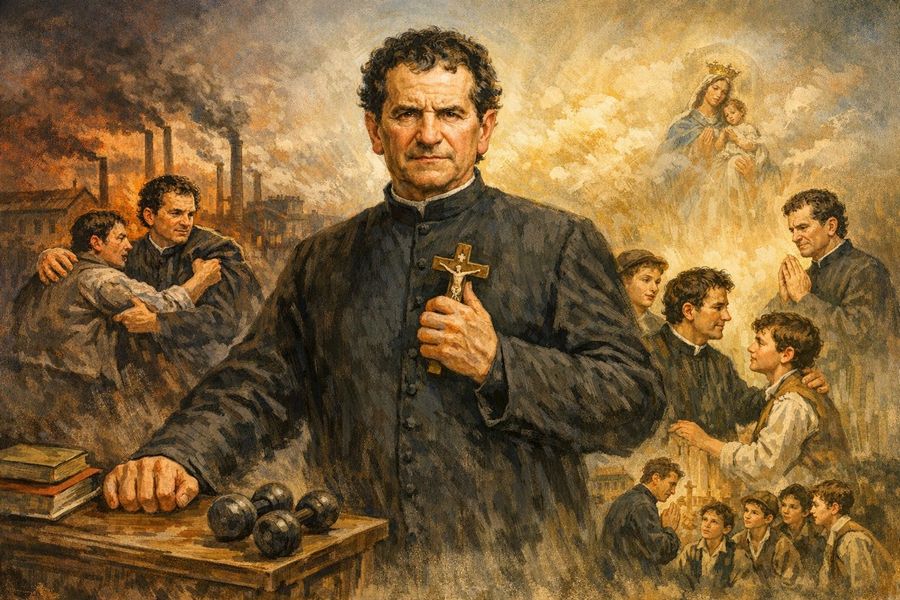
Reading time: 8 min.
Don Bosco’s personality was the result of a blend between his impulsive, fiery nature and a gentleness he achieved through constant self-discipline. Of short to medium height and with a humble appearance, he concealed a strong and determined character. Testimonies from his contemporaries confirm his “easily ignited” temperament, which was stubborn and prone to anger, yet he managed to channel it, transforming aggression into tenacity and perseverance. This mastery of self-control was fundamental to his educational method. He became a model of patience, humility, and gentleness—qualities that were not innate but painstakingly acquired, which allowed him to understand and help the most vulnerable young people in industrial Turin.
Why he began by educating himself
Giovanni Bosco is one of the most fascinating figures in nineteenth-century pedagogy: a man of modest appearance who concealed an extraordinary personality. Behind the short-to-medium stature and humble bearing of a Piedmontese peasant lay a strong and determined character, forged through constant work on himself. The contrast between his impulsive, fiery nature and the gentleness he managed to acquire over the years reveals the secret of his educational greatness. Don Bosco was not born a saint. He became a model of patience and kindness precisely because he knew how to master a “highly flammable” temperament and transform his own aggression into tenacity, his own stubbornness into perseverance. This journey of self-education, which began in childhood, was the key that allowed him to understand the most vulnerable young people of industrial Turin and to dedicate to them a work destined to change the history of education.
Those who knew Don Bosco described him as small, slender, with a humble bearing, unkempt curly hair, and rather large ears, whereas in photographs he ‘grows’, becoming taller (due to the cropping of the space above his head, the vertical effects from emphasising the folds of his cassock, and the shifting of his figure from the centre to one side of the scene), his face becomes more refined and, thanks to retouching, sometimes even handsome.
In reality, the adult Don Bosco was physically a brachy type of short-to-medium stature (one metre and sixty-three centimetres tall), who walked “…with a slight waddle” (MB, VI, 2) like a peasant. He possessed extraordinary physical strength; he had practised weight training and bodybuilding by working in the fields or during long training sessions as a street performer to entertain his friends. His face, moreover, had nothing of the ascetic about it. It was an open, cordial, good-natured, paternal face, though proud and courageous, which shone with generous kindness.
The psychological profile of the adult Don Bosco was that of a “so-called normal” individual (“so-called”, because normal in the absolute sense does not exist), with a strong, dynamic ego, defined by action, a profound sense of duty and a clear awareness of his own responsibility. And since there is always a relationship between being and doing, he had an active, persevering, tenacious, extroverted personality; he was a priest who would ‘roll up his sleeves’, hardworking and cheerful, who preferred to persuade more with deeds than with words.
He did, however, have the patience, practicality, and tenacity of one who is a son of the soil, as Fr. Giovanni Battista Lemoyne testified: “He used to tell us: — In the greatest difficulties, I never lose sight of the goal. When I encounter an obstacle, I do not lose heart; I do like someone who, walking along a road, finds it blocked by a large boulder. If I cannot move it, I climb over it, or go around it, or, leaving the enterprise I had begun at that point so as not to waste time waiting, I immediately turn my hand to something else. In the meantime, with time, things mature; men change and the original difficulties are smoothed over. But I never lose sight of the work I have undertaken—” (PC, 665-666).
Despite his certainty that the Lord would help him, Don Bosco never failed to use every means to overcome the many obstacles, applying the saying: “God helps those who help themselves” to the letter. And he circumvented many obstacles, partly because his life unfolded during a period of great transformation, so he found himself involved in an era of change, such as the transition from an agricultural economy to an industrial one.
The city of Turin in those years was undergoing significant demographic growth. Driven by industrial expansion, individuals (especially boys) or entire families came there from other provinces and neighbouring regions, including Lombardy, in search of work. As Stella writes (1979, I, 104), there was an abundance of “…boys who occupied the streets, squares, and fields, children of disadvantaged families, of often unemployed parents, without a trade, without the hope of having one; or who took any job just to live, just to improve their living conditions.”
In that climate of confusion, Don Bosco realised that children and young people represented one of the most fragile parts of society (the one that pays the highest price for any social transformation) and that something more responsive to the “signs of the times” needed to be organised to help them. For these reasons, it was at the Refugio, as we have already written, that he started the Oratory on 8 December 1844, which represented a new way of bringing young people together, the fruit of his sociological openness. He named it after Saint Francis de Sales, the Bishop of Geneva who died in 1622, because as Don Bosco himself explained: “…since that part of our ministry required great calm and gentleness, we placed ourselves under the protection of this Saint, so that he might obtain for us from God the grace to be able to imitate him in his extraordinary gentleness…” (MO, 141).
“Everything under control”
Don Bosco undoubtedly had difficulty sublimating his instinctive drives due to his temperament, which was “highly flammable and at the same time not very pliable, and hard” (MB, I, 94). While his brother Giuseppe was meek, docile, and patient, Giovanni revealed an impulsive, fiery, and at times even violent temperament from a young age, as when he struck some boys who were blaspheming with “…blows of his fists” (MB, I, 124). He also found it difficult to obey and to submit, and was often a stubborn child. His parish priest, the theologian Pietro Antonio Cinzano, called him “stubborn” (MB, IV, 286).
This aggressive tendency, though controlled, was also apparent as a cleric and as a priest. Fr. Giovanni Giacomelli, his seminary companion and great friend, wrote: “Extremely sensitive by nature even to small things, one could see how without virtue he would have let himself be overcome by anger. None of our companions, and there were many, was as inclined to this fault as he was. However, the great and continuous violence he did to contain himself was evident” (MB, I, 407).
Fr. Giovanni Battista Lemoyne also testified: “He also showed strength of mind in conquering his fiery nature, so as to appear one of the gentlest of men. He himself confided in me that in his childhood and youth, he felt strongly inclined to anger, but with time he came to have such self-mastery that at times, even in painful encounters, he seemed almost insensitive” (PC, 665).
The theologian Ascanio Savio highlighted his “…bilious nature” (MB, IV, 559) and Fr. Cafasso himself stated that “…one had to let him have his own way” (MB, III, 50); even Dr. Giovanni Albertotti (1929), who treated him in the last sixteen years of his life, noted his “quick and fiery” character in his short biography dedicated to his illustrious patient. Finally, Fr. Michele Rua emphasised the effort John Bosco made to control these aggressive impulses:
“Don Bosco had a fiery character, as I and many others with me were able to observe, for on various occasions, we noticed how much violence he had to do to himself to suppress the stirrings of anger at the setbacks that befell him.
And if this was true in his advanced age, it gives reason to believe that his character was even more lively in his youth. Except that, in imitation of Saint Francis de Sales, knowing this inclination of his, he watched continually over himself, so as to always maintain his calm, and to be a model of patience, gentleness, and kindness” (PC, 667).
By sublimating his aggression, Don Bosco indeed became a model of patience, gentleness, and tolerance, to the point that as an adult, he almost always maintained his calm, sweetness of heart, and serenity of mind. Furthermore, the sublimation of this drive brought him tenacity, perseverance, and constancy. He faced all the obstacles he encountered in the course of his life with sure determination, from those related to the “travelling” Oratory (1844-1846) to the expansion of the Salesian family and the approval of the Society itself.
Don Bosco gave great proof of tenacity in following the path that led him to the foundation of the Salesian Society. After having developed the idea of a religious association in the years 1854-1859, he still had to circumvent the law of 29 May 1855, which decreed the suppression of religious communities and the confiscation of their assets. With perseverance, struggling for fifteen years, he achieved the foundation of the Salesian Society, and “…knew how to overcome all the vicissitudes of life to reach his goal” (MB, I, 95), always managing to complete the works he undertook.
Humble, strong, robust
As an adult, Don Bosco was a tenacious fighter, a reassuring and charismatic leader; and, above all, endowed with a spirit of sacrifice, constancy, and humility. Braido writes, “He is, however, a discreet and wise man. In order not to weigh down his action, he does not let himself be seized by greed for doing good. Don Bosco, in this sense, thinks that the best is the enemy of the good. Therefore, sobriety, prudence, and a sense of limits guide him in the practical implementation of ‘openness’.”
Humility was certainly not an easy goal to reach for a personality like Don Bosco’s, characterised by a strong, winning, leader’s ego. He himself, referring to his past stay at the seminary in Chieri, recalled, “On certain days, the game of tarot was allowed, and I took part in this for some time. But here too I found the sweet mixed with the bitter. Although I was not a skilled player, I was so lucky that I almost always won. At the end of the games, I had my hands full of money; but seeing my companions afflicted because they had lost it, I became more afflicted than them. In addition, in the game, I fixed my mind so much that afterwards I could no longer pray or study, my imagination always being troubled by the king of cups and the jack of swords, by the 13 or the 15 of tarots. I therefore made the resolution to no longer take part in this game, as I had already given up others. I did this in the middle of the second year of philosophy, 1836” (MO, 93).
And even as a cleric, he severely condemned certain outbursts of his character and wanted to fight his own “…passions, especially the pride that had taken deep root in my heart.”
In his pedagogy, Don Bosco privileged the virtue of humility, and he was the first to set an example, humbling himself throughout his life to hold out his hand to anyone who could help him. He formed himself in humility from a young age, from when, due to the violence of his older stepbrother, he had to leave home and beg for work at the Moglia farmhouse where, in addition to his keep, he earned fifteen lire a year.
Reading Don Bosco’s life carefully, one is particularly struck by the “good manners” he normally used with everyone and especially with humble, common people. As a priest, he even used the formal “voi” with prisoners. He would also uncover his head even before the porters of palaces when he addressed them to look for someone. If important guests arrived at Valdocco, he would welcome them with every sign of respect, accompanying them, always with his biretta in hand, throughout the House.
Don Bosco spoke, preached and wrote in a simple way that was understandable to all (and this too is a sign of humility). There was also in him a reserved modesty, a private discretion for everything concerning his personal world, which rarely showed through. Both when he spoke and when he wrote (and we refer particularly to his letters), if he mentioned himself, he used the third person to express himself in a non-subjective way, as if speaking of another. In his writings, he used to prefix the simple title “priest” to his name and surname as a sign of humility. And one need only look at his photographs, where the expression on his face does not at all imply an intention to project a charismatic image of himself.
Giacomo DACQUINO, Psychology of Don Bosco, p. 50 ff.
 P. Wirth MORAND