


 By Fr Bruno FERRERO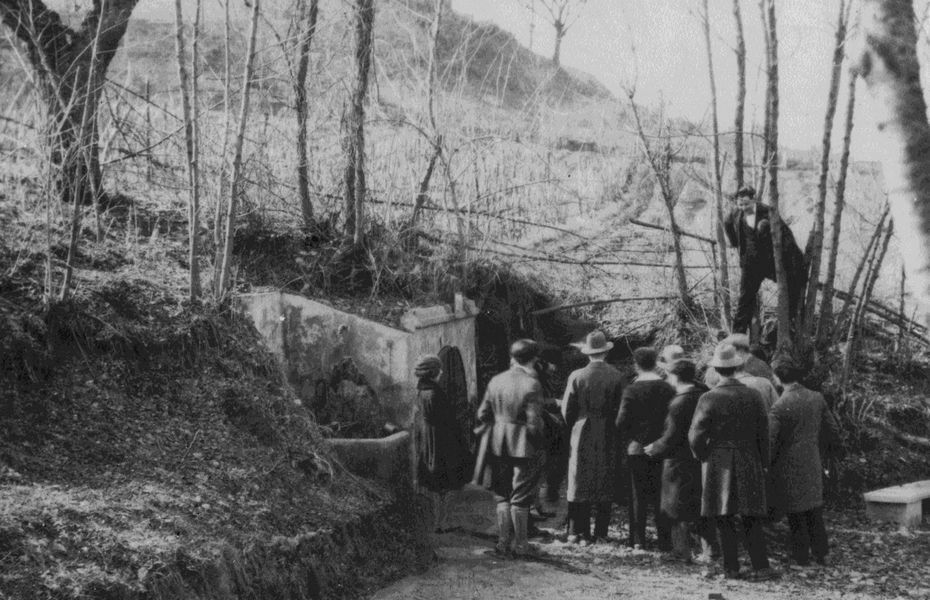
Reading time: 6 min.
The fountain of Mamma Margaret at the foot of Don Bosco Hill (1960s)
Young Giovanni grew up within a complex family dynamic in which his mother, Margherita Occhiena, played a crucial role. After moving to the small house in Becchi in 1817, Margherita found herself managing three sons with very different temperaments: the lively and enterprising Giovanni, the mild-mannered Giuseppe, and her problematic stepson, Antonio. Despite family tensions and poverty, this widowed, illiterate woman managed to give her sons an exemplary Christian upbringing, rooted in Piedmontese tradition. It was a balanced approach to education, blending strictness with affection, which shaped the personality and vocation of the future founder of the Salesians.
Why, on his mother’s lap, he learned what an educational system is
When, in1817, the family moved into the little house, it comprised Margherita Occhiena Bosco (29 years old), her mother-in-law Margherita Zucca (65 years old), and the three young Bosco boys: Antonio Giuseppe, Giuseppe Luigi, and Giovanni Melchiorre (aged 9, 5, and 2 respectively).
The three Bosco boys were very different from one another. Giovanni was lively, perceptive, imaginative, enterprising, with a great desire to discover and learn; he seemed born to be a leader. His brother Giuseppe, by contrast, was essentially a follower. Apart from occasional moments when he showed himself fickle and stubborn, he was generally gentle and sweet-natured, patient and reserved. Antonio, Margherita’s stepson, however, appears — according to data provided by the Memoirs and other testimonies collected by Lemoyne — to have been problematic from the outset. Orphaned of his mother at age four and now also without his father, he seemed to feel like a stranger in the household, despite being the eldest of the brothers. Yet, upon reaching adulthood (which at that time occurred at age21), he would become head of the household, according to Piedmontese custom. As he grew older, he became even more difficult. He is described as disobedient and disrespectful toward his stepmother, despite her gentleness and attentiveness toward him. Later, we see him stubbornly opposing Giovanni’s attendance at school. The two had incompatible temperaments, which strained their relationship. It seems that after the death of Giovanni’s paternal grandmother, Margherita Zucca (†1826), Antonio, then eighteen, became even more quarrelsome. On the other hand, he bore the heaviest burden of agricultural labour. The concern that domestic conflict might escalate into something more serious and dangerous eventually convinced Margherita of the wisdom of sending Giovanni to work as an apprentice on a nearby farm, until matters concerning the division of property among the children were settled. We must acknowledge her ability to keep the family united despite tensions, and to prevent Antonio’s complete isolation.
In Lemoyne’s edifying biography of Margherita, many examples of her spirituality and devotion are recorded. She is described as a pious and devout woman, with a strong character, wholly dedicated to her children and to serving God and neighbour. The biographer particularly highlights her role as a Christian educator, as did the witnesses at the diocesan process for Don Bosco’s beatification. We read how she carefully nurtured her children’s education, teaching them catechism, taking them to church, preparing them for the sacraments, etc. She directed her best efforts especially toward their development as persons, since she wished to give her children a strong moral conscience and the spiritual and human resources for concrete engagement in life. She taught them to sense God’s presence, to believe in His loving providence, to live with honesty and integrity, to love work and toil, to be faithful to commitments, and to be capable of perceiving and responding to the needs of others. She educated them in Christian optimism and hope for divine reward.
Beyond maternal education, many other factors contributed to shaping Giovanni morally, religiously, and spiritually. First, the regional character. Piedmontese peasants were industrious people, tireless workers, persevering and even stubborn in pursuing their goals, yet not for that reason rude or antisocial. Like his ancestors, Giovanni grew up with a passion for work and a desire to improve his condition — a passion that never compromised his temperament or his ever-ready smile. A second factor was the Catholic faith, which permeated Piedmontese history, culture, and identity from ancient times. Deeply rooted Catholic traditions were nourished by the parish, the centre of social and religious life. New ideas emerging from the French Revolution and disseminated during the Napoleonic period were viewed with suspicion and fear, considered anti-Christian, and did not erode the spiritual identity of the population. Shaped in this environment, Giovanni could not conceive of a social, religious, or spiritual life outside the tradition of Roman Catholicism.
Margherita trained her children in a life of toil and austerity: extremely simple food, hard mattresses of corn husks, and rising at dawn. But above all, she devoted herself intensely to teaching them religion, forming them in obedience, and assigning them tasks appropriate to their age. The Bosco family prayed together, morning and evening. Don Bosco writes in the Memoirs of the Oratory, “While I was still very young, she herself taught me prayers; as soon as I was old enough to join my brothers, she made me kneel with them morning and evening, and together we recited prayers aloud, including the third part of the Rosary.” These were common customs among Piedmontese people at that time: communal prayers, Rosary every evening; recitation of the Angelus three times daily at the sound of the bell, interrupting all work. Though illiterate, Margherita knew by heart the main lessons of the catechism. Regarding this, Lemoyne states, “Margherita understood the power of such Christian education and how God’s law, taught through catechism every evening and recalled throughout the day, was the sure means of making her children obedient to her maternal precepts. Therefore, she repeated the questions and answers as many times as necessary until her children had memorised them.”
Don Bosco himself confirms Lemoyne’s words, writing with reference to the time of his First Communion. “I knew the entire small catechism, but because of the distance from the church, I was unknown to the parish priest and had to rely almost exclusively on the religious instruction of my good mother.”
Thus, Margherita instilled in her children’s minds the idea of a personal God, always present, merciful, and just. And Don Bosco was convinced of God’s personal and constant presence — a God of infinite greatness, yet also of infinite love, who gives us “our daily bread,” forgives our sins, and helps us, poor sinners, not to fall again into sin.
When Giovanni reached seven or eight years of age, Margherita carefully prepared him for his first confession. “Sin” assumed for him a horrifying and terrifying aspect. During Easter1827, with even greater care, Margherita prepared her boy for his First Communion. Three times during Lent she accompanied him to the confessional, and when, at home, Giovanni prayed and read a spiritual book, she, seeing him engaged in prayer, offered him her maternal advice. When the great day arrived, she left Giovanni alone in the silence of his recollection. In church, she attended his “preparation” and “thanksgiving” after Holy Communion, helping him repeat the prayers the parish priest read from the altar.
Thus, under his mother’s guidance, young Giovanni experienced personally a sacramental life that, later as a priest, he would never tire of instilling in his own disciples. Margherita’s religious and moral education belonged to the Piedmontese tradition, and the strict relationship between parents and children, typical of Piedmontese families, made it even more rigorous. But these traits were tempered by her constant appeal to reason and religion, with such loving personal care. Margherita’s success can be attributed to her wisdom and an enlightened educational style that balanced every binding rigour of tradition.
The biographer, referring to Margherita’s special attention to Giovanni, in whom she saw exceptional potential, wrote, “[Giovanni’s preparation] was the work of Margherita, with her holy diligence and foresight, which did not oppose, but rather modified and directed toward God the natural inclinations and gifts with which Giovanni was endowed. He showed great openness of mind, attachment to his own judgments, tenacity of purpose; and the good mother accustomed him to perfect obedience, not flattering his self-esteem, but persuading him to submit to the humiliations inherent in his condition. At the same time, she left no means untried so that he might devote himself to study, without undue anxiety, leaving it to divine Providence to determine the right time. Giovanni’s heart, which one day would hold immense riches of affection for all mankind, was full of exuberant sensitivity that could then have been dangerous if indulged. Margherita never lowered the dignity of motherhood to thoughtless caresses or to pity or tolerate anything that might bear a shadow of defect; yet she never used harsh or violent methods with him, which might have exasperated him or caused a cooling of his filial affection. Giovanni possessed within himself that sense of confidence in action, by which a man is naturally inclined to lead and which is necessary for one destined to preside over multitudes, but which can so easily transform into pride. Margherita did not hesitate to restrain his small caprices from the beginning, when he was not yet capable of moral responsibility. But when she saw him excelling among his peers for the purpose of doing good, she would silently observe his conduct, not oppose his small enterprises, and not only allow him freedom to act as he pleased, but also procure for him the necessary means, even at the cost of her own privations. In this way, she gently and sweetly insinuated herself into his soul and bent him to always do her will.”
But overall, within the context of peasant culture, the portrait of Margherita as an educator drawn by Lemoyne rings true. He reports, both in the biography and in the Biographical Memoirs, examples of her firmness, gentleness, and wisdom as a Christian educator. The biographer, however, focuses more on the support Margherita gave to Giovanni, on how she accompanied him step by step along his vocational path.
Arthur J. LENTI, Don Bosco: History and Spirit, Volume1, p.146
 BSOL Editor
  P. Wirth MORAND