


 By BSOL Editor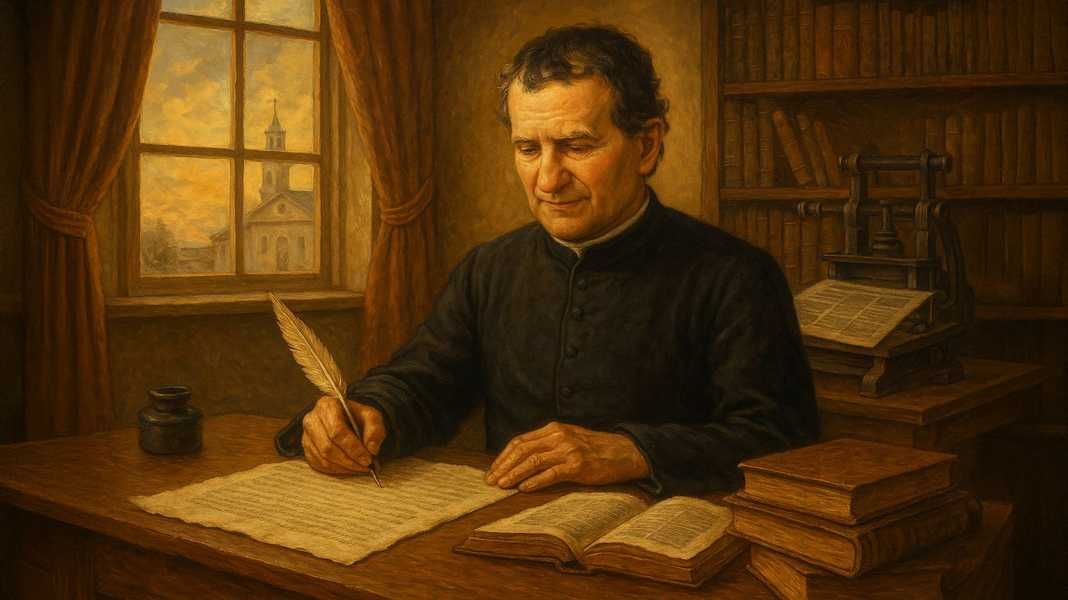
Reading time: 6 min.
When speaking of Don Bosco and his relationship with the press, a misunderstanding can arise. John Bosco wrote a great deal, published over a hundred works, founded a periodical like the Salesian Bulletin, and distributed millions of copies of booklets, biographies, and popular manuals. All of this would suggest a man who fully embodied the figure of the “journalist”. Yet, this is not the case. Don Bosco did not want to be a journalist, at least not in the sense in which the nineteenth century understood and practised this profession.
The distinction is not insignificant. While he recognised the educational and social power of the printed word, he avoided reducing his mission to an editorial profession. Don Bosco can be considered a great Catholic publicist — that is, a man capable of communicating ideas, values, and religious content to the general public — but not a journalist in the professional, political, and militant sense that the term assumed in his time.
The historical context of the press in the nineteenth century
To understand Don Bosco’s choices, they must be placed in the context of the 19th century. In Italy, especially from the 1840s and 1850s onwards, the periodical press played an increasingly important role. Newspapers were instruments of political debate, consensus building, and public opinion formation. The journalistic profession, however, was still poorly regulated and often intertwined with propaganda. Papers were born and died according to political events, linked to parties, ideological currents, anti-clerical or pro-Catholic battles.
The journalist of the time, therefore, was more a militant or a polemicist than an impartial reporter. And this world did not attract Don Bosco. He did not recognise himself in a profession that would have forced him to take a stand on political disputes, to descend into the arena of polemics, to expend energy on ground that was not his own.
Don Bosco also had an experience as a journalist, founding the newspaper L’Amico della gioventù (The Friend of Youth) in October 1848, as a religious, moral, and political publication aimed at young people. However, he soon gave up journalism. His newspaper lasted about six months and at the end merged with another periodical entitled L’Istruttore del Popolo (The Instructor of the People). Fr. Lemoyne writes:
“Don Bosco, enlightened by the vicissitudes encountered in the direction of this newspaper [Amico della gioventù], had soon felt that Divine Providence had not permanently destined him for the office of journalist. He saw how this threatened to hinder his other occupations, as he had to devote too much time to reading and studying disparate subjects such as political economy, public law, and Catholic apologetics. He understood how in those times the Catholic journalist, if he did not want to follow the dominant maxims of the day, had to be ready to face the eventuality of being brought before the courts, condemned to pay large fines, and even to be imprisoned in the citadel’s jails. Don Bosco absolutely did not want to participate in error, and could not risk a danger that would have compromised his primary mission. Indeed, Lo Smascheratore (The Unmasker), which succeeded the Giornale degli Operai (Workers’ Newspaper), advocating the Catholic cause with great vivacity and wit, had in April 1849, the first press trial in which jurors participated. He therefore recognised that it was not prudent to create ruthless enemies, as polemics with irreligious journalists were inevitable and the Gazzetta del Popolo (People’s Gazette), due to its secret and overt affiliations, had such power as to impose its will on Parliament and the Senate themselves. Unfortunately, he foresaw that he would not lack adversaries to fight in a struggle, one might say, to the death, which he would at first have to sustain almost alone; and these were the Protestants. However, by leaving the journalistic career, he had the consolation of seeing the incomparable Theologian Giacomo Margotti, a student of that Academy, descend from Soperga, capable of victoriously confronting the dominant revolution.” (MB III, 483-484)
Don Bosco’s vocation: priest and educator
The primary reason why Don Bosco did not want to be a journalist lies in his priestly vocation. From the very beginning of his ministry, he perceived himself as a priest of young people, a shepherd and a father. Everything he undertook — from vocational schools to oratories, from popular missions to publications — was always oriented towards this goal: the salvation of souls, especially of the poorest and most abandoned.
Being a journalist would have meant assuming a different identity, more secular and professional, more linked to social dynamics than to pastoral ones. Don Bosco, instead, considered the press only as one of the tools at the service of his educational and evangelising mission. He did not want to replace preaching with reporting, nor spiritual direction with journalistic polemics.
Don Bosco the publicist: prolific writer and populariser
That said, it must be acknowledged that Don Bosco was an extraordinary publicist. From his early years as a priest, he began to publish texts intended for the Christian people: catechism booklets, prayer books, edifying lives of saints and martyrs, manuals of sacred history. His purpose was clear, to provide simple and accessible tools for the religious formation of the people.
The success was enormous. His works were reprinted multiple times, translated into various languages, and widely distributed in parishes and schools. An emblematic example is Il Giovane provveduto (The Young Person Provided For) (1847), a small manual of Christian life that had dozens of editions and accompanied generations of young people in prayer and devotion.
Don Bosco’s style was simple, direct, popular. He did not seek erudition, but clarity. He did not aim for academic discussion, but for practical formation. And above all, he did not aim to inform about the news of the day, but to shape consciences.
The experience of the “Salesian Bulletin”
The culmination of Don Bosco’s publishing activity was the founding of the Salesian Bulletin in 1877. It was not a newspaper in the classical sense, but a periodical for connection and animation. The purpose was twofold: to inform readers about Salesian works scattered throughout the world and to foster a sense of belonging and solidarity among benefactors, friends, and the Salesians themselves.
The Bulletin did not report political news or current polemics, but edifying stories, missionary news, examples of young people and educators, and appeals for charity. It was, in essence, a tool for both internal and external communication. It created a network of sympathisers and supporters, offered formative content, and consolidated the identity of the Salesian Family.
In this sense, the Bulletin well represents the difference between journalism and publicism. Don Bosco did not intend to found a daily or weekly newspaper of information, but a “voice” capable of transmitting the Salesian spirit and circulating good.
Distrust of polemical journalism
Another reason why Don Bosco avoided journalism was his distrust of the polemical and anti-clerical press. He was well aware of how aggressive the newspapers of the time could be towards the Church and the Pope. The controversies over the Roman Question, the cultural battles of liberalism, and the attacks on religious congregations showed a press often used as a political weapon.
Don Bosco preferred not to expose himself directly in that field. There are, of course, decisive positions in his works in defence of faith and the Church, but they were never inserted into the typical register of polemical journalism. He chose a positive and constructive communication, based on telling examples, spreading good, and educating conscience.
At this point, we can better clarify the difference between Don Bosco the publicist and Don Bosco the journalist (which he did not want to be).
The journalist informs about current events, offers news, comments on facts, and participates in public debate.
The publicist communicates ideas and values to the general public, disseminates educational messages, and popularises religious or moral content.
A legacy for the Salesian Family
The legacy of Don Bosco the publicist is still alive today. The Salesian Bulletin, translated into dozens of languages and distributed in over a hundred Countries, continues its mission of connection and animation. Don Bosco’s popular works remain models of popular communication, capable of combining clarity and spiritual depth.
For the Salesian Family, this legacy is an invitation to consider the media not as an end in itself, but as tools at the service of the educational and evangelising mission. Fidelity to Don Bosco does not consist in becoming professional journalists, but in continuing to be communicators of good, capable of using every means to speak to young people and families.
Don Bosco did not want to be a journalist because it was not his vocation. He was a priest, educator, founder. But he ingeniously used the press to become a great Catholic publicist, a tireless populariser, a popular communicator.
His choice was not a renunciation, but a discernment: not to be absorbed by the polemics of current events, but to remain faithful to the educational mission. Thus, the press became for him not a profession, but an apostolate. And precisely for this reason, more than a century later, his voice continues to resonate, not in ephemeral chronicles, but in the lasting formation of consciences.
And let us remember what Fr. Lemoyne wrote:
“Finally, we will note how from the above facts Don Bosco drew a great admonition, which he often repeated to his disciples, namely that journalism, especially that which deals in any way with politics, was not their field of action. He had written a prohibitive article on this point in the Rules of his Pious Society, which was however removed by the Sacred Congregation of Bishops and Regulars, not because the Church opposed such a prescription, but because being enunciated in too general a way, explanations would have had to be added which prudence at that moment advised against. Nevertheless, Don Bosco continually repeated that it was his firm intention that the Salesians should always remain extraneous to political struggles, as the Lord had not called them for this, but rather for poor and abandoned young people.” (MB III, 487)
 Fr Bruno FERRERO
  P. Natale CERRATO