


 By P. Natale CERRATO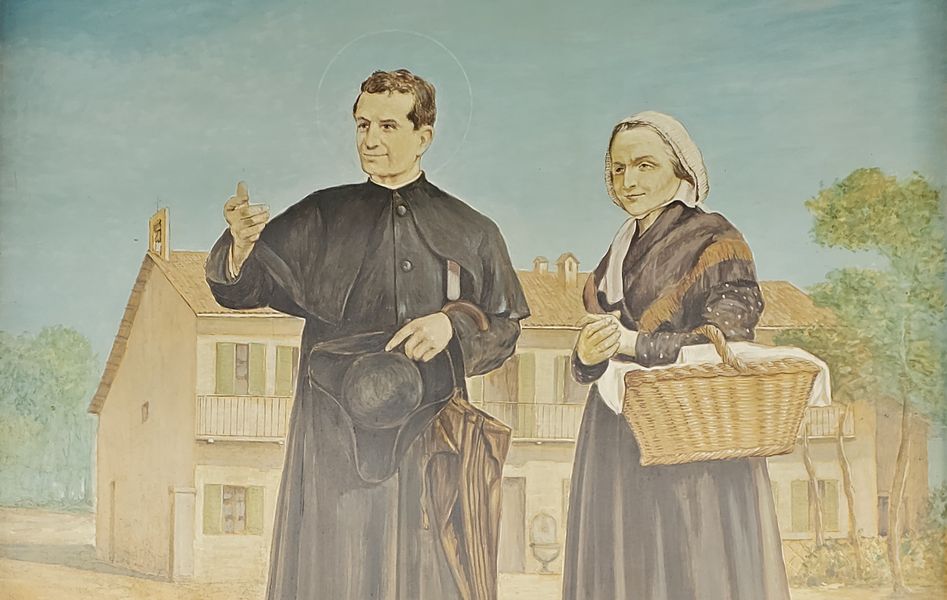
Reading time: 10 min.
How far and how did the Saint of Youth travel? Let us retrace these paths.
In the age of international express trains, Formula 1 racing cars, supersonic jets and space shuttles, it may even seem pathetic to speak of Don Bosco’s journeys on foot, by coach or by “steamer”. Yet this not insignificant aspect of his activity cannot leave one unmoved when one thinks of the amount of time, money and sacrifice it cost a man who had neither time, money nor health to waste.
On foot and on horseback
When John took up residence in Castelnuovo at the age of 15, he had already made a practice, exceptional even for those times, of lengthy walks. How many times had he walked the lonely country roads from the Becchi to Morialdo, to Capriglio, to Buttigliera, to Moncucco, and above all to Castelnuovo, with only the company of cold or heat, snow or rain, fog or heat, mud or dust.
At the age of 16, he went to Chieri. His first safe journey to Turin was in April 1834, when he presented himself at the Convent of the Friars Minor at Our Lady of the Angels in the street of the same name, to discuss the question of his vocation.
How many followed that first trip to Turin? We do not know. Certainly the most famous was in November 1846. From the Becchi Don Bosco and Mamma Margaret left for Valdocco, he with a packet of exercise books, a missal and the breviary, she with a basket of laundry and the most necessary things. Father Vola, who met them tired and dusty at the Rondò della Forca, asked them:
“Where do you come from?”
“From our village.”
“And why have you come on foot?”
“Because… we are lacking this…” And Don Bosco ran his thumb over his forefinger with the typical gesture of someone who lacks the money to even make up a lira.
Those were Don Bosco’s times when legs still served man as a means of locomotion. The cost of carriages discouraged poor people from using them. There was not the haste or laziness we have nowadays. For Don Bosco, then, walking was not just a matter of economy. He suffered terribly from motion sickness. While still a sub-deacon at Castelnuovo, invited to preach at Avigliana, he preferred to walk the whole way – 54 kilometres – to spare himself the nausea of a carriage ride. When he expressed to Fr Cafasso his desire to leave for the missions, he heard the reply:
“You don’t feel like going one mile, one minute in a closed carriage without an upset stomachand you want to cross the oceans? You would die on the way!”
And Don Bosco, as long as he could, used St Francis’ horse, in town and out, alone and in company. One need only recall his famous autumn rides in the 1850s and 60s.
Advanced in years, he was heard to say in conversation:
“Physical activity is the best thing for health. I was always sickly in the seminary and in my first years of priesthood, but later I became very active and felt stronger. I can still remember once walking more than 20 Piedmontese miles [50 kilometres] in a single day with Fr Giacomelli on a round trip from Avigliana to Turin. Another time I set out from Turin and and walked twelve miles [30 kilometres] to the Becchi in six hours, practically non-stop. Now, even when I feel weak and ache all over, I go to visit sick friends who live even as far off as the Po River or at Porta Nuova, and I never take a coach, unless I have to because of pressing duties or lack of time or an urgent appointment.
“I believe that inactivity is a significant cause of the present day’s sagging health. Readily available coaches, buses and trains have eliminated the need to walk even short distances, while just fifty years ago people thought nothing about talking a walking jaunt from Turin to lanzo. I don’t think that a jolting coach or railway carriage offers us enough exercise to keep healthy.” (BM XII, 244)
But Don Bosco had also learnt to ride a horse. In the summer of 1832, the provost of Castelnuovo, Fr Dassano, who was giving him lessons, entrusted him with the care of the stable. John had to take the horse for a walk and, once outside the village, he would jump on its back and gallop it. As a new priest, he was invited to preach in Lauriano – about 30 kilometres from Castelnuovo – and set off on horseback to reach it in time. But the ride ended badly. On the Berzano hill the beast, frightened by a large flock of birds, reared up and the rider ended up on the ground with broken bones.
Don Bosco did some of these rides on occasion, in his wanderings around Piedmont and on stretches during outings with his boys. Worthy of mention is the triumphant ascent to Superga in the spring of 1846. The Oratory was leading a precarious life in the Filippi field and one day Don Bosco wanted to take his mischievous boys on a pilgrimage to the famous shrine. When they arrived at Sassi, at the foot of the slope, they found a horse fully harnessed that the parish priest of Superga, Fr Giuseppe Anselmetti, had sent to the captain of the brigade. Don Bosco mounted it on the archway surrounded by his young ruffians who, as they walked, amused themselves by taking the beast by the bridle, by the tail, grabbing it, pushing it. And it seems that this time the quadruped, more patient than a donkey, let them do so, as if it knew it had Don Bosco in the saddle.
Far from triumphant, however, was the crossing of the Apennines on the back of a donkey on the journey to Salicetto Langhe in November 1857. The path was narrow and steep, the snow deep. The animal stumbled and fell at every turn and Don Bosco had to dismount and push it forward. On the descent, too steep, already drenched in sweat, he himself fell badly, injuring his leg. Only the Lord knows how he was able to reach the village in time for his sacred mission.
That was not Don Bosco’s last journey on a donkey. In July 1862 he made the 6 km journey from Lanzo to St Ignatius by the same means of transport.
So, probably, other times.
But one of Don Bosco’s most glorious rides was the one in October 1864 from Gavi to Mornese. He arrived in the village late in the evening to the festive sound of the bells. The people came out of their houses with their lamps lit and knelt down as he passed, asking him for a blessing. It was the people’s hosanna to the saint of youth. “I think,” Fr Luigi Deambrogio wrote of that event, “that there is nothing to demythologise or change. No one, only those who do not love, can bind the manifestations of the Lord.”
By coach at the time of the stagecoach
Despite poverty, stomach ailments and the habits of a strong walker, Don Bosco was forced to make frequent use of public coaches and private vehicles from stagecoaches to omnibuses to stately carriages.
Stagecoaches were large carriages with about 12 seats, with an interior, coupé and an upper deck or open top. Pulled, usually, by six horses with two postillions, they served long distances and cost passengers less than government postal couriers. The first stagecoach service in Piedmont belonged to the Bonafous Brothers, inaugurated in 1814. When taking the stagecoach, Don Bosco preferred to sit on the open top in order to breathe fresh air and save himself from the gag reflex that the closed coach gave him.
In 1828 the velociferi appeared on the roads of Piedmont, marking a step forward in passenger service both in terms of the number of seats, which could reach thirty, and the lower cost of the journey. The haulage of the velociferi was generally four horses with only one postillion, their speed somewhat greater than that of the stagecoaches due to the more frequent change of horses. However, they served shorter routes, connecting towns such as Turin and Pinerolo, Turin and Asti. Given the speed, the size of the coach and the road conditions, if the stagecoaches could be called “digestive carriages”, the velociferi must have meant serious stomachaches for passengers like Don Bosco.
The omnibuses served even shorter routes, connecting the city centre with the suburbs or neighbouring towns. These were horse-drawn, four-wheeled carriages with no more than 16 seats. The service, established in Turin in the years 1845-46, was then transformed in 1871 into an animal-drawn omnibus with rails, the “Carrozza di tutti” immortalised by the pen of De Amicis, a carriage, that is, for all kinds of people, which announced its arrival at city crossroads with a trumpet blast.
In addition to public transport, among which one must not forget the town or city carriages, of course all kinds of private vehicles were available, first, second or third class according to their structure and capacity, the number of wheels and horses, from two-seater open-top calessini to four-seater closed sedans.
It would be impossible even to list all of Don Bosco’s journeys by stagecoach, velocifero, omnibus or private carriage. And even more difficult to distinguish at times whether it was really a journey by stagecoach or not rather by velocifero or omnibus.
In any case, Don Bosco’s first trip by stagecoach, that we have any record of, was from Pinerolo to Turin during the Easter holidays of the 1834-35 school year, when he was a student in Chieri. The information is given to us by a youthful letter of his, the first in the Epistolario edited by Fr Ceria. John had travelled to Pinerolo at the invitation of the family of his friend Annibale Strambio. In the letter, the first part of which is missing, there is no mention of the outward journey. But the return journey is well detailed: “I stayed another two days in Pinerolo and […] on the appointed day I boarded the stagecoach and arrived in Turin, from here I returned to Chieri’. The Turin-Pinerolo service was run in 1835 by Diligenze Bonafous at a price of 2.70 lire on first-class coaches, 2.20 on second-class coaches and 1.65 on third-class coaches. It is to be assumed that John took a third class carriage.
Towards the end of 1850 Don Bosco made his first trip to Milan with a passport, invited by Father Serafino Allievi to preach the jubilee at the S. Luigi oratory in Via S. Cristina. Apparently he made that journey by velocifero via Novara and Magenta, then changing carriages at the main stations. In all, at least 15-16 hours.
Of his omnibus journeys, we recall, by way of example, the one from Turin to Rivoli in 1852 when he took the boys from Valdocco to the retreat in Giaveno. The 18-kilometre Rivoli-Giaveno stretch was, of course, covered on foot. The omnibus must have served Don Bosco on other occasions to walk to towns like Moncalieri, Rivoli, Chieri, Trofarello and Carignano.
A journey by “coach” that had a particular echo at Valdocco was the one from Turin to Lanzo in July 1862. Don Bosco himself wrote about it to his young men. Two years later he made that journey again by “omnibus”. But it was probably, in both cases, a velocifero. In fact, it does not appear that there were omnibuses on the Turin-Lanzo road in those years, but rather velociferi, which left, as early as 1858, from Piazza Milano to Porta Palazzo near the Rosa Bianca hotel, twice a day.
In the case of 1862 things went quite well as far as Ciriè, but from Ciriè to Lanzo, that is, for about a dozen kilometres, it rained cats and dogs. Don Bosco sat on the upper deck between two passengers who kept their umbrellas open. So, along with the rain he also received the run-off from the umbrellas. He arrived at Lanzo as wet as a chick. He then wrote in his letter: “You, dear young men, would have seen Don Bosco coming down from the car all soaked, like those rats you often see coming out of the bealera behind the courtyard.” The bealera was one of those irrigation and drainage canals that were not lacking in the Valdocco area near the Dora. The tale is hilarious, but makes one think.
Don Bosco made use of private carriages in and out of Turin, especially during his stays in cities like Rome and Marseilles. In those cases it was evidently a service rendered to him by benefactors.
In Mr Alberto Nota’s carriage John Bosco made his trip from Pinerolo to Fenestrelle with his friend Hannibal Strambio in the spring of 1835. When they almost reached Fenestrelle, such a furious wind arose that the horse backed up. Darkness then, due to the impending storm, forced them to seek shelter in an inlet on the mountain. They returned to Pinerolo late at night as the storm subsided.
Also by buggy was Don Bosco’s first trip to Stresa in the autumn of 1847. Businessman Federico Bocca offered to accompany him. On the outward journey they went to Chivasso, Santhià, Biella, Varallo, Orta and Arona. On the return journey they followed the route to Novara and Vercelli. At the stops Don Bosco spent his time chatting with innkeepers, coachmen and stable boys, even persuading some to go to confession. He did this, after all, when he sat in a box next to some postilion who was too easy to swear at the horses to get them trotting.
Of his Roman sojourns we can recall one in 1869, when Card. Berardi put his carriage at Don Bosco’s disposal. Apparently, during that stay, Pope Pius IX himself sent a carriage to pick up Don Bosco and take him to the Vatican. The Pope’s carriage, Don Bosco would tell the youth, was so large that it could well hold 14 people; it was all covered in silk and fringes. And if the fringes were not there, he would put them there.
On his journeys in France, noble gentlemen from Nice, Lyon, Marseilles and Paris competed for the honour of carrying Don Bosco in their carriages. And he had to adapt, even though he was convinced, as he said, that “you don’t go to heaven in a carriage.”
By train
With the increasing development of the railways, the public carriages came to assume a complementary and subsidiary role to the new means of transport. The greater economy of travelling by “steam” benefited everyone and especially those who, like Don Bosco, habitually travelled third class. Not to mention the time saving, which was practically reduced to a third. The horse in fact cannot exceed 10-12 kilometres per hour on the trot. So, with the relevant stops at the post stations, a journey such as Turin-Asti could take up to eight hours with the old stagecoaches, not much less ith the velocifero. By rail, in the 1860s, it would have lasted normally, and with trains stopping at all nine stations along the route, an hour and 40 minutes. The Turin-Genoa section, which involved a stagecoach journey of about 25 hours, could be done by train in about eight hours. This was still a far cry from today’s speeds, but, in those days, it already seemed impressive. There was no shortage of inconveniences that would now seem unbearable, such as the frequent stops, the extreme cold in winter, the lack of services, the inconvenience of steamer smoke and the like. Just think of the noisy and exciting passages in the tunnels! Getting on a train in those days still seemed to be a risk and the fear of disaster was not entirely absent.
When, in 1858, Don Bosco made his first trip to Rome, he arranged not only for a passport but also a will. However, he only made the Turin-Genoa stretch by train, which had been completed in 1853 with the Apennine tunnel. In 1858 the price of that journey was 16.60 lire in first class, 11.60 in second and 8.30 in third, quite a saving compared to the thirty lire for the stagecoach.
In Genoa Don Bosco had to embark on the Aventino, a steamer that ran to Civitavecchia. He caught a fever and suffered from seasickness. From Civitavecchia to Rome he travelled on a postal coach pulled by six horses.
After 1858 Don Bosco’s journeys by rail were no longer counted. Just think of the 20 trips to Rome from 1858 to 1887, the 12 to France from 1876 to 1886, the trip to Austria in 1883, and the one to Spain in 1886.
On his frequent rail journeys Don Bosco did not remain idle. Despite his physical discomfort, he spent his time proofreading or in conversation with his travelling companions, instructing the ignorant, confounding the wicked, defending his works if necessary. He also exercised priestly ministry at times, when he was not gathered in prayer.
The Last Journey
With his return from Rome in May 1887 Don Bosco ended his long pilgrimage around the world. By doctor’s orders, and the very fact that he could no longer stand upright, he still availed himself of a donated carriage in the afternoons for a few short outings in the city, then in July he was forced to leave the sultry heat of Turin and spend a few days in Lanzo. There, every evening, he took a short walk in a wheelchair pushed by his faithful secretary Fr Viglietti. He was heard to exclaim: “I used to challenge the slimmer ones to do the jumps, but now I have to walk in a carriage with other people’s legs!”
During his last illness in December ’87 – January ’88, he replied to Dr. Fissore who gave him courage: ‘Doctor, you want to resurrect the dead? Tomorrow… I will make a longer journey!”
And 31 January 1888 was his last journey.
 Fr Bruno FERRERO