


 By P. Natale CERRATO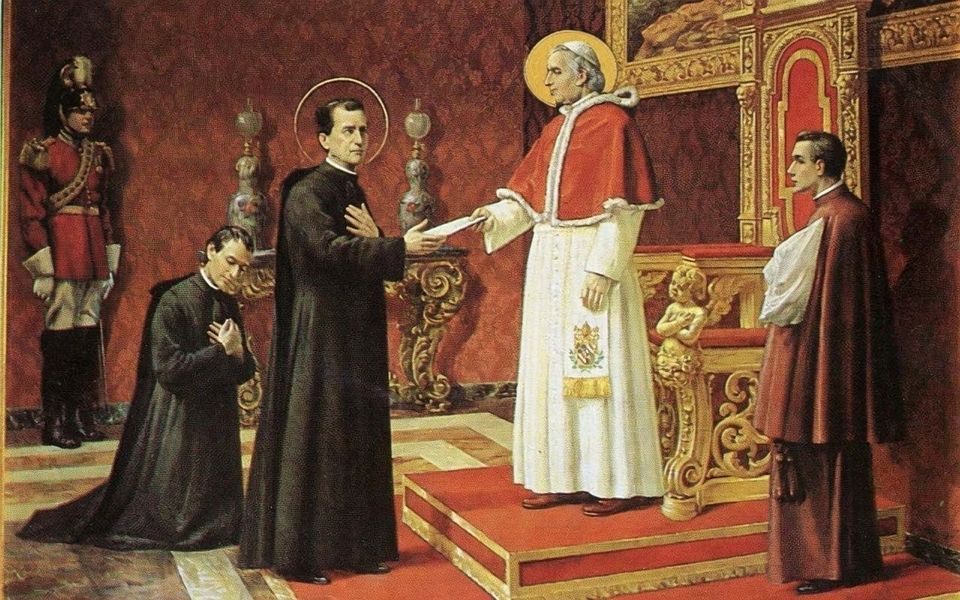
Reading time: 5 min.
Don Bosco was profoundly faithful to the Church and to Pope Pius IX, whom he loved with filial affection. The Pope received him in audience fifteen times over thirty years, showing him constant benevolence through letters and paternal “Pontifical Briefs”. As a sign of gratitude, Don Bosco had the church of St John the Evangelist built in Turin, complete with a statue of the Pontiff. Pius IX was, providentially, the Pope who accompanied Don Bosco from the very beginning of his work for poor and abandoned youth.
Don Bosco the priest was very obedient to the Church and at the same time a loyal citizen to his country. However, as a man of God he could not but consider the Roman Pontiff more than any other leader. He used to say that every wish of the Pope was a command for him. This attitude stemmed from that sensus Ecclesiae and loyalty to the Pope that he considered essential aspects of an integral Christian faith.
In addition to this absolute loyalty to the Holy Father, as Vicar of Christ and Supreme Pastor of the Church, Don Bosco, who carried out his work under the aegis of Pius IX, also loved the great Pontiff with filial affection, and the latter was truly a father to him.
The fact is that the angelic Pius IX, now Blessed, along with the Venerable Margaret Occhiena and with St Joseph Cafasso, made up the splendid trio that the Lord placed in support of all that Don Bosco was able to accomplish in his life. His mother played a unique role in the education and early apostolate of her son, profoundly influencing the spirit and style of his future work. Fr Cafasso was his spiritual director at the time of Don Bosco’s youthful choices, difficulties, uncertainties and doubts.
Pius IX, with his paternal benevolence, far-sighted intuition and the supreme guarantee of his authority, was the inspired guide who confirmed the path for him to follow, enabling him to overcome every obstacle and making it possible in a relatively short time for him to found, approve and develop his Work worldwide.
The Audiences and the papal “Briefs”
For Don Bosco, therefore, it was also a matter of the heart. The kindness of Pius IX, the serious trials he had to endure for the Church, and his benevolence towards the Salesian work, were so many ties that intimately bound him to him. And, in turn, Pius IX loved Don Bosco.
Twenty times Don Bosco went to Rome and made 15 of those journeys to be received by the Pope. The first was in the spring of 1858, when he obtained three successive audiences. Pius IX was fascinated. From that moment on he became a great friend of Don Bosco and his work, giving him multiple proofs of his friendship over 30 years. It was a friendship rich in advice, favours and generous understanding of his problems.
It is certainly not possible in an article such as this to describe all the relations that existed between the great Pontiff and the Founder of the Salesians. We will limit ourselves to recalling two significant instances of the correspondence – can we call it that? – between Don Bosco and the Pope.
In the Central Salesian Archives there are 12 letters from Pius IX to Don Bosco, letters that although they have the external form of “Papal Briefs”, differ completely from them because they replace the usual Curia formulary with a paternal language in which all the Pope’s affection for Don Bosco, his sons and his work vibrates.
On 7 January 1860, in response to an address that Don Bosco had sent him on behalf of himself and his sons, the Pope replied, in Latin of course, giving vent to his sorrow at what was happening and expressing his consolation for the good that was being done in Turin, concluding
“Endure if any tribulation befalls you, and bear with greatness of mind the sufferings of the present time. Our hope is placed in God who, through the intercession of the Immaculate Virgin Mary, Queen and Lady of the world, will deliver us from these grave evils” (ASC 126.2, transl.).
The last letter or “Papal Brief” bears the date 17 November 1875. The Pope had received in special audience the first Salesian Missionaries leaving for America. In the Brief he said:
“We have with paternal benevolence embraced the Missionaries you recommended to us. From their appearance and from their words the hope, which We already had, grew in Us that their labours in those distant countries where they are going should be fruitful and salutary for the faithful” (ibid.).
All these manifestations of kindness on the part of the great Pius IX amply compensated Don Bosco for his many afflictions.
A trick of Providence
In memory of the great Benefactor Don Bosco had, the church of St John the Evangelist built in Turin on the Viale del Re, east of Porta Nuova Central Station, which bore the name of Pope Mastai’s patron saint, and was to be a monument of perpetual gratitude to the great Pius IX. For the same reason, Don Bosco had a large statue representing his majestic figure placed at the entrance.
The statue was placed in its base on 25 April 1882. On the morning of 11th April Bishop Celestino Fissore, Archbishop of Vercelli, had consecrated the church of San Secondo on the opposite side of the Central Station. But on that occasion the sectarians, annoyed by the fact that a bust of the late Pontiff with an inscription was to be placed on the gable of the church, which was also a monument to the memory of Pius IX, organised a protest at the site during the ceremony. A mob of preachers, who had purposely come to the site, caused such an uproar that the bust and the inscription had to be removed in order to avoid greater evil.
But at the very moment when the bust of Pius IX was being removed from the facade of San Secondo, a cart carrying the statue of the Pontiff was arriving from the railway station at the church of St John the Evangelist. Salesian Brother Joseph Buzzetti, who was looking for labourers to unload the enormous weight, came across the bricklayers who were returning from the work accomplished at San Secondo. He invited them to transport the statue inside the church of St John the Evnagelist. Happy with the sudden opportunity for profit, the poor men gladly accepted. And so the same hands that had removed the bust of the Pope in one place, raised the statue in another (BM XV, 313). Joke of Providence?
Pius IX was the Pope that Providence sent to Don Bosco from the very beginning of the work he undertook for poor and abandoned youth. He was truly a loving Father to the one whom John Paul II would proclaim “Father and Teacher of Youth”.
 BSOL Editor
  P. Wirth MORAND