


 By BSOL Editor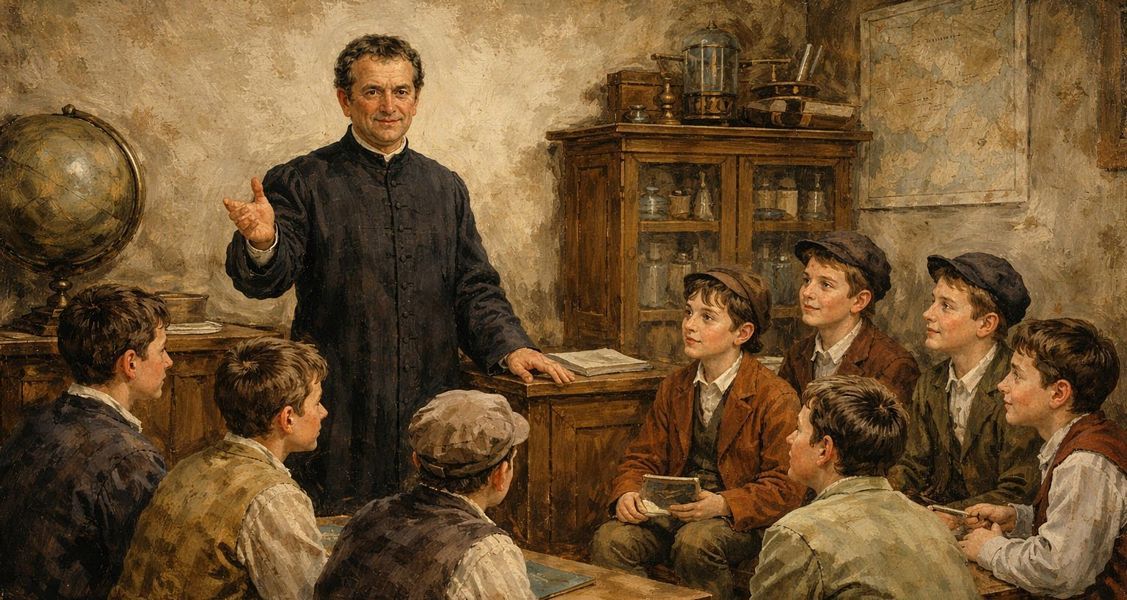
Reading time: 8 min.
At the beginning of the Christmas novena in December 1859, Don Bosco offered the young people of the Oratory some brief instructions and words of confidence to prepare well for the feast. They were words spoken in simple language, nourished by the Eucharist, capable of touching the heart and guiding daily life. Through study, honesty, language, obedience, and sincerity in confession, a unified educational path emerges, in which piety illuminates every duty. This is advice born of love, designed to form “good Christians and honest citizens,” and it remains surprisingly relevant today.
It was December 1859. The Christmas novena was about to begin and Don Bosco, as always, did not let such a precious opportunity pass to make his young people love the ineffable mystery of the Incarnation. In those days he spoke several times: sometimes, in the evening, he had to stay late in the confessional; yet he never failed to offer brief, simple, and incisive words. A cleric noted down the main points — including those from the end of the year — and passed them on to us as a gift.
At the top of the pages was written a verse from the Song of Songs: “Sicut vitta coccinea labia tua… et eloquium tuum dulce” — “Thy lips are like a thread of scarlet, and thy speech is comely.” It was a way of expressing the affection that flowed from Don Bosco’s lips, nourished each morning by the Eucharist, an affability and a grace that can only be explained by seeing their effect on hearts.
Announcement of the novena and means to sanctify it
Tomorrow the holy Christmas novena begins. It is said that one day a devotee of the Child Jesus, travelling through a forest in winter, heard what sounded like the cry of a child. Venturing into the woods towards the place where he heard the voice coming from, he saw a beautiful little boy who was crying. Moved with compassion, he said, – Poor child, how is it that you are here, so abandoned in this snow? – And the child replied, – Alas! How can I not cry, when you see me so abandoned by everyone? When no one has compassion for me? – Having said this, he disappeared. Then that good traveller understood that the child was Jesus himself, who was lamenting the ingratitude and coldness of men. I have told you this story so that we may ensure that Jesus does not have to complain about us too. Therefore, let us prepare to make this novena well. In the morning, at the time of Mass, there will be the singing of the Prophecies, a few words of preaching, and then the blessing. I recommend two things to you in these days, to pass the novena in a holy manner.
First: to remember the Child Jesus often, his love and the proofs he has given us of it, even to the point of dying for us. In the morning, getting up immediately at the sound of the bell, feeling the cold, think of Jesus who trembled on the straw. During the day, study well, work well, pay attention in school for love of him, remembering that Jesus too “grew in wisdom and stature, and in favour with God and man.” And above all, be vigilant so that, through a thoughtless act or a fault, you do not cause him displeasure.
Second: to go and visit him often. “We envy the shepherds of Bethlehem,” he said. They saw him just after he was born; they kissed his hand; they offered him their gifts. “And yet we have nothing to envy; the same Jesus who was visited in the stable is here, in the tabernacle.” Only one thing changes; they saw him with the eyes of the body; we see him with faith. And nothing is more pleasing to him than to be visited.
How to visit him? First of all, with frequent Communion. During the novena, at the Oratory, there was always great fervour, and Don Bosco hoped for the same that year. Then with brief visits to the church during the day, even for a minute, reciting a simple Glory Be. “Have you understood? Two things, remember him often and draw near to him with Communion and with a visit.”
To study means to be good
Don Bosco noted with joy that the marks for study were good. “If the marks are good, it means you are studying; and if you are studying, it means two things, you will do yourselves credit and you are good lads.” He also spoke of the prizes with a smile, not just for a few, but for all those who would have deserved them. And he imagined the day at the end of the year, with relatives, parish priests, mayors, and friends invited; what satisfaction for those who had truly studied.
But even those who had only just passed would have a great reward, to be able to say with sincerity, “I did what I could,” to have a consoled conscience, to make their parents happy, to enrich their minds with useful knowledge. Then he added a deeper thought. “The main means that stimulates study is piety.” The good marks therefore also indicated that the novena was bearing fruit and that the Child Jesus had already lit a “fire” of goodness in their hearts. “Courage, let it not be the fire of a single week, but of all weeks.”
He exhorted those who were already at the top to persevere; and those who were at the level of a pass to take heart. “If so-and-so got top marks, why can’t I get them too?” He reminded them of the good fortune of having the means to study. Many, at their age, longed for them but did not have them; many others would have wished to enter the house, but there was no room. “You have been favoured by Providence. If someone, being able, were to choose laziness, what an account he will have to render to God for the time wasted!” Even a minute is not without value before the Lord.
Finally, he gave a practical piece of advice: to study well “one must begin on high.” Before studying, recite the Actiones with devotion, as St Aloysius, Comollo, and Dominic Savio recited it.
Do not steal
The habit of handing in any found objects every evening — even the smallest ones — did not suggest dishonesty; and yet Don Bosco wanted to issue a warning, because “the devil is cunning.” The vice of taking what is not one’s own is “the most dishonourable.” When someone is known as a thief, that name sticks to him and follows him everywhere. But above all, a word from Scripture was frightening; “Fures regnum Dei non possidebunt” — thieves will not possess the kingdom of God.
He used a concrete image, “Do you know how much can fit inside an eye? Not even a straw. Well then, not even a straw of someone else’s property enters paradise.” Even a small thing, if held unjustly, weighs heavily before God. And he recalled the principle; sin is not forgiven unless what was taken is returned, when possible; and if it is not possible, at least the true will to make amends is required. He also warned, many “small things” added together become a grave matter. Two pennies today, an object tomorrow, then a notebook… and in a short time a serious account is prepared for the tribunal of God.
The conclusion was clear, do not touch anything that is not your own; the property of others should be considered like fire. If you notice something near you that is not yours, however small, leave it where it is. If you need something, ask for it simply; your companions can be generous; and then there are the superiors, who will provide.
Do not utter coarse words
Don Bosco then moved on to language. Some are offended if they are called by humiliating titles; and yet they do not blush at making themselves similar with coarse words, curses, and street manners, which make a bad impression on those who listen. He specified, it was not contempt for workers, who are men like everyone else and often lack education; it was instead a reminder to the young people of the Oratory. “You have more education and are occupied in higher things; show it with your actions and with your words.”
Someone might have objected: “It is not a sin to say certain words.” Don Bosco replied with a question, if it is not a sin to do a humble trade, why then would one avoid that trade? Not everything that is not a sin is fitting: education matters, scandal matters, the joy of one’s parents matters. He told of having heard certain words as a stranger was passing by, and if it had been an important person, what idea would he have formed of the young people?
To correct oneself, he suggested a method, make a resolution not to say them “on purpose”; be vigilant at times when they slip out more easily; accept the admonitions of the assistants with serenity; ask companions to point it out, as an act of charity, when a coarse expression slips out. “Do it in honour of the Child Jesus.”
Obey the confessor
He then spoke of obedience, limiting himself that evening to one point: obedience to the confessor. If a superior speaks in the name of the Lord, all the more so does the confessor act in God’s place. For this reason, his words should be received with great respect.
He gave a famous example. Saint Teresa, favoured with extraordinary graces, received from her confessor — who feared deception — the command to spit at the apparitions. When Jesus appeared to her, she obeyed; and the Lord praised that act which seemed an offence but was in fact a virtue. “If you confess well,” he concluded, “it will not be easy for the confessor to make a mistake; and even if he were to make a mistake in commanding something, you will never make a mistake by obeying.”
He advised not to leave the advice in the confessional. Think about it immediately, decide to put it into practice, review it in the evening examination of conscience, and renew the resolution. Even when going to church, say to Jesus, “For love of you I will do what the confessor has told me.” “If you do this,” he assured, “you will make great progress in virtue.”
Sincerity in confession
Finally, he addressed the most common “snare” of the devil with young people: shame in confessing. When he pushes them to sin, he removes the shame and makes everything seem like nothing; then, at the moment of confession, he returns it magnified, suggesting that the confessor will be astonished and will lose esteem. Thus, the devil drags souls ever deeper into evil.
Don Bosco overturned this lie. The confessor is not surprised by sin, not even in one who seemed good; he knows human weakness and sympathises. Just as a mother loves her sick child more, so the confessor feels joy in “resurrecting” the soul. Indeed — he said — after confession he often thinks no more of it; and even if he did remember, he would have reason to love and rejoice more, thinking, “This son has returned to God.” He recounted two episodes of Saint Francis de Sales. To a penitent who feared contempt, the saint replied that after a good confession he saw him “whiter than snow”; to a penitent who feared judgement on her past, he explained that before God that forgiven past “is no longer anything”; what remains is the celebration of conversion, which the angels celebrate.
And he concluded with a clear and fatherly word, if someone, despite everything, could not manage to open up fully, rather than commit a sacrilege, they should change confessor and go to another.
Suggestions for the solemnity of Christmas
For the Christmas festivities, Don Bosco wanted full joy. “I will think of the joy of the body and you, with me, of the joy of the soul.” The Child who is born and who each year wants to be reborn in our hearts awaits a special gift. And he recalled a truth that makes Christmas personal. What Jesus did, he did for everyone, but also for each one; many Fathers said that he would have been born and died even to save a single person. Everyone can therefore say to themselves, “He was born for me; he suffered for me: what sign of gratitude will I give him?”
He proposed two concrete gifts. First: a good Confession and a good Communion, with the promise to be faithful to him. Second: to write a beautiful letter to relatives, not to ask for food and presents, but as Christian children, to send good wishes, assure them of your prayers, thank them for their sacrifices, ask for forgiveness if you have been disrespectful, promise obedience, send his greetings and wish them a Merry Christmas and a Happy New Year. And not to forget benefactors and the parish priest, so that they may recognise young people who are good-hearted, grateful, and well-mannered.
With this Don Bosco closed, wishing everyone a happy festive season.
 P. Wirth MORAND