


 By P. Natale CERRATO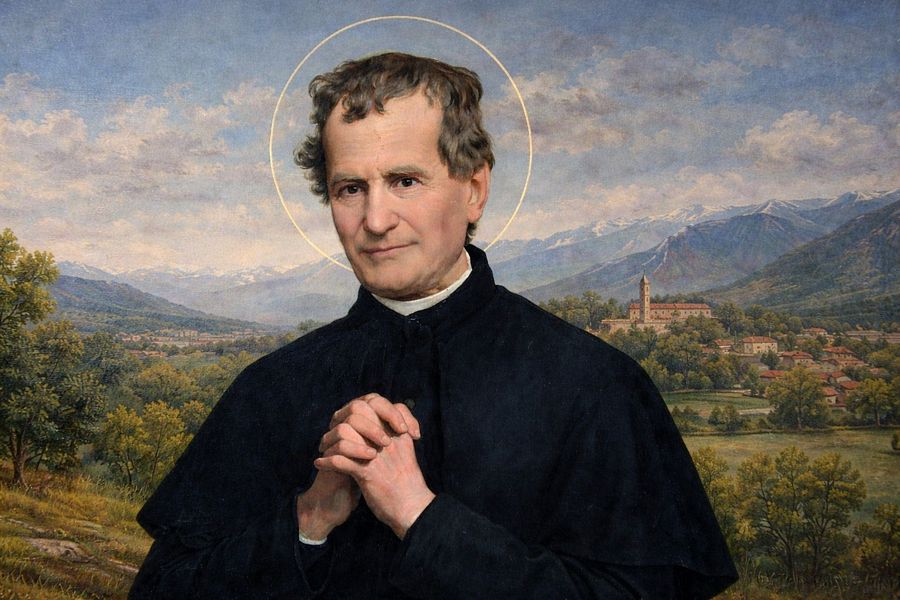
Reading time: 5 min.
To understand Don Bosco, one must perhaps consider contrasting judgements, the voices of the Church, and the words of the saint himself. Between enthusiastic praise, biting irony, and historical analysis, a complex and profoundly human profile emerges, far from both naive hagiography and preconceived criticism. Don Bosco’s holiness is thus restored in its authenticity, founded not on the grandeur of his works or on extraordinary charisms, but on a rich inner life, on virtues lived out daily, and on sincere humility. It is a portrait that helps to explain why the Church has recognised him as a father, teacher, and saint for the young.
What hasn’t been said or written about Don Bosco since his own time? For good, of course, and sometimes, for ill too! About him, about his projects.
To the priests of Turin who were concerned about Don Bosco’s “overly enterprising zeal”, Saint Joseph Cafasso would reply, “Let him be, let him be!” (MB II, 351).
In the mid-19th century, a Protestant journal offered far from flattering opinions on the popular publications by the priest of Valdocco, known as the “Catholic Readings”. Here is an example: “But my dear Don Bosco, who do you expect to believe you when you tell such tall tales? […]. When one utters such colossal nonsense, one must have the talent to say it in a way that doesn’t make one look ridiculous” (“La Buona Novella”, 2.12.1853, p. 71).
At the same time, a highly prestigious Catholic periodical, in its “Contemporary Chronicle” section, reported the opinion of its own Correspondent from the Sardinian States, who described the same works as, “Little booklets, full of sound instruction, suited to the understanding of the common people and altogether timely for these times; this is the merit of these ‘Catholic Readings'” (“La Civiltà Cattolica”, Year IV, 2nd series, Vol. 3, Rome, 1853, p. 112).
If one were to leaf through certain years of the anti-clerical and satirical Turin newspapers of the era, one would find vitriolic remarks about “Mr. Don Bosco… the famous holy man”. One need only consult “La Gazzetta del Popolo” or “Il Fischietto” from those years to see for oneself; only to then discover what Catholic newspapers like “L’Armonia” and “L’Unità Cattolica” said in his praise.
Even in our own times, criticism has not been lacking, neither the serious kind from competent scholars, nor the prejudiced and vulgar sort whose only merit is to reveal bias and bad faith. On the other hand, modern hagiography itself seeks the human figure of the saints more than their mystical or ascetic one.
“We want to discover in the saints what makes them like us, rather than what sets them apart from us; we want to bring them down to our level as lay people, immersed in the not always edifying experience of this world; we want to find them as brothers in our toil and perhaps even in our misery, to feel at ease with them and to share in a common, burdensome earthly condition” (Paul VI, 3.11.1963).
It is not for nothing that someone wrote with ill-concealed irony, “Today, to be well-received by readers, is it not perhaps better to find faults and failings in the saints?” (A. RAVIER, Francis de Sales. A Scholar and a Saint, Milan, Jaca Book, 1987, p. 10).
What the Church said about Don Bosco
In 1929, Don Bosco was proclaimed Blessed and in 1934, declared a Saint by the Church. In April 1929, the Salesian Fr. Eusebio Vismara had the opportunity to speak with the Abbot of Saint Paul Outside the Walls in Rome, who would later become Archbishop of Milan, the Blessed Cardinal Ildefonso Schuster.
Knowing that he had been a Consultor in the Congregations that had examined the heroic virtues of Don Bosco, he took the liberty of asking him if the members of those Congregations had not been swayed and led to a favourable decision on Don Bosco by the sheer scale of his work and the supernatural gifts that had accompanied it.
— No – the then Monsignor Schuster replied, – first of all, that was not even considered; it was dismissed from the outset, because all that is external, and even if it is supernatural, can be a pure charismatic gift; it is not virtue; it is not holiness, which is an entirely internal matter.
And he added, expressing his admiration for Don Bosco’s holiness:
— Perhaps you yourselves do not fully know all the richness of virtue and interior life that animated Don Bosco (BS, April-May 1934, p. 143).
Don Bosco was a man like any other, it is true, but not in the sense that the hostile press has sometimes described him. A man of his time, he was not its victim but a protagonist and, without much fuss, he managed to achieve with his illuminating example, with the simplicity of his language, his gestures, and his actions, an educational effectiveness that transcended his time. Fearless and imperturbable because he felt inspired and supported from On High, he was a man of great faith and a big heart. With a brilliant synthesis and a style all his own, he blazed a trail to holiness for the young. It is not for nothing that on the centenary of his death, John Paul II proclaimed him, “Father and Teacher of Youth”.
What Don Bosco said about himself
And yet, in his great humility, Don Bosco always considered himself nothing more than “a poor farmer’s son” (MB X, 266), whom God’s mercy had raised to the priesthood without any merit of his own, “a wretched instrument in the hands of a most skilled artist” (BS, August 1883, p. 127).
One evening, he finished hearing confessions in the church after the Valdocco community had already finished supper. He then went to the refectory. The Salesian coadjutor Giuseppe Dogliani, who alternated between music lessons and serving at table, ordered supper for him. The cook, annoyed by the lateness, sent a plate of overcooked, cold rice. When Dogliani dared to say, “But it’s for Don Bosco!” The other, tired from the day’s hard work, let slip a gruff reply,
— And who’s Don Bosco? He’s just like anyone else in the house.
Dogliani, humiliated, presented the plate and withdrew. But the cleric Valentino Cassini, later a missionary in America, could not restrain himself and reported the thoughtless words to Don Bosco. The latter, without batting an eyelid, commented with complete calm:
— The cook is right! (MB XI, 284).
In 1883, Don Bosco, accompanied by Fr. Michele Rua, made a memorable trip to Paris. On the train journey back, after those laborious days, they were both resting in thoughtful meditation. The good Father had been enthusiastically honoured and applauded by every class of person. The Blessed Virgin had worked wonders through him. Such a triumph in the Paris of those years was unimaginable.
Finally, Don Bosco broke the silence:
— How strange! Do you remember, Don Rua, the road that leads from Buttigliera to Morialdo? There, on the right, there is a hill, and on the hill a little house, and from the little house down to the road, a meadow stretches down the slope. That miserable little cottage was my mother’s and my home; in that meadow, as a boy, I used to lead two cows to pasture. If all those gentlemen knew they had carried a poor peasant from Becchi in triumph, eh? The quirks of Providence! (MB XVI, 257)
That is who Don Bosco was!
 P. Wirth MORAND
  BSOL Editor
  Fr Bruno FERRERO